A fictional company, a 20mm air restrictor and a parking lot in Texas: how a student contest grew into a worldwide family of competitions.
Formula SAE is a student competition begun at the University of Texas at Austin, first held in 1981, in which teams design, build and race small formula-style cars. Formula Student, run by the Institution of Mechanical Engineers in Britain since 1998, uses the same rules with supplementary regulations.
In 2009, at the Formula SAE West endurance event, a single-cylinder student car crossed the line only two seconds behind a four-cylinder one, and used far less fuel to do it. The four-cylinder car, built by the Rochester Institute of Technology, still won the competition, but by a margin of only 8.9 points.
That near-tie shows what a student racing competition is really testing. It is not a race to the flag. Formula SAE and its British cousin, Formula Student, ask teams of undergraduates to design, build and race a small single-seater, then score the whole project: the idea, the engineering, the cost, and how the car performs on track.
What is Formula SAE?
Formula SAE, organised by SAE International (formerly the Society of Automotive Engineers), is a design contest for students. Its premise is make-believe: a manufacturer has commissioned a student team to create a compact formula-style racer, and the prototype is assessed as a possible product. The buyer in mind is the amateur who races autocross at weekends. Each team designs, builds and tests a prototype to rules with two aims, keeping the track safe, since the students drive the cars themselves, and rewarding clever problem solving. Combustion and electric divisions differ mainly in powertrain rules.
Judging begins with a technical inspection of braking, rollover stability and noise, and only then may a car enter the four dynamic events, skidpad, autocross, acceleration and endurance. Sponsors add awards for particular achievements, such as the best use of E-85 ethanol, innovative electronics, recyclability, crash worthiness, analytical design and overall dynamic performance. Staff from carmakers including Ford, Chrysler and General Motors can meet more than 1000 student engineers through it, and teams range from two people to 30. Design judges have included well-known racing engineers, among them Carroll Smith, Claude Rouelle and Ron Tauranac.
Rochester Institute of Technology won the 2009 Formula SAE West event by only 8.9 points, ahead of a single-cylinder car that had used far less fuel.
How did Formula SAE begin?
Its roots lie in the SAE Mini-Indy, held just once, in 1979 at the University of Houston. Dr. Kurt M. Marshek conceived it after a Popular Mechanics article described a small, wooden, Indy-style vehicle powered by a five-horsepower Briggs and Stratton engine. Students had to build their own using the same stock engine. Thirteen schools entered and eleven competed, with the University of Texas at El Paso winning.
Nobody organised a second one, and in 1980 the freshly formed SAE student branch at the University of Texas at Austin heard it had died. They decided to create something larger: an intercollegiate contest that let students apply their lessons to a complex real-world problem, designing a race car. Robert Edwards and John Tellkamp led the discussion and pictured a car in the mould of the SCCA Formula 440 entry-level series. Faculty adviser Ron Matthews supplied the name, following Formula A and Formula Vee but stressing that this was an engineering contest, not a driving one. Students drafted safety and competition rules, and Matthews asked Bob Sechler at SAE headquarters for permission to host the first event in the summer of 1981.
Formula SAE was not a renamed Mini-Indy. Earlier competitions had specified a stock engine; this one left the choice to the team, provided it was a four-stroke with a one-inch intake restrictor, and encouraged engine modifications. The first event took place on Memorial Day weekend in 1981 in the parking lot of the University of Texas baseball field, with Indy 500 champion Jim Hall among the judges. A sudden rainstorm sent everyone running for cover just before the endurance event, but the weather did not dampen the mood and Formula SAE was born.
What is Formula Student?
Formula Student is the annual British competition, run by the Institution of Mechanical Engineers. Teams of students from around the globe design, build, test and race a scaled-down formula-style car, and are marked on several criteria. The rulebook is the original Formula SAE one plus supplementary regulations.
The inaugural event took place in 1998 at the proving ground of the Motor Industry Research Association (MIRA). It then spent three years at the NEC Birmingham, from 1999 to 2001, and a spell on the kart track at Bruntingthorpe Aerodrome, 2002 to 2006. In 2007 it moved to Silverstone Circuit, where it remains. Dynamic events have used Luffield and Brooklands corners, and in 2012 they were run at Copse corner and on the pit straight of the National Circuit. In 2019 Formula Student partnered with Racing Pride to support greater inclusivity for LGBT+ fans, employees and drivers in British motorsport.
What are the Formula Student classes?
There are three entry classes, designed for progressive learning. The Formula Student Class, formerly Class 1, is the main event. Teams enter their own designed-and-built cars, are marked in six categories and have to clear a judges' inspection before the dynamic events. There are usually 100 to 120 teams. The Concept Class, formerly Class 2, is for teams that have only a project and plan for a full car. They may show whatever parts exist so far, and are marked on how well they present the business case, the cost and the design. Schools can enter both, so inexperienced students can practise in the Concept Class before a full entry. The FS-AI class, for driverless cars, was introduced in 2019.
Before 2012 there were also Class 1A and Class 2A. Class 1A catered for alternative fuels, with the environmental cost of racing at its heart. Last year's Class 1 car could be re-entered after re-engineering, sustainability replaced the cost judging, and endurance gave more weight to measured emissions. Class 1A had its own ranking, and from 2012 petrol and alternative-fuel cars have shared one table.
Formula SAE, Formula Student and their relatives
| Competition | Where or who | Started | Distinguishing feature |
|---|---|---|---|
| Formula SAE | SAE International, United States | First event 1981 | The original; combustion and electric divisions |
| Formula Student | Institution of Mechanical Engineers, Silverstone since 2007 | 1998 | Same rules with supplementary regulations; three classes |
| Formula SAE Australasia | Australia | - | Part of the SAE family of events |
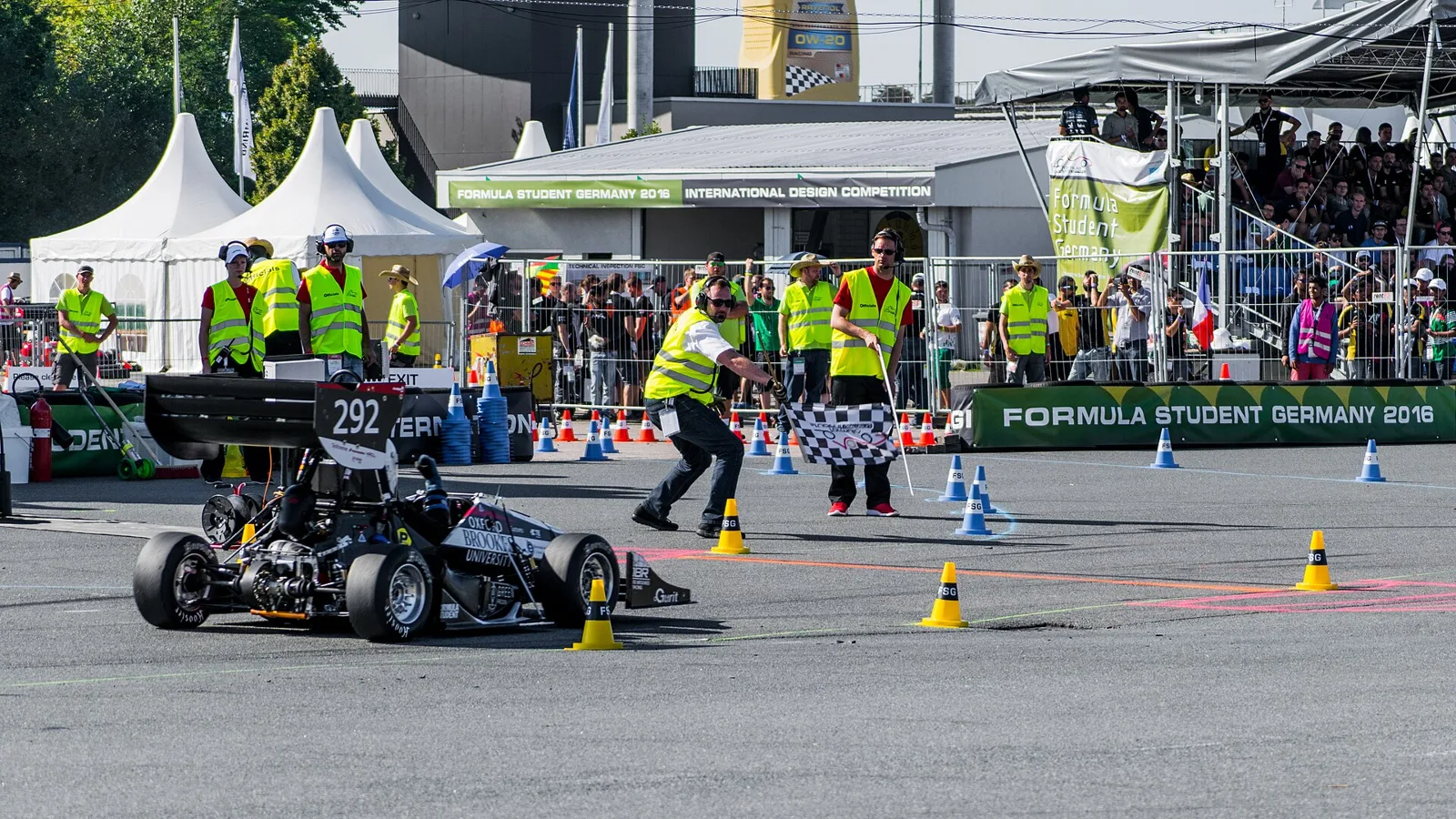
| Formula Student Germany | Verein Deutscher Ingenieure, Hockenheimring | - | Run by the VDI |
| Formula Hybrid | New Hampshire International Speedway | 2007 | Every car has a gasoline-electric hybrid powertrain |
| Formula Student Electric | SAE-sanctioned electric class | 2010 | Fully electric racing vehicles |
| Formula Student Driverless | SAE-sanctioned driverless class | 2017 | Autonomous cars |
What rules apply to the car and the team?
The whole team, drivers included, must be active college students. That limits work hours, skills and experience in ways professional teams never face, which is why the rest of the rulebook can be looser than in most series. Professional engineers and faculty may offer advice and criticism, yet the design itself must be the students' own, and they are responsible for raising money, although most successful teams sit within curricular programmes with university budgets. The points system is built so that several strategies can succeed, producing a variety among cars that is rare in motorsport.
For combustion cars, a four-stroke Otto-cycle piston engine of up to 710cc is required. Air must pass through a round restrictor, no wider than 20mm for gasoline or 19mm for ethanol, fitted after the throttle and before any compressor; it holds nearly every car below 100 hp. Most teams use production four-cylinder 600cc sport bike engines because they are easy to get, though some choose smaller V-twins and singles for weight and packaging. Building an engine from scratch is rare. Examples are Western Washington University's 554cc V8 in 2001, the University of Melbourne's WATTARD in 2003 to 2004 and the University of Auckland's V-twin. For 2019, 120 teams registered and 109 turned up, bringing 2567 students.
Electric cars have an accumulator, the term for the battery pack, limited to 600V with no cap on capacity, and an energy meter ensures that no more than 80kW is drawn. Most teams use lithium-ion cells, although lead acid and capacitors are allowed. Teams must watch cell voltage and temperature and link cells with fusible links, which leads many young teams to buy ready-made modules. An Electrical Safety Form is completed before the event, and a Shutdown Circuit ties every safety button and switch together so that removing any one makes high voltage outside the accumulator physically impossible.
Suspension is open apart from safety rules and a requirement for 50 mm of total wheel travel. Most teams use four-wheel independent suspension, almost always double wishbones, and active suspension is legal. Aerodynamic packages are not required but are common among the fastest cars. Speeds rarely exceed 60 mph (97 km/h), so designers must justify them in design judging with wind tunnel work, computational fluid dynamics and track testing. Devices are limited by size and powered aerodynamics are banned.
How light is a Formula SAE car, and why does fuel economy matter?
There is no weight limit, and a typical competitive car in race trim weighs under 440 lb (200 kg). With a power ceiling set by the restrictor, teams chase weight through composites, elaborate machining and rapid prototyping. From 2009 fuel economy was worth 100 of the 400 endurance points, double the previous 50, and engine downsizing followed. Several leading teams swapped four-cylinder cars for one- or two-cylinder engines that make far less power but save 75 lb (34 kg) or more and use much less fuel.
The 2009 Formula SAE West endurance event shows the trade-off. Rochester Institute of Technology, third in the endurance event, completed the course in 22 minutes 45 seconds in a four-cylinder car, and Oregon State University, fourth, took 22 minutes 47 seconds with a single. RIT collected 290.6 of the 300 race points, OSU 289.2. But Oregon State drank less than any other car, .671 US gallons (2.54 L), equal to 20.3 mpg-US over the whole endurance run, and took the full 100 fuel-economy points, whereas RIT burned 1.163 US gallons (4.40 L), 11.75 mpg-US, and earned just 23.9. RIT still won overall by 8.9 points, having scored slightly better in every other dynamic event.
What safety rules govern the cars?
Most of the rulebook is about safety. Whatever the rest of the chassis is made from, a car needs two steel roll hoops of set thickness and alloy. An impact attenuator in the nose is mandatory, with impact test data submitted before competing. Cars need dual hydraulic brake circuits and five-point racing harnesses, and the driver's position must fit set geometric templates. A tilt test checks that nothing leaks in hard cornering, and the driver must have no direct view of fuel, coolant or oil lines.
Where the competitions stand
Formula SAE today includes more than 12 events worldwide. In 2007 it gained an offshoot, Formula Hybrid, at the New Hampshire International Speedway. The Formula Student Electric class began in 2010 and Formula Student Driverless in 2017, and Formula Student introduced its own driverless FS-AI class in 2019. The Verein Deutscher Ingenieure runs Formula Student Germany at the Hockenheimring, and Formula SAE Australasia takes place in Australia.