The engineer behind Sepang, Shanghai and Yas Marina, why so many new Formula One tracks share a look, and why that has split opinion.
Hermann Tilke is a German engineer and former racing driver whose firm, Tilke Engineering, designed Sepang, Shanghai, Yas Marina and many other Formula One circuits. His tracks aim for fast, interesting racing with strong architecture, but critics say they look alike and punish mistakes too little.
The ground was swampland, a former rice paddy on the north-western edge of Shanghai. Eighteen months of work by some 3,000 people a day turned it into a Formula One circuit with space for 200,000 spectators and a paddock laid out like pavilions on a lake. The man whose plans made that possible is Hermann Tilke, and the same name sits behind Sepang in Malaysia, Yas Marina in Abu Dhabi and a long list of other grand prix venues.
Who is Hermann Tilke?
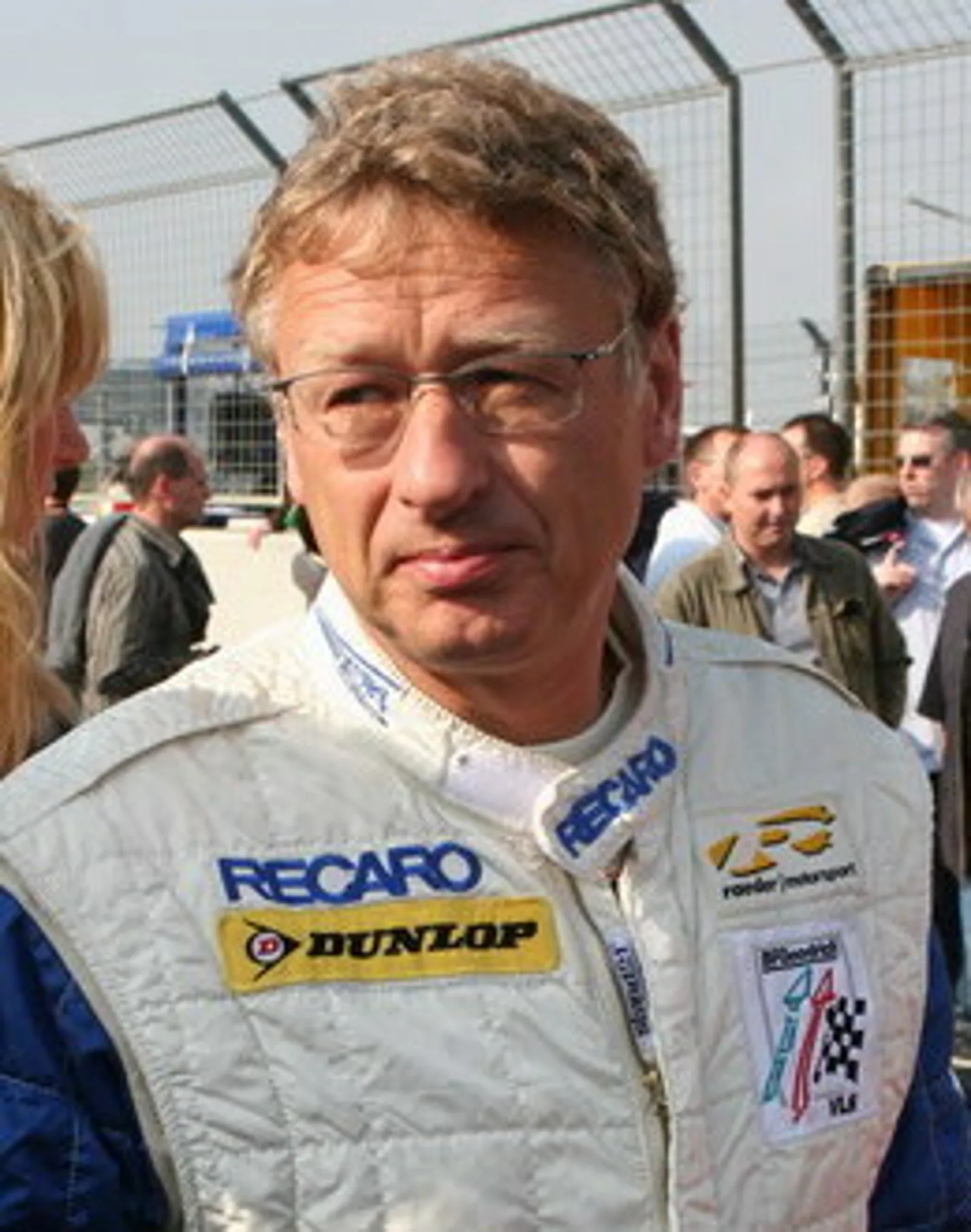
Hermann Hugo Tilke was born on 31 December 1954. He is a German engineer, driver and circuit designer, and his son Carsten is an architect.
In the 1980s he raced touring cars, mostly on the old Nurburgring Nordschleife, and he also took on endurance events there. With Dirk Adorf he won some VLN races in a V8Star Series car in 2003 and 2004. He also travelled to Australia for the Bathurst 24 Hour race, where a Honda S2000 entered by the promoter Ross Palmer brought him 14th place outright and third in Class 9, sharing the car with Peter Hansen and Melinda Price.
His 2003 return to Mount Panorama, in a Porsche 996 GT3-RS for the British GT team Cirtek Motorsport, ended with a failed engine before dawn on the Sunday, after 325 laps.
Off the track, Tilke trained as a civil engineer. His degree at Fachhochschule Aachen specialised in transport and traffic management, and in 1984 he founded Tilke Engineering. The company brings together architecture, civil engineering and electronic engineering, and it was set up to offer complete solutions for motor racing and, less glamorously, for waste disposal projects.
Corners that promise a fast and interesting race but avoid pulling the field apart.
How Tilke became the designer of the modern grand prix track
Tilke is one of four circuit designers recognised by the FIA and, Silverstone's 2010 redesign aside, he has been among those commissioned to draw Formula One tracks.
The start was modest. One of his first jobs was a short access road at the Nurburgring, a commission that came through the contacts he had made racing there. His first major project was far bigger: in the 1990s he took the fast Osterreichring in Austria and transformed it into the much shorter A1-Ring.
Overhauls followed at established European venues, among them the Hockenheimring, the Circuit de Catalunya and the Nurburgring, and at Fuji Speedway in Japan. Then came the commissions that made his name: complete circuits, drawn from a blank sheet, chiefly across Asia with a few in eastern Europe.
The new-build list starts with Sepang and Bahrain, then takes in Shanghai, Istanbul Park, Valencia, Marina Bay in Singapore, Yas Marina, Korea and the Buddh International Circuit. Add Austin's Circuit of the Americas, the venue for Formula One's 2012 return to the United States.
His more recent designs include the Sochi Autodrom, which held its first race in 2014 when Russia made its F1 debut, and Kuwait Motor Town, which opened officially in 2019.
How a Tilke track is designed
Think of a tailor who measures the customer before touching the cloth. Tilke's process starts with the plot of land, not with a favourite corner. He wants to know the lie of the land, the prevailing wind, the infrastructure around the site and the quality of the soil before a line goes on paper.
Each track is the work of several engineers from Tilke Engineering alongside Bernie Ecclestone, the former commercial rights holder of Formula One. Two aims run through the brief. One is architecture that reflects the host country, and the lotus-leaf grandstands at Sepang in Malaysia are the example given. The other is comfort and clear viewing for spectators.
On the track itself, the stated aim is corners that deliver quick, absorbing racing without stretching the field out. That last clause is the clue to everything that follows, both the praise and the complaints. A layout built to keep cars close together is also a layout that can make it hard to separate them.
Sepang International Circuit: lotus-leaf grandstands and a hairpin
Sepang International Circuit sits in Selangor, about 45 km (28 mi) south of Kuala Lumpur and next to the city's main airport. It went up between 1997 and 1999 under Mahathir Mohamad's government, one of the big infrastructure projects of the decade, near Putrajaya, the country's then-new administrative capital. The aim was plain: to host a Malaysian Grand Prix.
Mahathir inaugurated the circuit on 7 March 1999. The first MotoGP race followed on 20 April 1999, and the first Formula One Malaysian Grand Prix on 17 October 1999. The main circuit measures 5.543 km (3.444 mi) and is normally raced clockwise. Its straights are wide, between 16 m and 22 m (52 to 72 ft), and its corners sweep.
The layout has a quirk. A back straight of 0.927 km (0.576 mi) is separated from the pit straight by a single, very tight hairpin, so a driver who passes on that straight must take care not to be re-passed going into turn 1. The first corner is a long, slow turn taken in second gear, drivers brake very late and lose speed gradually through it, and the first two corners are bumpy enough to make putting power down awkward.
Two shorter circuits can be carved from the same tarmac: a north circuit of 2.706 km (1.681 mi) and a south circuit of 2.609 km (1.621 mi).
A circuit that outlasted its grand prix
The nineteenth Malaysian Grand Prix, in 2017, turned out to be the last, and Sebastian Vettel set the official lap record of 1:34.080 in it. The surface had been completely redone in 2016 with the help of the Italian designers Dromo, who reprofiled several corners to reward mechanical rather than aerodynamic grip. The final corner was lifted by about 1 metre, which officials said would force a later apex and open up different lines.
In October 2016 came rumours that the race might be dropped as ticket sales dwindled, and the contract, due to run out in 2018, was threatened by rising hosting fees as well.
Formula One was also due back for a reason nobody planned. In July 2026 the Prime Minister, Anwar Ibrahim, announced that Sepang would stage the 2026 Bahrain Grand Prix from 2 to 4 October, under the name Gulf Air Bahrain Grand Prix in Malaysia. The April race at Bahrain had been called off because of the 2026 Iran war. Reports said Bahrain would meet most of the rescheduling costs and keep the ticket pricing rights and the proceeds. The Saudi Arabian Grand Prix, cancelled at the same time, stayed off the 2026 calendar.
Shanghai International Circuit: a city's calling card on a swamp
Shanghai's authorities conceived the circuit as a way of introducing the city to the world. They chose a site of 5.3 sq km in the Jiading district, near major car parts manufacturing facilities, and raised a budget of 2.6 billion yuan ($450 million) through a government-funded joint venture, the Shanghai Jiushi Group.
Tilke got the job of designing the track and its buildings. His engineers walked the site in April and May 2003 and found swampland that had been rice paddies, so heavy groundworks came first. For 18 months about 3,000 workers were there every day.
The result is a circuit with a distinctly Chinese identity. The layout takes its cue from the character shang, which opens the name Shanghai and means above or ascend. The main grandstand and pit complex, with wing-like viewing platforms that cross the circuit at each end, holds 30,000 spectators by itself, and the rest of the grandstands lift the total to 200,000. Every Formula One team got its own paddock building, set out like pavilions on a lake to recall the ancient Yu Garden in Shanghai.
It was the first circuit in China purpose-built for Formula One. The Chinese Grand Prix was held there from 2004 to 2019 and has returned from 2024 onwards, and the Shanghai ePrix has been on the programme since 2024.
A lap of Shanghai
At 5.451 km (3.387 mi), the track is of typical Formula One length. The opening bends form a right-hand curve taken at 185 km/h (115 mph), which flows into turns 3 and 4 at 105 km/h (65 mph). Turns 1 and 2 demand a lift on entry, then a series of small throttle and brake inputs to hold the balance, and the corner turns blind towards its middle. Turns 1 to 4 form the first of two "snails", the second being turns 11 to 13.
Turns 7 and 8 form a left-right chicane where the cars see a constant 3 g at around 160 km/h (99 mph) at the slowest. Then comes the straight: 1.170 km (0.727 mi) between turns 13 and 14, one of the longest on the calendar. It ends in a tight second-gear hairpin at turn 14, a prime place to attempt a pass under heavy braking.
Michael Schumacher's 1:32.238 from 2004 remains the official race lap record. In qualifying for the 2025 Chinese Grand Prix, Oscar Piastri took pole with 1:30.641, an unofficial track record, on a surface renewed ahead of that race.
Yas Marina Circuit: racing past a hotel
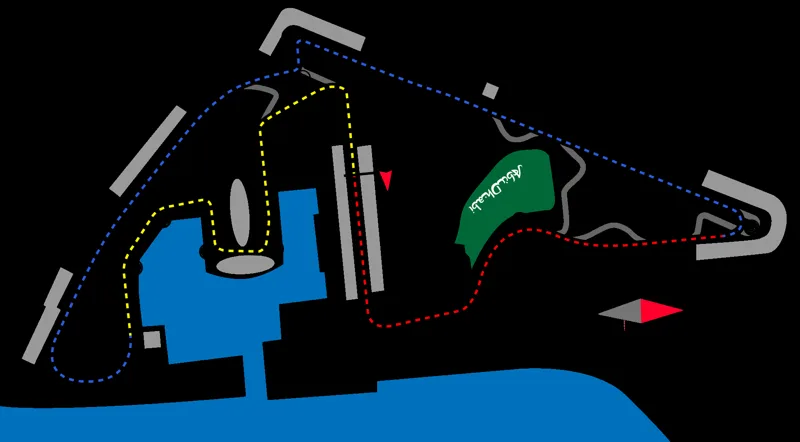
Yas Marina Circuit is a 5.281 km (3.281 mi) track on Yas Island in Abu Dhabi, a headland separated from the mainland by a canal. The circuit has hosted the season-ending Abu Dhabi Grand Prix since 2009 and came second among the Middle East's Formula One venues, after Bahrain and ahead of Qatar and Saudi Arabia.
The setting is the point. The track has sixteen corners, runs alongside the marina and goes beneath the W Abu Dhabi hotel, the work of Asymptote Architecture's Hani Rashid and Lise Anne Couture. The pit lane exit dives underneath the track, and one run-off area runs beneath the West grandstand. There are five grandstand areas in all.
The permanent floodlighting, by Musco Lighting, is the biggest of its kind at any sports venue, taking the record from Lusail International Circuit in Qatar. The surface is graywacke aggregate shipped from a quarry at Bayston Hill in Shropshire, England, which drivers rate for grip at the cost of faster tyre wear. Bahrain uses the same material.
The FIA gave final approval on 7 October 2009, with Bruno Senna first out on a test run. Reactions after the opening practice sessions were mixed. Nico Rosberg called every corner unique. Adrian Sutil preferred it to Singapore, the other night race, finding Marina Bay over-lit. Giancarlo Fisichella disliked the pit exit tunnel and called it difficult and dangerous.
Changing the layout
After the 2017 race, Tilke said changes were being considered to open up more passing. BBC Sport's Andrew Benson called the 2020 event dreary, Matt Beer of The Race put the layout among six reasons Abu Dhabi races keep disappointing, and Daniel Ricciardo backed alterations.
In June 2021 Saif Al Noaimi, acting chief executive of Abu Dhabi Motorsports Management, said changes had been approved, and they were ready for that year's race. A single, less severe hairpin replaced turns 4, 5 and 6, a sweeping banked curve took the place of turns 11 to 14, and turns 18 to 20 were opened up so cars could carry more speed through them.
Three Tilke circuits side by side
| Circuit | Location | Length | Formula One hosting | Signature feature |
|---|---|---|---|---|
| Sepang International Circuit | Selangor, Malaysia | 5.543 km (3.444 mi) | 1999 to 2017 | Lotus-leaf grandstands; 0.927 km (0.576 mi) back straight |
| Shanghai International Circuit | Jiading, Shanghai, China | 5.451 km (3.387 mi) | 2004 to 2019, and from 2024 | Layout inspired by the character shang; 1.170 km (0.727 mi) straight |
| Yas Marina Circuit | Yas Island, Abu Dhabi | 5.281 km (3.281 mi) | Since 2009 | Track passes under a hotel; pit exit tunnel |
Why do Tilke tracks look the same? The Tilkedrome debate
Most of the complaints concern similarity. A 2009 profile in The Guardian said Tilke stood accused of drawing dull tracks and, worse, of butchering great ones such as Hockenheim. The Russian commentator Alexey Popov coined the word Tilkedrome to capture the supposed ennui of his circuits.
Jackie Stewart, the former driver and team owner, widened the attack in a 2011 piece for The Daily Telegraph. He called the designs largely carbon copies of each other and blamed them for a lack of overtaking and excitement. His praise was real, too: he credited the circuits with a vast improvement in safety and with fine amenities. But he argued that safety had gone too far the other way, because big tarmac run-offs do not punish errors.
His evidence was the 2010 race at Yas Marina, where Mark Webber could not pass Fernando Alonso even though Alonso ran wide four times, because the run-off did nothing to slow him. Stewart suggested that run-off areas should be made of a material that slows cars and punishes errors. Webber said Stewart was spot on. Alan Jones, the 1980 world champion, called them boring, with the same constant-radius bend repeated.
Others have defended Tilke. The driver and commentator Anthony Davidson argued that he understands the demands of modern cars and provides run-off areas that are well thought out. In his view Silverstone produces less passing because it was laid out for slower cars that did not rely on downforce, whereas recent circuits pair a long straight with a bigger braking zone. Davidson singled out Turn Eight at Istanbul Park for praise.
Where this goes next
Tilke's name is now attached to a legal dispute over the Madring project in Spain. In 2025 IFEMA ended its construction-support contract, numbered 24/219, with Dromo Circuit Design and brought in companies from the Tilke group to carry on.
In 2026 the Cologne Regional Court gave Dromo temporary relief that applies only in Germany. Two Tilke companies may not copy Dromo's protected Madring design, wholly or partly, or have anyone else do so. A court-appointed expert had found matching Dromo documents on their computer systems as early as February 2025, and later copies included altered versions. The court noted that a separate licence agreement had not been expressly ended. The order is preliminary and leaves the wider contract dispute in Spain undecided.
On the existing tracks the diary points to 2027: Super GT at Sepang, Superbike and Supersport World Championship rounds at Shanghai, and Ferrari Challenge Middle East at Yas Marina.
What this means if you want to see a Tilke track
Each of the three circuits is a destination in its own right. Sepang stages the Malaysian motorcycle Grand Prix in November and the Sepang 12 Hours in December, along with series such as GT World Challenge Asia in April. Shanghai counts as a 4A-rated tourist attraction, with shopping, dining and entertainment on site, and has the city's only world-class outdoor karting track. Yas Marina stages the Formula One finale in December and an Asian Le Mans Series round in February.
The Chinese Grand Prix is held in March and the Shanghai ePrix in July.