A rejected Chevrolet design, five prototypes and a Prime Minister's unveiling in 1948 produced the first Holden, and a nickname that outlived the car.
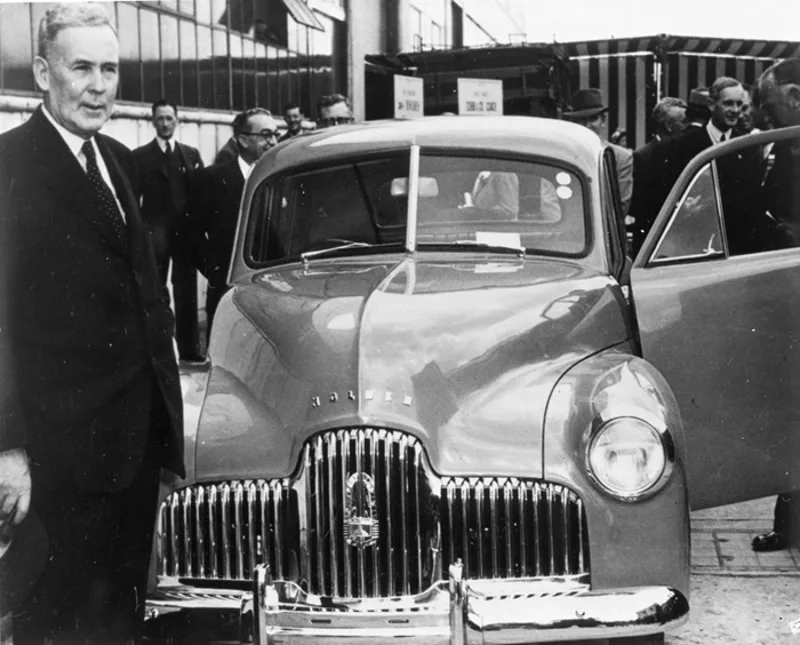
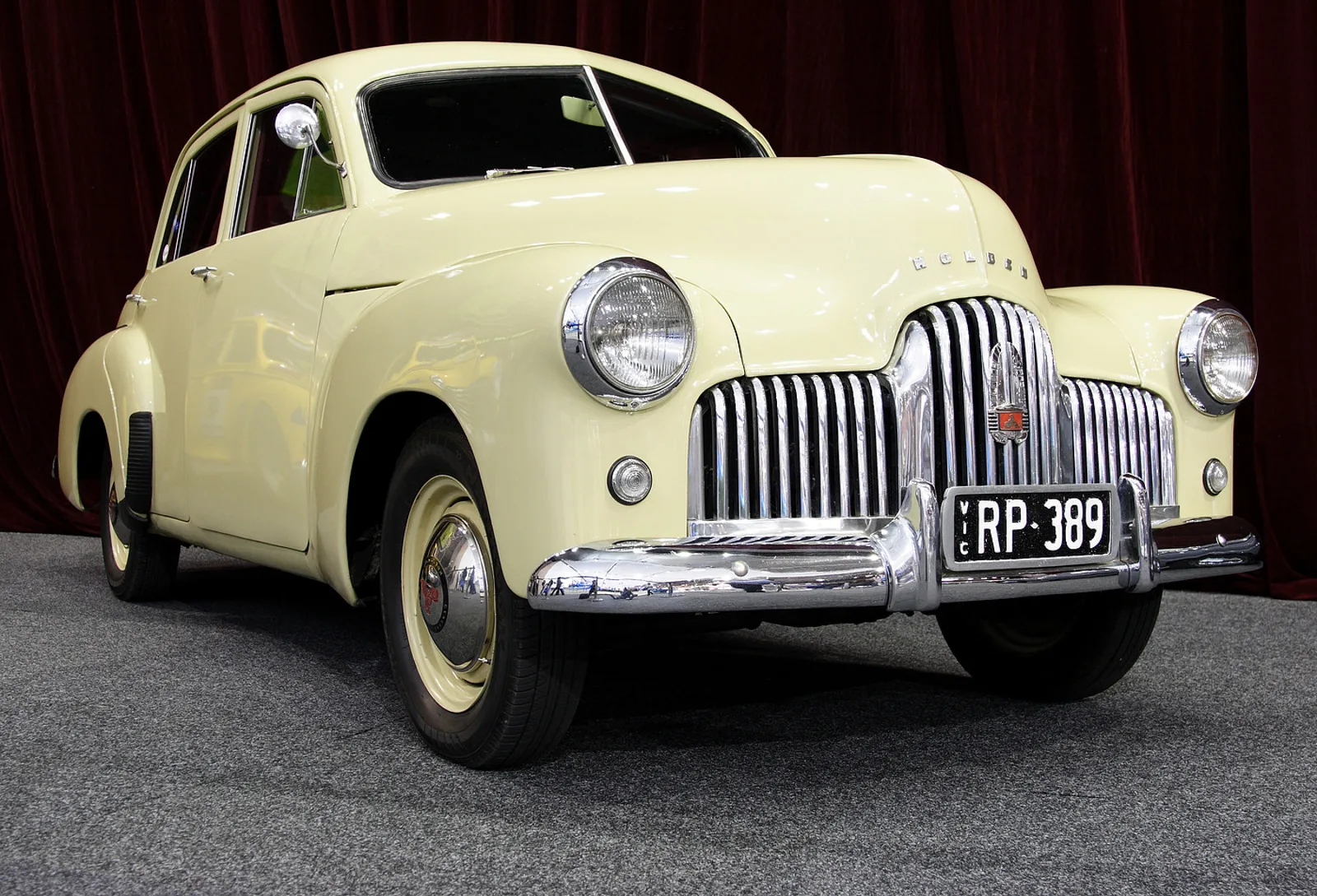
The Holden 48-215 was the first car to carry the Holden name, built from November 1948 to October 1953 and unveiled by Prime Minister Ben Chifley. Its design came from a previously rejected Chevrolet proposal, and its 60 hp straight-six made it the basis of Australia's postwar family car.
Australia's own car began life as a Chevrolet that Detroit decided not to build. The design behind the Holden 48-215, the sedan that Prime Minister Ben Chifley unveiled on 29 November 1948, had been put forward by General Motors in America after the war and set aside, then pulled out of the cupboard and reworked for a country that wanted a family car of its own. By the time it was replaced in 1953 it had produced the first Holden ute and a queue of customers who joined long waiting lists.
What was the Holden 48-215?
The Holden 48-215 was a mid-size sedan built by the Australian company Holden between November 1948 and October 1953. Within General Motors' Australian operation it was the earliest car to bear the Holden name, and it was sold with no model name at all: buyers asked for a Holden and that was that.
The strange-looking number is a factory code. In daily conversation the official designation was dropped in favour of the short word on the badge, and the code survived mainly in paperwork and in the hands of collectors. A coupe utility version, coded 50-2106, joined the sedan in January 1951 and was sold as the Holden Coupe Utility. Both were replaced in 1953 by the facelifted FJ.
Australia's own car began life as a Chevrolet that Detroit decided not to build.
Why did Australia want its own car?
Before the Second World War had even finished, the Australian government was taking steps to encourage a local motor industry. Both General Motors and Ford were asked to supply studies describing how the first Australian-designed car might be made.
Ford's proposal was the government's first preference, but it would have needed substantial financial help from Canberra. General Motors offered a study that asked for far less intervention, and that is the one that won. It was a practical choice rather than a patriotic one.
The war had already reshaped Holden's factories. The Fishermans Bend plant at Port Melbourne, opened by Prime Minister Joseph Lyons on 5 November 1936, spent the war years building vehicle bodies, field guns, aircraft and engines. Afterwards the company went back to making bodies for Buick, Chevrolet, Pontiac and Vauxhall, and it built the Oldsmobile Ace from 1946 to 1948. The last Hillman Minx sedans it assembled left the line in 1948. Holden had spent decades dressing other people's chassis. The idea of producing a whole car under its own name was a new ambition.
A compromise between Adelaide and Detroit
The project did not run on goodwill alone. Holden's managing director, Laurence Hartnett, wanted a locally designed car. General Motors preferred to build on an American design and call the result Australia's Own Car. The outcome was a compromise: the finished design was based on a postwar Chevrolet proposal that had previously been turned down.
That compromise explains the car's character. It looked and felt like a mid-century American sedan in a smaller suit, but the engineering that underpinned it had to be rebuilt around Australian roads, Australian suppliers and an Australian price.
From Detroit prototype to first Holden
Five prototypes were built before a single customer car existed. Three were put together by hand in 1946 at the General Motors workshop in Detroit, by a mixed team of American and Australian engineers. They spent months being tested for durability and performance in the United States before being shipped to Australia.
The first of them was registered in Victoria as JP-480 on 12 February 1947, and notably it was registered as a Chevrolet. The second and third took the plates JP-481 and JP-482. Two more prototypes were built in Australia, the first registered as KJ-400 and the second as KY-442. All five wore Chevrolet identity, because the Holden name had not yet been decided.
Prototype number one survives today, held by the National Museum of Australia. KJ-400 passed through private hands: Peter Briggs owned it from 1980 to 2013, and when it was offered at the Motorclassica auction in Melbourne in October 2013 its value was put at more than A$1 million. Only two of the five were used for photography. Number one was painted a dark colour, Seine Blue, while number four, KY-442, wore the light shade Gawler Cream.
Building a supply chain from nothing
Making the car at all meant making the things that go into it. Australia had no established supplier base for car manufacturing, so the company had to create fresh forging capacity for crankshafts and open a new foundry for the big castings. It is a bit like opening a restaurant in a town with no farms: before the first plate leaves the kitchen, someone has to grow the vegetables.
To get into production quickly, engineers accepted simplifications that look startling now. The first cars had no direction indicators and no provision for heating or demisting, and the rear carried only one tail lamp, mounted in the centre. Because the mild climate across most of the populated areas allowed it, a small 6-volt battery with 11 plates saved weight and cost. Interior trim was kept to a minimum. Weight reduction was pursued, in the words used at the time, with great vigour, and at 2,247 lb (1,019 kg) in running trim the team counted it a success.
What was under the bonnet of the first Holden?
The 48-215 used a cast-iron straight-six of 2,171 cc (132.5 cu in), known inside the company as the Grey motor, and it produced 60 hp (45 kW). Power reached the driver through a three-speed manual gearbox.
Performance was modest by any later standard. The turning circle measured 37 ft (11.3 m). The Grey engine remained the company's workhorse until the EH series of 1963 brought in the Red motor, which gave better performance.
The early Holden family at a glance
| Model | Code | Period | Notes |
|---|---|---|---|
| Holden sedan | 48-215 | November 1948 to October 1953 | Six-cylinder 2,171 cc, 60 hp (45 kW), three-speed manual |
| Holden Coupe Utility | 50-2106 | From January 1951 | Payload of 7 long hundredweight (360 kg) |
| Business Sedan | 48-215-257, renamed 48-217 | Added July 1953 | Added to the range in the final months of production |
| Holden FJ | FJ series | From 1953 | Facelift with new slatted grille; added a panel van |
How did the Holden get its name?
The decision was made on 1 September 1948. The name honoured Sir Edward Holden, who chaired the company first and was a grandson of the saddler James Alexander Holden, who had emigrated to South Australia from Walsall in 1852 and founded the business in 1856.
It was not the only candidate. The list of rejected names reads like a dare. GeM and Austral were in the running, along with Melba, Woomerah, Boomerang and Emu, and so was Canbra, which spelled out the capital's name the way it sounds. Any of them would have made a different kind of statement. The one chosen put a family name, a company and a nation behind a single word.
Where does the nickname FX come from?
The nickname FX is not factory branding. It began in 1952 in the drawing office at General Motors-Holden's, where someone pencilled the letters on a parts list as an informal way to tell two kinds of 48-215 apart: cars with front suspension that used lever-action shock absorbers, and those that took the new telescopic shock absorbers introduced in 1953.
The label then lived a second life in the used-car trade. The first known use in advertising came from the Melbourne dealer Reg Smith Motors, which ran two such notices in The Age dated 10 February 1960. For anyone shopping for an early Holden, the shorthand still matters, because it points to a specific suspension arrangement rather than a whole car.
Ten pilot cars and one very large open day
In April 1948 the Woodville plant in South Australia began tooling up to make bodies identical to those on the prototypes, and the engine assembly line was started at Fishermans Bend. On 25 September engine number 1001 fired up. Five days later, in the evening of 30 September, pilot car number one was completed. Nobody celebrated, because General Motors-Holden's had not designated it the first Holden; the car was later nicknamed Old Number One. It was registered as MG-501 on 19 October.
Ten pilot cars were built and used for testing, wearing all four of the Holden colours. Three went to the Engineering Department, five to Manufacturing, one to the General Sales Manager and one to the managing director, H. E. Bettle.
Once every department was content, volume production started. Early output leaned heavily towards black bodies, though the company saw to it that cream, blue and grey cars reached every capital city too. In the end 68 Holdens were distributed to the capitals before unveiling day.
The week it all went public
The first public look came on 21 November 1948, when staff at Fishermans Bend and their families were invited to tour the plant and inspect the new car. The company reckoned 12,000 people came, passing half-built cars on the line as well as completed ones. Dealers in Victoria had their own official launch on Friday 26 November, at Melbourne's Oriental Hotel.
The formal unveiling followed at 2:30 pm on Monday 29 November, inside the Social Hall at Fishermans Bend. Chifley did the honours. Silver curtains drew back to show a cream Holden set against black velvet and caught in spotlights, and 400 guests applauded while the orchestra struck up a Brahms waltz in A-flat. Across the plant, 1,200 official guests joined the celebrations, and the public could buy the car at Port Melbourne.
What did the first Holden mean for postwar Australia?
It meant waiting lists. After the 1948 launch, demand ran ahead of supply, and the queues for a Holden extended through 1949 and beyond. Behind that demand was a simple fact: for the first time, an Australian family could order a mainstream sedan that had been assembled at home.
The ute becomes a national workhorse
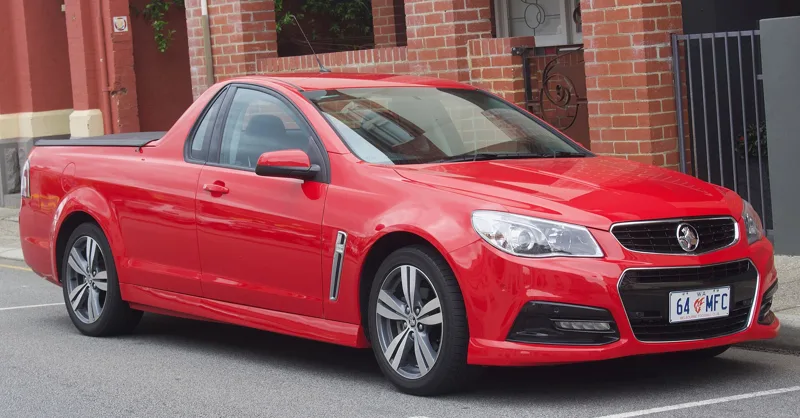
The coupe utility was arguably the more consequential vehicle. Cheaper four-cylinder cars could not handle the rugged going in rural areas, and the Holden six could. The 50-2106, known colloquially as the ute, became ubiquitous in country districts as the workhorse of choice, and the word entered the language alongside the car.
A car as a national symbol
Throughout the 1950s Holden dominated the Australian market, and General Motors invested heavily in production capacity to meet the postwar demand. When the FJ took over from the 48-215 in 1953, it marked the first big revision since 1948. It gained a new horizontally slatted grille and a third body style, the panel van, and over time it came to be regarded as one of Australia's most recognisable automotive symbols. The FJ went on sale in New Zealand in 1954. The company revisited the shape with the Efijy concept, shown at the 2005 motor show in Sydney.
Sales success lifted Holden into a position as a cultural icon. The brand became synonymous with the Australian way of life and with the stability of postwar Australian capitalism. Some of that was deliberate. General Motors had inherited an Australian identity when it bought Holden in 1931, and it used public relations to cultivate nationalist appeal for the company.
The FE of 1956 added a station wagon body style that the company called the Station Sedan, and a new factory opened at Dandenong in the same year. By 1957 Holden's export markets had grown to 17 countries. The revised FC of 1958 lifted the company's share of the Australian market above 50 per cent, and by 1959 Holden employed 19,000 people across the country.
What should you know if you are buying or admiring one?
The first prototype is in the national museum, which also holds a 1949 model 48/215 sedan.
The Business Sedan was added in July 1953. It was first called the 48-215-257 and later renamed the 48-217.
Where did Holden go next?
The company that built the first Holden had been founded in 1856 as a saddlery in Adelaide, entered the automotive field in 1898 and became a General Motors subsidiary in 1931. Its path after 1948 ran through the Falcon rivalry of the 1960s, when Ford's new Falcon, whose front suspension in particular proved not durable, struggled in Australian conditions, and through the HR series of 1966, which made Holden the first Australian carmaker to fit front seat belts as standard across the range.
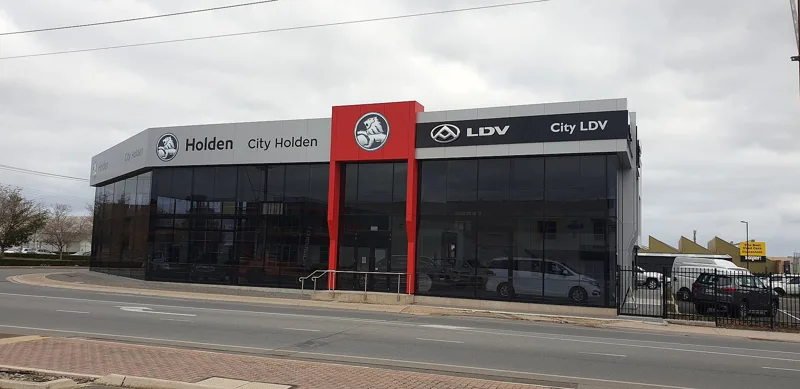
The ending came in stages. In 2013 Holden disclosed that A$2.17 billion in federal assistance had come its way over the previous 12 years. Its explanation for leaving local manufacturing was the strong Australian dollar, costly production and a small home market, and on 11 December 2013 it announced that vehicle and engine production would stop by the end of 2017. Engine production at Fishermans Bend, the same site where the 48-215 was unveiled, ended on 29 November 2016. The last Australian-built Holden Commodore was produced on 20 October 2017, and the Elizabeth plant closed. In total the company had built nearly 7.7 million vehicles.
General Motors said on 17 February 2020 it would retire the Holden marque by 2021. Trading stopped at the end of 2020, and GM Specialty Vehicles took over, importing the Chevrolet Silverado and Corvette.