Over a billion tyres a year are mixed, built on a drum, cured in a press and spun against a test wheel. What each layer does and why a new tyre can still shake.
A car tyre is mixed from rubber and additives, assembled from layers such as the liner, plies, belts and tread on a drum, then cured in a mould in about 16 minutes. Uniformity machines then test it, because small variations in stiffness make a finished tyre vibrate.
A passenger tyre is cooked for about 16 minutes at roughly 350 degrees Fahrenheit, and in the final finish it is spun against a simulated road to find out whether it would make a car shake.
Around 455 factories make more than a billion tyres every year. The tests at the end of the line explain why one new tyre runs smoothly and another sets the steering wheel trembling.
What is a car tyre made of?
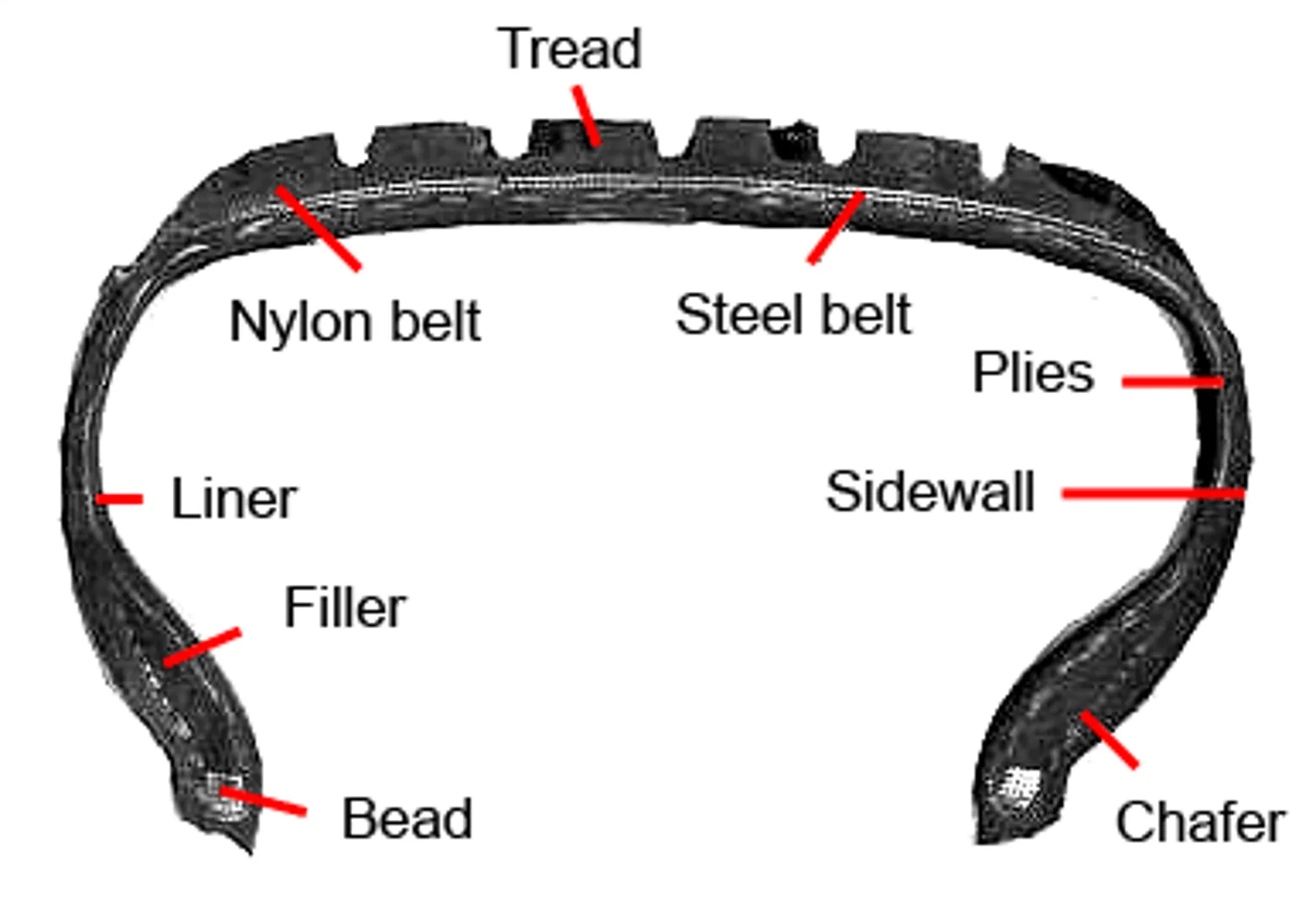
A tyre is assembled from many separate components laid up on a building drum, after which the whole thing is pressed and heated in a mould. The heat drives a reaction that links rubber molecules into long, elastic chains. Each component has its own recipe and its own job, from holding in air to gripping the road.
Components at a glance
| Component | Construction | Job |
|---|---|---|
| Inner liner | Calendered halobutyl rubber sheet with additives for low air permeability | Keeps high-pressure air in without an inner tube |
| Body ply | Rubber, reinforcing fabric, rubber; one or two in a passenger tyre | Gives the tyre its structural strength |
| Sidewall | Non-reinforced extruded profile with antioxidants and antiozonants | Resists abrasion and the environment; carries the raised lettering |
| Bead | High tensile-strength steel wire in rubber, coated with bronze or brass alloys | Fits the tyre to the wheel |
| Apex | Triangular extruded profile against the bead, also called filler | Cushions between the rigid bead and the flexible liner and ply |
| Belt package | Rubber, closely spaced steel cords, rubber; two or three in a passenger tyre | Adds strength and dent resistance while staying flexible |
| Tread | Thick extruded profile around the carcass | Provides wear resistance and traction |
| Cushion gum | Extruded layer between belts and tread in many higher-performing tyres | Shields the tread from wear by the steel belts |
The tread is a study in trade-offs. Hard compounds last a long time but grip poorly, while soft compounds grip well and wear out fast, so developing a tread compound is an exercise in compromise. Construction methods vary with how the tyre will be used and what it costs, and makers keep introducing new materials and methods to raise performance and lower cost.
Tread compound development is an exercise in compromise: hard rubber lasts and slides, soft rubber grips and wears.
Which materials go into the rubber?
Natural rubber is the basic elastomer, but synthetic rubber makes up 60% to 70% of all the rubber the tyre industry uses. Styrene-butadiene copolymer is often swapped in for part of the natural rubber depending on raw material cost, and polybutadiene is blended with other rubbers because it builds up little heat.
The supporting cast is long. Halobutyl rubber lines tubeless tyres because air passes through it so slowly, and bromobutyl performs better than chlorobutyl but costs more. Carbon black forms a high percentage of the compound and supplies reinforcement and abrasion resistance. High-performance tyres add silica alongside it. Sulphur links the rubber molecules during vulcanisation, accelerators speed that along, and zinc oxide is the main activator. Antioxidants and antiozonants stop the sidewall cracking under sunlight and ozone, while textile fabric reinforces the carcass.
How are tyres made, step by step?
Traditionally a tyre plant is divided into five departments that work like independent factories under one roof. The stages run from mixing rubber, through preparing components and assembling them, to curing and a final finish with testing. Large makers may build several of these factories on one site or spread them across a region.
Mixing comes first. Internal mixers are big housings holding a pair of rotors that turn in opposite directions and shear the rubber and its additives together, usually in three or four stages so the ingredients go in at the right moment. The shearing generates a great deal of heat, so rotors and housing are water-cooled to keep the batch from starting to vulcanise early. Afterwards the batch is squeezed into a roller die or milled into a thick sheet, then cooled and stacked in a pallet bin. Many mixers stop on the power integration method: they measure the current to the motor and end the cycle once a set amount of mix energy has gone into the batch.
Perfect blending is the aim, though in practice there is some unevenness. Uneven temperatures in the housing, too much gap around the rotors, worn rotors and sluggish circulation all leave a little more carbon black in one place, a little less in another and a few clumps that never fully combine.
How are the components prepared?
Components fall into three classes: calendered, extruded and beads. An extruder pushes compound through a die, after which the profile is vulcanised in a continuous oven, cooled and cut or spooled. Treads are often made in a quadraplex extruder, which has four screws working four compounds at once, usually base, core, tread and wing. A calender squeezes compound between large rolls into a sheet of about 2 metres wide, with a layer of fabric or steel cord sandwiched in the middle for body plies and belts. Hundreds of spools of fabric or wire feed it from a creel room.
How is a tyre built?
The building machine wraps the inner liner, body plies and sidewalls around a drum, places the beads and turns the assembly up over them. In the second stage the carcass is inflated and the belt package and tread are applied. Every component needs splicing. Liner and plies get a square-ended overlap, tread and sidewall a bevel-cut skived splice, and belts are joined end to end with no overlap.
Splicing matters more than it sounds. A splice that is too heavy or lopsided produces defects in force variation, balance or bulge, and one that is too light or open can cause visual defects and sometimes failure. The finished article is called a green tyre, green meaning uncured.
Pirelli developed a process called MIRS in which robots move and turn the building drum from one station to the next, each station adding a component. It can build different sizes in consecutive operations without a tooling change, which suits small volumes with frequent size changes. The largest makers have built their own automated assembly machines in pursuit of precision, yield and lower labour.
What happens during curing?
The green tyre is dropped into a mould, a rubber bladder goes inside it, and the mould closes while the bladder inflates. Pressure pushes the rubber into the engraved tread pattern and sidewall lettering. Inside the bladder circulates a heating medium: steam, hot water or an inert gas. Temperatures sit around 350 degrees Fahrenheit and pressures around 350 PSI, and a passenger tyre cures in approximately 16 minutes. Then the pressure is bled off and the tyre stripped from the mould, sometimes onto a post-cure inflator that keeps it fully inflated while it cools.
Presses come in two types. Mechanical presses lock the mould shut with toggle linkages. Hydraulic presses use oil and a breech-lock, and have become the most cost-effective, since their structure need not withstand the force of the mould opening and so can be lighter. The biggest off-road tyres go into ovens instead, and may need close to 24 hours. The chemistry has a downside: several carcinogenic substances, among them nitrosamines and dibenzopyrenes, form during the manufacture of rubber tyres.
What is tyre uniformity?
Tyre uniformity describes the dynamic mechanical properties of a pneumatic tyre, measured to standards and test conditions accepted by tyre and car makers worldwide. Makers use it to identify poorly performing tyres so they are not sold. Both tyre and vehicle manufacturers want better uniformity because it improves ride comfort.
Picture the tyre's circumference as a ring of tiny springs, each with a slightly different stiffness depending on how it was made. As each spring enters the contact patch it compresses, and as it leaves it recovers. A perfect tyre on a perfectly smooth road would push on the car with a constant force. A normally made tyre pushes with a force that varies and repeats once per rotation, and that variation is what causes ride disturbances.
Why do new tyres vibrate?
A main cause is radial force variation, the change in the upward force supporting the car as the tyre turns under load. Take a tyre carrying 4,000 N (900 lbf) that swings between 3,900 and 4,100 N (880 and 920 lbf). That is a 200 N (40 lbf) radial force variation, and the car feels it once per revolution.
Engineers split such waveforms into harmonics using a Fourier transform. The first harmonic pulses the car once per rotation and is the main source of ride disturbance, followed by the second harmonic, which pulses twice. Harmonics also act as clues to production faults: a mould made of 8 segments may deform with heat and generate an eighth harmonic, which points straight at a problem where the mould sections meet. High harmonics matter less, because at highway speed they occur so rapidly that other vehicle dynamics damp them out.
Sideways force causes different symptoms. A tyre exerting about 100 N (22 lbf) laterally makes the car pull to one side, and a swing between 90 and 110 N (20 and 25 lbf) counts as a 20 N (5 lbf) lateral force variation. Lateral force carries a sign, so the pull can be to the left or to the right. Tangential variation, along the line of travel, shows up as a small speed fluctuation each rotation as the rolling radius changes.
What is tyre runout?
Radial run-out is how far the tyre departs from a perfect circle, and lateral run-out is how far the sidewall departs from a perfect plane. Both excite the car in much the same way as their force-variation cousins. Radial run-out is most often measured near the centreline, though some makers measure at the left shoulder, centre and right shoulder.
Sidewall bulges and depressions are a third visual measure. A bulge is a weak spot that swells when the tyre is inflated, while a depression is a stiff patch that swells less than its surroundings. Bulges can also signal defects such as missing cords, which are a safety hazard, so makers apply stringent inspection standards to find them.
Why do some tyres have a red or yellow dot?
Some makers mark the sidewall with a red dot at the location of maximum radial force and runout, the high spot, and a yellow dot at the point of least weight. The practice is specified in the Technology Maintenance Council's RP243 standard. To compensate, the red dot should sit by the valve stem if the stem is at the low point, or the yellow dot should if the stem is at the heavy point.
What do conicity and ply steer do to steering?
Conicity is a tendency to roll like a cone, and it affects how the car steers. It is worked out as half the difference between the lateral force measured clockwise and counterclockwise. In many high-performance cars, tyres with equal conicity go on the left and right so their effects cancel and the ride is smoother with little steering effect. That means the maker must measure conicity and sort tyres into groups of like values.
Ply steer is the sideways force a tyre generates from asymmetries in its carcass when it rolls forward without slip, the tendency to crab walk. It is calculated as half the sum of the lateral forces measured rolling forward and back.
How do factories test and correct a tyre?
A uniformity machine centres the tyre, lubricates the beads, seats it on a lower chuck and lowers an upper chuck to the top bead. The tyre is inflated, a load wheel advances to press on it, and the spindle accelerates it to test speed. When speed, force and pressure are steady, load cells record the force the tyre exerts on the load wheel. Tyres are then marked with details such as the high point of radial force variation and the side of positive conicity.
The standard test speed is 60 r/min on a load wheel, roughly equivalent to 5 miles per hour. High-speed machines that reach 250 km/h and higher are used in research and development and have been introduced for production testing, and some combine force variation with dynamic balance measurement. Large truck and bus tyres, and some passenger and light truck tyres, are also inspected by X-ray or magnetic induction to examine the steel cord structure. The last check is human eyes, looking for incomplete mould fill, exposed cords, blisters and blemishes.
Faults can be ground away. In the centre grind, a grinder removes rubber from the middle of the tread where radial force variation peaks. Grinders on the upper and lower shoulders reduce the size of the footprint and so the force variation, and they can work independently to reduce conicity. Grinding also corrects excessive radial run-out. Remaining imperfections can be offset when the tyre is fitted, by mounting it so that unbalanced rims and valve stems compensate.
Geometry is read by a succession of sensors. Contact stylus probes, an early method, ride on the surface but demand considerable upkeep and see only a narrow strip of sidewall. Capacitive sensors cover an area on the order of 10mm and have proved highly reliable, although they must sit very close to the tyre and collisions have caused maintenance problems. Fixed-point and sheet-of-light laser sensors complete the list.
Where this goes next
Tyre makers continue to introduce new materials and construction methods in pursuit of higher performance at lower cost. The largest have invested in automated assembly of their own, and robotic building such as Pirelli's MIRS is aimed at frequent size changes. Higher-speed uniformity testing has already moved from the laboratory into production, and machines that fold dynamic balance into the same test are in use.