Who can bid, where the cars come from and why prices land where they do, from closed trade auctions to a Scottsdale sale where fewer than two in a hundred visitors bid.
Most car auctions are trade events where licensed dealers buy off-lease, rental, fleet, repossessed and trade-in cars quickly at below-retail prices. Barrett-Jackson is a public collector car auction in Scottsdale, while Pebble Beach is a judged concours that also hosts a high-end auction.
In 2015, Barrett-Jackson's Scottsdale auction drew 350,000 people and only 5,000 of them were there to bid. Fewer than two in every hundred visitors were bidders, yet the sale is among the best-known car events in the world.
Car auctions come in layers. Beneath the glamour sits a wholesale trade that moves millions of ordinary used cars a year behind closed doors, and above it sits a collector world where a car's story can be worth more than its engine. How the layers differ explains how car auctions work, who gets in and why prices land where they do.
How do car auctions work?
Most auto auctions are trade events. They are found in most countries and are usually open only to licensed dealers, who bid on cars that sellers want gone quickly. Millions of vehicles pass through dealer auctions each year, and prices tend to come in under what a dealer would ask on the forecourt. Sellers accept less because ageing stock costs a dealer both money and reputation.
Prices are not as low as people imagine. Cars are sent to auction to be sold fast and without fuss, at figures a dealer can recoup with a small profit on resale. Cars rarely sell for silly money. When one does, it is usually because too few bidders turned up or the car is exceptionally unattractive. Many sellers set a reserve price, kept secret, and a winning bid only counts as a sale if it reaches it. A car that fails to sell can be listed again.
Fewer than two in every hundred visitors were bidders.
Where do dealer auction cars come from?
Most come from six places. Returned lease cars, retired rental fleets, company vehicles, repossessions and part-exchanges make up the bulk, with salvage as a separate stream. Each has a typical character, and experienced buyers read a car's origin as a clue to how it has lived.
| Source | Typical age and use | What to expect |
|---|---|---|
| Off-lease | Returned within 2-3 years, often under factory warranty | Mileage capped by the lease, regular servicing required, wear penalised |
| Off-rental | Fleets replaced about once a year | Well maintained but driven hard by all sorts of drivers; few options beyond A/C and automatic |
| Company and fleet | Kept two or more years, sometimes current-year models | Adequate maintenance; use ranges from luxury saloons driven carefully now and then to delivery trucks that mount kerbs |
| Repossessed | Any age | Often sells for less since the lender only wants to cut its losses; condition can suffer from neglect or sabotage |
| Trade-in | Often older and out of warranty | May carry after-market modifications; condition varies widely |
| Salvage | Cars bought by insurers after accidents, floods, fires or recovered thefts | Sold to dealers, body shops or recyclers who repair or part them out |
There are good cars in the mix. Late models with factory warranty left are not rare, and sellers must by law declare major mechanical faults, a declaration that can mark a car as junk, salvage or a lemon buy-back. Special auctions handle those, along with police and government vehicles, and a few of the latter allow public access.
What are car auctions like in different countries?
In the United States, auctions are the main wholesale market for used cars. Most states allow only closed auctions, and in 2018 there were 139 used car-auction sites open only to dealers. A few states, among them New Hampshire and Pennsylvania, also have auctions open to the public. Finance firms sell off-lease returns there, fleet owners sell ageing vehicles, banks and government agencies sell repossessed or seized cars, and insurers sell write-offs. A niche market handles classic and luxury cars worth $1 million or more.
Online sales are growing in popularity, and eBay Motors is among the best known, where any user can list a car, even in a state that allows only closed auctions. There is usually a selling fee, some buyers prefer to search for local sellers so they can inspect the car in person, and scams are a known problem. When travel shrank in 2020, Insurance Auto Auctions and Copart grew rapidly as rental firms cut their fleets, which proved controversial as numerous race tracks were sold off and converted into storage for those vehicles.
In the UK, the bulk of the cars are ex-company fleet vehicles, which tend to have good service histories. Dealer groups clear surplus stock and small local dealers fill gaps on their forecourts, while banks, governments and private sellers also use auctions.
Japan shows the closed model at its tightest. Auctions are the most popular way to sell a used car there, but only dealerships can be members, so individuals must go through one. The country had 30 auction groups and over 200 locations. Bidding is often done online: the AUCNET system uses video and standardised inspector ratings, and on the floor, cars appear on big screens at once while each bidder uses a joystick to decide quickly.
What can a buyer check before bidding at auction?
Pre-sale inspection or a test drive is allowed at some auctions. Some sites will prepare a car for sale for a premium, and many offer, for a fee, post-sale inspections that look for mechanical or frame damage and give the buying dealer a window to back out. Sellers can also pay for a pre-sale inspection, so buyers can bid knowing the car has passed.
Announcements on a screen behind the auction block carry the details a bidder needs. They can show that a car was a taxi or fleet vehicle, the status of its title, such as Salvage or Buy Back, and any major mechanical issue. A red, yellow and green light system flags liens, odometer discrepancies and other problems. Behind the scenes, most dealers do not pay cash: they rely on a line of credit known as floorplanning, or flooring.
How did Barrett-Jackson start?
Barrett-Jackson began with a newspaper advert. Tom Barrett was trying to sell a Cadillac V-16 and met Russ Jackson through the ad; the sale fell through, but the two became friends and partners. Both had moved to Scottsdale, Arizona, in 1960, Barrett from Illinois and Jackson from Michigan. Jackson had bought a car wash and added a restoration shop. In 1967 came Fiesta de los Autos Elegantes, a fundraising car show for civic facilities in Scottsdale, among them an art centre and a library.
In mid-1971 they went to a classic car auction run by Robert Kruse and his family in Auburn, Indiana, and came home with an idea. Kruse and his family called the bids when the first Barrett-Jackson auction opened in Scottsdale that December, in 1971. It offered 50 cars from Barrett's collection, 25 from Jackson's and 75 from other sellers, and it was meant to be a one-off. It drew 3,000 people, did better than expected and became annual.
The first sale was staged at the Safari Hotel, on bare dirt. In 1977 it moved to Phoenix Municipal Stadium, until Scottsdale's mayor, Herb Drinkwater, lured it back by having the city build an events arena, WestWorld, where it has run since 1989. The partners called each other Mr. Loose and Mr. Tight, a joke about their spending.
How did Barrett-Jackson grow into a television event?
Russ Jackson died of cancer in 1993, aged 77, and Barrett retired and died 11 years later, aged 75. Jackson's son Brian died in 1995, leaving his brother Craig in charge. Craig, who had started on trash duty as a child, proved the sceptics wrong. He introduced internet bidding, and customer surveys led him to add vendors and live entertainment.
Television did the rest. In 1996 Jackson agreed a deal to broadcast on the new Speedvision network, later Speed Channel, making Barrett-Jackson the first collector car auction on TV. The first coverage was taped highlights; the year after it went live for six hours. After Speed closed in 2013, coverage spread over several Fox channels, then moved in 2015 to Discovery Channel and Velocity, and in January 2020 to a new agreement that put it on History and FYI.
The money followed. Barrett-Jackson took $108 million in 2007, a record that stood until 2014, when it was beaten by about $5 million. The Great Recession hurt, and it took until 2018 for business to bounce back fully. In August 2022 IMG bought a 55% majority stake, paying in cash and shares in a transaction worth roughly $261 million.
How is Barrett-Jackson different from a dealer auction?
Barrett-Jackson is open to the public, for an admission fee, and runs over several days. The Scottsdale event drew up to 150,000 people a year as of 2002. Most of them watch. Ringmen in the audience shout to draw the auctioneers' attention to bids, and vehicles typically sell without a reserve; in 2005 every car was offered without one for the first time. For a fee, sellers can have a crew detail their car.
What sells has changed. The early auctions showed many pre-war cars, then tastes moved to muscle cars, and in the mid-2000s the house specialised in American vehicles from the 1950s to the 1970s. By 2017 younger buyers had shown up with an interest in Japanese cars and vintage SUVs. The company prefers cars with a story, such as celebrity ownership or racetrack use, and keeps a verification team to check them. Cars once owned by Howard Hughes, Lucille Ball and Paul Walker have crossed the block, as have movie cars from the Fast and Furious and Transformers series.
Stories can fail the test. In 2020 a Rolls-Royce Phantom V said to have belonged to the evangelist Billy Graham was pulled when its ownership was questioned. In 2011 Barrett-Jackson auctioned a 1963 Pontiac Bonneville ambulance billed as having carried President Kennedy's body, then conceded that credible reports pointed to two such ambulances, so the history could not be definitely proven.
The sale spread beyond Scottsdale, with sites at Palm Beach from 2003 and Las Vegas from 2008. Others did not last. Costa Mesa, California, hosted three auctions from 2010 to 2012, but the tent that held them was costly to transport and run and profits fell short. Reno, tried from 2013 to 2015, was the least profitable site even in a record year. A Connecticut event, started in 2016, was cancelled during the pandemic, and a Houston auction opened in 2021.
What is the Pebble Beach Concours d'Elegance?
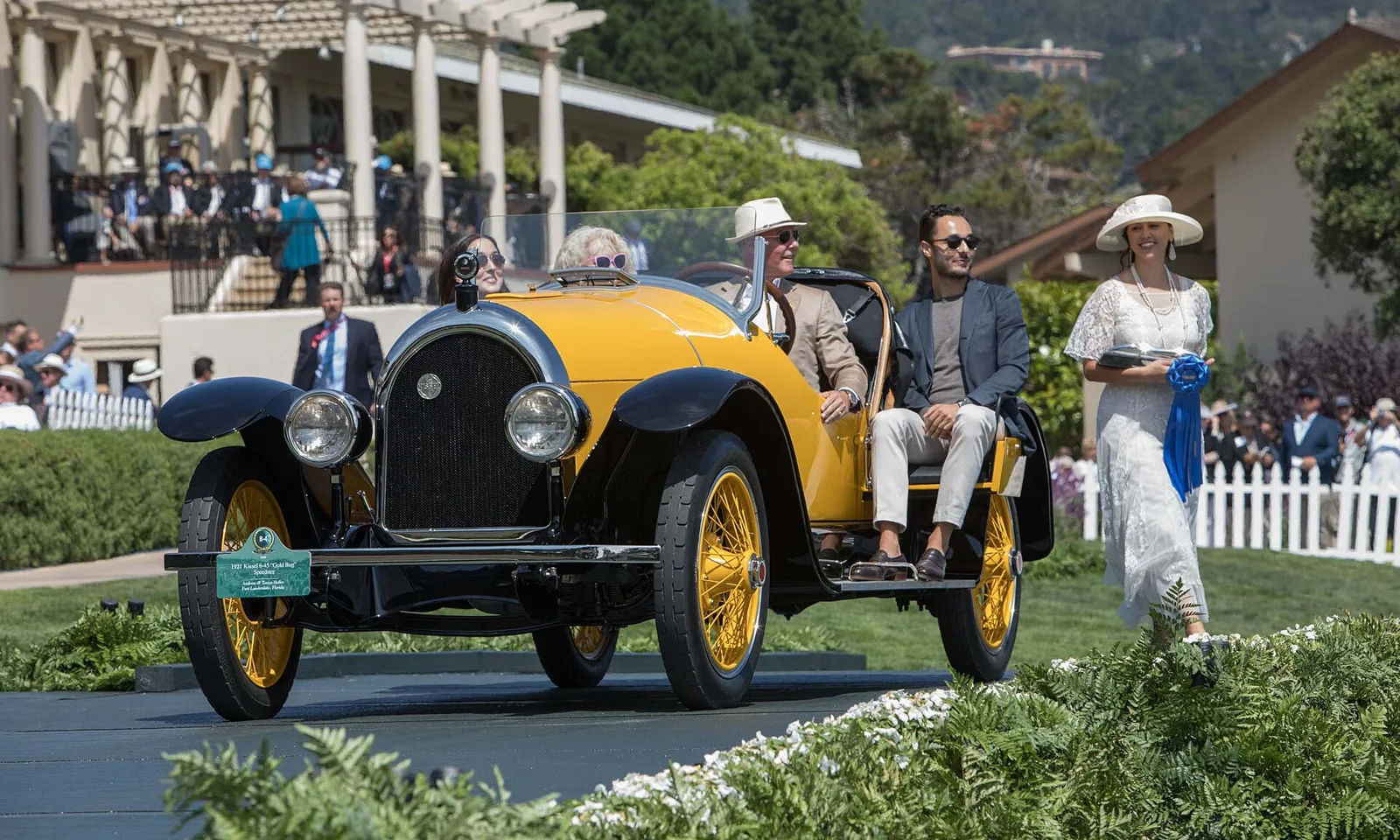
It is a yearly show of collector cars on the Pebble Beach Golf Links in California, the finale of Monterey Car Week. Many regard it as the world's most prestigious car show. A concours is French for a competition of elegance: cars, prewar and postwar, are judged on authenticity, function, history and style rather than sold.
It began in 1950 as an adjunct to a road race run on closed public roads. Thirty cars were shown on 4 November 1950 and 23 in May 1951, beside a private club. In 1952 the show moved to the 18th green overlooking Carmel Bay. It has run every year since except 1960, when scheduling conflicts forced a cancellation, and 2020, when the pandemic cancelled the 70th edition and it was deferred to 2021. In 2006 there were 175 cars from 27 states and 13 countries across 25 judged classes, and the cars were estimated to be worth $200 million; the field was cut from 227 the year before so the judges had longer with each one.
Entry is by application, car by car, and collectors may devote years, and sums running to hundreds of thousands of dollars, to buying and restoring a car in the hope of selection. A car that is accepted cannot return for ten years, with exceptions for a change of owner, a restoration or an obscure featured marque. Judges award first, second and third in each class and then choose a Best of Show, which carries an engraved trophy and an engraved Rolex. J.B. Nethercutt has won it six times, and Bugatti and Mercedes-Benz have taken ten each as of 2024, when a 1934 Bugatti Type 59 Sports won both Best of Show and the Stanford Award for Automotive Innovation.
Is Pebble Beach also a car auction?
Yes. The concours hosts Pebble Beach Auctions, which centre on high-end cars valued in the millions, and in 2022 alone sales totalled US$469 million. The concours is the centrepiece of over 50 events spread over a week, including vintage racing at WeatherTech Raceway Laguna Seca. Luxury and supercar makers use it to debut new models and concepts, with some building their own display halls. The Bugatti Veyron Grand Sport was revealed there in 2008. About 15,000 spectators attended in 2012.
Money raised has gone to the Pebble Beach Company Foundation and to the Monterey County branch of United Way, 56 years of support between them. The 2016 show alone raised over $1.75 million, and lifetime giving to charity tops $23 million.
What does this mean for anyone who wants to buy at auction?
The route depends on the kind of auction. Dealer auctions in most US states are closed to individuals, and in Japan only member dealerships can bid, so individuals must go through one. Public options include the few states that allow public car auctions, some police and government sales, online sellers such as eBay Motors and collector sales such as Barrett-Jackson, which sells to anyone who pays admission.
Where this goes next
Online bidding is growing in popularity in the trade, and Barrett-Jackson has set its own course for growth. When it bought the Collector Car Network in 2021, with its classic car publications and its Future Collector Car Show, the stated aim was to expand the collector car market. IMG's majority stake, announced in August 2022, put the company under new ownership. At Pebble Beach, meanwhile, each year's show picks a featured marque, coachbuilder or type, and the application process decides who gets onto the lawn.