A twisted steel rod links both wheels of an axle, stops the body leaning and tunes the balance between understeer and oversteer: how it works and what replaced it.
An anti-roll bar is a torsion spring linking opposite wheels so the body stays more level in corners. Its stiffness rises with the fourth power of its radius, and shifting stiffness between front and rear tunes understeer. The first patent dates from 1919; active versions arrived in 1994.
A stiffer anti-roll bar does not reduce the weight a car throws onto its outside wheels in a corner. That total is fixed by how high the centre of gravity sits and how wide the track is, and no bar can change it. What the bar does is stop the body leaning over, and, by how it is split between the axles, steer the car towards understeer or away from it.
Here is how a length of twisted steel does both jobs, what controls its stiffness, what it costs in comfort, and how active systems from Citroen, Mercedes-Benz and Mitsubishi tried to improve on it.
What does an anti-roll bar do?
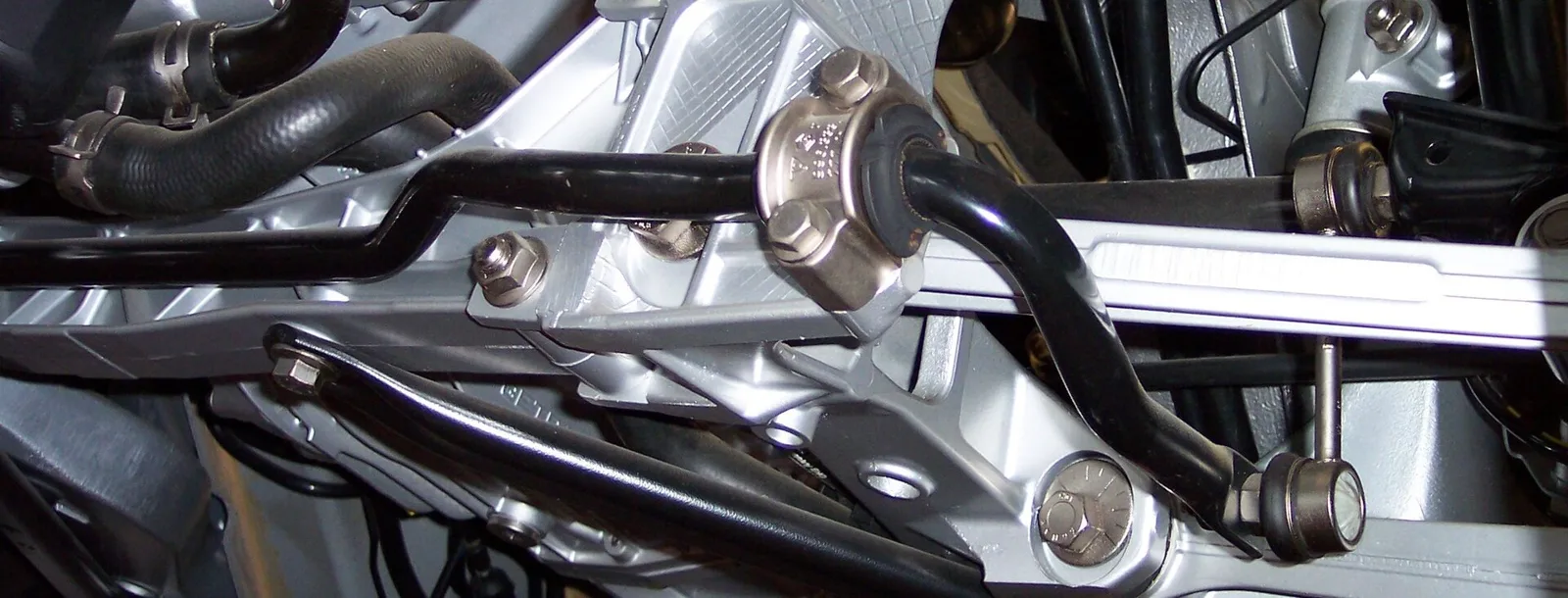
An anti-roll bar goes by several names: sway bar, anti-sway bar, stabiliser bar or simply roll bar. It is a suspension part that limits body roll when you corner hard or the road surface is uneven. Joining the two wheels of an axle, front or rear, to a torsion spring through short lever arms, it raises the suspension's roll stiffness, its resistance to leaning in turns.
Think of what happens without one. In a bend the car's weight pushes down on the outside wheel's suspension, compressing it, while the inside spring relaxes and the body leans. The bar fights that. It forces the inner wheel's suspension to compress along with the outer one, which keeps the body more level. A useful side effect is that the car's centre of gravity drops slightly during the turn, adding stability. When bars are fitted at both ends, their combined effect also helps the body follow the general slope of the terrain.
The first stabiliser bar patent was awarded on 22 April 1919 to Stephen Coleman, a Canadian inventor from Fredericton in New Brunswick. Even so, the bars were unusual on cars made before the Second World War, since suspensions were much stiffer and roll was simply accepted. From the 1950s production cars gained them in growing numbers, especially those with softer coil-spring suspension.
The bar does not cut the weight thrown to the outside wheels; it stops the body leaning and decides which axle carries the load.
How does an anti-roll bar work?
The bar is usually a cylindrical steel rod bent into a U. Two mounts on the long centre section fix it to the body, and each end carries a link. If both wheels rise and fall in step, the bar merely rotates in its mounts and does nothing. If one wheel moves differently from the other, the bar twists, and its resistance to twisting is the whole point. Imagine wringing out a wet towel: the more you twist, the harder it pushes back.
Each end of the bar connects through a flexible joint to an end link, and the link attaches near the wheel or axle. The path of the force is a short chain. It starts at the more heavily loaded suspension, passes through a bushing to the end link, crosses a flexible joint into the bar, runs along to the end link on the opposite side, and finishes in the opposite suspension.
Stiffness is governed by three things. It rises with the stiffness of the material, with the fourth power of the bar's radius, and as the lever arms get shorter. The fourth power means size counts for a great deal: double the radius and the bar is sixteen times stiffer. Where the mounts sit, and how rigid they are, matters too. The stiffer the bar, the more force it takes to move one wheel relative to the other, and so the more force the body needs to roll.
Why not just fit stiffer springs?
In a turn, the body's mass produces a sideways force at the centre of gravity, proportional to lateral acceleration. Because the centre of gravity normally sits off the roll axis, the line running between the front and rear roll centres, that force creates a twisting moment about the axis. Engineers call it the roll couple. The suspension resists it with roll stiffness, which comes from the spring rate of the springs and from the anti-roll bars, if any.
Springs alone could supply that stiffness, but stiffer springs also harden the ride over every bump. A bar offers a way around it. It lets designers cut roll without stiffening the springs in the vertical plane, giving better body control without much sacrifice in ride comfort. Suspension design is always a compromise between road holding and ride, two aims that pull against each other.
Roll itself is damaging beyond the discomfort. For typical unibody suspension geometry, body lean puts the outside wheels at positive camber and the inside wheels at negative, which reduces their cornering grip, especially on cross-ply tyres.
Where does the car roll about?
The roll centre is the notional point at which the suspension reacts cornering forces to the body. Two definitions exist: the geometric or kinematic roll centre, which depends only on suspension geometry, and a force-based one used by the Society of Automotive Engineers. On a car whose left and right suspensions are mirror images, the roll centre sits on the centreline.
Its importance appears when you compare it with the centre of mass. The gap between them forms a moment arm, and how long that arm is, together with the stiffness of the springs and bars, decides how much the car rolls. Roll centres migrate as the car rolls, and their height affects behaviour at the start of a turn, including nimbleness and initial roll control.
How does bar size change understeer and oversteer?
This is the bar's second job. Altering the share of the car's total roll stiffness provided by the front and rear axles changes the handling balance. Add roll stiffness at the front and the front axle takes a larger proportion of the load transfer, while the rear takes less. In general the outside front tyre then works at a relatively larger slip angle and the outside rear at a smaller one, which increases understeer. Putting more of the roll stiffness at the rear does the opposite and reduces understeer.
| Change | Effect |
|---|---|
| Stiffer front bar | Front axle handles more of the load transfer; understeer increases |
| Stiffer rear bar | Rear axle handles more of the load transfer; understeer decreases |
| Larger bar radius | Stiffness rises with the fourth power of the radius |
| Shorter lever arms | Stiffer bar |
| Bar set too aggressively | Inside wheels can lift in hard cornering |
Engineers describe the split with roll couple percentage, a simplified way to express how lateral load transfer is shared front to rear. It is the effective roll rate of each axle as a proportion of the vehicle's total, and it is commonly adjusted with the anti-roll bars, though different springs can change it as well. The overall roll rate, measured as torque per degree of body roll, depends on sprung mass, track width, the height of the centre of gravity, spring and damper rates, front and rear roll centre heights, bar stiffness and tyre construction. It usually differs front to rear, which gives tuners room to shape both the turn-in and the settled cornering behaviour.
Roll rate leaves total weight transfer unchanged. It changes how fast the transfer happens and what share each axle takes: broadly, an axle with a higher roll rate takes a faster and larger share. Transfer through springs, dampers and bars is called elastic, while transfer through rigid links, A-arms and toe links among them, is geometric.
What are the drawbacks of an anti-roll bar?
A bar that ties the two sides together will carry a bump from one wheel across to the other. On rough or broken pavement this can produce jarring side-to-side body motion, a waddling sensation, that gets worse as the bar's diameter and stiffness increase. Other suspension techniques can delay or damp the effect.
Overdo the roll stiffness, usually by setting a bar up too aggressively, and the inside wheels can lift off the ground in hard cornering. That can be turned to advantage. Plenty of front-drive road cars lift a rear wheel on purpose when cornering hard, overloading the opposite wheel to limit understeer.
Can the bar be adjusted, switched off or replaced?
Yes, and engineers have tried every route. Racing bars are often adjustable. Some are altered in the pits, and some can be changed on the move by the driver, from the cabin, as in Super GT. Adjustment works by lengthening or shortening the lever arms, or by rotating a flat blade of steel, stiff when it stands on its edge and softer when it lies flat. A mechanic can then tune roll stiffness for different circumstances without replacing the whole bar.
| Approach | Example | How it works |
|---|---|---|
| Passive bar | Most cars | Fixed stiffness set by radius and lever arm length |
| Adjustable bar | Racing cars, Super GT | Lever arm changed in the pits or from the cockpit |
| Semi-active bar | Mitsubishi Mirage Cyborg, 1988; Jeep Rubicon models | Hydraulic actuator or decoupler switches the bar between modes |
| Active bar | Citroen Xantia Activa, 1994 | Suspension ECU stiffens the bar in hard cornering |
| No bar | Mercedes-Benz Active Body Control | Sensors and hydraulics raise or lower the springs to counter roll |
| Disengaged bar | Toyota KDSS | Stabiliser bars essentially disengaged off-road |
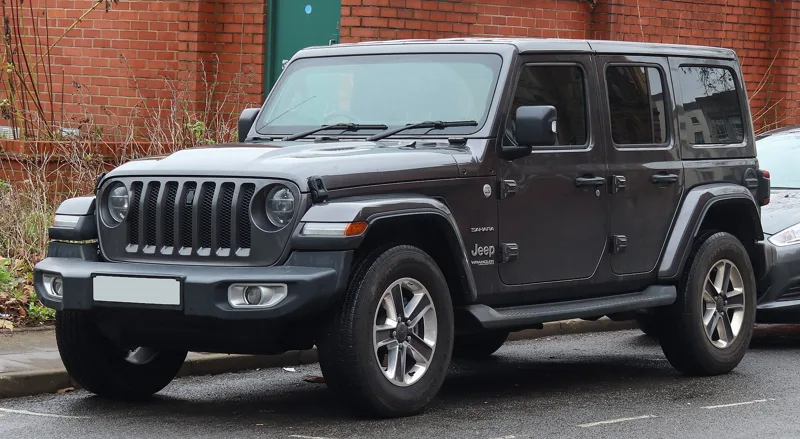
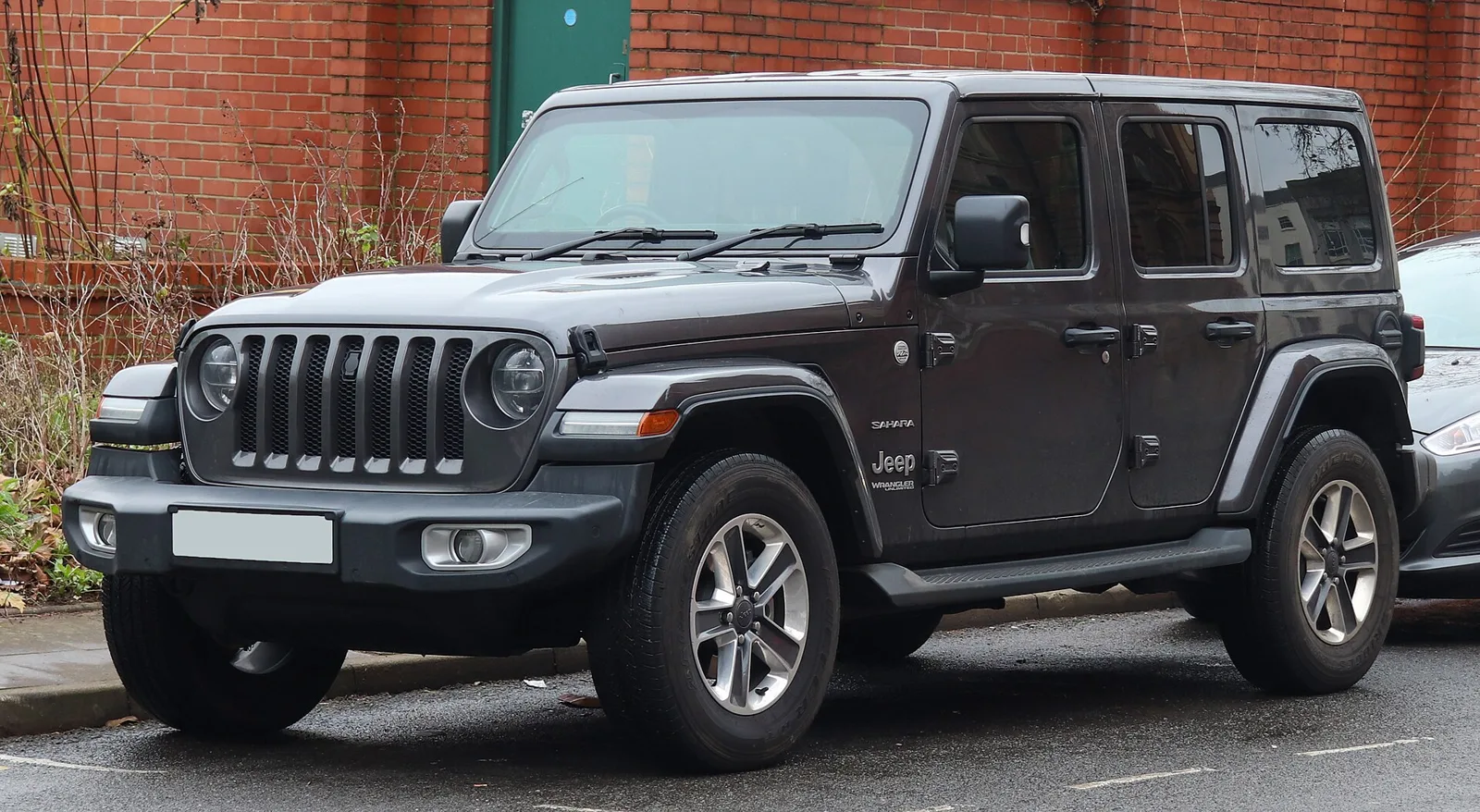
The first production car with a semi-active bar was the 1988 Mitsubishi Mirage Cyborg. Its 16-valve turbo model had a Dual Mode Suspension, with a hydraulic actuator in the front bar link operated from the dashboard to switch between sport and touring settings. Jeep's Wrangler (JK, JL) and Gladiator (JT) go the other way on Rubicon models, using a switchable decoupler to free up wheel articulation off-road.
The first fully active system was Citroen's SC.CAR, short for Systeme Citroen de Controle Actif du Roulis, on the 1994 Xantia Activa, a medium-sized European saloon. The suspension ECU stiffened the bar in hard cornering and held body roll to 2 degrees. Mercedes-Benz took the bar out entirely with the Active Body Control of the S-Class. Sensors detect lateral load, lateral force and the height difference at the suspension strut, and hydraulics then move the spring up or down to fight roll. Toyota uses a mechanical system, the Kinetic Dynamic Suspension System, which in effect disengages the stabiliser bars off-road for greater articulation and a better ride.
Why was the MacPherson strut built around the bar?
The MacPherson strut is a common type of strut suspension. In MacPherson's first patent, the bar was built into the suspension as an essential element, on top of its usual job of controlling roll. A strut suspension needs a hinged lower member to control the wheel's position both in and out, which sets the track, and forwards and backwards. A wishbone with a number of joints can do it, or an additional radius rod.
MacPherson replaced the wishbone with a simple, cheaper track arm that has just one joint at its inboard end, and left the bar to hold the wheel's fore-and-aft position. The set of suspension members became simpler and cheaper than with wishbones, and unsprung weight fell. Because the bar had to control wheel position, bars in this layout could be connected through ball joints. Many later suspensions that carry the MacPherson name have since gone back to wishbones instead of the simplified arm.
What this means for buyers and drivers
A car's bars are part of its character. A stiffer front bar will push a car towards understeer, a stiffer rear will relieve it, and a front-drive car that lifts an inside rear wheel is not suffering a fault; it may be doing exactly what its designers intended to limit understeer. The price of firm bars is a busier ride on bad road surfaces, so a car that feels fussy on broken tarmac may owe it to the bar linking the wheels.
Off-road, the logic reverses. Roll control is a handicap when wheels need to move independently, which is why Jeep fits a decoupler to Rubicon models and Toyota disengages its bars with KDSS.
Where this goes next
Passive bars are no longer the only answer. By 2021 certain models offered dynamic roll control built on air suspension that can change ride height, plus adaptive dampers. Citroen's SC.CAR of 1994 and the Mercedes-Benz hydraulic system both used sensors and computers to control roll, the first through a bar and the second without one.