Pulses, scavenging and back pressure: what manifolds, catalysts, resonators and mufflers each do to a car's note and output, and where the law draws its lines.
An exhaust system carries burnt gas from the cylinders through a manifold or header, a catalytic converter, resonators and a muffler. Each part shapes either sound or flow. Mufflers cancel sound waves but add back pressure, so every exhaust compromises between noise and power, and many countries tightly regulate modifications.
The quietest part of every exhaust pulse does the most work. When a cylinder dumps its burnt gas, the pulse leaves in three stages: a high-pressure head, a medium-pressure body and a low-pressure tail. The momentum of the first two can pull the pressure in the cylinder below that of the atmosphere, and that dip helps drag out the last of the combustion products and draw in fresh mixture. Engineers call it scavenging, and much of what an exhaust system is designed to do comes back to it.
What does an exhaust system do?
An exhaust system carries burnt gases away from the engine through one or more pipes. Depending on the design, the gas may pass through the cylinder head and exhaust manifold, a turbocharger, a catalytic converter and a muffler, which British English calls a silencer.
The pipe has to move toxic gases, including hydrocarbons, carbon monoxide and nitrogen oxides, away from the people using the machine. The gas is also scorching, so the pipe must withstand the heat and keep away from anything flammable or heat-sensitive. For an internal combustion engine the system should be tuned for efficiency, and it must satisfy the norms of the country where the car is sold: China 5 in China, EURO 5 in European countries and BS-4 in India, for example.
Silence and flow pull in opposite directions, and every exhaust is a compromise between them.
How do exhaust pulses scavenge a cylinder?
Each time an exhaust valve opens, the compressed gas in the cylinder rushes into the manifold. The large pressure difference between the chamber and the outside air creates the high-pressure head of the pulse. As the pressures equalise, velocity falls and the pulse becomes a medium-pressure body. What remains is the low-pressure tail.
Momentum is the secret. The head and body are moving quickly, and they keep pulling after the pressure has equalised, which can reduce the pressure in the combustion chamber below atmospheric. That relatively low pressure helps extract the combustion products and draws in the intake charge during valve overlap, the short period when intake and exhaust valves are both partly open. The length, cross-section and shape of the exhaust ports and pipework decide how strong the effect is and across what range of engine speeds it occurs.
The effect is a direct function of the speed of the high and medium-pressure parts of the pulse, so performance headers try to raise exhaust velocity as much as possible. One method is to give the primary tubes a tuned length, so that each pulse follows the one before it in the pipe. The low-pressure tail of one pulse then increases the pressure difference for the high-pressure head of the next, which makes the next pulse faster. On V6 and V8 engines with two banks, Y-pipes and X-pipes apply the same principle.
The pulses themselves matter. A four-cylinder engine produces four high-pressure pulses in each operating cycle, and a six-cylinder produces six, with a low-pressure pulse between each pair that serves to scavenge the next. The more distinct and separate the pulses are, the more positively the gas flows and the more efficiently each cylinder empties.
Manifold or header: what is the difference?
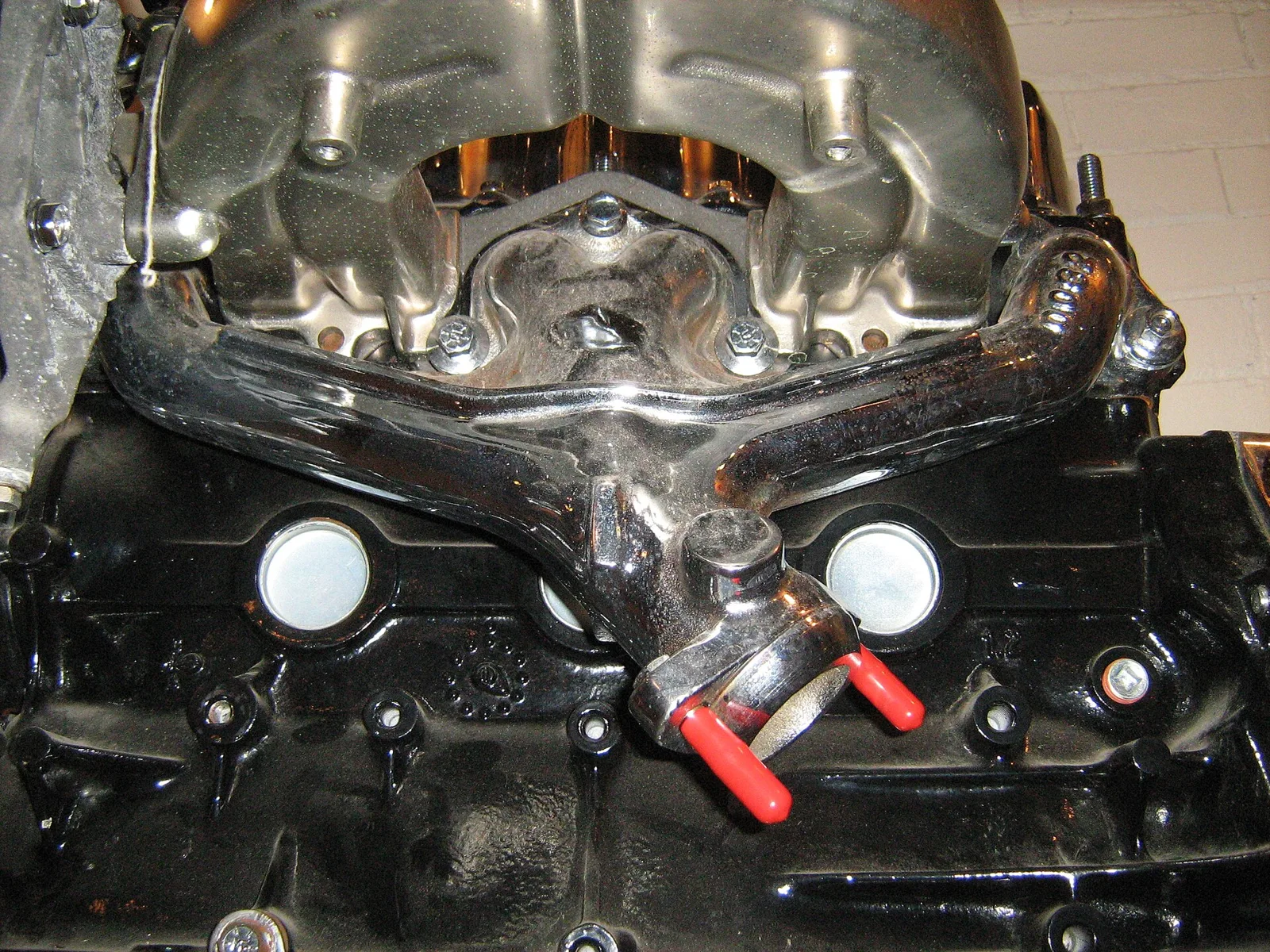
A manifold collects the exhaust from several cylinders into one pipe. A header is a manifold built purely for performance.
Manifold is an Old English coinage meaning, roughly, many folds, and a stock exhaust manifold is usually a simple cast iron or stainless steel part. Designers of production cars tend to use the least metal and space and the lowest cost, which is why the manifold is often a compromise on flow. Cylinders fire at different moments, so a pressure wave from one can still be in the pipe when the next arrives. That builds back pressure and restricts the engine's performance. Cast iron nevertheless stays popular among engineers, because of its handling of heat and its durability.
A header ignores weight and cost and goes for optimal flow. It uses tubing with bends calculated to make the path from every exhaust port to the shared outlet the same length, joined at narrow angles so that pressure waves run out through the collector instead of back towards the other cylinders. In a tuned set the pipe lengths are worked out to boost flow across a chosen speed range. On inline-four and V8 engines, the typical layouts are 4-2-1, where four pipes merge into two and then into one, and 4-1, where all four merge directly.
Primary tube sizing needs care. Tubes that are too large let the gas expand and slow down, weakening scavenging. Tubes that are too small create resistance that the engine must work against, costing power and leaving exhaust behind to dilute the incoming charge. Wide primaries give the best gains at high engine speeds, narrow ones at low speeds, and long primaries resonate at lower revs than short ones.
Aftermarket headers are usually mild or stainless steel tubing with flat flanges and a collector, which sometimes is left off in the "zoomie" style. Chrome-plated headers tend to blue with use, and polished stainless steel takes on a yellow tint, but less than chrome. Heat is managed by ceramic paint, a thermally sprayed ceramic coating or exhaust wrap, which is cheap and simple although it can shorten the manifold's life. Insulation cuts the heat given off into the engine bay and so reduces the intake manifold temperature.
What does the catalytic converter do?
The catalytic converter cuts the hydrocarbons, carbon monoxide and nitrogen oxides in the exhaust, turning the pollutants into water and carbon dioxide. It only works properly once it reaches its light-off temperature.
It can also be a restriction. A blocked converter, or one too small for the flow the engine needs, creates back pressure, and removing or upgrading it can raise power at high revs. The converter remains vital to the car's emission control, though, and a non-standard product can make a vehicle unroadworthy. Catless systems, often called de-cat, do exist. In the United States a catalytic converter is a legal requirement, and it may not be removed even from a vehicle used only off-road.
What is the difference between a muffler and a resonator?
Both reduce noise, but they work in different ways. A muffler is an acoustic device designed to lower the loudness of the sound pressure the engine makes. A resonator is a section of pipe that widens so sound waves reflect off its walls and cancel one another.
Mufflers combine reactive, resistive and absorptive silencing with shell damping. Inside, passages and chambers, some lined with fibreglass and some shaped as resonating chambers harmonically tuned to the task, produce destructive interference, where opposite sound waves cancel each other out. Resonators can sit inside a muffler or be fitted as separate parts of the system.
| Part | How it handles noise | Effect on flow |
|---|---|---|
| Original-equipment muffler | Reflects sound waves inside the muffler to meet noise regulations | Can add significant back pressure |
| Glasspack | Straight-through perforated tube with fibreglass around it | Less back pressure, but relatively ineffective at cutting sound |
| Chambered muffler | Pipes in an expansion chamber; waves bounce off closed ends and partly cancel | More restriction than a straight-through design |
| Resonator | Pipe widens so waves reflect off the walls and cancel | Used inside mufflers or as a separate part |
| Catalytic converter | Converts pollutants to water and carbon dioxide | Back pressure if clogged or undersized |
Glasspack mufflers, nicknamed cannons or hotdogs, are built from a perforated inner tube and a solid outer shell, packed with fibreglass between. Back pressure is often lower than with a factory muffler, but they do little to reduce sound levels. Chambered mufflers use a series of pipes inside an expansion chamber; sound travels into them, bounces off the closed, flat ends and partly cancels itself.
Why does changing the muffler change the sound and the power?
Because silence and flow pull in opposite directions. The exhaust gas has to follow the same complex path through the muffler as the sound pressure the muffler is built to reduce, so a side effect of noise reduction is restricted flow and back pressure, which can lower efficiency.
Back pressure is not simply the enemy. Some of it helps, and higher back pressure can reduce nitrogen oxide emissions in some engines. Designers therefore compromise between gas extraction, exhaust pressure, fuel efficiency, power and noise suppression. If performance is the priority, pipes and muffler must be big enough for the engine to breathe yet narrow enough to keep the gas moving fast. A muffled high-performance system depends on two independent factors: tuning the pressure waves by choosing length and diameter, and keeping back pressure down by choosing mufflers with suitable flow capacity.
Some aftermarket mufflers claim more power or lower fuel consumption from slightly reduced back pressure, and that usually comes with less noise reduction, so more noise. Greater muffler flow may add power, but flow capacity beyond what the engine needs brings no extra benefit and costs more while being louder.
Pipe diameter follows the same logic. If it is too small, power at high revs falls. If it is too large, low-rev torque can drop, and the system sits lower to the ground, which raises the risk of knocking it while moving. Twin systems often include a crossover, either a perpendicular H-pipe or an X-pipe with angled pipes that merge and separate. On a cross-plane V8, two consecutive firings in one bank create a high-pressure zone, and the crossover bleeds part of it away. Without it the flow would be jerky, and part of the next pulse might not leave the cylinder, which could cause either detonation on a lean mixture or a misfire on a rich one.
What does the law say about modified exhausts?
Muffler rules are older than most people expect. Oregon's lawmakers acted on 18 May 1905, ordering that vehicles carry a light, a muffler and brakes that work well.
Whether you may change a car's factory exhaust depends on where you live. The United States, Canada, Australia and many other developed countries regulate such changes heavily or ban them outright. The catalytic converter has its own rules in the United States, where it must stay in place. European noise and pollution regulations pushed motorcycle makers away from single exhaust mufflers by the early 2000s, forcing them to find other ways to raise performance.
Why do exhaust tips sit where they do?
The end of the exhaust, the tailpipe, is generally the only visible part of the system. It often ends in a straight or angled cut or a decorative tip, which may be chromed and often has a larger diameter than the rest of the pipe. That produces a final reduction in pressure and sometimes just improves the look.
The side of the rear bumper where the pipe emerges usually reveals the market the car was built for. Japanese and British cars have exhausts on the right, which keeps them away from the kerb in left-hand-traffic countries, while European cars have them on the left.
In the late 1950s American manufacturers briefly fashioned rear bumpers with a hole at each end for the exhaust to pass through, two outlets symbolising a V8. Cadillac, Lincoln, Imperial and Packard all used the idea. The fashion faded after customers noticed that the rear of a car is a low-pressure area which collects soot from the exhaust, and its acid content ate into the chrome-plated bumper. The 1930s to 1950s also saw lake pipes, named after the vast, empty lake beds to the north-east of Los Angeles County, where specialists tested one-piece headers.
What this means for buyers and drivers
Three points follow. Quiet and free-flowing are trade-offs, so a louder car does not automatically mean a faster one: excess flow capacity adds noise and cost with no benefit. Headers can add power through larger pipe area and pulse timing, but they are tuned to an engine speed range. And before changing anything, check the local rules, because in many places altering the original exhaust is tightly regulated or banned, and removing a catalytic converter can make a car unroadworthy or illegal.
Where this goes next
Understanding of exhaust fluid dynamics has produced mechanical refinements that adapt the system to engine speed. One example is the exhaust ultimate power valve, or EXUP, on certain Yamaha motorcycles, which continually tunes the back pressure in the collector to shape the pressure waves as engine speed changes, which keeps low- to mid-range performance strong. At low speed the valve partly closes to generate larger negative pressure waves and lift torque, and at higher speed it opens fully so the exhaust flows freely.