How a piston, a connecting rod and a few thin split rings turn combustion pressure into rotation, how the designs differ and what goes wrong.
A piston passes the force of expanding combustion gas through the connecting rod to the crankshaft, turning straight-line motion into rotation. Rings seal the gas, carry heat to the wall and scrape oil, accounting for about 24% of engine friction. Rods can fail at high speed, and cylinders can wear oval.
A set of piston rings, thin split bands of iron or steel, accounts for about 24% of an engine's total mechanical friction losses. That is a startling bill for parts that most owners will never see, and it explains why so much engineering goes into the humblest components in the block.
How does a piston work?
A piston is the moving part that slides in a cylinder, kept gas-tight by its rings. In an engine its task is to take the push of the expanding gas and deliver it to the crankshaft via a connecting rod. In some engines it does a second job as well, working as a valve that opens and closes ports in the cylinder wall as it slides past them.
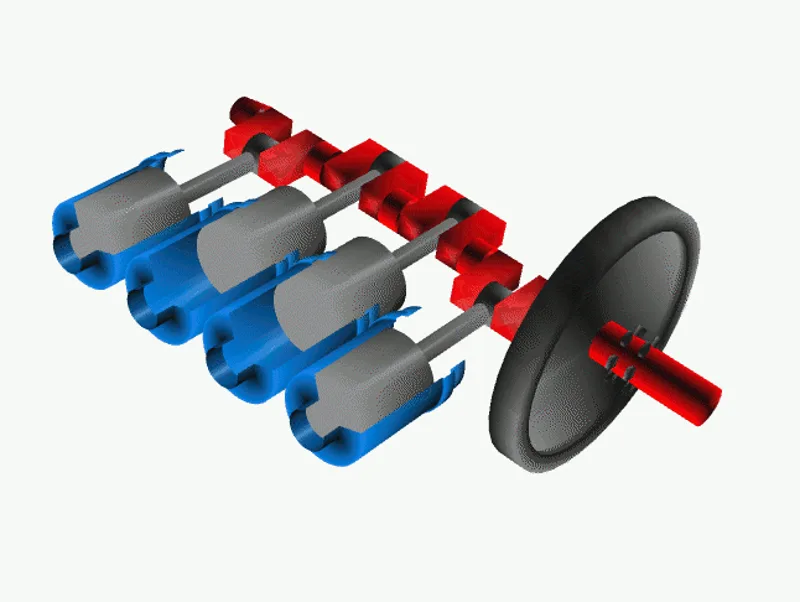
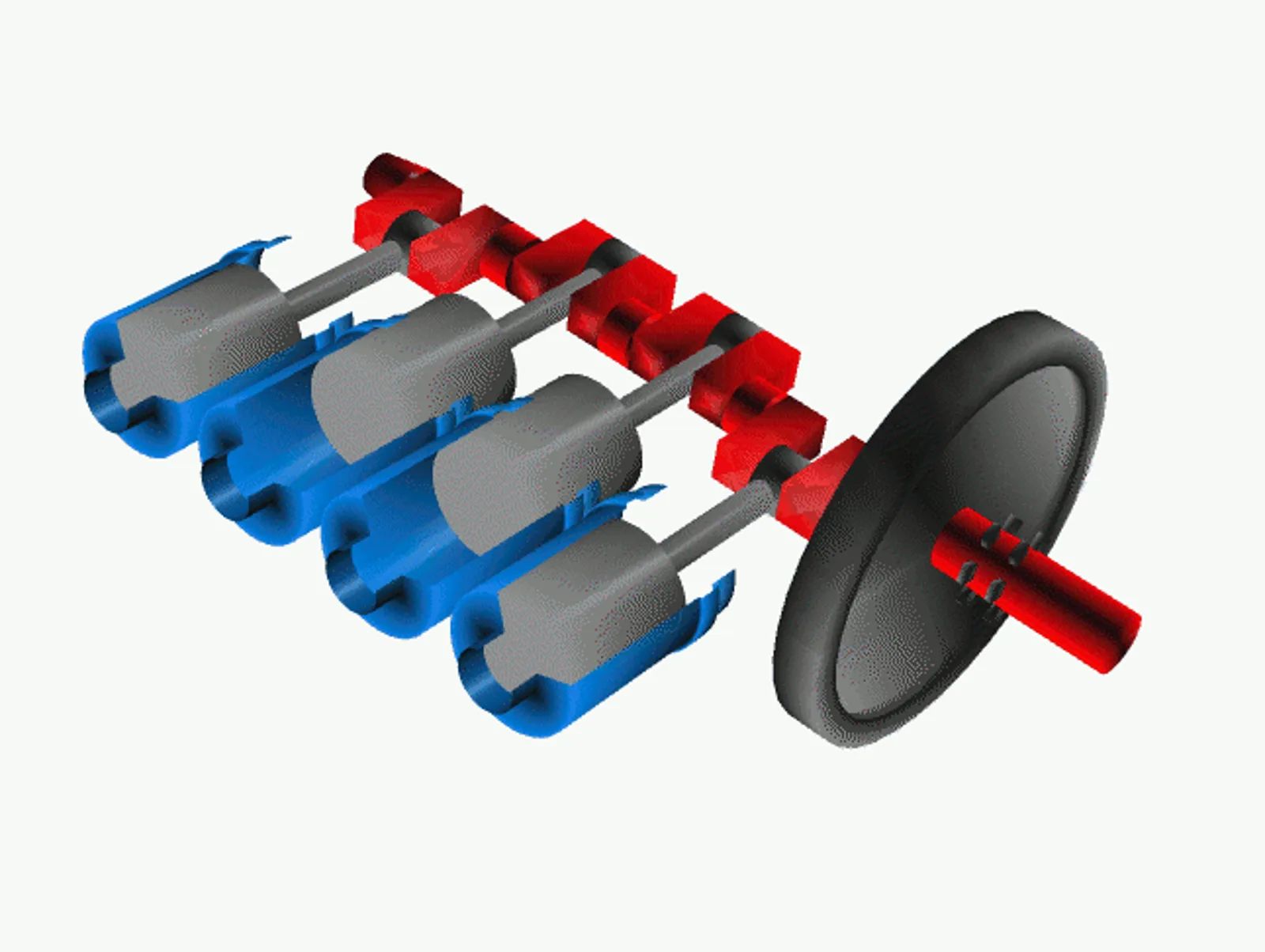
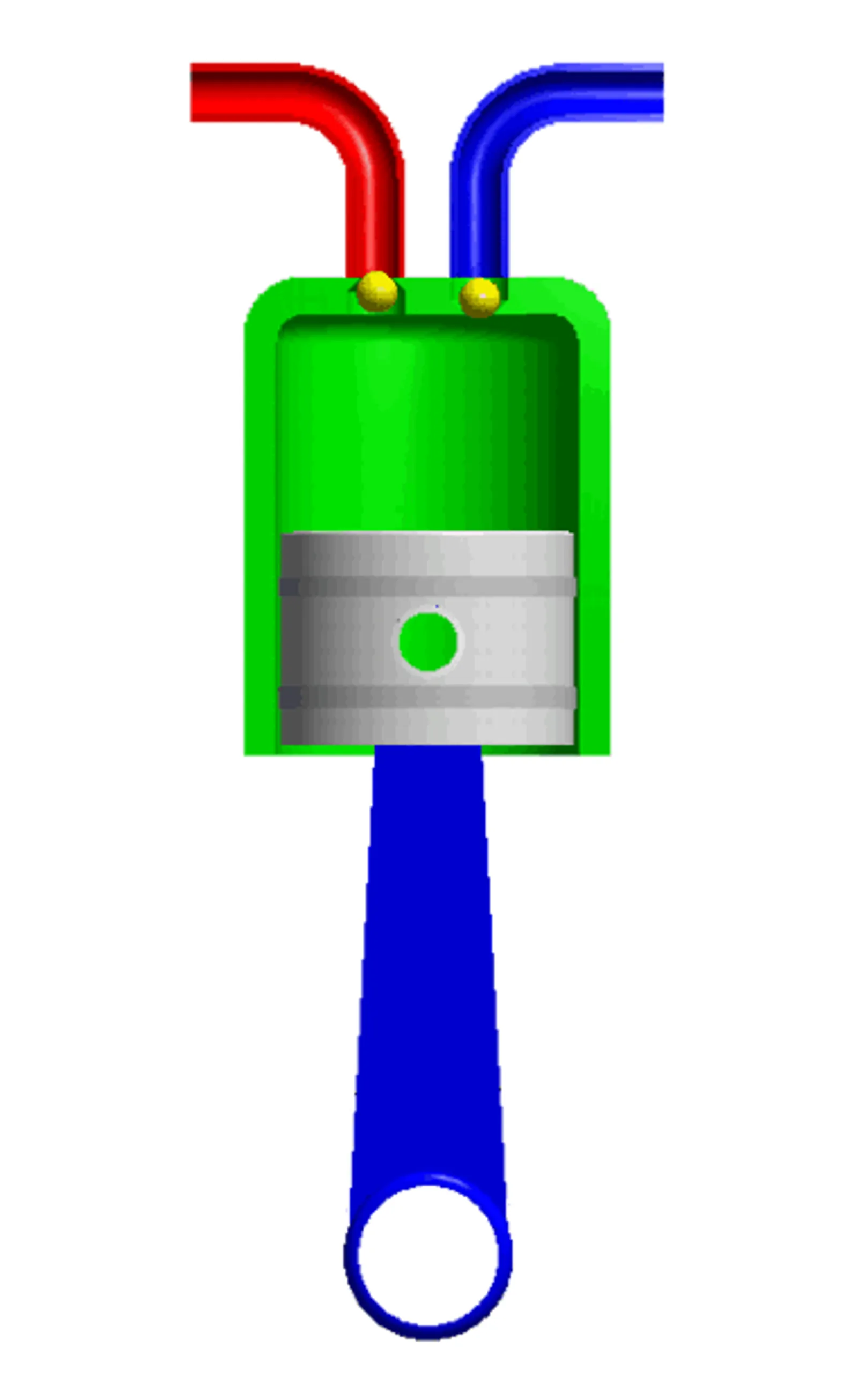
In a petrol or diesel engine, burning gases expand in the combustion chamber at the top of the cylinder. Their pressure shoves the piston downwards, and the force travels through the connecting rod to the crankshaft. The rod joins the piston through a swivelling gudgeon pin, known in the United States as the wrist pin. Unlike a steam engine, a car engine has no piston rod or crosshead; the pin sits inside the piston itself. Only big two-stroke engines are an exception.
The pin is hardened steel, locked into the piston and left free to turn in the rod. A few designs let it float freely in both parts. Either way it has to be held from wandering sideways, because a pin end that dug into the cylinder wall would be disastrous, and circlips usually do that job.
What conditions does a piston live in?
The harshest conditions are in high-power diesels. Combustion chamber pressure can climb to 20 MPa, while parts of the piston surface can exceed 450 C. One answer is a cooling cavity inside the piston, fed with oil through a supply channel from an injector. The design has to be carefully calculated and analysed, and the oil flow through the cavity should be no less than 80% of the flow through the injector.
Most pistons are cast or forged from aluminium alloy. Some racing pistons are forged for better strength and fatigue life, and billet pistons turn up in racing engines because they do not depend on the size and shape of available forgings, which allows last-minute design changes. Look closely and a piston is not perfectly round. It is made slightly oval, with a taper, so it is wider towards the foot of the skirt than at the crown. You could not see that with the naked eye.
Early pistons were cast iron. A lighter alloy brought obvious benefits for engine balance, but it had to survive combustion temperatures, so metallurgists developed new alloys, Y alloy and Hiduminium among them, specifically for pistons. Effectively all internal combustion pistons today are single-acting, meaning gas pushes on one face only.
Rings seal the gas, move heat to the wall, ration the oil and take a quarter of an engine's friction.
What does the connecting rod do?
The connecting rod, or con rod, ties the piston to the crankshaft. With the crank, it converts the piston's up-and-down motion into rotation, and in doing so it must carry both compressive and tensile forces from the piston. At the piston end it pivots; at the shaft end it turns.
A rod for an internal combustion engine has three parts: the big end, the rod itself and the small end. The small end grips the gudgeon pin, which lets the rod and piston rotate relative to each other. The big end usually connects to the crankpin through a plain bearing to reduce friction, although some smaller engines use a rolling-element bearing instead, which saves them a pumped lubrication system. Rods with rolling bearings are one-piece, so the crankshaft has to be pressed through them, whereas the two-piece type can be bolted round the journal of a one-piece crankshaft.
A small pinhole drilled through the big-end bearing lets lubricating oil squirt onto the side of the cylinder wall that takes the thrust, which lubricates the pistons and rings as they travel. Because the rod can rotate at both ends, the angle between it and the piston keeps changing as it moves up and down and swings round the crankshaft.
Rods are usually steel in mass-produced car engines, although the range of materials runs from spheroidized graphite cast iron and sintered iron-based metal to alloy steel and carbon steel. Aluminium and titanium alloys are other possibilities. High-performance engines can use billet rods, machined out of a solid block of metal rather than cast or forged.
An idea older than the car
The crank-and-rod mechanism has a long past. A crank with its connecting rod has turned up at Paule in Brittany, in a Celtic oppidum, and is dated to 69 BC. Roman-era watermills used the same linkage to turn the rotation of a waterwheel into the straight-line movement of a saw blade; early examples include a sawmill at Hierapolis from the late 3rd century and mills at Ephesus and Gerasa from the 6th century. Between 1174 and 1206 AD, the inventor Al-Jazari described a water-raising machine that combined a rod with a crankshaft.
Steam took longer to adopt it. The Newcomen atmospheric engine of 1712 used a chain, since its piston only produced force in one direction. Most steam engines after it were double-acting, with force in both directions, and that called for a connecting rod.
Which types of piston are there?
| Type | Where it is used | Defining feature |
|---|---|---|
| Trunk piston | Petrol and diesel engines since the early days | Long relative to its diameter, so it acts as both piston and crosshead |
| Slipper piston | Petrol engines, including racing | Cut down in size and weight to reduce reciprocating mass |
| Crosshead piston | Large slow-speed diesel engines | A rod runs down to a smaller guide piston that carries the gudgeon pin |
| Deflector piston | Two-stroke engines with crankcase compression | A raised rib on the crown directs the incoming mixture upwards |
| Racing piston | Racing engines | Much stronger and stiffer than a road piston, and much lighter |
Trunk and slipper pistons
Because the connecting rod stands at an angle for much of each turn, it pushes the piston sideways against the cylinder wall. A trunk piston is long to support that side force. Most trunk pistons, particularly in diesels, carry an oil ring groove below the gudgeon pin as well as the rings between pin and crown.
High-speed engines have moved on to the slipper piston, a petrol-engine design trimmed as far as possible. In the extreme case only the crown, the ring supports and enough skirt to leave two lands remain, and those lands keep the piston from tilting in its bore. The aim is mostly to cut reciprocating mass, which makes the engine easier to balance and allows higher speeds. The forces needed to accelerate and decelerate moving parts also produce more friction between piston and wall than gas pressure does, so lower inertia improves mechanical efficiency. Halving the skirt area trims friction a little, but most friction comes from the rings and the wrist pin bearing, so the gain is limited.
Crosshead and deflector pistons
Large slow-speed diesels often need extra support against side forces, and they use crosshead pistons. The main piston carries the rings and seals the gas, while a large rod runs down to a smaller piston that is purely a mechanical guide and holds the gudgeon pin. The lubrication has an advantage: its oil is kept out of the heat of combustion, so no soot contaminates it, heat does not break it down, and a thinner oil can be used. Friction in the piston and crosshead together may be only half that of a trunk piston. The extra weight keeps this design out of high-speed engines.
Two-stroke engines with crankcase compression use deflector pistons, with a raised rib on the crown that stops fresh mixture shooting straight across the cylinder from inlet to exhaust. Designers developed the rib into a large asymmetric bulge, but cross scavenging never lived up to expectations, and most engines now use Schnuerle porting, which gives the cylinder a transfer port on each side and swirls the gas around a vertical axis.
What do piston rings seal and scrape?
A piston ring is a split band of metal that fits around the piston. It has four jobs: sealing the combustion chamber so that little gas leaks to the crankcase, carrying heat from the piston to the cylinder wall, keeping the right amount of oil between piston and wall, and scraping oil off the wall back to the sump to control consumption. Most are cast iron or steel.
The rings sit loosely in grooves just below the crown. Each is split at one point, which lets it press on the cylinder with a light spring pressure, and some rings get extra tension from a separate spring behind them. Upper rings have solid faces and handle gas sealing, while the lower rings, narrow-edged and U-shaped in section, work as oil scrapers.
Most pistons have at least two rings, and automotive engines typically have three. The top two are compression rings, mainly for sealing the chamber. The bottom one is the oil control ring, which meters how much oil reaches the cylinder wall, enough to lubricate the skirt and the oil control rings themselves.
Why the gap matters
The ring must seal the space between piston and wall. Make the gap too small, and the thermal expansion of the piston could make it seize in the cylinder, causing serious damage. Make it too large and sealing suffers, so that combustion gases leak into the crankcase as blow-by and less pressure acts on the piston, which cuts power. Fitted in the bore, the gap closes to a few thousandths of an inch. The gap itself comes in several cuts, among them square, angled, tite joint, stepped, hook step and mitre step.
How the rings are built
Compression rings in a car engine typically have a rectangular or keystone cross-section. The upper ring usually has a barrel-shaped rim, while the lower one typically has a taper napier face. Oil control rings come as a single piece of cast iron, as multiple pieces of steel, or as steel or iron with a helical spring behind it to supply the tension. The multi-piece steel type sandwiches a spacer-expander spring between two thin rails, which holds the rails apart and gives radial pressure. An older design, the Clupet ring, was split like a key ring so that it had no gap and still pressed on the wall.
Friction and lubrication
Sliding costs energy. As noted, rings account for about 24% of an engine's mechanical friction losses, so ring design is a compromise between low friction, good sealing and an acceptable life. Lubricating them is hard, and the difficulty has driven improvements in motor oil. The oil has to withstand high temperatures and a harsh, fast-sliding contact, and the ring oscillates rather than turning continuously like a bearing journal. At each end of the stroke it stops and reverses, which disrupts the oil wedge that a hydrodynamic bearing relies on and reduces the effectiveness of the lubrication.
The rings also need freedom. They must float in their grooves to stay in touch with the cylinder, and rings that bind, usually because of a build-up of combustion products or broken-down lubricating oil, can cause engine failure. It is a common cause of failure in diesels.
A short history of the ring
Early steam engines sealed the cylinder with hemp packing, which caused high friction and sealed poorly. The first piston ring in a steam engine cylinder appeared in 1825, made by the Glasgow engineer and mill owner Neil Snodgrass, who used springs to keep it steam-tight and tried it on the steamer Caledonia on the Gareloch.
John Ramsbottom invented the modern metallic split ring in the 1850s. His first design, in 1852, was a plain circle and wore unevenly. The discovery behind the revision was that a ring perfectly round before fitting, with a split cut in it, presses unevenly on the wall once installed. His 1854 version was made out of round so that the pressure would be even in the cylinder, and it was claimed to last as much as 4,000 mi (6,437 km). A patent in 1855 recorded the change. Metal rings cut friction, steam leakage and piston mass, which brought meaningful gains in power and efficiency, with more time between services.
What wears out or fails inside?
Thrown rods
Each turn of the crankshaft subjects a connecting rod to heavy, repeated loads: shear because of the angle between piston and crankpin, compression as the piston goes down, tension as it goes up. These forces rise with the square of engine speed. When a rod fails, an event often called throwing a rod, the broken rod usually punches through the side of the crankcase and leaves the engine beyond repair.
The common causes are tensile failure at high engine speed, the impact when a piston meets a valve because of a valvetrain problem, failure of the rod bearing, usually through a lubrication problem, and incorrect installation of the rod.
Oval cylinders
The crankshaft pushes the piston sideways through the rod, and over time that can wear a cylinder into an oval. Performance then falls significantly, because circular rings cannot seal properly against oval walls. How hard the piston is shoved sideways depends on how steep the rod stands, so a longer rod lowers the force and the wear. The limit is the size of the engine block, since stroke plus rod length must not carry the piston beyond the top of the block.
Worn rings
Rings wear as they slide up and down the bore under their own load and the push of the gas. To resist, they are made from wear-resistant materials (cast iron and steel) and then coated or treated. Coatings include chromium, nitride and ceramic layers applied by plasma deposition or physical vapour deposition, known as PVD. Most modern diesels have top rings with a modified chromium coating, called CKS or GDC, with aluminium oxide or diamond particles mixed into the chrome. Port design also affects ring life in two-stroke engines.
Laboratory work has added detail. Studies of modern high-nitrogen steel rings found that wear can be strongly influenced by hydrogen-containing fuels and by the chemistry of lubricating coolants. Others looked at starved lubrication, where the ring and liner contact can shift from gentle abrasive and oxidative wear to severe scuffing, with a higher friction coefficient and a direct effect on reliability and service life.
What this means for an engine owner
Several lessons run through the failure list. Oil quality matters because ring lubrication is so demanding. Deposits and broken-down oil can freeze rings in their grooves, a common way diesels fail. Worn rings or oval cylinders lose sealing and with it power. And a thrown rod is mostly the product of excess speed, a valvetrain fault, a lubrication fault in the rod bearing or poor assembly.
Where this goes next
The development work described in recent studies is about coatings. Modern piston rings increasingly use advanced hard coatings applied by physical vapour deposition, including multilayer systems based on chromium, nitrides and carbon, intended to cut friction and improve wear resistance. Reviews of coating technology point to better deposition methods, nanostructured layers and tailored wear behaviour as routes to greater durability, efficiency and lower emissions.