The order and spacing of the bangs, together with how the moving parts cancel out, explains the smooth six, the shaking four and the two kinds of V8.
An engine's firing order is the sequence in which its cylinders ignite, and the gaps between those bangs shape its sound. Even spacing is smoother, uneven spacing burbles and shakes more. Engine balance, using crank design, counterweights and balance shafts, then decides how much vibration reaches the driver.
In an ordinary inline-four, the piston has to travel further in the top half of the crankshaft's turn than in the bottom half, so the force of inertia at the top of the stroke can run to double that at the bottom. Nothing is faulty. It is geometry, and it is the reason a four-cylinder engine can never be perfectly smooth without help.
That is one thread in a larger story about two things, the order in which an engine's cylinders fire and the way its moving parts cancel each other out.
What is firing order?
Firing order is the sequence in which an engine's cylinders ignite. In a petrol engine it is the order in which the spark plugs fire; in a diesel it is the order in which fuel is injected. It is written as a string of cylinder numbers, so 1-3-4-2 means cylinder one fires first, then three, then four, then two.
Four-stroke engines have an extra job to do, because their valves stay shut for some strokes and must be timed to match. The order influences vibration, sound and how evenly power arrives, and it has a heavy influence on how the crankshaft is designed.
Numbering is less standard than you might expect. Straight engines count from the front. On V engines the frontmost cylinder is usually number one, but two habits exist: numbering each bank in sequence, as Audi, Ford and Porsche V8s do, or numbering by position along the crankshaft, as General Motors and Chrysler V8s do. The Ford Flathead V8 and the Pontiac V8 even place cylinder one slightly behind its opposite number, simply so that every Ford has it on the right bank and every Pontiac on the left. Engines mounted backwards, with the gearbox towards the front of the car, count from the firewall, which was the case for the Citroen Traction Avant and the Saab 99 and 900.
The common orders are easy to recall in outline. Straight-fours usually fire 1-3-4-2, though some British engines used 1-2-4-3. Straight-fives typically use 1-2-4-5-3, chosen to cut the primary vibration caused by the rocking couple. Straight-sixes usually use 1-5-3-6-2-4, while a flat-four fires R1-R2-L1-L2 and V8s use a variety of orders, sometimes differing between engines from the same maker.
The piston travels further in the top half of the crank's turn than the bottom, so an inline-four can never be smooth by geometry alone.
Why does an engine's firing interval change how it sounds?
The order tells you which cylinder goes next. The interval tells you how long you wait. Most engines are designed with the power strokes evenly spaced, and for a four-stroke the even interval is 720 degrees divided by the number of cylinders. A six-cylinder therefore fires every 120 degrees. An uneven six might fire at gaps of 90 and 150 degrees instead.
Even spacing gives a smoother engine with less vibration, and it delivers regular pulses of exhaust gas to a turbocharger. Uneven spacing usually produces a burble or a throaty growl, along with more vibration. If you have ever wondered why V8s sound different from one another, or why some engines have a lumpy idle, the spacing of the bangs is where the answer starts.
Uneven intervals are most often found in motorcycle engines, such as big-bang designs. Some cars have used them too. Examples include most four-stroke V-twins, the 1961-1977 Buick V6, the 1992-2017 Dodge Viper V10 and the Audi and Lamborghini 5.2 litre V10 built from 2008. The 2009-2020 Yamaha R1, an inline-four with a crossplane crankshaft, is another odd-firing example.
Why do V8s sound different: cross-plane versus flat-plane
The link between firing order and crankshaft is close, and nowhere is it clearer than in the V8. Most production V8s, including the Ford Modular and the General Motors LS, use a cross-plane crank with the throws set 90 degrees apart. A few high-performance V8s, the Ferrari 488 among them, use a flat-plane crank with throws 180 degrees apart. That layout is effectively two inline-fours sharing a crankcase.
The trade is straightforward. A flat-plane engine can usually run to higher revs, but it has stronger second-order vibrations, so it suits racing engines better than everyday ones. The cross-plane crank is the usual fix for the secondary imbalance that a 180-degree or single-plane crank would bring to a V8, which is why the single-plane version appears only in high-performance engines where its advantages outweigh the shake.
How does engine balance work?
Every moving part in an engine has inertia, and balancing is the job of cancelling those forces with counterweights and balance shafts, so that they do not turn into unpleasant and potentially damaging vibration. The strongest forces occur once per crankshaft turn and are known as first-order forces. Balancing them is mandatory. Forces at twice crankshaft speed, the second-order ones, matter in some engines too.
Engineers split the motion into reciprocating parts, such as pistons and the up-and-down movement of connecting rods, and rotating parts, such as the crankshaft, camshafts and flywheel. The sideways swing of a connecting rod exists but is much smaller than the vertical shake from the pistons.
Imbalance comes from two sources. One is static mass: pistons or rods of unequal weight, a crankshaft with uneven webs, or a lopsided flywheel. These can be corrected in manufacturing, by removing material from a counterweight or adding a dense material to it. The other is cylinder layout. Even with perfectly matched components, some layouts do not cancel at all times, and those flaws are built into the design. The answer there is balance shafts or other measures that cut noise, vibration and harshness before it reaches the cabin.
A third trouble is torsional vibration, which appears when torque impulses arrive at the shaft's resonant frequency. It cannot be balanced away. It has to be damped, and if the shaft's resonance cannot be moved out of the operating range, a damper is fitted. The vibration stays inside the engine, but fatigue from it could crack a crankshaft. Radial engines do not experience it.
Why does the inline-four shake and the inline-six not?
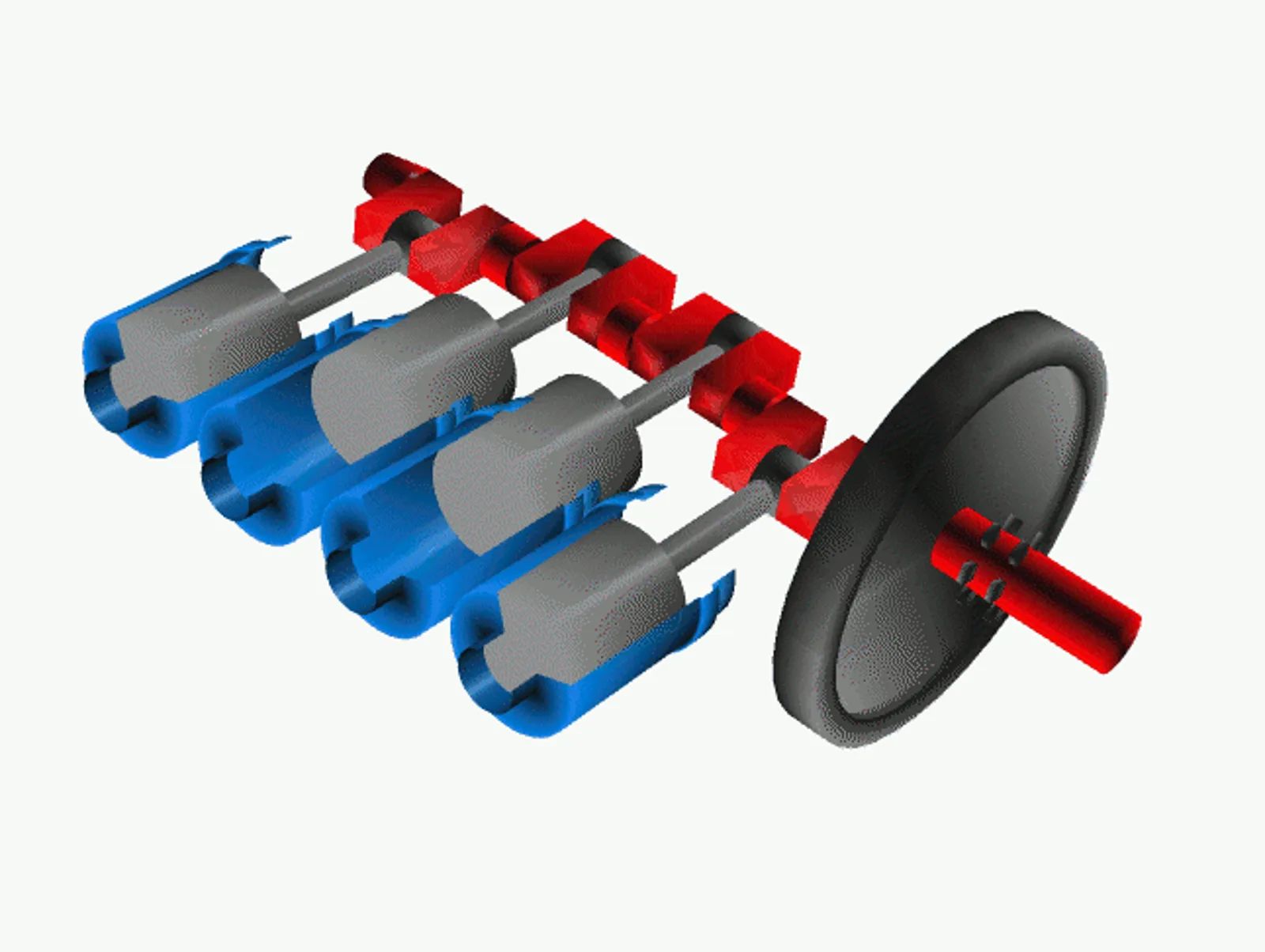
You might expect four cylinders to be perfectly balanced, since two pistons go up as two come down. Primary balance is indeed perfect. The trouble is secondary. Because the connecting rod's big end swings sideways, the piston does not move in a smooth sine wave, which is the same top-half versus bottom-half difference described at the start. All four pistons are in phase at twice the rotating frequency, so the secondary forces add together and are high.
The remedy is a pair of balance shafts that spin in opposite directions at twice engine speed. They are called Lanchester shafts after the original manufacturer. An engine of this layout with cylinders bigger than roughly 500 cc (30 cubic inches), depending on other factors, needs them to keep the vibration down. Counterweights on passenger-car crankshafts have been used since the mid-1930s, either full or half designs.
Now compare the straight-six. It has a 120-degree crankshaft and the firing order 1-5-3-6-2-4, a perfectly even firing interval, overlapping power strokes, and perfect primary and secondary balance in both the reciprocating and rotating planes. Because it behaves like two straight-threes placed end to end, a pair of simple three-into-one exhaust manifolds gives even scavenging. This is the layout that is smooth by its nature rather than by additions.
| Layout | Typical crank | Firing interval | Balance |
|---|---|---|---|
| Straight-twin | 360 degrees | Even | Highest primary and secondary imbalance, equal to a single cylinder |
| Straight-twin | 180 degrees | Uneven | Primary balance; rocking couple; secondary half as strong |
| Straight-twin | 270 degrees | Uneven | Minimal secondary imbalance; primary rotating-plane imbalance |
| Straight-three | 120 degrees | Regular, no overlap | Perfect reciprocating balance; rotating-plane imbalances |
| Straight-four | 180 degrees | Regular, no overlap | Primary perfect; high secondary reciprocating forces |
| Straight-five | 72 degrees | Regular, overlapping | Perfect reciprocating balance; rotating-plane imbalances |
| Straight-six | 120 degrees | Regular, overlapping | Perfect in every plane |
What do twins, threes and fives teach us?
The straight-twin shows how much a crank angle can change. With a 360-degree crank the firing is even but the imbalance is as bad as in a single cylinder. A 180-degree crank gets primary balance at the cost of uneven firing and a rocking couple. A 270-degree crank minimises the secondary imbalance, and it sounds and delivers power much like a 90-degree V-twin.
The straight-three has a regular firing interval but the strokes do not overlap, and it leaves rotating-plane imbalances. The straight-five uses a 72-degree crank and fires at perfectly regular intervals with overlap, giving an idle smoother than any engine with fewer cylinders. Overlap is the key word. Engines with four or fewer cylinders have no overlapping power strokes, so their pulses of power shake the engine rotationally.
How do V engines change the picture?
A V-twin with a 90-degree angle and offset crank pins can achieve perfect primary balance. With a shared crank pin, as in a Ducati, the 360-degree crank gives an uneven firing interval and a rocking couple, because the connecting rods sit at different positions along the crankshaft unless fork-and-blade rods are used.
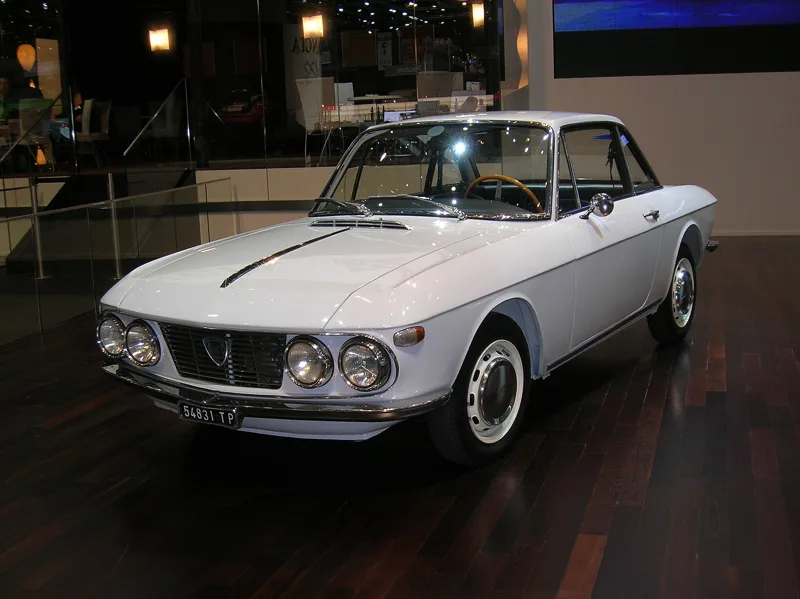
V4 engines vary widely. A narrow-angle Lancia Fulvia V4 has crank pin offsets that match its V angle, so it fires like a straight-four. The Honda RC36 has a 90-degree V and a 180-degree crank with firing intervals of 180, 270, 180 and 90 degrees. The Honda VFR1200F has a 76-degree V and shared crank pins with a 28-degree offset, so it fires at gaps of 256 and 104 degrees, and its unusual rod arrangement, with wider spacing between cylinders on the front bank, reduces rocking couples at the cost of a wider engine.
V6 engines depend heavily on the bank angle. A 60-degree design is compact, and its short crankshaft reduces torsional vibration, but the staggered banks make the reciprocating imbalance harder to cancel with crankshaft counterweights. The 90-degree V6 grew out of chopping two cylinders off a 90-degree V8 to save design and construction cost. The Chevrolet version has an 18-degree offset crankshaft and fires unevenly, whereas the Honda C engine used 30-degree offset crank pins to fire evenly. The Alfa Romeo 690T uses three crankpins 120 degrees apart and fires unevenly, with a harmonic order of 1.5.
Flying arms, direct links between neighbouring crankpins with no main bearing between them, appear in some V6 and V8 crankshafts. They allow an even firing interval at different V angles and cut the number of main bearings, but they reduce the rigidity of the crank, which can cause trouble at high revs or high power.
The newest answer: the 120-degree V6
A 120-degree bank angle is historically less common than 60 or 90 degrees, because the block costs more to design and build than a 90-degree V6 and is wider than a 60-degree one. The attraction is that it gives an even firing interval without offset crankpins. Ferrari's F163 uses it, found in the 296 and the F80, as does the McLaren M630 in the McLaren Artura, and both were developed to package a hot vee turbocharging system. As with other V6 bank angles, these engines keep primary imbalances and staggered banks, with smaller secondary imbalances.
What does this mean when you buy or drive a car?
Three practical readings follow from the facts. First, the smoothness of an engine is largely baked in by its layout. A straight-six starts with every advantage, while an inline-four relies on balance shafts and a twin or three-cylinder on careful crank design.
Second, character and refinement pull in opposite directions. Engines with uneven intervals tend to burble and growl and carry more vibration. Engines with a flat-plane crank rev higher but carry stronger second-order vibrations, which is why the Ferrari 488 sits among the exceptions rather than the rule.
Third, the vibration you feel was designed in or damped out deliberately. A crankshaft can take upwards of 8.6 tonnes (19,000 pounds) per cylinder in some cases, and a flywheel on the end smooths the delivery of power. Main bearings are spread along the shaft rather than only at the ends, with diesels often fitting one between every cylinder. Bending in long crankshafts helped end the straight-eight in the 1950s, once compression ratios and engine speeds climbed.