A pushrod engine keeps its camshaft low in the block, while overhead cam engines raise it into the head. What that costs and buys in size, valves, revs and complexity.
A pushrod engine keeps its camshaft in the block and reaches the valves through pushrods and rockers, which makes it compact and simple. Overhead cam engines put the camshaft in the head, with fewer moving parts and more freedom over valve count, ports and high-rpm behaviour.
In 1994 Team Penske turned up at the Indianapolis 500 with a custom-built Mercedes-Benz 500I engine, and that engine had pushrods. A loophole in the rules let it run a larger displacement and higher boost pressure than the overhead cam engines around it, and Penske qualified on pole and won by a large margin. A layout that looks old-fashioned on paper had been the quickest in the field.
What is the difference between a pushrod and an overhead cam engine?
The difference is where the camshaft lives. A pushrod engine, formally an overhead valve or OHV engine, keeps the camshaft in the block and reaches up to the valves with pushrods and rocker arms. An overhead cam engine puts the camshaft in the cylinder head, directly above the valves it operates.
The name causes confusion because both layouts have their valves in the head. That is what separates them from the flathead or side-valve design, where the valves sat beside the cylinder in the block. In everyday usage, though, "overhead valve" has come to mean the cam-in-block version. A few designs sit between the camps. The Ford CVH and Opel CIH have the camshaft in the head, but below or alongside the valves, so they can be treated as overhead valve engines in practice.
The cam-in-block chain of command
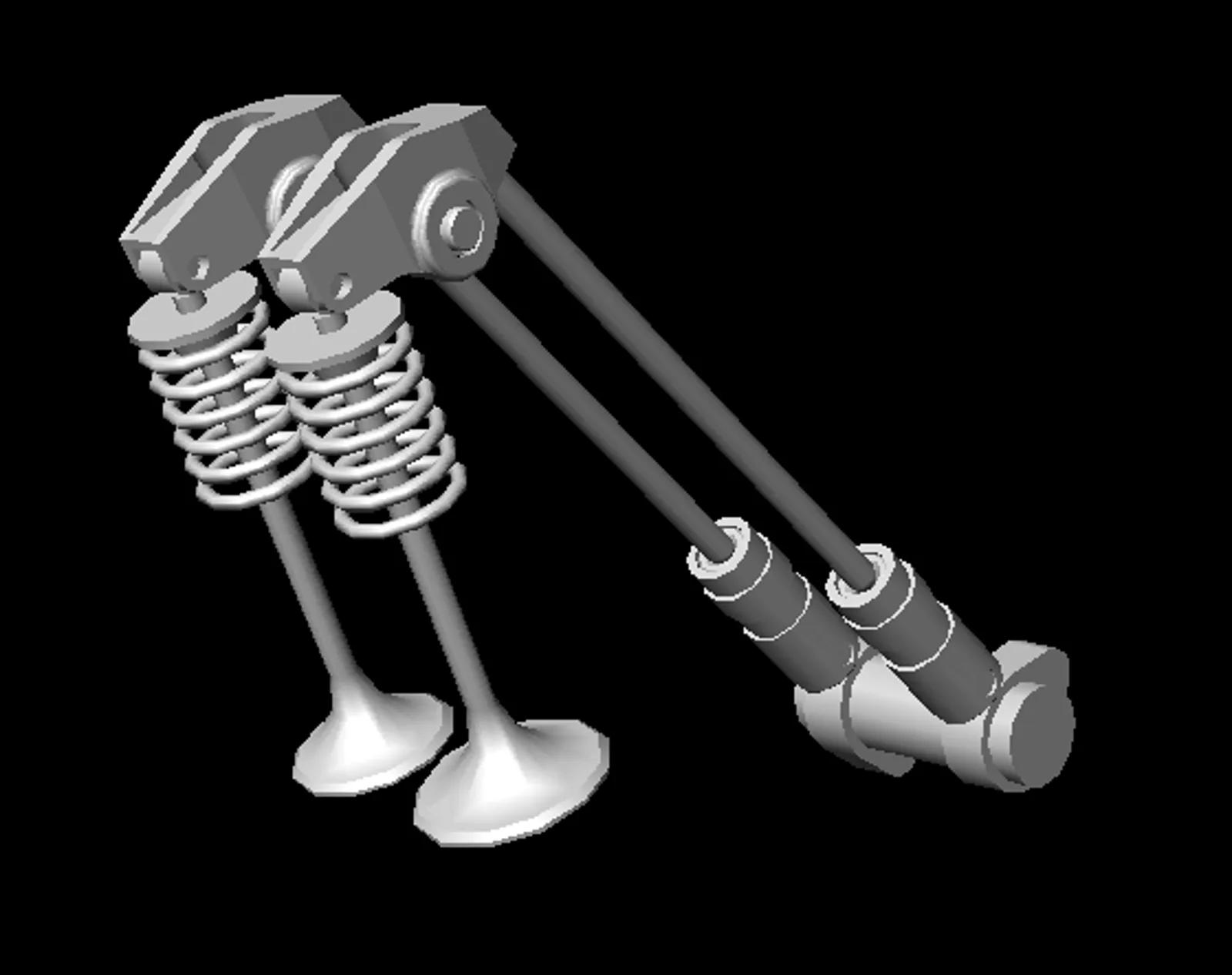
Follow the motion in a pushrod engine. The camshaft turns near the bottom of the engine, a lifter rides the cam, a pushrod carries the lift up to the head, and a rocker arm flips it over to open the valve. A spring shuts the valve again. In an overhead cam engine the lobe can press on the valve itself, through a tappet, or through a short rocker arm. Fewer links in the chain mean fewer parts that have to move.
A pushrod engine wins on packaging and simplicity; an overhead cam engine wins on revs and breathing.
How does a camshaft control an engine?
A camshaft is a rod with a row of lobes, one for each valve. As it rotates, each lobe pushes a valve open, and a valve spring pushes it shut once the lobe has passed. In a four-stroke engine the valves open only half as often as the crankshaft turns, so the camshaft is geared to rotate at half crankshaft speed.
Three features of the lobe shape the character of an engine. Duration is how long the valve stays open: longer duration can lift power at high revs but costs torque at low revs. Lift is how far the valve opens, and more lift lets in more air. Lift has limits, though. The valves can be struck by the piston if they open too far, and a steeper profile raises the force needed to open them, which leads to valve float. That happens at high rpm, when the spring cannot keep the valve following the cam, and it loses power and, in extreme cases, bends a valve.
The third feature is timing. Advancing the camshaft relative to the crankshaft raises low-rpm torque, while retarding it raises high-rpm power, and the shifts involved are small, often in the order of five degrees. Engines with variable valve timing adjust this on the move instead of compromising. Camshafts are usually cast iron in volume production, where chilled iron resists wear, or billet steel for high-performance engines and small runs, which is more time-consuming and generally more expensive.
What is the difference between SOHC and DOHC?
A single overhead camshaft (SOHC) engine has one camshaft for each bank of cylinders. A dual overhead camshaft (DOHC) or twin-cam engine has two, one for the intake valves and one for the exhaust. A straight engine therefore has one or two camshafts in total, and a V or flat engine two or four.
That counting rule explains why a V6 with four camshafts is a DOHC engine. Marketing sometimes calls a four-cam V engine a quad-cam, which overstates it: the name would properly fit only an engine with eight.
Most SOHC engines have two valves per cylinder, though some have three or four. Many DOHC engines have four valves per cylinder, and some have five, as certain Audi and Volkswagen engines do. DOHC also allows a wider angle between the intake and exhaust valves, which improves the flow of the air-fuel mixture, and it lets the spark plug sit in the best possible spot, which improves combustion efficiency. A newer benefit is independent phasing of each camshaft against the crankshaft, which gives a broader torque curve and better fuel economy. Every maker has a trade name for it, but all such systems count as variable valve timing.
What are the advantages of a pushrod engine?
Size comes first. The cam-in-block design makes the engine smaller overall than an equivalent overhead cam engine, which can help centre of gravity and bonnet height in a V layout.
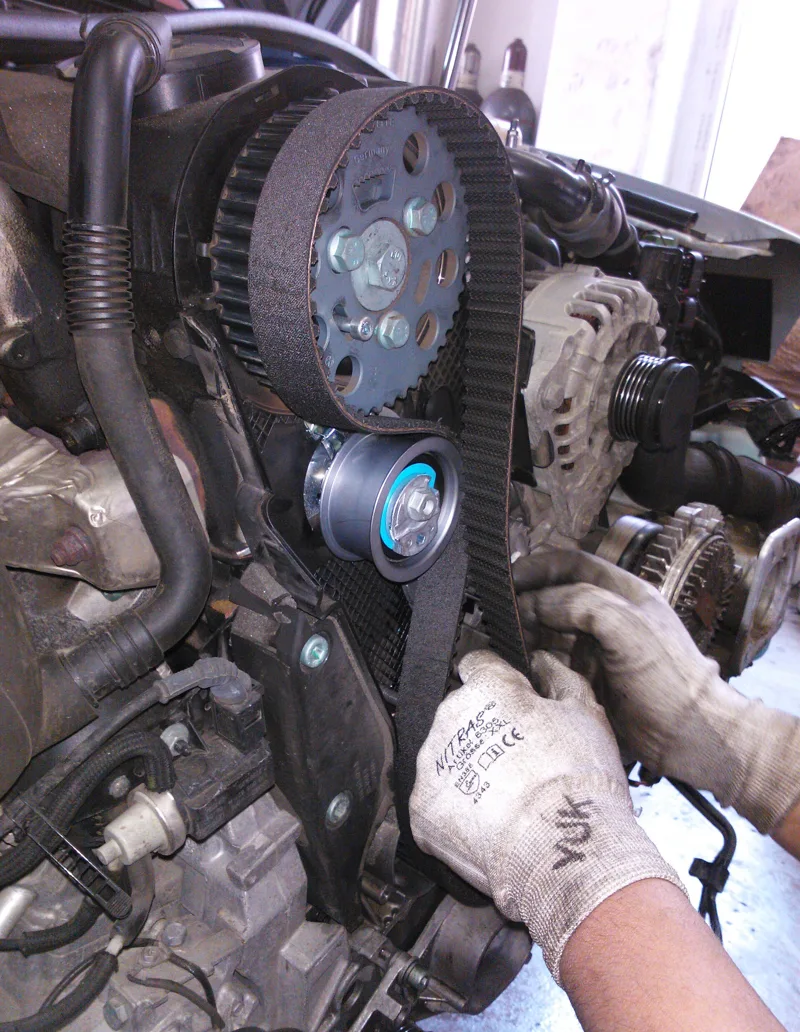
Simplicity is the second. Most overhead cam engines drive their camshafts with a belt, a chain or several chains, and those systems need tensioners. A pushrod engine has its camshaft next to the crankshaft, so a much shorter chain or even a direct gear connection will do. The gain is partly cancelled by the extra parts needed in the valvetrain itself.
The third is lubrication. A pushrod head typically has one camshaft in the block, where an overhead cam engine can have two per bank and needs oil passages through the head. Only the rockers need oil, and it reaches them through the hollow pushrods rather than a dedicated system in the head. Lower demands can also mean a smaller, lower-capacity oil pump. Size and cost are the reasons the layout is still used in many industrial engines.
What are the disadvantages of a pushrod engine?
High revs are the problem. The valvetrain has more moving parts, including lifters, pushrods and rockers, and the inertia of those parts makes the engine more prone to valve float at high speed. An overhead cam engine with the same number of valves has fewer reciprocating components and less valvetrain inertia, so valve float is less of a concern.
The second limit is breathing. In a pushrod engine the pushrods and the head casting constrain the size and shape of the intake ports and the position of the valves. It is rare for such an engine to have more than two valves per cylinder, where overhead cam engines often have four, allowing quicker combustion and exhaust. An overhead cam head has no pushrods to avoid, so the designer is free to optimise the ports, which improves gas flow, power and fuel efficiency.
The overhead cam layout has its own price. The camshaft drive is more complicated: the Audi 3.2 uses a four-chain valvetrain. After a repair that involves taking off the cylinder head, the cam timing has to be reset. And the head is large, either to hold the camshafts or to house the extra valves, which means that at the same displacement the overhead cam engine usually ends up physically bigger.
How do pushrod, SOHC and DOHC engines compare?
| Layout | Camshaft position | Camshafts per bank | Typical valves per cylinder | Valvetrain |
|---|---|---|---|---|
| Pushrod (OHV) | In the block | One | Rarely more than two | Lifters, pushrods and rockers; more inertia |
| SOHC | In the head | One | Two, sometimes three or four | Direct via tappet or via rocker arm |
| DOHC | In the head | Two | Often four, sometimes five | Usually direct via bucket tappet; independent cam phasing |
How are overhead camshafts driven?
By a belt, a chain or, occasionally, gears. Many 21st century engines use a toothed belt made from rubber and Kevlar. Belts are inexpensive, quiet and need no lubrication, but they need replacing regularly, with a life that typically falls between about 50,000 and 100,000 km (31,000 to 62,000 mi). If the belt is not replaced in time and snaps in an interference engine, major damage is possible.
A timing chain, made from one or two rows of metal roller chain, does not usually need replacing at set intervals but is noisier. By the early 1960s most production overhead camshaft designs used chains. Gear trains are common in diesel overhead cam engines for heavy trucks and not common in light trucks or cars. The first known automotive use of a timing belt on overhead camshafts was the 1953 Devin Panhard racing specials, and the first production car to use one was the 1962 Glas 1004. Before that, several engines used a shaft with bevel gears, among them the Bentley 3 Litre and the MG Midget, while the Leyland Eight used three cranks and rods in parallel.
How did each layout arrive?
The pushrod came first. A prototype diesel engine of 1894 became the first overhead valve design, using overhead poppet valves operated by a camshaft, pushrods and rockers. Walter Lorenzo Marr built a motorised tricycle with a single-cylinder OHV engine in 1898, and worked for Buick, which received a patent for an overhead valve design in 1904. The same year, the Buick Model B became the first production car with an OHV engine: a flat-twin with two valves per cylinder. Buick sold 750 of them in 1905, and OHV engines have powered almost all of its cars since. In 1911 Chevrolet followed Buick in using it almost exclusively, although flathead engines stayed common in the United States until the mid-to-late 1950s.
Overhead cams followed almost at once. The Maudslay SOHC engine of 1902 and the Marr Auto Car engine of 1903 were among the first. For decades the layout stayed mostly in high-performance cars. The first DOHC engine, a Peugeot inline-four, took the 1912 French Grand Prix, and a DOHC Peugeot won again in 1913. A Mercedes-Benz 18/100 GP with an SOHC engine won in 1914, and its engine became the starting point for Mercedes and Rolls-Royce aircraft engines in the First World War.
The first production DOHC car is dated variously to 1910 and to the 1926 Sunbeam 3 litre Super Sports. Either way, Duesenberg added a DOHC straight-eight to the Model J in 1928, and the DOHC Offenhauser engine, which appeared in 1933, ruled American open-wheel racing for decades, from 1934 into the 1970s. After the war the twin-cam spread through sports cars: the Lagonda straight-six, the Jaguar XK straight-six, which ran from 1949 to 1992, and the Alfa Romeo Twin Cam, which lasted from 1954 to 1994. In the 1980s the need for more performance with less fuel use and fewer emissions brought DOHC into mainstream cars, starting with Japanese makers, and by the middle of the 2000s the DOHC layout was the usual choice.
Why do some V8s still use pushrods?
Overhead cams became the majority design by the start of the 21st century, with the exception of some North American V8s. The pushrod's strengths, a compact block and a simple drive, count for most in V engines.
It has also kept adapting. Early in the 21st century, pushrod V8s built by General Motors and Chrysler adopted cylinder deactivation, aiming to trim fuel consumption and emissions. In 2008 the fourth-generation Dodge Viper became the first production vehicle with a pushrod engine to use variable valve timing. The older design is, in other words, still being developed instead of only preserved.
Where does this go next?
Valve actuation is already moving beyond the camshaft. Camless piston engines use electromagnetic, hydraulic or pneumatic actuators; the first appeared in turbocharged Renault Formula 1 engines during the mid-1980s, and the Koenigsegg Gemera is slated to bring one to the road. Ducati has used desmodromic valves, which a cam and lever close without springs, since the 1956 Ducati 125 Desmo. The Wankel rotary engine, used by Mazda from the 1967 Cosmo until the RX-8 ended in 2012, dispenses with both pistons and valves.