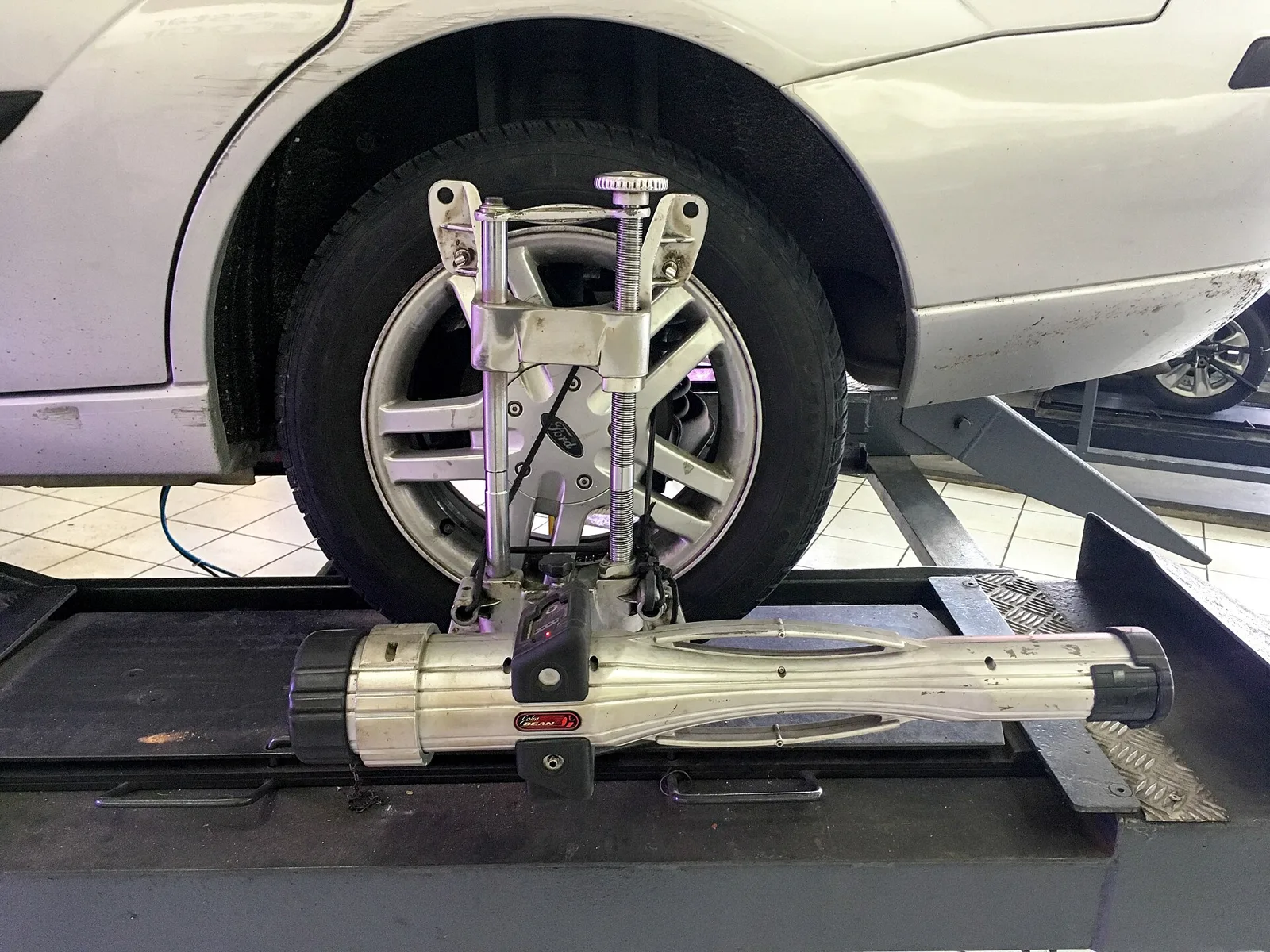
Three small angles decide tyre life, straight-line stability and cornering grip: what negative camber, toe-in and positive caster really change, and what lowering a car does to them.
Wheel alignment adjusts three angles: camber, the tilt of the wheel seen from the front, toe, whether the wheel fronts point in or out, and caster, the tilt of the steering axis. Correct settings prevent abnormal tyre wear and keep a car stable and straight, while deliberate changes trade tyre life for grip.
Look at almost any modern car head-on and the tops of its wheels lean very slightly inwards. Nearly every car now runs what engineers call negative camber on all four wheels, a convention that dates from an age when the opposite was more common. That tilt, together with two other small angles, decides how long your tyres last, whether the car tracks straight and how hard it grips in a corner.
What is wheel alignment?
Wheel alignment, sometimes called wheel tracking, is a maintenance procedure that adjusts the geometric angles of a vehicle's wheels. Correct alignment helps prevent abnormal tyre wear, keeps the handling stable and lets the car travel straight without pulling to one side.
The three primary angles are camber, caster and toe, and they describe how the wheels sit relative to each other and to the body. At the front, caster, camber and toe are all present. At the rear there are only camber and toe, because rear wheels are typically not steered and so carry no caster. On some cars, not every angle can be adjusted at every wheel.
In motorsport and off-road use, owners and teams sometimes set the angles outside the manufacturer's specification on purpose, to get a particular handling character. For ordinary road cars, manufacturers may require the angles to stay within specified tolerances at vehicle inspection. Newer monitoring systems go a step further: embedded sensors measure the orientation and motion of the vehicle or its wheels, and software processes that data to estimate alignment and detect misalignment.
| Angle | What it describes | Too much does this | Adjustability |
|---|---|---|---|
| Camber | Tilt of the wheel, seen from the front or rear | Uneven tyre wear and impaired handling | Often fixed on strut suspensions; may be adjustable on double wishbones |
| Toe | Whether the fronts of the wheels point in or out | Toe-in adds slight tyre wear and slows the turn-in | Usually adjustable; often the only angle that needs resetting |
| Caster | Tilt of the steering axis, seen from the side | Heavier, less responsive steering | Front wheels only; often not adjustable |
Zero camber grips best in a straight line, negative camber grips best in a corner, and every real car is a compromise between them.
What is camber, and what is negative camber?
Camber measures how far a wheel's upright axis is tipped from the car's own upright axis, as seen from the front or rear. If the top of the wheel leans away from the car, that is positive camber. If the bottom sits further out than the top, so the top leans inwards, that is negative camber.
Negative camber helps a car corner. In a turn the tyre is pushed outwards by centrifugal force, and tilting the wheel in the opposite direction places the tyre at a better angle to the road. The force then runs through the vertical plane of the tyre instead of shearing across it, and the contact patch is maximised. That holds only for the outside tyre in the corner; the inside tyre would actually benefit most from positive camber, at least on a short-long-arm suspension. But weight transfer loads the outside wheels harder, so a bit of negative camber improves the handling overall. Caster helps too, in a small way, by tilting the top of the outside tyre inwards.
The cost shows up on the straight. With no camber at all the tread lies flat and traction peaks, because the contact patch is as large as it gets. Any tilt alters that patch, so too much hurts straight running in rain and snow and under hard acceleration. Heavy-duty vehicles such as tractors and trucks tend to be built with more positive camber so that once loaded and squatting lower, the wheels stand almost upright. Tractors also use positive camber to lower the steering effort.
How does camber wear out a tyre?
Excessive camber in either direction wears the tyre unevenly, a condition called camber wear. Too much negative camber puts extra load on the inboard shoulder of the tyre, which then wears faster than the outboard shoulder. Positive camber does the reverse and loads the outboard shoulder. Both are among the reasons that factory settings avoid extremes.
There is a subtlety. Depending on the suspension design, a small amount of negative camber can slightly reduce wear in cornering. Lateral load shifts from the inside wheels to the outside ones, and with zero camber the outside tyre can acquire positive camber under cornering and load its outboard shoulder. A little negative camber compensates for that and spreads the load more evenly across the tread.
What does toe do?
Toe, also called tracking, is the angle each wheel makes with the long axis of the car. A wheel with its front pointing towards the centreline has toe-in, which is positive toe. A wheel pointing away has toe-out, or negative toe. In the United States toe has traditionally been given as a linear distance measured at axle height, which depends on tyre diameter, whereas a toe angle does not.
On a rear-wheel-drive car, more front toe-in steadies the car on the straight but slows its reaction in a turn. Performance cars may run zero front toe or even a touch of toe-out for a quicker response to the steering. Toe-in has a price: it marginally increases tyre wear, because with the steering set straight ahead the tyres are in slight side slip. On front-wheel-drive cars the situation is more complex, and rear toe-in gives better stability while cornering.
Toe is where most alignment work happens. It is usually adjustable on production cars even where caster and camber are not. Front-end maintenance used to involve all three adjustments, but today it usually involves only setting the toe, and in most cases, even where caster or camber can be changed, only the toe needs attention. On some cars toe is adjustable only at the front.
Two further details explain why toe is not a single number to be set once. First, the toe that suits straight-line travel is wrong in a turn, because the inside wheel follows a smaller radius than the outside wheel. The steering linkage compensates by following Ackermann steering geometry, adapted to each vehicle. Second, toe interacts with camber. A cambered wheel tends to roll in a curve, as though it were part of a cone, a tendency known as camber thrust. That raises rolling resistance and tyre wear. A small amount of toe, toe-out with negative camber and toe-in with positive camber, cancels the effect.
What does caster do?
Caster is the tilt of the steering axis away from vertical, seen from the side of the car. The steering axis is an imaginary line through the centres of the upper and lower ball joints, or through the kingpin on vehicles that have one. Caster makes a wheel line itself up with the direction of travel, and shopping trolleys offer the extreme example: the wheel trails behind its pivot and falls into line the moment you push.
The idea is old. Arthur Krebs proposed positive caster in a British patent of 1896, as a means of keeping the car running in a straight line. With positive caster the steering axis meets the road slightly ahead of the centre of the tyre's contact patch, by a distance called trail. The wheel then trails around behind the axis, which gives the steering a degree of self-centring, makes the car easier to control and reduces its tendency to wander.
More is not always better. Excessive caster makes the steering heavier and less responsive. Racers use large caster angles because they improve camber gain in a corner. Angles over 7 degrees are common with radial tyres, and power steering is usually needed to overcome the jacking effect of high caster. Some alignment settings even call for different caster left and right, known as cross caster, with the difference called the spread.
Caster angle and trail are separate quantities that affect the steering in different ways. Caster adds damping to the steering; trail adds feel and helps the wheel return to centre. The tyre also has its own trail, called pneumatic trail, because lateral forces act behind the centre of the contact patch. It varies with speed, load, steer angle, surface, tyre type, pressure and time, and a figure of 30 mm behind the centre is a reasonable starting point.
What does a bad alignment feel like?
The signs follow from the angles. A car that pulls to one side, or that will not travel straight without correction, is the classic symptom of alignment trouble. Tyres that wear on one shoulder, the inner edge with too much negative camber or the outer edge with too much positive, point to camber. Poor caster settings make the driver move the steering wheel into and out of each turn, which makes it hard to hold a straight line.
Increased toe-in has a quieter symptom: slightly faster wear, because the tyres are scrubbing sideways even as the car goes straight.
What changes when you lower a car?
Cars with double wishbone suspension may have fixed or adjustable camber, but with MacPherson struts it is normally fixed. Removing an adjustment can lower maintenance requirements, but lowering a car on shortened springs changes the camber angle regardless. Excessive camber then brings increased tyre wear and impaired handling, which is why a lowered car is a candidate for fresh alignment work.
Parts exist for the job. Aftermarket plates with slots in place of holes for the strut mounts let the whole shock absorber shift back and forth, allowing fine tuning of camber, and some coilovers arrive with camber plates built in. Eccentric camber bolts can change the angle by up to two degrees when they replace the original bolts. Control arms with adjustable ball joints allow side-to-side adjustment, and control rods of adjustable length change camber on cars that use rods in place of A-arms. Larger modifications may need the mounting points of the upper control arm or strut altered so that they can move in or out.
The stance scene grew from this. Negative camber was first used in motorsport for traction through corners. Later, owners adopted it as a way of lowering a car and fitting wheels that would not otherwise clear the arches, and many suspension layouts let the wheels camber inwards naturally when the car drops below its ride height. The look became mainstream in the 1970s with the bosozoku cars of Japan, and it grew more extreme over time. It also drew criticism, because cars with severe camber and almost no ground clearance can be hard to use day to day.
Where this goes next
Modern monitoring systems already use embedded sensors and software to estimate wheel alignment while the vehicle is in use and to flag misalignment.
Design is changing too. Managing camber used to be as much an art as a science, and computers now work through the variables mathematically, where designers once leaned on intuition and experience, so even cheap cars handle far better than they used to.