How an insurer-funded laboratory builds its tests, what American federal standards actually demand, and how a British charity crash-tests cars in markets with weaker rules.
The IIHS tests cars in front, small overlap and side crashes and awards Top Safety Picks, the FMVSS are the federal minimum rules every US-market car must meet, and Global NCAP is a UK charity that star-rates cars in weakly regulated markets such as India and Africa.
When the Insurance Institute for Highway Safety released its first small overlap results in August 2012, only three of the 11 midsize luxury and near-luxury cars it had tested earned a Good or Acceptable rating. The new test was far more demanding on vehicle structure than the 40% offset test it sat beside, and most of the cars did poorly.
That test sits at the centre of a wider system. An insurer-funded laboratory in the United States sets the bar for the best-known safety award there. A federal rulebook sets the minimum that any car sold there must meet. And a British charity runs its own crash tests in countries where the rules are weak or the local programmes have not started. Each one measures something different, and the gaps between them are where the interesting stories sit.
How does the IIHS crash test work?
The Insurance Institute for Highway Safety is an American nonprofit, set up in 1959 by three insurance groups. Its sister body, the Highway Loss Data Institute, followed in 1972 and compiles insurance loss statistics by vehicle type. Members, which are insurance companies and groups of insurers, pay for both, so the people who pay for crashes also pay for the tests.
Russell Brown led the institute until 1968, when its board turned it into an independent scientific organisation. William Haddon Jr. took over the next year, and the first crash test the institute ran was a low-speed bumper test. It publishes an annual list of the safest vehicles, built around the Top Safety Pick award.
Its frontal test grades six categories, each Good, Acceptable, Marginal or Poor, before arriving at an overall rating. The older of its two frontal tests, the moderate overlap, was introduced in January 1995 and was formerly called the frontal offset. It drives 40% of the front of the car into a deformable barrier at about 40 mph (64 km/h). The federal government's own crash programme, run by the National Highway Traffic Safety Administration, takes a different approach: the car is driven straight at a fixed barrier at 30 mph (48 km/h), square on rather than offset.
A rating is a statement about one car in its weight class. The heavier vehicle usually has the advantage in a crash with a lighter one, or when it hits something alone, so scores do not transfer across classes. In 2009 the institute made the point by crashing three midsize sedans into three minicars that had each earned Good ratings of their own. In those car-to-car tests the minicars were rated Poor, and the sedans came out Good or Acceptable.
In December 2022 the institute added a second dummy, seated behind the driver, to the moderate overlap test. Its argument was that the belt tensioners and load limiters found in front seats belong in the rear too. Among 15 small SUVs put through the revised test, nine were rated Poor overall, because of high injury readings for the head, neck and chest of the rear passenger.
With so little of the car engaged, the wheel and the outer corner take the first load, not the structure built to absorb it.
What is the IIHS small overlap test?
The IIHS small overlap test, first reported on 14 August 2012, runs alongside the 40% test rather than replacing it. Only 25% of the front end meets the barrier, which is solid and rounded rather than deformable, again at 40 mph. With so little of the car engaged, the wheel and the outer corner take the first load, not the central crash structure built to absorb it. That makes it far harder on the body than the 40% test.
The scoring has its own quirks. Hip and thigh and lower leg and foot ratings replace the separate ratings for each leg and foot, and a car cannot earn a full score unless the front and side curtain airbags both deploy, because the impact throws the occupant sideways. Since then it has put everything from minicars to large pickups through it, and from 2015 it has run the test on the passenger side too.
The institute points to real crashes as the reason. According to the IIHS, 25% of frontal crash deaths come from small overlap collisions. A Medical College of Wisconsin study found that this kind of collision raises the risk of injury to the head, chest, spine, hip and pelvis. It is typical of two-lane roads with oncoming traffic and no centre median, and single-vehicle crashes into trees or poles make up 40% of small overlap crashes.
What else does the institute test?
The side test arrived in 2003. A stationary car is struck by a four-wheeled sled carrying a deformable barrier, standing in for a high-riding pickup or SUV. At first the sled hit at 31 mph (50 km/h). In 2019 the institute decided that version was unrealistic and changed it: a heavier sled, a new barrier and a speed of 37 mph (60 km/h). The revised test officially began in 2021. Of 20 small SUVs tested under it, only one earned a Good rating. In May 2022 the institute finished testing 18 midsize SUVs, of which ten earned Good, two Acceptable and six Marginal.
| Test | Set-up | Status |
|---|---|---|
| Moderate overlap front | 40% overlap, deformable barrier, about 40 mph (64 km/h); introduced January 1995 | Second dummy added December 2022 |
| Small overlap front | 25% overlap, rounded rigid barrier, 40 mph; first results 2012 | Passenger side added 2015 |
| Side | Sled with deformable barrier; 31 mph (50 km/h) from 2003, 37 mph (60 km/h) from 2021 | Heavier sled and new barrier |
| Roof strength | Plate pushed on roof; top rating needed four times curb weight before 5 in (130 mm) of crush; introduced 2009 | Discontinued 2022 |
| Head restraint | Driver seat on a sled at 20 mph, imitating a rear-end collision | Discontinued 2022, reintroduced January 2026 with a 30 mph test added |
The roof test used a hydraulic plate pushed diagonally onto the roof above the side windows, and rollovers account for nearly 25% of passenger vehicle deaths in the United States. The head restraint test addressed whiplash, which the institute estimated in 2005 accounted for 25% of related medical costs.
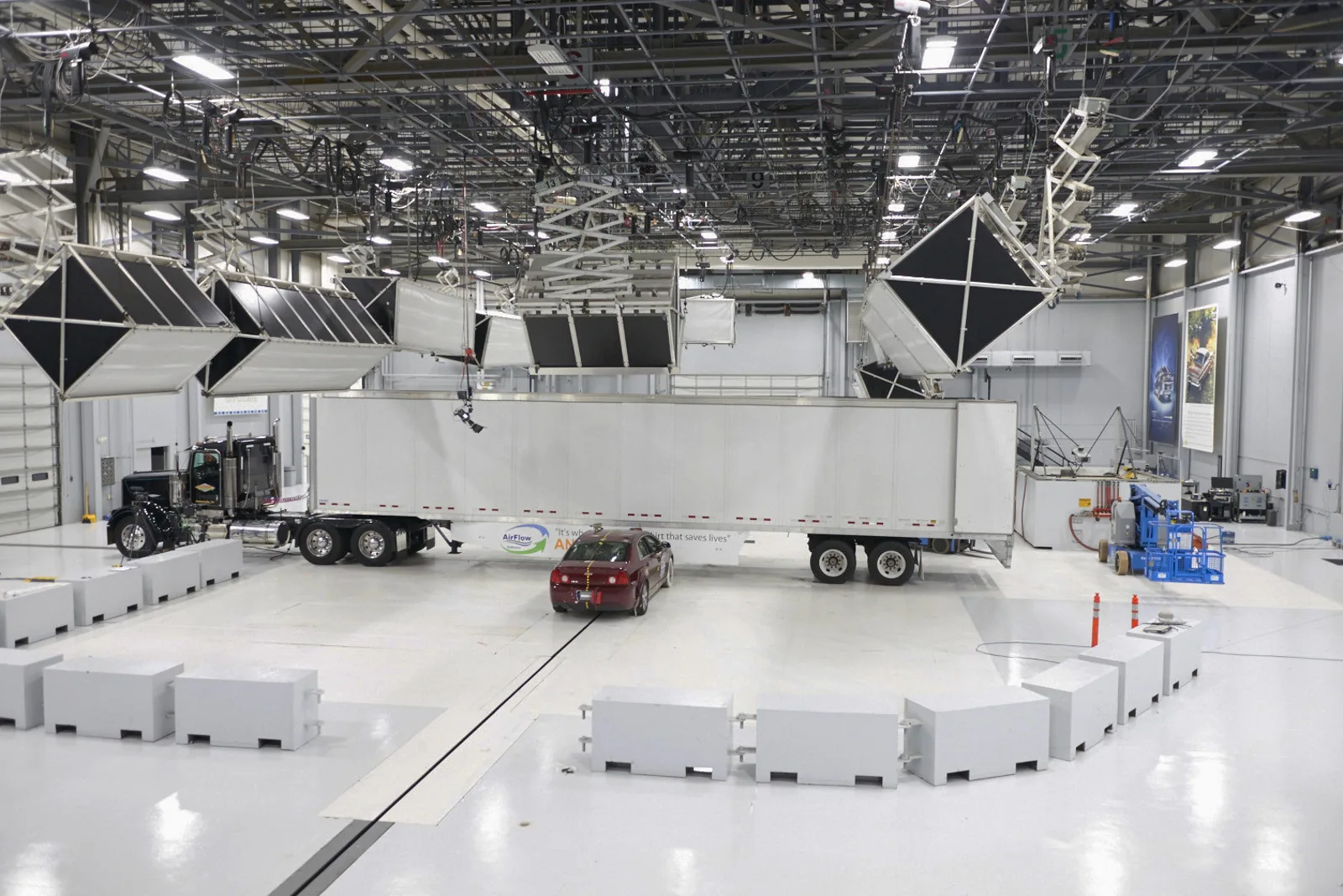
Crash avoidance is judged separately. The current vehicle-to-vehicle test sends the car at a target at 31, 37 and 43 mph (50, 60 and 69 km/h). The target is a semitrailer, a car or a motorcycle, placed in the middle or offset to either side for the last two. Points reward an early warning and, for the car and motorcycle, how far the car slows down; in the semitrailer test the engineer steers away. A pedestrian test runs three scenarios, each at two speeds: an adult crossing the path, a child of about seven stepping out from between a parked sedan and a parked SUV, and an adult walking alongside traffic.
Headlights got their first ratings in March 2016. Most family cars were rated marginal or poor, and only the Toyota Prius V earned a Good rating, with specific headlights. Four months later none of the small SUVs managed it, and in October 2016 the Honda Ridgeline was the only pickup to do so.
The institute's 50th anniversary test in 2009 put decades of progress on film. A 1959 Chevrolet Bel Air was driven head-on into a 2009 Chevrolet Malibu, 40% offset at 40 mph. The Bel Air's occupant compartment was badly damaged, and with no airbags or seat belts its dummy recorded forces that would probably have killed a real driver.
What does an IIHS Top Safety Pick require?
Since the revision of February 2023, a car must earn Good in the moderate overlap test, in the driver-side and passenger-side small overlap tests, and in the side test as updated in 2021. Its headlights must be rated Good or Acceptable across every trim level sold. Roof strength, head restraints and front crash prevention between vehicles were once part of the assessment but were dropped in 2023, because nearly all vehicles tested well in them.
The Top Safety Pick+ keeps all of that and adds a strong showing in the nighttime pedestrian test, where crash prevention systems can struggle in low light.
What do FMVSS standards require?
The Federal Motor Vehicle Safety Standards are the American government's rules on how vehicles and safety components are designed, built and tested for performance and durability. They are the US counterpart to the UN Regulations drawn up by the World Forum for Harmonization of Vehicle Regulations, which most other countries recognise to varying degrees. Canada has its own analogous set, the CMVSS, which overlaps with the American one substantially but not completely. Both North American sets differ significantly from the UN requirements, so a car built to foreign specification is difficult or impossible to import privately.
The standards are codified in Title 49 of the Code of Federal Regulations, Part 571, with each one a numbered section, so FMVSS No. 101 is 49 CFR 571.101. The National Highway Traffic Safety Administration develops and enforces them under the National Traffic and Motor Vehicle Safety Act of 1966. The numbering tells you what they are for: 100-series rules cover crash avoidance, 200-series rules cover crashworthiness, and 300-series rules cover survival after a crash.
The first to be adopted, on 1 March 1967, was FMVSS No. 209 on seat belts. It is still in force and has been made more stringent over time. Later ones cover fuel system integrity (No. 301), the flammability of interior materials (No. 302), the leakage of electrolyte and risk of electric shock in electric-powered vehicles (No. 305), interior trunk releases (No. 401) and low-speed vehicles (No. 500).
What does Global NCAP do?
Global NCAP is a UK-registered charity. It acts as an umbrella for the various new car assessment programmes around the world, and it serves as a consumer test in markets that are weakly regulated or have no programme of their own.
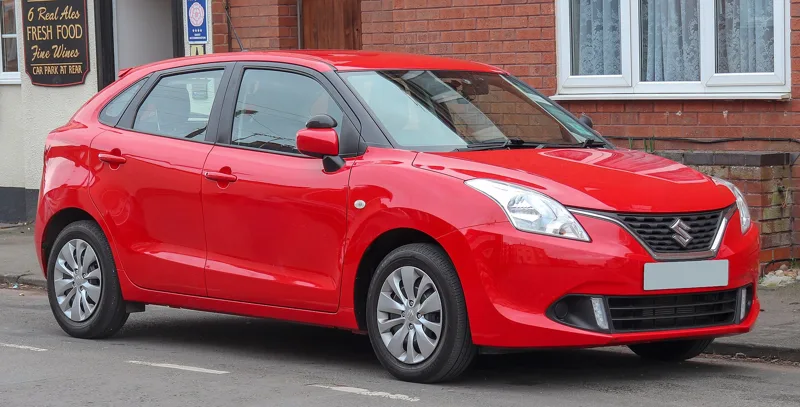
Its best-known work began in January 2014, when it published the first independent crash results for five popular compact cars sold in India, under a project called Safer Cars for India. The cars had no frontal airbags, and their passenger cells collapsed to varying degrees. All five received zero stars for adult occupant protection because the dummies recorded unacceptably high risks of serious or critical injury. Four of the five also fell short of ECE R94, the frontal impact standard on which European Union approval rests.
The results drew international media attention, and manufacturers including Toyota and Volkswagen made frontal airbags standard across their Indian ranges. Indian law then moved. It required frontal airbags, and it enforced UN-equivalent front and side impact standards for new models from 2017 and for existing models from October 2019. Global NCAP says Indian cars now show less intrusion at fascia level in its test, though the standards lack consumer-test features such as protection of the feet, and its frontal offset results remain mixed.
In October 2023 India's Ministry of Road Transport and Highways launched Bharat NCAP, a local programme based on the assessment protocols of the Safer Cars for India project. Global NCAP said its funded testing under that project would end after results announced at its World Congress on 23 April 2024, although manufacturers can still submit cars at their own expense.
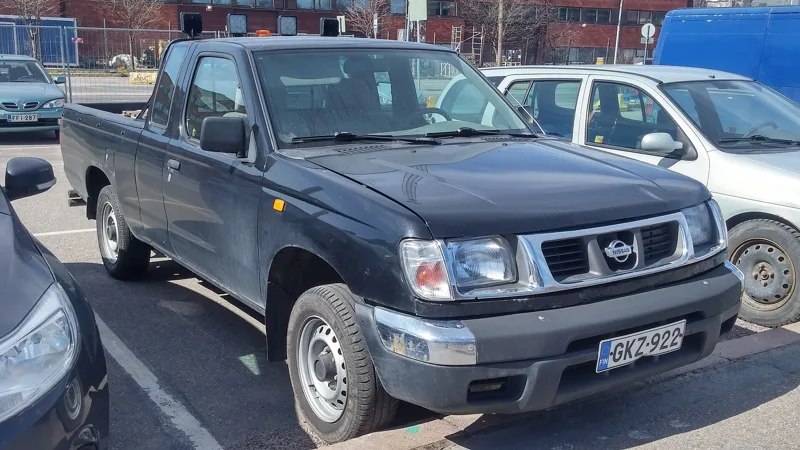
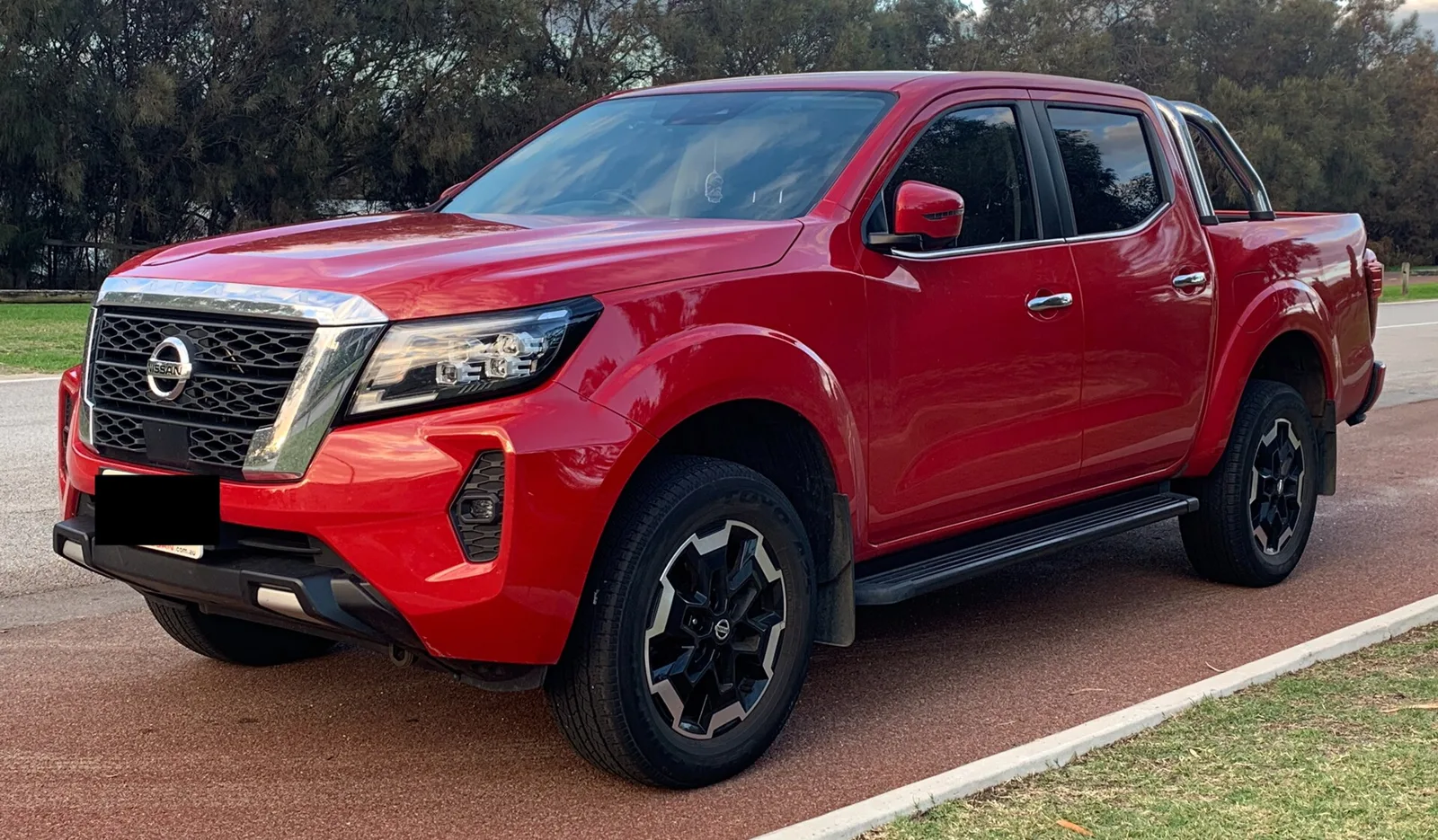
Safer Cars for Africa began in November 2017 with the Automobile Association of South Africa and used the same protocols. Five compact cars were tested first, pickups joined in the second round and fleet models in the third. In early 2020 Global NCAP crashed a South African Nissan NP300 Hardbody into a second-hand Nissan Navara from Europe. The European car carried several airbags and stability control, and its cabin kept its shape far better. In early 2021 Nissan South Africa announced that it would stop building and selling the NP300.
How does Global NCAP score a car?
Star ratings follow a protocol designed for emerging markets, and the criteria are made more demanding from time to time, usually by adding new areas to the assessment. The first Indian results used the 2013 Latin NCAP criteria. In 2017 Q-Series child dummies replaced the older P-Series in dynamic tests. In July 2022 side impact protection and rear seatbelt reminders began to count towards the score. Higher star ratings now also depend on pedestrian protection, and on stability control and side head airbags being offered as options.
The latest change came in August 2025. Safety equipment is now rewarded only when fitted as standard, and manufacturers can submit type approval certificates in place of official testing for some tests. A moose test was added as consumer information only, with no effect on the score.
Results are grouped into four increasingly demanding classes:
- 2014 to June 2022, based on the 2013 Latin NCAP protocol.
- July 2022 to July 2025, similar to Bharat NCAP 2022 and based on the 2016 Latin NCAP protocol.
- August 2025 to 2029, based on the 2019 Latin NCAP protocol.
- 2030 onward.
A separate Safer Choice Award, introduced in 2018, recognises technology beyond the star ratings. At first it went to five-star cars that met the UNECE pedestrian protection standard and sold stability control, at least as an option, in sufficient numbers. Those requirements moved into the basic protocol in 2022, and the 2024 update added speed limitation, blind spot detection and automatic emergency braking, again as options in sufficient numbers.
What do critics say about Global NCAP?
The charity has met the criticism that most NCAP programmes face in their early years. After the second round of Indian results, the writer Bertel Schmitt accused it of double standards, pointing out that it crashed cars at 64 km/h while C-NCAP, a Global NCAP member, used 50 km/h. The two cannot be compared on speed alone. The 64 km/h test hits an offset deformable barrier, while the 50 km/h test is a full-width impact into a rigid barrier, which is hard on restraint systems.
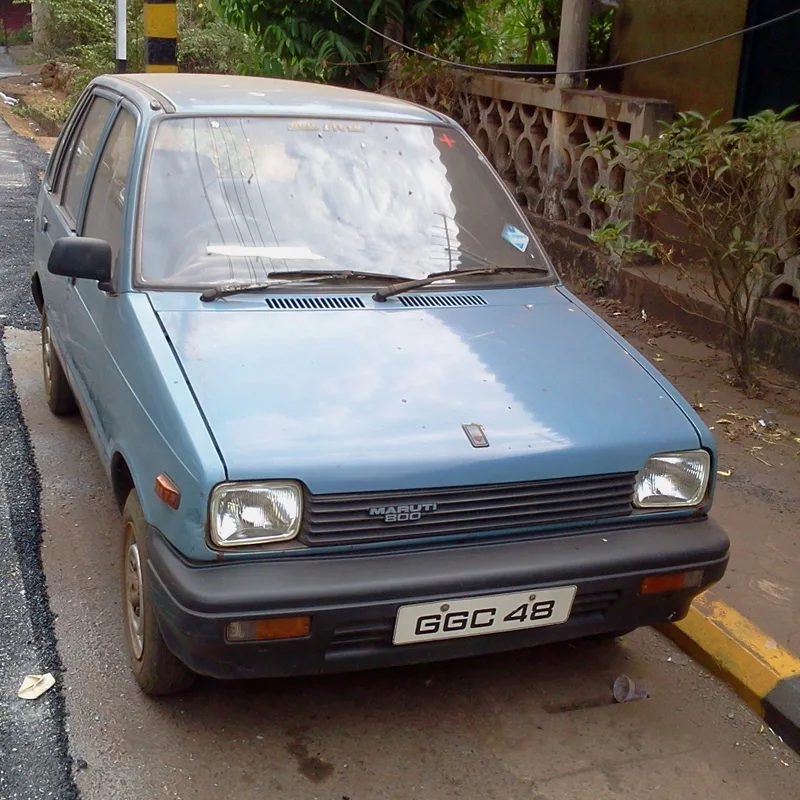
In 2014, after a basic-specification Maruti Suzuki Swift received zero stars, the company's chairman, R. C. Bhargava, defended the result. He argued that car safety fell outside the safe systems approach and that road deaths in India had no link to the safety of the cars on sale.
Consumers have complained that the tests were limited. Until mid-2022 they used 2013 Latin NCAP protocols that cover only offset frontal impact, and Global NCAP says its budget is constrained. Others have questioned whether cars picked from early production are representative. Global NCAP says they are chosen at random from the plant's distribution area. It has also been argued that its 64 km/h offset crash covers a lower fraction of Indian collisions than European ones, because Indian cars more often hit aggressive partners such as commercial vehicles or fixed objects.
Global NCAP has sometimes transferred results between India and South Africa to save on testing costs. For a Suzuki Ertiga picked for a 2024 test in the African project, some figures came from an older Indian-market test. The Suzuki distributor in South Africa said this nullified the results. In May 2026 Toyota South Africa sent the Automobile Association of South Africa a cease-and-desist letter over a Starlet tested without side and curtain airbags, a version the company called obsolete and unrepresentative of the Starlet now on sale there.
Where this goes next
Global NCAP has said it intends to prioritise Safer Cars for Africa in 2025. Its 2024 accounts stated that, with Bharat NCAP active, its advocacy focus would shift from India to Africa and that further rounds of testing would follow. Its comparison classes already look ahead to 2030, when a fourth, more demanding class begins.
The IIHS has also been adjusting its programme. Its head restraint test returned in January 2026 with a 30 mph crash added to the original 20 mph one and updated rating metrics.