Three small parts keep a turbo engine cool, capped and calm, and only one of them makes the noise.
An intercooler cools compressed intake air, making it denser and less likely to knock. A wastegate diverts exhaust around the turbine to cap boost. A blow-off valve vents or recirculates intake pressure when the throttle closes, preventing compressor surge and producing the familiar whoosh.
The whoosh you hear when a turbocharged car's driver lifts off the throttle is not the turbo. It is a valve letting out air that the engine no longer wants, and in some set-ups the engine's computer still pays for that vanished air with extra fuel. It is one of three small parts, along with the intercooler and the wastegate, that decide whether a turbo engine delivers its power reliably or merely briefly.
What does a turbocharger need alongside it?
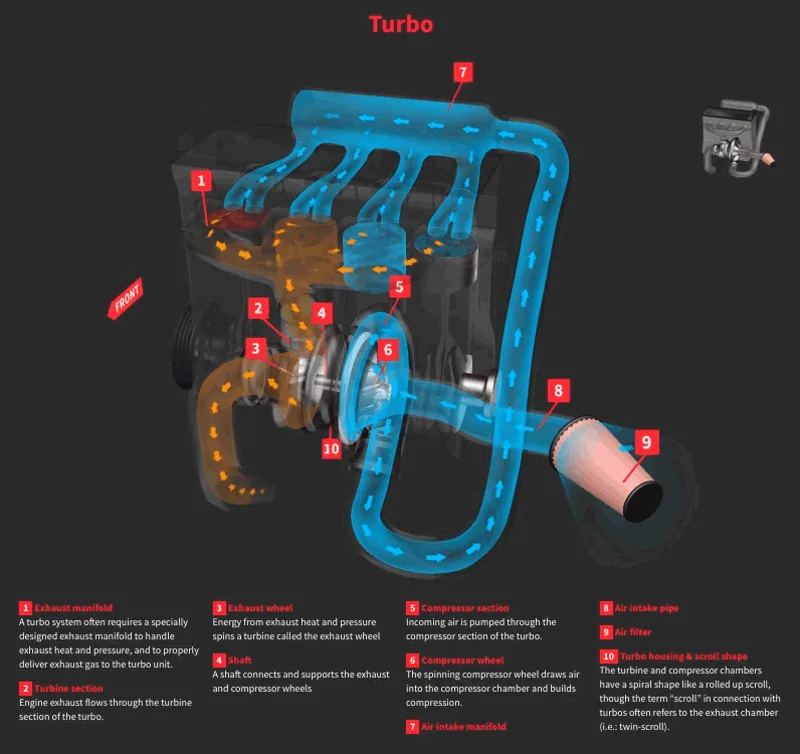
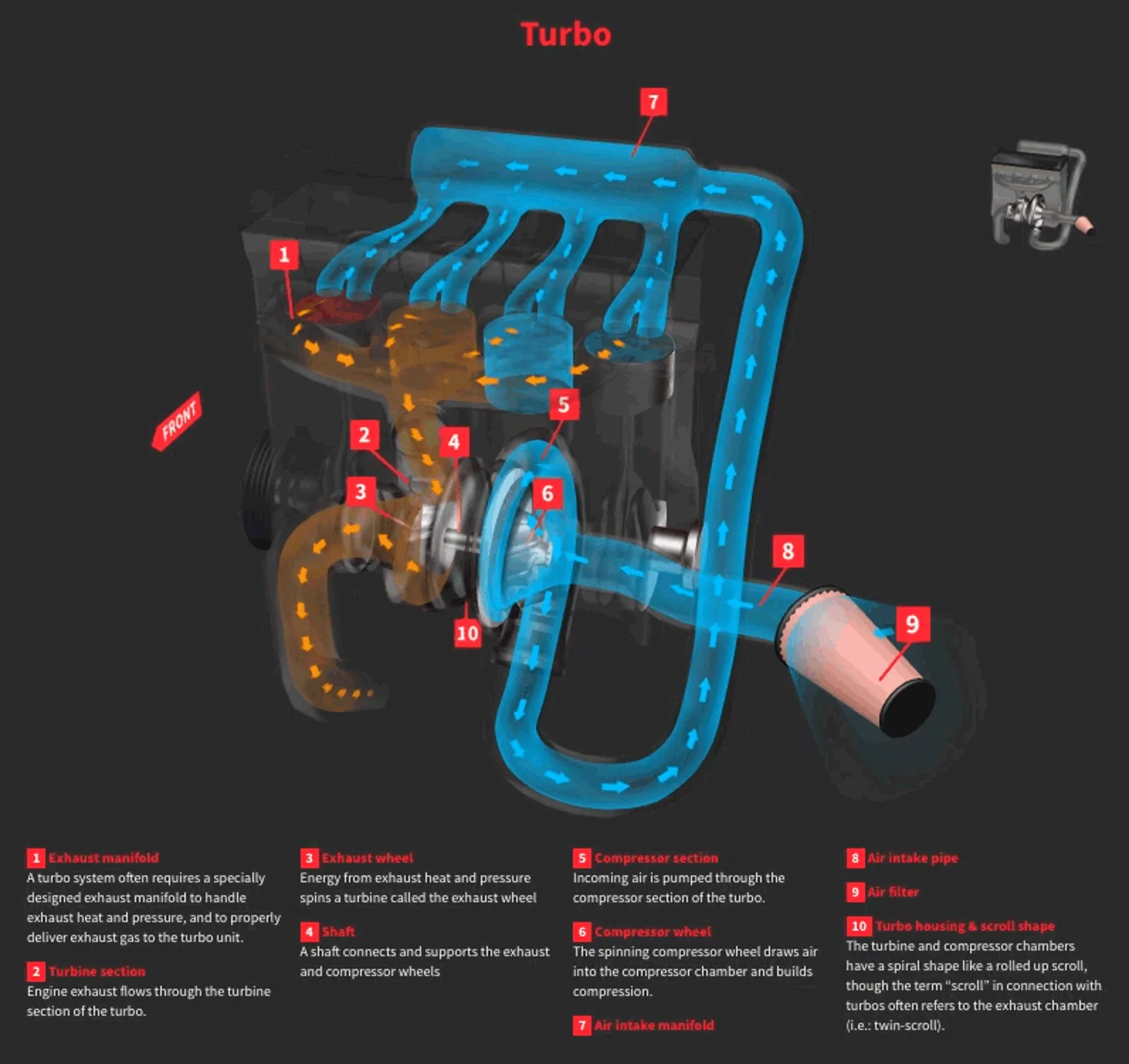
A turbocharger squeezes the air going into an engine so that it can burn more fuel for its size. Unlike a supercharger, which is usually driven by a belt from the crankshaft, a turbo is spun by the energy in the exhaust stream. A turbine on the hot side catches the exhaust flow and spins a shaft, and a compressor on the other end pressurises the air. The turbine can spin at up to 250,000 rpm.
In its simplest form, a turbo that floats freely with nothing else attached would reach maximum boost only at maximum revs and full throttle. A car has to be driven across a range of loads and speeds, so extra components are needed. The usual list is an intercooler, water injection, a wastegate and a blow-off valve. Each solves a different problem.
The whoosh is not the turbo; it is a valve letting out air the engine no longer wants.
What does an intercooler do?
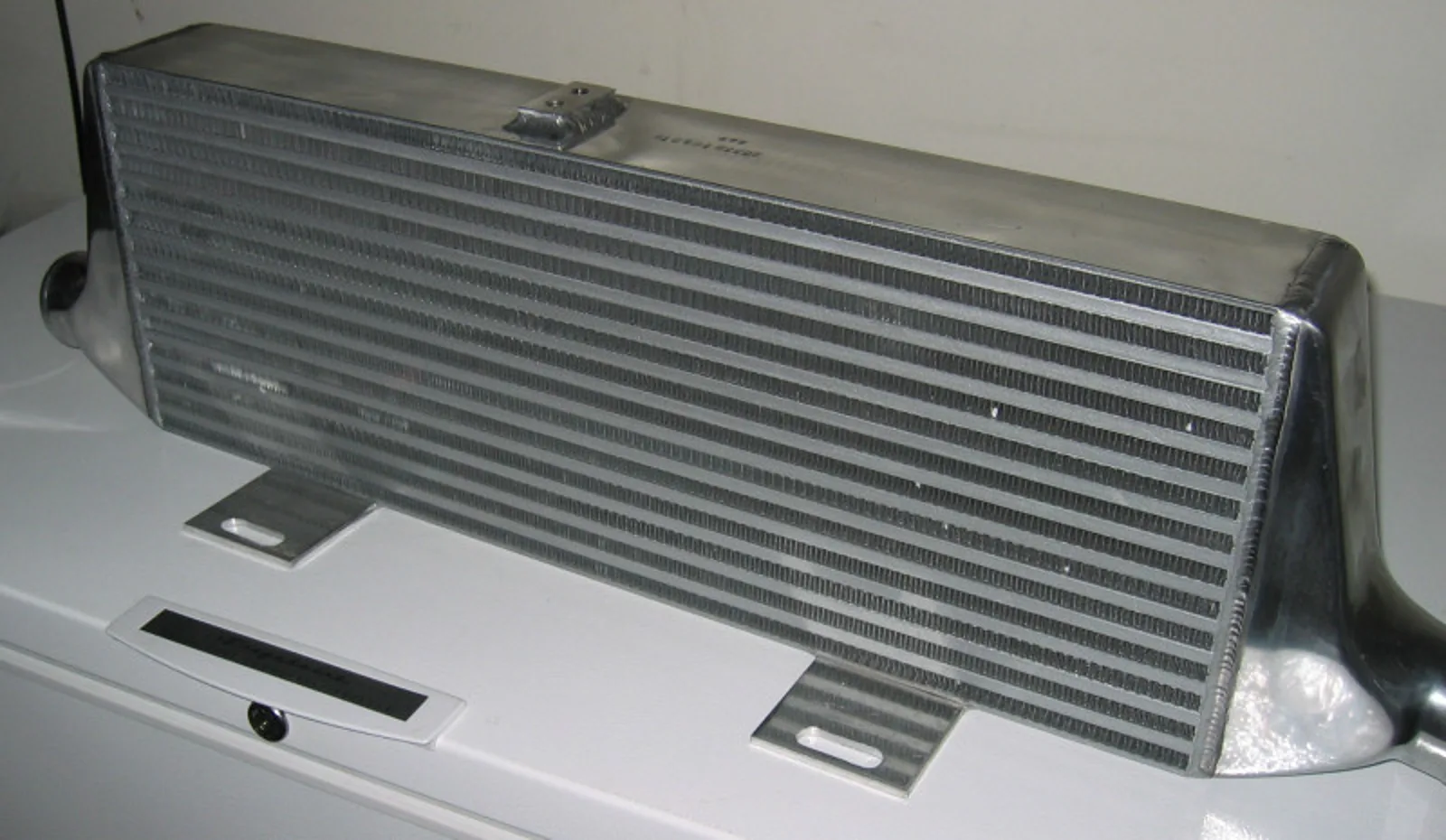
An intercooler is a heat exchanger that cools the air after compression. Squeezing air heats it, and heat soak adds to the effect, so the intake charge arrives warm. The intercooler counteracts the heat of compression and heat soak. Cooling the air makes it denser, which allows more fuel to be injected and gives more power, and it makes the charge less likely to suffer pre-ignition or knocking. Some systems add evaporative cooling with a fine spray landing on the intercooler core or in the intake stream.
Intercoolers vary dramatically in size, shape and design to suit the performance targets and the space available. Many passenger cars have a front-mounted intercooler in the bumper or grille opening, while others have a top-mounted one above the engine. The design can be air-to-air, air-to-liquid, or a combination. An air-to-air unit passes heat straight to the atmosphere. An air-to-liquid unit hands the heat to a liquid, usually water, which then releases it through a radiator like the one in the engine's cooling system, or sometimes through the engine's own cooling circuit. The liquid version is usually heavier because of the pump, radiator, fluid and plumbing. Marine engines mostly use it, since the lake, river or sea supplies the cooling water.
When an engine has several stages of forced induction, the intercooling usually comes after the last one, although a car such as the JCB Dieselmax land speed record machine used a separate intercooler for each stage. In a two-stage turbo system, the term intercooler can refer specifically to the cooler between the two turbos, with aftercooler describing the one between the second turbo and the engine. An older alternative, rarely used now, was to inject excess fuel so that its vaporisation cooled the cylinders and prevented knock, at the cost of higher fuel consumption and emissions.
What does a wastegate do?
A wastegate is a valve that controls how much exhaust gas reaches the turbine wheel. Diverting some of it regulates turbine speed, which in turn sets the compressor speed. Its primary job is to cap maximum boost pressure to protect both the engine and the turbocharger, because a turbo can often produce more boost than the engine can safely take. The Saab 99 Turbo was among the first production cars to carry a modern wastegate, and pre-series turbo cars arrived in 1977.
| Part | What it controls | Where it sits | What triggers it |
|---|---|---|---|
| Intercooler | Intake air temperature and density | Between compressor and engine | Always working |
| Wastegate | Exhaust flow to the turbine, and so maximum boost | On the exhaust side of the turbo | Boost pressure or an electronic controller |
| Blow-off valve | Pressure in the intake when the throttle closes | On the intake side after the compressor | Drop in manifold pressure behind the throttle |
Internal vs external wastegate: what is the difference?
An internal wastegate lives inside the turbocharger housing. A flap, hinged inside, lets excess exhaust pressure bypass the turbine and flow directly into the downstream exhaust. It is simpler and more compact, needs no external piping, and sends all the waste gas back to the catalytic converter automatically. That is why many original-equipment turbochargers use it. The drawbacks come from the small size of the internal valve. It has a limited ability to bleed off pressure, and the flap creates turbulence and may struggle to pass enough flow at higher revs. The result can be boost creep, an uncontrolled rise in boost.
An external wastegate is a standalone unit. It needs an exhaust manifold specially built with a dedicated port, and it can sit directly on the exhaust housing or on runners further away. A remote mounting allows a smaller turbine housing, which means less lag before the turbo starts to produce boost. As a rule, external gates hold boost more precisely, and because they are free of the constraint of fitting inside the turbine housing, they can be much larger. Most use a valve like the poppet valve in a cylinder head, except that it is operated by pneumatics and opens outward. An external unit can also dump its exhaust straight to the atmosphere, which cuts turbulence and back pressure. A dump pipe like that is commonly called a screamer pipe because of the loud, unmuffled noise.
Sizing runs backwards from what you might guess. A wastegate's size is inversely proportional to the targeted boost pressure and set by how much exhaust gas must be bypassed. A large turbo run at a low boost target must divert a high volume of gas to hold its shaft speed down, which calls for a larger valve to prevent boost creep. At high boost, or in racing, the turbine needs nearly all the engine's exhaust energy, so only a little needs bleeding off and a smaller valve will do.
How is a wastegate controlled?
The simplest arrangement is pneumatic. A small hose carries boost pressure from the intake to the wastegate actuator, and the valve opens further as pressure pushes against a spring until the two balance. A dual-port actuator adds a second port on the opposite side, so air pressure there helps the spring keep the valve shut as boost builds. An electronic boost controller can add more intelligent control on top.
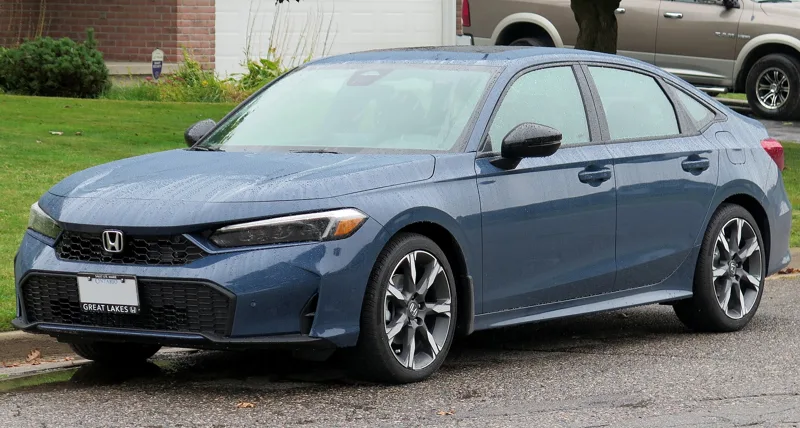
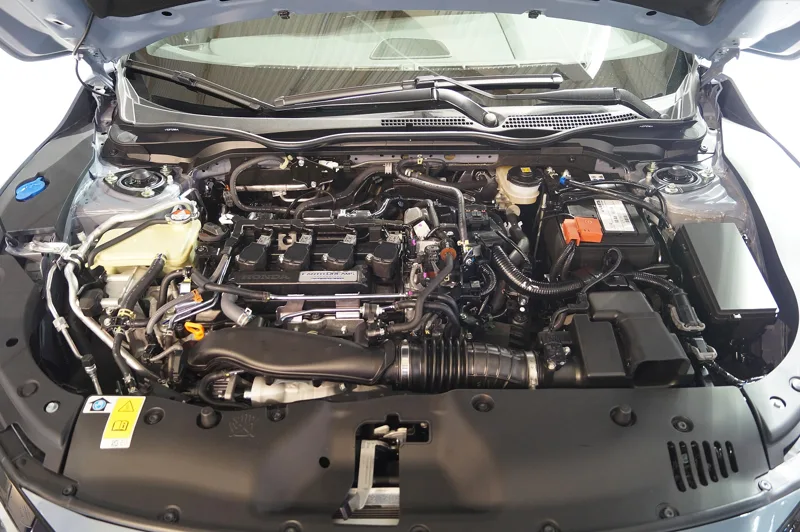
Manufacturers have generally moved to electronically controlled actuators. For the 2011 model year Hyundai offered the 2.0-litre Theta II turbo direct-injection engine in the Sonata with an electronic servo actuator. That strategy opens the wastegate when boost is not needed, reducing the exhaust back pressure caused by the turbo and improving fuel economy, and it holds the gate open on a cold start to bring the catalyst up to temperature faster and lower emissions. Honda began shipping direct-injected 1.5-litre turbo engines with an ECU-driven electric wastegate from November 2015, first in the 2016 Civic and then in the 2017 CR-V. In 2018, 1.5-litre and 2.0-litre turbo engines replaced naturally aspirated 2.4L and 3.5L engines in the Accord.
What does a blow-off valve do?
A blow-off valve, sometimes called a dump valve or a compressor bypass valve, is a relief valve fitted to most turbocharged petrol engines. It reduces pressure in the intake when the throttle shuts, which prevents compressor surge.
Surge is the problem it solves. Say the compressor is spinning fast and the driver lifts off for a gear change. The air has nowhere to go, and the flow through the compressor drops beyond its surge line. Pressure across the compressor falls, flow collapses and may even reverse, and the pressure in the intake plenum drops. Because the wheel is still spinning quickly, flow is re-established a moment later, and the cycle then repeats rapidly until the compressor slows or the throttle reopens. The sound of it is called turbo flutter. The repeated cycling puts a cyclic torque on the compressor and can increase the stress on the bearings and the impeller.
The valve takes its reference pressure from a vacuum hose tapped into the manifold beyond the throttle. With the throttle open, pressure is equal on both sides of the valve piston and the spring holds it closed. When the throttle closes, manifold pressure falls under the pressure on the other side of the throttle, and the valve opens to release the excess. Where that air goes defines the type. A true blow-off valve vents it to the atmosphere, which makes the distinctive sharp whoosh or rhythmic flutter. A recirculating valve, known as a diverter or bypass valve, sends it back into the intake upstream of the turbo.
Turbo wastegate vs blow-off valve: why venting can cause rich running
People mix up the two valves, but they sit on opposite sides of the turbo and do opposite jobs. The wastegate acts on exhaust gas to limit boost while the engine is working. The blow-off valve acts on intake air to protect the compressor when the engine is not.
The venting version has a side effect. If an airflow sensor sits upstream of a valve that vents to atmosphere, the fuel injection system never learns that some of the measured air was released rather than burned. It still counts that air when calculating fuel, so the engine briefly runs rich after each blow-off event. The consequences can include fouled spark plugs, a damaged catalytic converter, stalling, or hesitation as the throttle opens again.
There are three ways round it. The airflow sensor can be moved downstream of the valve, which is known as a blow-through layout, as opposed to the traditional draw-through one. The valve can recirculate the air instead of venting it. Or the car can use a manifold absolute pressure sensor rather than an airflow sensor to work out how much fuel is needed.
Which upgrades help, and what do they cost?
Every change moves a trade-off rather than removing it. A bigger or better intercooler cools the charge more, but the liquid type adds weight and an air-to-air one needs space at the front or top of the engine bay. An external wastegate controls boost more precisely and can avoid boost creep, but it demands a special manifold and extra piping, while the internal type is simpler and keeps the exhaust routed through the catalytic converter. A venting blow-off valve gives the sound people want and relieves pressure, but unless the airflow sensor is placed after it, the engine will run rich on each lift. A recirculating valve avoids that and keeps the pressurised air in the system.
Timing and boost control also affect lag, the delay between pressing the throttle and the turbo spooling up to deliver boost. Improving wastegate response is one way to cut it, alongside variable-geometry and twin-scroll turbines and lighter rotating parts. A boost threshold is a related but separate limit: below a certain engine speed the exhaust flow is too weak to spin the turbine enough to make significant boost.
Electric help for turbochargers
An electrically assisted turbocharger combines the usual exhaust-driven turbine with an electric motor to reduce lag. Advances in the early 2020s, including mild-hybrid integration, have enabled turbos to begin spooling before the exhaust provides enough pressure. That can cut lag further and improve efficiency, especially in slow, stop-start urban driving. It differs from an electric supercharger, which uses only an electric motor to drive the compressor.