From Fleming's DB Mark III to the Goldfinger prototype, the replicas built for No Time to Die and the auction prices since, the story of the DB5.
James Bond drove an Aston Martin DB5 in the 1964 film Goldfinger after effects expert John Stears persuaded the company to supply its prototype. Fitted with gadgets and promoted heavily, it became the best-known Bond car, returning in later films and selling for millions at auction.
In Ian Fleming's novel, James Bond drove an Aston Martin DB Mark III, not a DB5. The car that became his signature came from a special effects expert who talked the company into lending its DB5 prototype for Goldfinger.
Which cars has James Bond driven?
In the books, Ian Fleming placed Bond in an Aston Martin DB Mark III. In the films, the car most people picture is the Aston Martin DB5, first driven by Bond in Goldfinger in 1964. The villain of that film had a car of his own: Auric Goldfinger smuggled gold in the bodywork of a Rolls-Royce Phantom III.
Special effects expert John Stears modified a DB5 for the film and persuaded Aston Martin to make its prototype available. After that, the DB5 became so closely tied to the franchise that it has returned in film after film, while cars, guns and Q Branch gadgets run through most of the series. The films have grossed over US$7.04 billion in total, and 25 films had been made in the Eon series by 2021.
Sales of the DB5 rose after it was described as the most famous car in the world.
Where did James Bond come from?
Ian Fleming created James Bond in 1953 and went on to write twelve novels and two short-story collections about him. Goldfinger was based on his 1959 novel, and the film series began in 1962 with Dr. No, starring Sean Connery.
Fleming began the first book, Casino Royale, on 17 February 1952 at his Goldeneye estate in Jamaica, where he wrote all his Bond novels. Bond is an officer in the Secret Intelligence Service, known as MI6, and goes by the code number 007. Fleming died in 1964, the year Goldfinger reached cinemas. Six actors have played Bond in the Eon series, and Daniel Craig, the sixth, made his fifth and final appearance in No Time to Die.
What is the Aston Martin DB5?
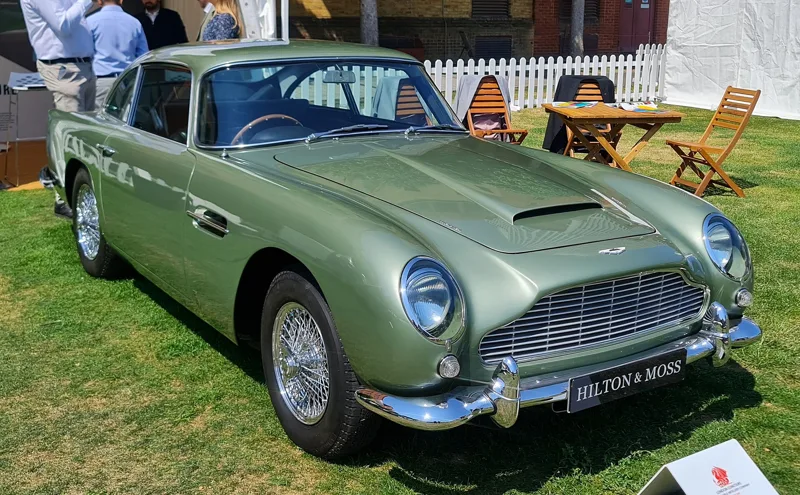
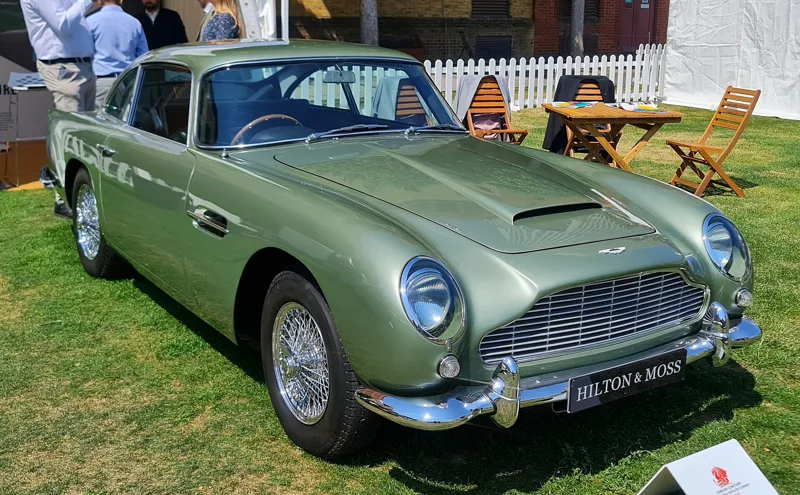
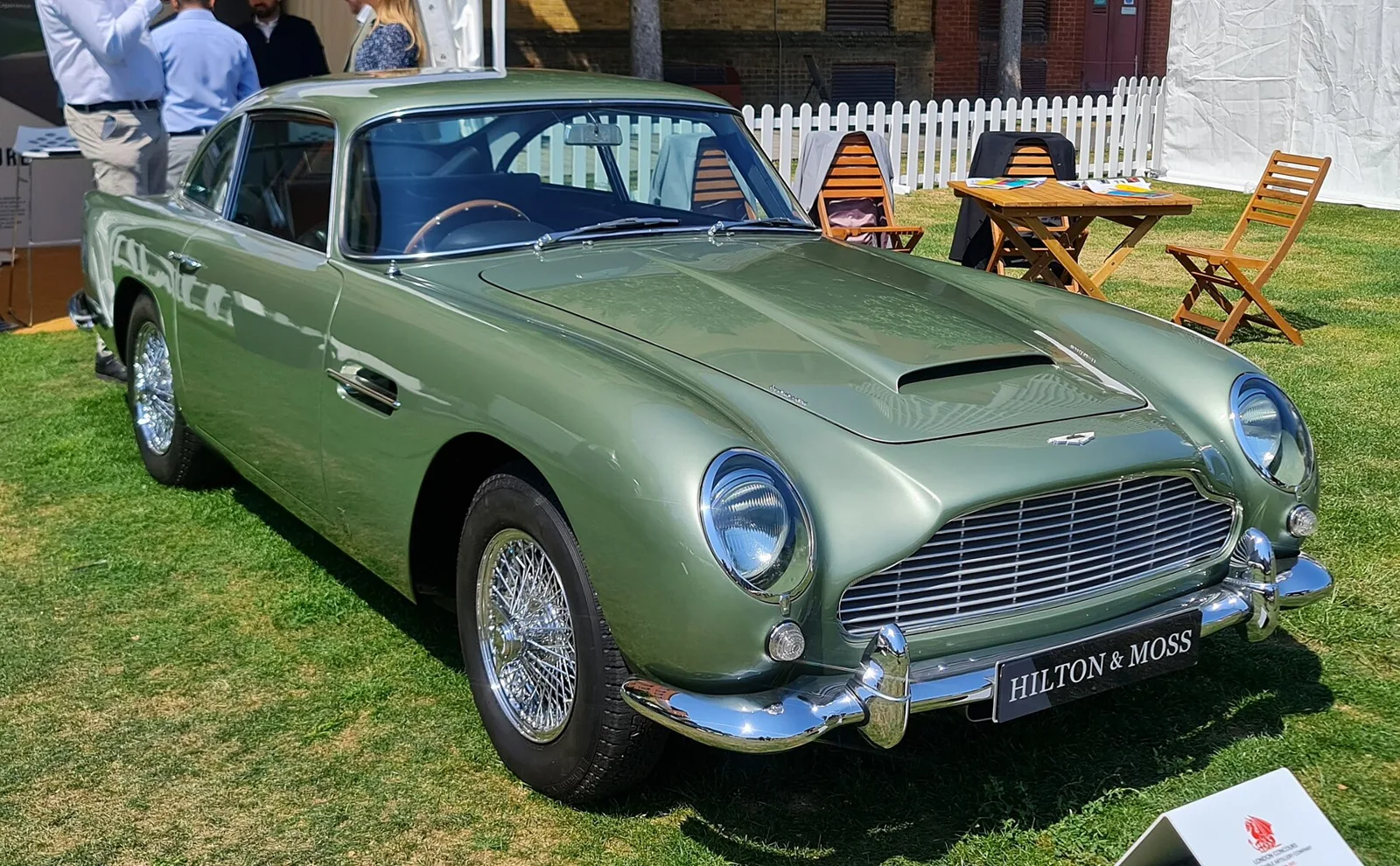
Built from 1963 to 1965, the DB5 is a British grand tourer styled by the Italian coachbuilder Carrozzeria Touring Superleggera. It grew out of the last series of the DB4, and the DB stands for David Brown, the man who built the company up after 1947.
Its 4.0 litre (3,995 cc) all-aluminium inline-six, enlarged from the DB4's 3.7 litres, breathed through three SU carburettors and produced 282 bhp (286 PS; 210 kW) at 5,500 rpm. It could reach 145 mph (233 km/h) and covered 0 to 60 mph in 8 seconds, at a weight of 1,502 kg (3,311 lb). A ZF five-speed gearbox replaced the earlier four-speed with optional overdrive, and a three-speed Borg-Warner automatic was also on offer. Like the DB4, it had a live rear axle.
The specification was generous for 1963. Inside were leather throughout, reclining seats, electric windows and wool-pile carpets; underneath sat twin fuel tanks and an oil cooler, with chrome wire wheels outside and a fire extinguisher on board. The body used the Superleggera patent technique, with a magnesium-alloy skin. All models had two doors and a 2+2 layout. Royal Mail put the car on a "British Auto Legends" stamp in 2013.
How did the DB5 get into Goldfinger?
Through John Stears. Fleming had chosen a different Aston Martin for Bond in the novel, but Stears persuaded the company to supply its DB5 prototype for the 1964 film, and he fitted it with the gadgets. Q hands Bond the modified DB5 with two tracking devices in the plot.
Four Goldfinger DB5s existed: two for filming and two used only for promotion. The first filming car, chassis DP/216/1, was the original prototype in Dubonnet Red, fitted with the gadgets, and it had already appeared in an episode of The Saint. Aston Martin later stripped it of its weapons and resold it. Later owners added non-original gadgets, and it appeared in The Cannonball Run in 1981, driven by Roger Moore. It was stolen from its last owner in Florida in 1997 and was reported still missing in 2021.
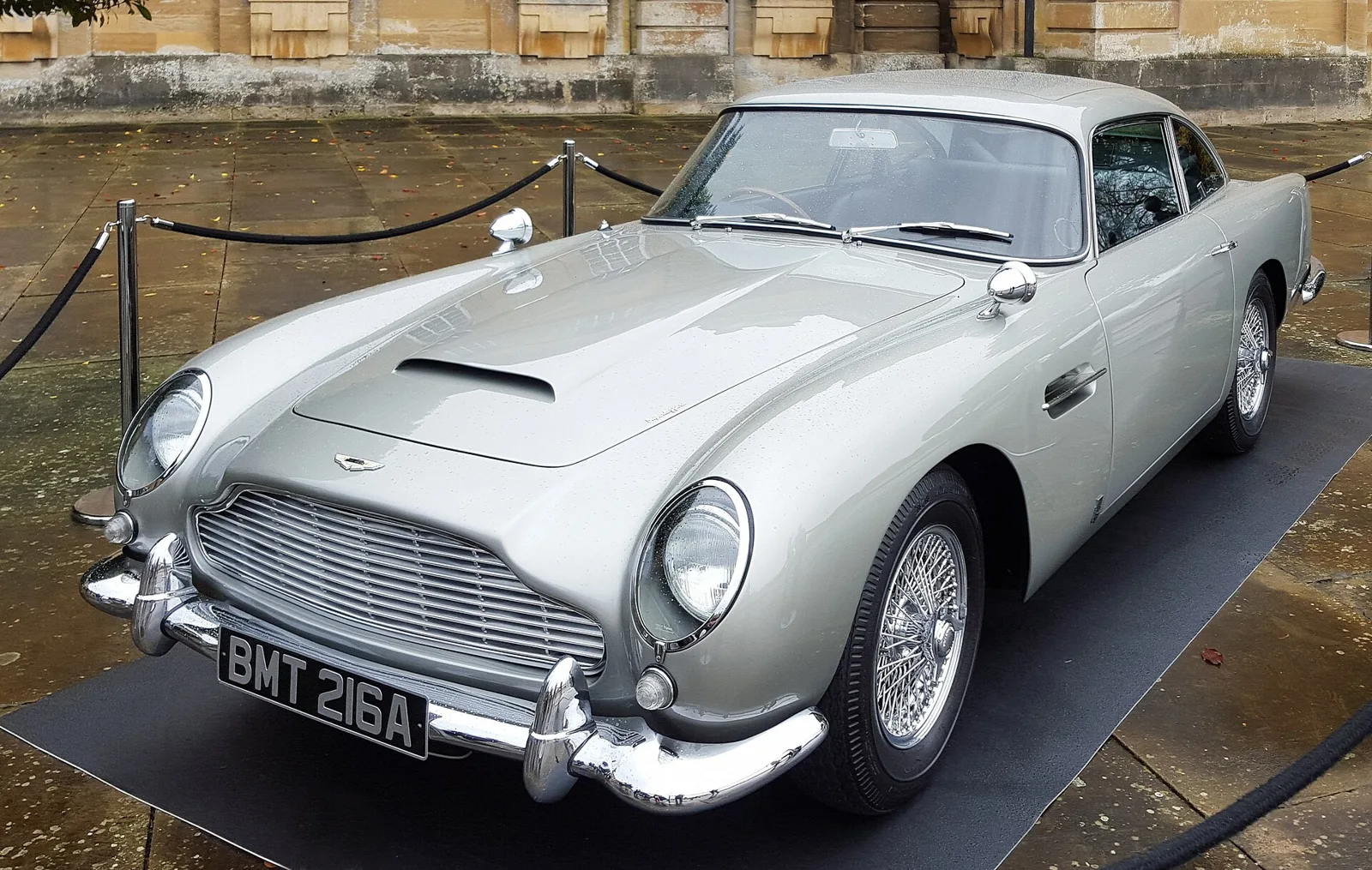
The second filming car, DB5/1486/R, had no gadgets and was used for driving scenes. The team added them after filming for promotion, which meant pop-out gun barrels behind the front indicators, a shield for the rear window, and a front plate that revolved between three registrations: LU 6789, 4711-EA-62 and BMT 216A. The two promotional cars were displayed at the 1964 New York World's Fair. Sales of the DB5 climbed once it was billed as the most famous car in the world.
The film gave it a big stage. Goldfinger was the third Bond film, with a $3 million budget equal to the two earlier films added together, and it was chosen with the North American market in mind. It became the first Bond film to take over $100 million, earning its budget back within two weeks and taking more than $120 million globally. It also won the series' first Academy Award, for Best Sound Editing. Many elements it introduced became staples, including the extensive use of gadgets, a long pre-credits sequence and tongue-in-cheek humour. A Corgi Toys model of the car became the biggest-selling toy of 1964.
How has the DB5 appeared in later Bond films?
| Film | The DB5 and its role |
|---|---|
| Goldfinger (1964) | Modified by John Stears; four cars built, two filmed and two promotional |
| Thunderball (1965) | The same car, registration BMT 216A, used a year later |
| GoldenEye (1995) | Registration BMT 214A; Bond's own car, gadget-free apart from an armrest champagne cooler and a fax machine; three DB5s used |
| Tomorrow Never Dies (1997) | Same car, a brief reappearance |
| The World Is Not Enough (1999) | Cameo planned in Scotland scenes, but most of those scenes were cut |
| Casino Royale (2006) | A left-hand-drive car with Bahamian plates, owned by Alex Dimitrios; Bond wins it in a card game |
| Skyfall | Silver birch car with registration BMT 216A; destroyed in the finale, with a one-third scale model built for the scenes |
| Spectre (2015) | Seen in stages of rebuild in Q's workshop; Bond drives it away at the end |
| No Time to Die (2021) | Eight replica stunt cars built rather than using existing vehicles |
Each appearance added its own twist. In GoldenEye, three cars were needed: one for a static shot beside the sea, one driven in a chase against a Ferrari in Monte Carlo, and one that Eon kept. Skyfall arrived as the 23rd Bond film, timed with the 50th anniversary of Dr. No, and used two cars, one of them first seen in GoldenEye. Spectre showed it in Q's workshop in various stages of rebuild. For No Time to Die, Aston Martin confirmed in 2019 that the DB5 would feature, and the plan was to build replicas rather than risk existing cars.
Where are the original Bond DB5s now?
They are spread among museums, auction rooms and private collections. The Louwman Museum in The Hague holds the first publicity car, DB5/2017/R. The second publicity car, DB5/2008/R, went to an undisclosed buyer at RM Sotheby's in August 2019 for $6.4 million.
The gadget-fitted filming car DB5/1486/R sold through RM Auctions in 2010 for $4.6 million to Harry Yeaggy. One of the GoldenEye cars, DB5/1885/R, which was driven in the chase against a Ferrari in Monte Carlo, sold at Christie's in 2001, and the price went into the Guinness Book of Records as the highest ever paid for Bond memorabilia. It later joined the London Film Museum. Another, DB5/1484/R, stayed with Eon Productions and reappeared in later films, including Skyfall alongside a second car, DB5/2007/R. A DB5 seen in the high-speed chase at the start of No Time to Die was sold for 2.92 million pounds at a charity auction in London in 2022.
What other DB5 versions were built?
The DB5 Vantage arrived in 1964 with three Weber carburettors and revised camshaft profiles, lifting output to 325 bhp (330 PS; 242 kW) at 5,500 rpm. Only 65 coupes were built. The convertible ran from 1963 to 1965; 123 were produced, of which 19 were left-hand drive.
The convertibles did not take the Volante name until 1965. Between October 1965 and October 1966 the final 37 DB5 chassis became "Short Chassis" Volantes, the first Aston Martins to carry that name, with DB6 bumpers and Triumph TR4 rear lights. The factory built a prototype shooting brake for David Brown, who loved hunting and kept dogs, and the independent coachbuilder Harold Radford converted a further 11 or 12 coupes. A DB5 Shooting Brake fetched a record $1.765m (1.456m pounds) in August 2019.
The condition of the survivors varies enormously. In December 2025 Aston Martin finished a three-year, 400,000 pound restoration of a rare 1965 Vantage at its Newport Pagnell works. It was a rare version, with silver birch paint, a higher-output engine and right-hand drive, and one of only 39 built. The work took 2,500 hours. The owner had bought it second-hand for 900 pounds in 1973, and it had been left to decay from the late 1970s. The restored car was valued at 1 million pounds.
What should you know before buying a DB5?
Rarity decides most of the story. Only 65 Vantage coupes, 123 convertibles and 37 Short Chassis Volantes were built, along with a prototype and a dozen or so shooting brakes. The right-hand-drive silver birch Vantage restored in 2025 was one of only 39.
Details differ from car to car. The ZF five-speed box was more robust than the earlier David Brown unit, except in some of the first DB5s. The original four-speed with optional overdrive was dropped, and the Borg-Warner automatic changed to the Model 8 shortly before the DB6 replaced the DB5. A steel removable hardtop was a rare factory option on the convertible, fitted by Works Service before delivery, and 12 convertibles left the factory with a Vantage engine. Of the 123 convertibles, only 19 were left-hand drive.
Can you buy a Goldfinger DB5 today?
Aston Martin built 25 new Goldfinger-themed DB5s at Newport Pagnell from 2020, as part of a continuation programme that began in 2017 with the DB4GT. They were made with Eon Productions, and they were intended to sell for about 2.75 million pounds each.
Where possible the factory used the original suppliers: ZF Friedrichshafen for the transmission and Connolly Leather for the interiors. Craftsmen shaped the aluminium panels and fitted them by hand to a steel chassis, as in the 1960s. Power came from a 4.0 litre inline-six rated at 290bhp, with three SU carburettors and a five-speed ZF manual gearbox, and the paint was the same Silver Birch as the original. Several gadgets were designed to work: a smoke screen, a simulated oil slick, revolving number plates and a rear bullet shield. The first car left the line at the beginning of July 2020.
Smaller versions have followed. The Little Car Company in Bicester, working with Aston Martin Lagonda, built two-thirds scale electric copies of three cars, the DB5 convertible, the Vantage and the No Time to Die DB5, priced between 35,000 and 90,000 pounds, using 3D scans of the original. Airfix sold a 1:24 plastic kit from 1966 to 1970, Danbury Mint made a 1:24 die-cast model in 2006, GE Fabbri released an 85-part 1/8 scale model in 2011, Hot Wheels Elite followed in 2015, and LEGO unveiled a 1,290-piece 1:8 set in July 2018 and a Speed Champions version for August 2022.