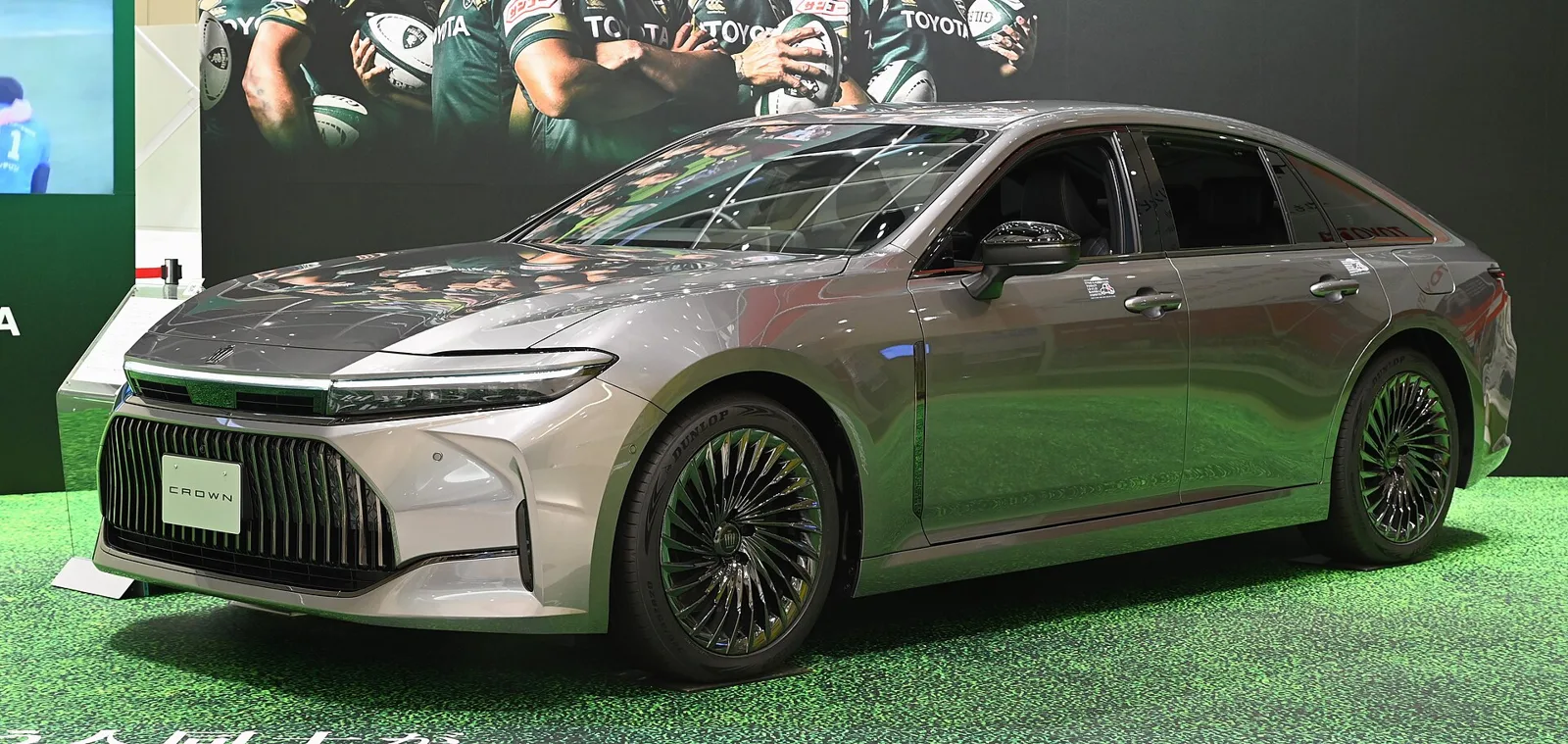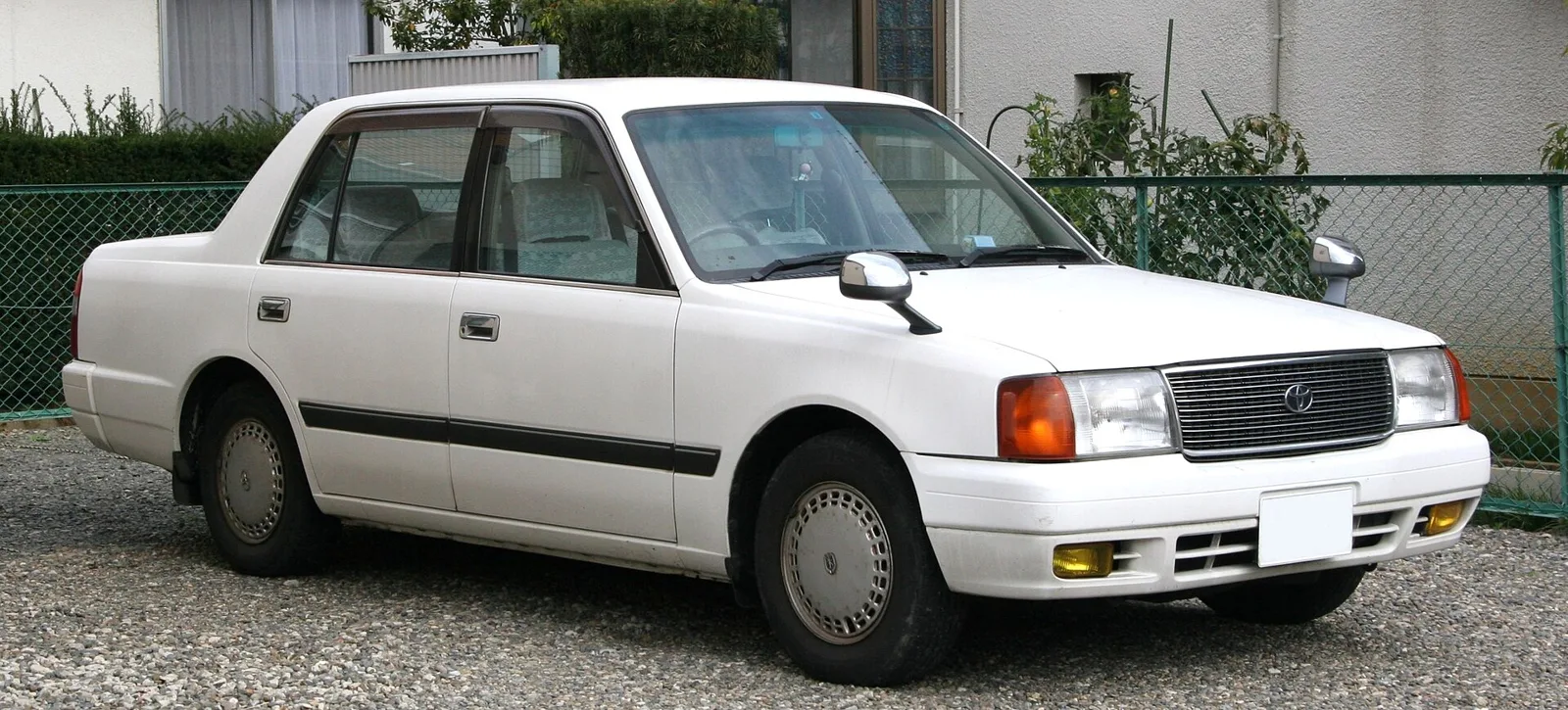
A plain Toyota sedan filled Tokyo's ranks for more than two decades with a driver-operated rear door and LPG power, before a hybrid with a wheelchair ramp took over.
The Toyota Comfort and Crown Comfort were sedans that Toyota built from 1995 to 2018 mainly for taxi fleets. The Toyota JPN Taxi, a hybrid with a wheelchair ramp built to a government universal design specification, replaced them from 2017 with sales concentrated in Japan, Thailand and Hong Kong.
In May 2018, roughly seven in every ten taxis on the streets of Tokyo were the same car, a plain Toyota sedan first released in 1995, and Toyota itself was happy to call it unspectacular. Both the Toyota Comfort and the longer Crown Comfort were built for taxi operators. That car, and its driver-controlled rear door, shaped the look of the Japanese taxi for more than two decades.
What is the Toyota Crown Comfort taxi?
The Toyota Comfort, alongside the longer Toyota Crown Comfort, makes up a pair of mid-size sedans that Toyota built from 1995 to 2018. They share a platform with the Toyota Mark II (X80) and were aimed at fleet buyers, with taxi companies the main target. They arrived on 19 December 1995 to take over from the cheaper fleet Mark II and the bigger Crown.
A 2001 addition, the Crown Sedan, was the 11th generation of that name and the first not derived from the regular Crown executive car. It was sold only in Japan and aimed at fleet users who wanted a high-end taxi or a company car. Nissan offered two rivals: the Crew, withdrawn in June 2009, and the Cedric Y31, which lasted until 2015.
Production of the Comfort stopped in January 2018, after more than 22 years. A 2011 report put total sales since 1995 at 364,000.
The Crown Comfort was unspectacular and proud of it: a taxi that the president of Toyota called a symbol of the company's quality, durability and reliability.
Why do Japanese taxis look the way they do?
Many visible quirks of a Japanese taxi come from the job it does. The Comfort was only ever a five-seater, while early Crown Comfort models could have a split front bench instead of separate seats. Five-seat cars carried a floor-mounted gear lever and six-seat cars a column shifter.
The most famous feature is the rear passenger door that the driver opens from the front seat, either through mechanical linkages or a pneumatic system. It is standard equipment on taxis in both Japan and Hong Kong. Taxis also wear mirrors on the front fenders, while private-use and driver's-education cars have the usual door-mounted ones.
Cost and repair were designed in. Toyota gave the body a thorough redesign to free up space for rear passengers, then stripped out the Mark II's plusher dashboard and trim for a modified version of the base S130 Crown dashboard and simple all-plastic fittings. That cut cost and weight and left room for taxi equipment. The front bumper can split in two, and the driving lamps come off quickly after a knock.
The Comfort has MacPherson strut independent suspension at the front and a coil-sprung solid axle at the rear. Its short-wheelbase version has a wheelbase of 2,680 mm, the same as the X80 Mark II, and the long-wheelbase 10 series models are 100 mm longer.
Which engines did the Toyota Comfort taxi use?
Early short-wheelbase Comforts used the 2L-TE diesel, the 3S-FE or 4S-FE petrol engines, or the 3Y-PE running on liquefied petroleum gas (LPG). From 2008 the only choices were the 1998 cc 1TR-FPE, giving 83 kW (113 PS) at 4,800 rpm, and the 1TR-FE, giving 100 kW (136 PS) at 5,600 rpm.
The long-wheelbase Crown Comfort had a wider menu. Early export cars for Hong Kong, Indonesia and Singapore had 2L or 5L diesels, whereas Japan received only LPG power from the 3Y-PE and the 1G-GPE. Hong Kong later gained the 3Y-PE, while Indonesia and Singapore stayed with diesel. The 1G-GPE was phased out in 2002 and the 3Y-PE in 2008, when the 1TR engines took over.
Six-cylinder cars were reserved for the top of the range. Some Super Deluxe and Crown Sedan models got the 1G-GPE and later the 1G-FE, and a BAS mild hybrid system with the 1G-FE was offered from 2002 to 2008. Six-cylinder engines were never fitted to the short-wheelbase Comfort or the lower Crown Comfort trims.
How did the Comfort change between 1995 and 2018?
Toyota kept the shape but revised the details through the years. Early cars below the SG trim had wind-up glass all round; power for the front pair was an option until it became standard at the start of 1997, and in 2007 power windows on all four doors became available. In 2002 every model gained ABS and a driver's airbag. Two years later an LED third brake light replaced the old bulb, and side indicators borrowed from the XP30 bB appeared on the front fenders.
Later cars picked up larger headrests, phased in from around 2001 and reaching the cheapest taxi trims by 2012. All eventually received a passenger airbag, and a start-stop system was fitted in Japan only. The Crown Sedan version had its own facelift with chrome-trimmed bumpers, new tail-lights and a dashboard with more elegant instruments, plus a steering wheel shared with the XV30 Camry. In August 2007 the Crown Comfort sold in Hong Kong received the Japanese Crown Sedan's chrome bumpers, tail-lights and boot panel.
Trim ladders ran from Standard, with steel wheels, air conditioning, a radio with two speakers, vinyl upholstery and power steering, up through Deluxe and SG to Super Deluxe. SG was the best a short-wheelbase buyer could order. Super Deluxe cars carried the Crown Comfort name until August 2001 and the Crown Sedan name afterwards, when wider tail-lights, chrome-accented trim, four cup holders and a better audio system arrived. The original optional "Q Package" with luxury cloth and faux wood became the "G Package" and added an air purifier.
What special versions of the Comfort were there?
Toyota adapted the same shell to some unusual jobs:
- Driver's education cars, which have a second brake pedal in the passenger footwell for the instructor and were sold only in Deluxe trim. A radio delete option was also available.
- Welcab paratransit taxis, with a rear seat that swings outwards to help passengers with limited mobility, marked with the International Symbol of Access.
- A swing-roof option for Shinto weddings, with a hinged panel above the rear door that lifts to clear a bride's wig and headdress.
- The Super Saloon of 2002, sold only as a Crown Sedan with LPG engines and aimed at corporate, government and chauffeur buyers. Its longer bumpers pushed it beyond the 4.7 m (15.4 ft) limit of Japan's small-size passenger vehicle class, so it was rated as a normal-size car.
There was even a hot one. The TRD Comfort GT-Z Supercharger, built from July 2003 to February 2004, used the 2.0-litre 3S-FE four-cylinder with a supercharger and produced 160 PS (118 kW; 158 hp) at 6,100 rpm. Only 59 were made.
Where was the Toyota Comfort taxi sold?
Taxi operators in Japan, Hong Kong and Singapore were the main buyers, and the short-wheelbase car was a common sight at Japanese driving schools. Smaller numbers of Crown Comforts went to Macau and Indonesia, where the Blue Bird Group was the best-known operator.
Singapore's adoption of Euro IV emission rules forced taxi companies to retire their Crown Comforts in 2014. Most were scrapped, but a handful lost their drivetrains and were donated to healthcare for rehabilitation training.
Did Toyota ever honour the Crown Comfort?
Two honours came its way. In October 2008 the Crown Comfort took a Good Design Award for long life design. Then in 2010 Akio Toyoda, Toyota's president, chose it as the first winner of an internal, semi-official prize. The company's explanation called the car unspectacular but very important, drivable by everyone from beginners to experts, and a symbol of its quality, durability and reliability. Toyoda uses the pseudonym Morizo in motorsport, which gave the award its name.
What is the Toyota JPN Taxi?
The Toyota JPN Taxi is a hybrid-electric cab engineered to a universal design standard set by the Japanese government. The 2013 Tokyo Motor Show, the 43rd, saw it first as a concept named JPN Taxi Concept, and Toyota has built it since 2017, mainly for Japan, Thailand and Hong Kong. Toyota presents it as the heir to both the Comfort and the Crown Sedan. Chief engineer Hiroshi Kayukawa supervised its development, and Toyota Motor East Japan builds it.
Its brief came from an emissions and accessibility mandate agreed in 2012 after consultation with carmakers, taxi companies and disability rights advocates, with the 2020 Summer Olympics as the target. Toyota also wanted the car to be as recognisable as the London black cab. It comes in black, white or a deep indigo that Toyota calls koiai.
How does the JPN Taxi make travel easier?
Wheelchair users get a ramp that unfolds once the rear seats are flipped up, and the rear passenger door slides open electrically. The door on the driver's side stays hinged. That way an oncoming vehicle is easier to spot when the door opens, and the passenger can step out.
Luggage space takes two large suitcases or four golf bags, and a high roof gives nine inches of headroom in the cabin. Built-in soundproofing and air purification are fitted, and the top Takumi trim adds a ceiling-mounted air circulator and heated rear seats. Safety kit includes six SRS airbags and Toyota Safety Sense collision sensors, and the car earned a five-star rating from the Japan New Car Assessment Program.
Size matters as much as comfort. The exterior dimensions follow Japanese size regulations that let commercial vehicles save on tax. The JPN Taxi was developed alongside the Toyota Sienta, but the two share almost nothing besides the floor pan, which had to be adapted to take taxi equipment.
What powers the JPN Taxi?
Underneath sits Toyota's THS II hybrid setup. The 1NZ-FXP engine, displacing one and a half litres, can also burn LPG, and its water pump is electric and needs no maintenance. The nickel-metal hydride battery lies flat under the floor.
How do the Comfort and JPN Taxi compare?
| Detail | Toyota Comfort and Crown Comfort | Toyota JPN Taxi |
|---|---|---|
| Years | 1995 to 2018 | 2017 onwards |
| Basis | Toyota Mark II (X80) platform | Developed with the Toyota Sienta; shares the floor pan |
| Power | Diesel, petrol and LPG engines; BAS mild hybrid on some Crown Sedans | Hybrid (THS II) with a 1NZ-FXP engine, LPG compatible |
| Access features | Driver-operated rear door; Welcab version | Ramp, electric sliding door, folding rear seats |
| Share of Tokyo taxis, May 2018 | About 70% | About 10% |
Where is the JPN Taxi built, and how quickly did it spread?
Toyota Motor East Japan assembled the JPN Taxi in Susono, Shizuoka, at the Higashi-Fuji plant, from 2017 to 2020. In December 2020 production moved to the company's Miyagi plant in Ohira.
The JPN Taxi accounted for about 10% of Tokyo taxis in May 2018, against about 70% for the Comfort. Toyota expected it to reach about one third of the Tokyo fleet by mid-2020, though the Tokyo Olympics were postponed to mid-2021 because of the COVID-19 pandemic. Government subsidies, described as generous, soften the cost of renewing fleets, and by September 2019 the Tokyo operator Hinomaru Kotsu had swapped two thirds of its 620 cars. The Sienta, its platform-mate, was the third best-selling vehicle in Japan in 2019.
Geely has tried to sell its larger and dearer LEVC TX, the London cab, in Japan, but it is too big for the size classes that bring the JPN Taxi its tax advantages. Conversely, the JPN Taxi does not meet the passenger capacity or turning radius London requires, though it offers good emissions and accessibility.
The JPN Taxi in Hong Kong and Thailand
Hong Kong is the clearest overseas test. The JPN Taxi appeared there in July 2018 as the Toyota Comfort Hybrid and was officially launched in January 2019, distributed by Crown Motors. By May 2019, 17 were in service, and they are due to replace the city's Crown LPG taxis. Four were first brought over for research and field testing.
Toyota Thailand floated the Toyota Thai Taxi in March 2023, a rebadged JPN Taxi pitched as an alternative-energy cab.