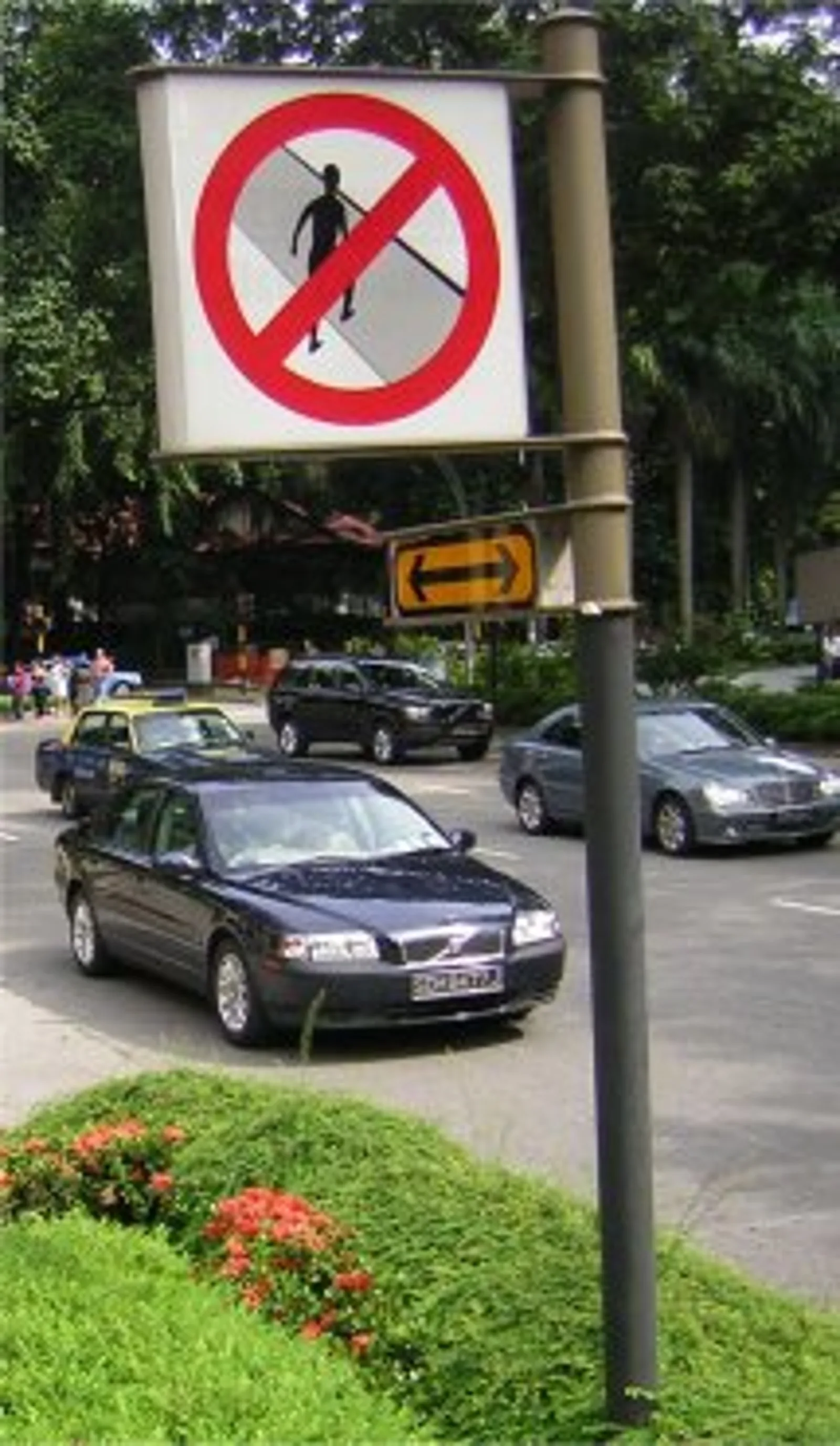
From Kansas jay drivers and a 1912 arrest to Los Angeles in 1925: how a word became an offence, and why some call the idea motonormative.
Jaywalking began as a 1905 Kansas term for drivers on the wrong side of the road, then shifted to pedestrians. Los Angeles made it a widely effective offence in 1925. Laws vary: the UK has none, Singapore fines it, and critics of car-centric streets call the idea motonormative.
The first jaywalkers were drivers. In 1905 the word "jay" was applied in Kansas to people steering horse-drawn carriages and cars down the wrong side of the street, and only later did it slide across to the people on foot. By 1925 Los Angeles had turned the new meaning into a criminal offence, using legislation that the motor lobby wrote.
Today jaywalking is illegal in some places, ignored in others and unknown in many. Behind the law sits a wider idea, motonormativity, which treats the way streets favour cars as something people no longer notice.
Where did the word jaywalking come from?
Jaywalking means walking in or across a roadway in a way that breaks traffic rules. The word began in the United States as a variation on "jay-driver", with "jay" meaning a greenhorn or rube. The earliest references to this behaviour in the street, from Kansas in 1905, concerned the badly behaved drivers, and the term spread quickly to pedestrians. By 1909 the Chanute Daily Tribune was warning that the jay walker deserved as much attention as the jay driver and was nearly as big a nuisance.
Two popular theories, that the word describes the J-shaped route a jaywalker might follow or comes from "jake walk", an old term for a drunkard's gait, have no historical support. What is documented is a run of Kansas City moments. A 1912 report in Popular Mechanics said the city used the term for pedestrians who ignore corner crossings and cut across the middle of the block or diagonally through intersections. Kansas City had approved an ordinance against diagonal crossing on 19 July 1911, and the first arrest for "jay walking" followed at 6:15pm on Thursday 25th January 1912, when Samuel Hebel was stopped at 10th and Main.
The word was not welcomed everywhere. In 1915, when New York's police commissioner Arthur Woods wanted to call anyone crossing mid-block a jaywalker, the New York Times objected in print, calling the word highly opprobrious and shocking. The Oxford English Dictionary's earliest citation dates from 1917. According to the historian and transport advocate Peter D. Norton, the pro-automobile lobby promoted the word in the 1920s, and in the United States today it is often used as a synonym for crossing the street illegally.
The first jaywalkers were drivers.
How did jaywalking become an offence?
Originally, American law held that all persons had an equal right in the highway, with each user taking due care not to injure the others. Then came the car. As cars arrived in the early 20th century, clashes on the street grew deadlier, yet most people had little sympathy for motorists or for first attempts to police walkers. The American car industry and allied organisations answered with public campaigns that framed pedestrians, newly labelled jay-walkers, as a problem of the new motoring age. In time streets became the province of vehicles, practically and legally.
Los Angeles passed the first widely successful ban in 1925, with a law drafted by the auto lobby, and other American cities followed with similar ordinances. The word itself is not a historically neutral one.
Is jaywalking illegal? How the laws vary
| Place | What the rule says | Penalty or enforcement |
|---|---|---|
| Singapore | Offence to cross within 50 metres of a crossing without using it | $50 fine for a first offence; repeat offenders $1000 and 3 months in jail, rarely imposed |
| Zimbabwe | Illegal under traffic laws gazetted in 2013 | Jail of up to six months, or a fine of 7,238.00 Zimbabwean dollars (about $20) |
| India | Not explicit; covered by "obstruction of traffic" in state and city laws | Fines of 100 to 500 rupees depending on jurisdiction |
| Iran | Crossing within 150 metres of a crossing point is banned, as is crossing on red; in place since the 1970s | Fines of 300,000 to 2,000,000 rials (US$9 to US$60) in 2009; almost never enforced |
| Philippines | Not illegal nationally; cities may ban it by ordinance | A pedestrian injured while jaywalking may forfeit damages where their own negligence contributed |
| United Kingdom | No jaywalking law | Highway Code relies on pedestrians' own judgement and the Green Cross Code |
The patchwork reflects a simple fact: in many countries the word is not used and, apart from high-speed roads such as motorways, no law limits where pedestrians can cross. Legal texts there use different concepts, such as the rules for pedestrians in the Vienna Convention on Road Traffic. Even a signatory such as the United Kingdom has no jaywalking law. Some municipalities that once criminalised jaywalking have since legalised or decriminalised it.
Elsewhere the detail differs. Hong Kong makes it an offence to cross inside the zigzag area around a zebra crossing, within 15 metres of other crossing points, or at a signalled crossing on red. In Belgium, where the limit is above 30 km/h (20 mph), walkers must use a marked crossing if one is within 20 metres. Israeli regulations tell pedestrians to cross at a "nearby" crossing or intersection, and the courts have ruled that the word "nearby" was left vague on purpose and must be judged case by case.
In Singapore, 8,650 people were caught jaywalking and fined in 2011, 1,758 were prosecuted between January and March 2012, and 2,409 fined in the same quarter of 2013. In the Philippines the 1964 Land Transportation and Traffic Code makes drivers yield to pedestrians on crossings in commercial or residential areas, and pedestrians yield to vehicles anywhere else, though crossing an expressway on foot is illegal and Metro Manila has an ordinance from 1995 against crossing outside crosswalks. In 2007 the Supreme Court applied Article 2179 of the Civil Code, ruling that a pedestrian injured while jaywalking may forfeit damages if their own negligence contributed.
China has tightened control as car traffic grew and has tested facial recognition to identify offenders, showing their photos on large public screens. The system has flaws: it once displayed the businesswoman Dong Mingzhu after misreading her image on a bus advertisement as a person crossing illegally.
Europe and the motorway rule
Many European countries ban pedestrians from motorways and expressways but allow them on ordinary roads, in line with the Vienna Convention, though traditions vary and Ireland follows the convention less rigorously than some. Pedestrians account for 10 per cent of motorway fatalities, as 217 pedestrians died on EU motorways in 2012 and 847 over the years 2010 to 2012. The share is 20 per cent in Poland, 17 per cent in Great Britain, 15 per cent in Spain and 10 per cent in France, and includes drivers who left a broken-down vehicle and workers in work zones.
Why do people jaywalk?
The reasons are mostly practical: convenience, a belief in the right to move freely, and sometimes personal safety. Reaching a crosswalk can mean a long detour. Law alone does not explain behaviour: signalised crossings carry comparable restrictions in Copenhagen and New York, but New Yorkers jaywalk far more often.
Cars blocking crosswalks in congestion, or stopping too far forward, push walkers out of them. Signals synchronised for cars give motorists green waves, but not always walkers, who may be told to wait at cross streets where almost nothing is coming. Some people dislike dealing with traffic from several directions at an intersection, whereas away from one they need to watch at most two. Others want to avoid the extra emissions of vehicles stopping and starting. In rural and suburban areas a lack of sidewalks pushes people into the road, and wide roads or distant crossings encourage informal crossings.
A study of behaviour in Montreal and Quebec City found that a phone in the hand made crossing on red less likely, whereas watching the traffic was linked to illegal crossing more than four times as strongly. Signals that need a button pressed cannot be used by observant Orthodox Jews on the Sabbath.
Marking an unsignalised crossing does not automatically make it safer: where drivers are likelier to yield, walkers take less care than at unmarked spots. In the United States nearly 60 per cent of pedestrian deaths happen outside crosswalks, while fewer than 20 per cent happen close to one, and police departments often run education and enforcement campaigns against jaywalking.
What is motonormativity?
Motonormativity, also written motornormativity and nicknamed windshield bias, car blindness or "car brain", is an unconscious bias in which the social norms of owning and using a private car, and their effects, are assumed to be natural, universal, inevitable and neutral. It is a systemic bias in car-centric societies, and it is not limited to drivers: people who do not drive show it too, and it affects those who cannot drive, because of age or disability, most.
Ian Walker, a psychologist at Swansea University, coined the term in a 2023 British study with Alan Tapp and Adrian Davis, both of the University of the West of England, and Tara Goddard repeated the work in the United States in 2024. Earlier, Paul Salopek, who was retracing ancient human migration routes on foot, dubbed the mental distance cars put between drivers and the world outside "car brain".
Why the bias forms
In the century since the car went mainstream, the early public opposition to its dangers has been largely forgotten, partly through automotive industry propaganda and advertising. Urban planning has made cars essential in many places, and cars have become symbols of status, identity and control. Walker proposes that people conflate all travel with driving, and the environmental and social costs of cars are hard to calculate, so they are overlooked. Cultural narratives that elevate drivers and stigmatise pedestrians and cyclists reinforce it, and people absorb them from friends, family, observed behaviour and the built environment. Tapp attributes some people's slide into pluralistic ignorance to media misinformation. The journalist Sarah Goodyear suggests that necessity forces drivers to ignore the risks, since thinking about them would be debilitating. For drivers there is a sunk cost too, and because the money for a car is not paid at each use, as a fare is, it is often undervalued.
What it looks like in practice
According to the studies, people are significantly more accepting of negative effects of cars than of comparable non-car scenarios. Attempts to cut car use are often misread as attacks on freedom of movement, and even minor inconveniences to motorists can be treated as unacceptable. The bias has been documented worldwide, not just in North America. Examples include building a hospital outside a city, which makes it harder to reach for people without a car, and the assumption that all adults hold driving licences, which can reduce the usefulness of other identity documents. In 2024 California enacted a law against employment discrimination based on driving licence status.
Walker points to road-safety campaigns that urge children to wear bright clothes as an example, since they present traffic as a hazard that others simply have to dodge, which would be called victim blaming in other settings. The bias also favours passive, euphemistic wording such as "accident". Road deaths, a leading cause of death in the United States, draw less demand for radical fixes than heart disease and cancer do, and traffic fatality is twice as prevalent as murder there. Walker's comparison is with smoking: tolerance of car exhaust, he argues, follows different standards from tolerance of cigarette smoke. A stolen parked car is also thought to deserve a stronger police response than other stolen belongings, whose owners are seen as more at fault for leaving them in the street.
Where the two ideas meet
The jaywalking story and the motonormativity concept describe the same shift from different sides. Norton describes campaigns that turned a drivers' insult into a label for pedestrians; researchers of motonormativity list narratives that stigmatise pedestrians among the forces that sustain car dominance. Elsewhere the law already puts the duty on drivers: in India drivers must yield at unsignalled and marked crossings, in the Philippines they yield on crossings in residential and commercial areas, and in Belgium marked crossings are required within 20 metres on faster roads.
Where the law and the debate are heading
The direction of change is uneven. Some cities have decriminalised jaywalking, China is experimenting with facial recognition, and California acted in 2024 on driving-licence discrimination. The 2023 motonormativity study has been replicated in the United States, and the concept is now used to question how streets, offences and language are framed.