From a 65:1 air-fuel ratio to a petrol engine with no spark plug, how thin mixtures save energy, why NOx and control problems got in the way, and who tried anyway.
Lean burn runs an engine on excess air, as thin as 65:1 against the 14.64:1 chemical ideal, to cut throttling losses and hydrocarbons, but it needs complex NOx control. HCCI compresses a lean mixture until it self-ignites, giving diesel-like efficiency but difficult control.
An ordinary petrol engine takes in about 14.7 parts of air for every part of fuel by mass. A lean-burn engine can run at up to 65:1. That thin mixture saves fuel and slashes hydrocarbon emissions, yet it has never become the default, because it fights with the catalytic converter that cleans up almost every modern petrol exhaust.
Homogeneous charge compression ignition, usually shortened to HCCI, pushes the idea to its limit. It drops the spark plug entirely and lets a lean, well-mixed charge light itself under compression. The result promises diesel-like efficiency with petrol-like emissions, and a long list of control problems.
What is lean burn and what does it save?
Lean burn means burning fuel with a large excess of air. The chemically ideal ratio for petrol, the stoichiometric point, is 14.64:1 by mass, and a lean-burn engine goes well beyond it. All that spare air carries away far fewer unburnt hydrocarbons.
The bigger prize is at the throttle. An engine is sized for the power needed to accelerate, yet most of its life is spent far below that, cruising. Normally the driver cuts power by partly closing the throttle, and dragging air past that restriction wastes energy. Thin the mixture instead, and the engine makes less power with the throttle nearer to fully open. Efficiency in ordinary driving, below the engine's maximum torque, can then rise.
Engines built for lean burning can also use higher compression ratios, which helps performance and fuel use as well as keeping hydrocarbons low. The very thinnest mixtures can only be achieved with direct injection.
A spark plug fixes the moment of ignition in a petrol engine, and the injector does it in a diesel. HCCI has no such trigger.
Why did lean burn not take over?
The catch is nitrogen oxides. A lean engine needs a complicated catalytic converter system to deal with NOx. It also sits badly with the three-way converter fitted to modern petrol cars, which needs a balance of pollutants at the exhaust port so that it can carry out its oxidation and reduction reactions together. For that reason most modern engines cruise and coast down at or close to the stoichiometric point.
Diesels are a curious case. Measured by the total volume of the cylinder, every diesel burns lean. But fuel and air are not mixed well beforehand, and the burn happens mostly around tiny droplets of fuel where the mixture is rich. Those fuel-heavy pockets are where particulates come from.
Who built lean-burn engines, and how far did they push the mixture?
| Maker | System | Details |
|---|---|---|
| Chrysler | Electronic Lean-Burn, 1976 to 1989 | Spark control computer; open-loop versions passed 1976 and 1977 US Federal rules without a catalytic converter |
| Toyota | 4A-ELU with TTC-L, 1984 | First engine in the world with lean-burn control using a lean mixture sensor |
| Mitsubishi | Vertical Vortex (MVV), 1991 | Air-fuel ratio as high as 25:1; 10-20% better economy in bench tests |
| Honda | Stratified-charge lean burn | Average ratio up to 22:1, richer mixture near the spark plug |
Chrysler's Electronic Lean-Burn, fitted to many of its vehicles from 1976 through 1989, was less an engine than a brain. A spark control computer set ignition timing from manifold vacuum, engine speed and temperature, throttle position over time and incoming air temperature. It drove the ignition coil directly, and the distributors had no vacuum or centrifugal advance. The open-loop versions were clean enough to pass US Federal rules in 1976 and 1977, and Canadian rules through 1980, with no catalytic converter. As rules tightened from 1981 the closed-loop version arrived, with an oxygen sensor and a feedback carburettor. Open-loop systems lingered to 1990 in markets with lax rules, for example on the Mexican Chrysler Spirit, and the control strategies stayed in use through 1995 on Chrysler throttle-body injection engines.
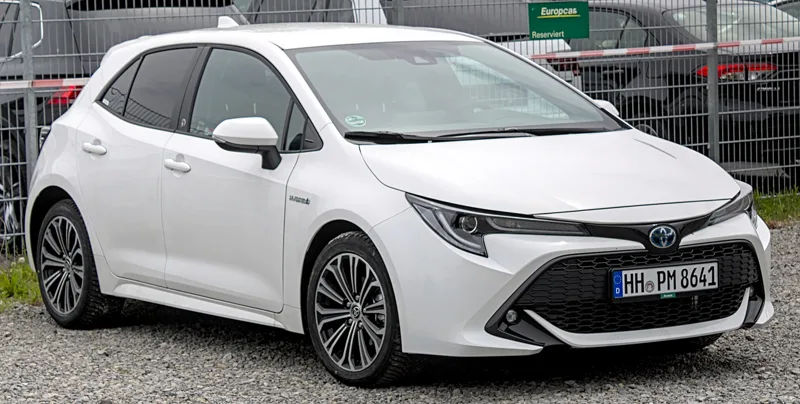
Toyota's 4A-ELU, released in 1984, was the first engine in the world with a lean-burn control system built around a lean mixture sensor in the exhaust. Toyota called the system TTC-L, for Toyota Total Clean-Lean-Burn, and it replaced an earlier exhaust-recirculation approach, TTC-V, on the Carina T150 in Japan. To keep thin mixtures lit, Toyota gave each cylinder its own injection volume and timing, and fitted platinum spark plugs and strong igniters. In the lean-burn 1587cc 4A-FE and 1762cc 7A-FE, each cylinder has two inlet and two exhaust valves, and butterflies restrict flow in every second inlet runner in lean mode to create swirl in the chamber. Their compression ratio is 9.5:1. The 1998cc 3S-FSE is a direct injection petrol lean-burn unit with a ratio of 10:1.
Mitsubishi's MVV, first used in the 1,468 cc 4G15 four-cylinder in 1991, shapes the air inside the cylinder. It has two intake valves and one exhaust valve, and the two intake ports are the same size but only one receives fuel. That sets up two vertical vortices, one of air and one of fuel and air, which stay as separate layers through most of the compression stroke. The spark plug sits nearer the fuel-rich vortex, so ignition starts where fuel density is higher, and the flame then spreads through the small turbulences created as the layers collapse. Mitsubishi quoted a ratio as high as 25:1. In bench tests on the Japanese 10-mode urban cycle, it says, economy improved by 10-20% over a conventional multi-port injection engine of the same displacement. The MVV engine idles at 600 rpm against 700 for the conventional one.
The control comes from a linear oxygen sensor. A standard sensor works like an on-off switch set at a single ratio, whereas the lean sensor measures across a range from about 15:1 to 26:1.
Honda's newer systems use very precise injection, strong swirl, a linear air-fuel sensor and a lean-burn NOx catalyst. The mixture is stratified: richer near the spark plug tip, where ignition needs it, and progressively leaner elsewhere, for an average of up to 22:1. The older CVCC engines used a small pre-chamber fed with the ideal ratio, which lit a larger, leaner charge in the main chamber and cut emissions without a catalytic converter. Those were carburetted engines, and the imprecision of carburettors limited the fuel economy the idea could deliver. Honda's lean-burn has to be confined to light load and lower revs, with a cut-off at higher speed, since thin mixtures burn slowly and combustion must be finished before the exhaust valve opens. The cars that used it include the 1992-95 Civic VX, the 1996-2005 Civic HX, the 2002-05 Civic Hybrid and the manual 2000-06 Insight.
Nissan's QG engines are aluminium double-overhead-cam four-valve designs, with variable valve timing and NEO Di direct injection as an option. The 1497cc QG15DE runs 9.9:1 compression and the 1769cc QG18DE 9.5:1.
How do big gas engines run lean?
Heavy-duty engines on natural gas, biogas or LPG often use lean burn. Some run lean all the time, while part-time designs run lean only at low load and high engine speed. These engines admit twice as much air as complete combustion needs in theory, which lowers combustion temperature and NOx. Their theoretical thermal efficiency is higher, though transient response and performance may suffer in some conditions. They are almost always turbocharged, which gives power and torque that stoichiometric engines cannot reach because of their higher combustion temperatures.
Many use a precombustion chamber in the cylinder head. A lean mixture is compressed hard in the main chamber, while a much smaller volume of richer mixture in the precombustion chamber is lit by a spark plug and spreads a flame into the main charge. The two-stage burn gives low NOx and no particulates, and higher compression ratios improve thermal efficiency. Makers include MTU, Cummins, Caterpillar, MWM, Jenbacher, Wartsila and Rolls-Royce.
How does an HCCI engine work?
Petrol engines mix fuel and air in advance and ignite them with a spark. Modern direct injection diesels spray fuel into air that compression has already heated. HCCI borrows from both. Fuel goes in during the intake stroke, as in a petrol engine, but nothing ignites it. Compression raises density and temperature until the entire mixture reacts at once.
The difference from a diesel is in the timing of the injection. Stratified charge compression ignition injects later, during the compression stroke, and burns at the boundary between fuel and air. That raises emissions but allows a leaner, higher-compression burn and greater efficiency. HCCI aims for diesel efficiency with petrol-engine emissions, and it needs microprocessor control and a firm physical grasp of the ignition process.
The idea is not new. HCCI is essentially an Otto cycle, and it was popular before electronic spark ignition arrived. The hot-bulb engine used a hot chamber to help vaporise fuel, and heat plus compression brought on combustion. Diesel model aircraft engines work on a similar principle.
What does HCCI offer?
Because the mixture is lean, an HCCI engine can run diesel-like compression ratios above 15, and that delivers efficiency around 30% higher than a conventional spark ignition petrol engine. Peak temperatures are much lower than in a spark engine, so NOx is almost negligible, and there is no soot. It can run on petrol, diesel and most alternative fuels, and it avoids throttle losses, which lifts efficiency further.
The low temperature also causes the problems. Burning is incomplete near the chamber walls, so carbon monoxide and hydrocarbon emissions before the catalyst are higher than in a typical spark ignition engine, partly through trapped crevice gases. Because the exhaust still contains oxygen, an oxidising catalyst can remove them, whereas NOx is extremely low without any converter.
Why is HCCI so hard to control?
A spark plug fixes the moment of ignition in a petrol engine, and the injector does it in a diesel. HCCI has no such trigger, so combustion starts when pressure and temperature happen to be high enough. Engineers must arrange the conditions so that this happens at the right moment, cycle after cycle.
Several problems follow. Cold starting is difficult. High rates of heat release and pressure rise wear the engine. The torque range is narrow, held back at low loads by the limit of lean flammability and at high loads by the pressure the cylinder can take. If auto-ignition arrives too soon or carries too much chemical energy, the burn is so fast that cylinder pressure can wreck the engine. That is why HCCI normally runs on lean overall mixtures. It is also unlike knock, where unburnt gas ahead of a spark-ignited flame lights spontaneously and sends a pressure wave through the cylinder.
The levers available include compression ratio, temperature and pressure of the inducted gas, fuel-air ratio and the amount of exhaust retained or re-inducted.
- Compression ratio. A movable plunger in the cylinder head changes the geometric ratio, as in diesel model aircraft engines. Shutting the intake valve either very late or very early, using variable valve timing, lowers the effective ratio. Both need energy for a fast response, and the implementation is expensive, but effective.
- Intake temperature. Resistance heaters are too slow to act cycle by cycle. Fast thermal management mixes hot and cold air streams quickly enough for that, but it is expensive and its bandwidth is limited by actuator energy.
- Exhaust gas. Hot gas retained from the last cycle advances ignition, while cooled recirculated gas dilutes the charge, delaying ignition and cutting output.
- Valve actuation. Variable valve actuation widens the operating region by controlling either the effective compression ratio or the amount of hot exhaust kept in the cylinder. Electro-hydraulic and camless systems are currently complicated and expensive, whereas mechanical variable lift and duration systems are cheaper.
- Fuel blending. Mixing a fuel with low resistance to ignition, such as diesel, with a more resistant one, such as petrol, moves the timing as the ratio changes. The blend can be made upstream in liquid form, or in the chamber with one fuel in the port and the other injected directly.
Another route is partially premixed charge compression ignition, a compromise that keeps some of the control of diesel injection with lower soot. Injection is timed so that a spread of air-fuel ratios exists when ignition begins, so different regions light at different times and heat release slows. High exhaust recirculation and diesel fuel that resists ignition more like petrol allow longer mixing and fewer rich pockets.
Why is power such a problem for HCCI?
In a flame-propagation engine only part of the fuel burns at any moment, so peak pressure and heat release stay low. In HCCI the whole charge burns in a very short interval. The engine needs a stronger structure to withstand that, and adding more fuel makes the peaks worse. Many workable control strategies also preheat the charge, which reduces its density and with it the power.
Proposed remedies include fuels with different autoignition properties, which lower the heat release rate and let the fuel-air ratio rise, and thermal stratification so that different parts of the charge burn at different times. A third is to run in HCCI mode only at part load, switching to diesel or spark operation at higher loads. Blending fuels, though, needs significant infrastructure, and dilution with exhaust gas cuts both pressure and output.
A divided combustion chamber takes a different tack. A small auxiliary chamber has a high compression ratio and a larger main chamber a moderate one, held just below its auto-ignition threshold. The lean mixture in the auxiliary chamber ignites itself with no spark plug, and the burnt gas bursts through transfer ports just before top dead centre, setting off the main charge. With this layout the engine need not be built stronger.
Where this goes next
HCCI has not been implemented as widely as spark ignition or diesel injection. The research that keeps it alive aims at its narrow operating range. Work on reactivity controlled compression ignition, which combines fuels of different reactivity such as gasoline and diesel, has been shown to give highly efficient, low-emission running over wide load and speed ranges. Variable valve actuation continues to extend the usable region, with mechanical systems offering a cheaper route than camless ones.
In lean-burn, engine control units now use pre-programmed datasets to hold the air-fuel ratio at the right level across all conditions, lean for cruising efficiency and rich for peak acceleration. Full-range oxygen sensors supply the continuous feedback they need.