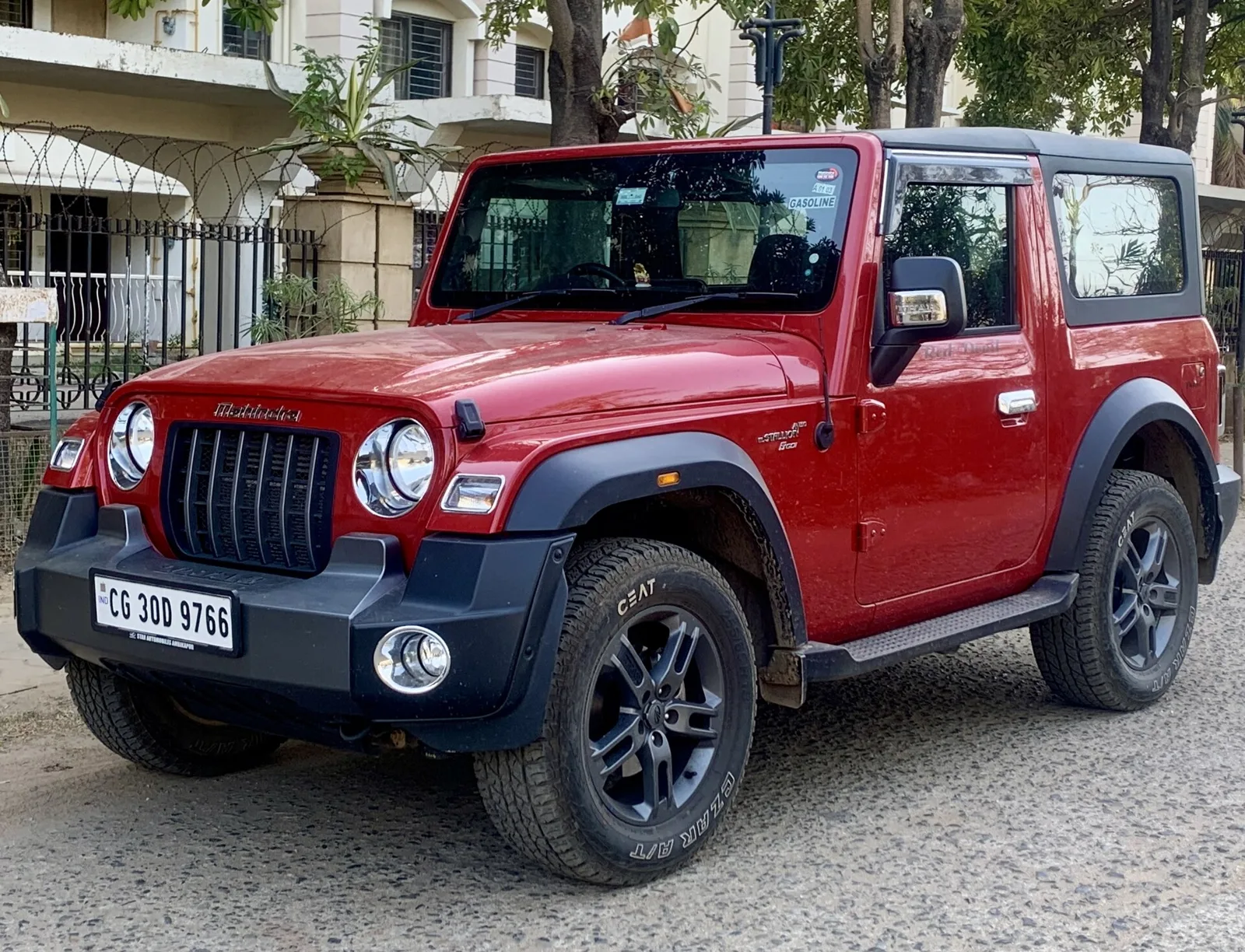
A Jeep-derived off-roader that sold over 185,000 units in its second generation, and a city electric car that Mahindra bought back from British customers at full price.
The Mahindra Thar is a Jeep-derived compact off-roader launched in 2010, now in a second generation that includes the five-door ROXX and the 2026 Thar OG. The e2o was a small electric hatchback with a 120 km range, sold from 2013 to 2017.
In May 2017 Mahindra pulled its e2o electric hatchback out of the British market and bought the cars back from customers at full price. The same company builds the Thar, a boxy off-roader whose second generation had sold more than 185,000 units by August 2024. The two cars could hardly be further apart, and together they sketch an unusually wide carmaker.
What is the Mahindra Thar?
Mahindra & Mahindra's Thar is a compact SUV that first appeared on 4 October 2010 in succession to the Major. It is named after the Thar Desert and was designed to be a rugged, affordable off-roader that could cope with rough ground across India.
Its roots run deep. The Major was itself based on the Mahindra MM540, which had been in production in India since the 1980s, and the design traces back to the Jeep CJ series that Mahindra had built under licence since the 1940s. The Thar replaced the Major.
One carmaker built a boxy descendant of the Jeep CJ and a small electric hatchback it later bought back from customers at full price.
What was the first-generation Thar like?
The 2010 Thar came with a 2.5-litre turbocharged diesel rated at 47 kW (63 hp; 64 PS), with 182 N m (134 lb ft) of torque. Two trims were sold, the DI 2WD and DI 4WD, with soft-top versions and a seven-seat option that can be converted into a two-seater.
Entry-level DI 2WD buyers got a soft top and no air conditioning; the DI 4WD came with a hardtop and air conditioning. The Thar CRDe followed in 2015, named for its common rail diesel engine. Output rose to 78 kW (105 hp; 106 PS), with torque of 247 N m (182 lb ft), and safety kit now included airbags and ABS. Two trims were offered, the CRDe 4WD and a version with air conditioning.
What is the Mahindra Roxor?
The Roxor is a variant of the Thar for the United States, revealed on 2 March 2018 by Mahindra Automotive North America. Unlike the Thar, it is not street legal. Mahindra sells it as an off-road side-by-side that tops out at 45 mph.
Kits arrive complete and are put together at Auburn Hills, in Michigan. A 2.5-litre four-cylinder turbodiesel provides 62 hp and 144 lb-ft through a five-speed manual, with an automatic as an option. It has two seats, a 148-inch body and a 96-inch wheelbase.
How did the Thar change in its second generation?
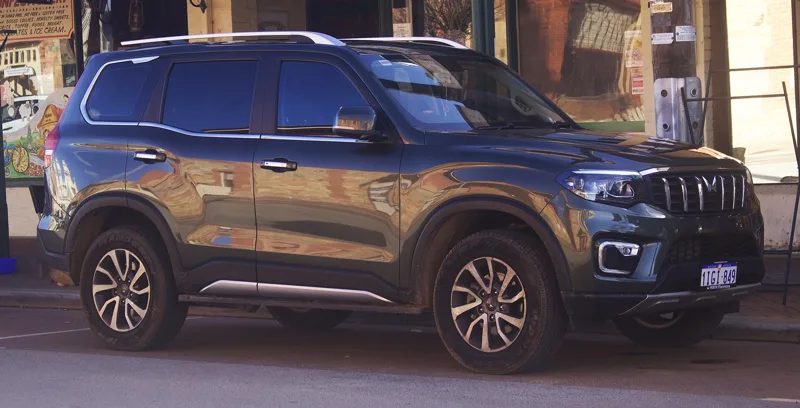
The second-generation Thar, code W501, was introduced on 15 August 2020 as a complete redesign and went on sale in October 2020. The styling is sharper, with a bold grille, LED lights and a hardtop, and the engine choice is a 2.0-litre petrol or a 2.2-litre diesel.
Both engines can be paired with a six-speed manual or a six-speed torque-converter automatic made by Aisin. The new Thar also has updated suspension and driveline parts, including a multi-link rear suspension, plus a touchscreen, a reversing camera and an adventure statistics display. Trims are the base AX and a more upmarket LX, and the roof can be a hard top, a soft top or a soft top with a fold-down mechanism. In 2023 a rear-wheel-drive version with the 4D15 engine joined the line-up on the W503 Thar.
By August 2024 the second-generation Thar had sold more than 185,000 units.
What does the Thar ROXX add?
The Thar ROXX, code W502, is a five-door version of the Thar. Mahindra teased it on 20 July 2024 and launched it on 15 August 2024. It brings a redesigned grille, LED headlights and tail lamps, a 10.27-inch touchscreen, a panoramic sunroof and ADAS driver assistance.
White seats were dropped for a Mocca Grey colour. The ROXX offers the D22 mHawk diesel with four-wheel drive, and the G20 mStallion petrol only in two-wheel-drive form, both with a six-speed manual or torque-converter automatic. Autocar India named it Car Of The Year in 2024.
What changed in the 2025 and 2026 Thar?
In October 2025 Mahindra launched an updated second-generation Thar in India, keeping the engine range but changing the look and cabin. On 22 September 2026 it followed with the facelifted three-door Thar OG, priced from INR 10.32 lakh to INR 18.99 lakh ex-showroom, with deliveries beginning on 11 October 2026.
The October 2025 car gained a grille painted in the body colour, a two-tone bumper with silver details, and two fresh paints, Tango Red and Battleship Grey, while keeping its round headlamps and boxy shape. Inside came an all-black cabin, a reworked dashboard, rear AC vents, separate armrests, a grab handle on the A-pillar and a steering wheel borrowed from the XUV700. A 10.25-inch touchscreen runs Android Auto and Apple CarPlay and shows off-road statistics, and the car also got a reversing camera, rear wash-wipe and connected telematics. Engines remained a 2.0-litre turbo-petrol, a 1.5-litre diesel and a 2.2-litre diesel with six-speed manual or automatic gearboxes, in rear- or four-wheel drive. At launch the range was priced between INR 9.99 lakh and INR 16.99 lakh, ex-showroom.
The Thar OG is built on a new-generation platform. It shares its LED headlamps with the ROXX. Under the skin come stronger mHawk diesel and turbo-petrol engines, electric power steering and DAVINCI, a frequency-dependent damper system. Six airbags are standard, along with disc brakes at every wheel and electronic stability programme. Its rivals include the Force Gurkha and the Maruti Suzuki Jimny, which also use body-on-frame construction.
How safe is the Thar?
Global NCAP crash-tested the second-generation Thar in 2020 in its basic specification of two airbags and Isofix anchorages and awarded four stars for adult protection. The passenger compartment stayed stable in the offset frontal test, but the footwell ruptured and the knee areas were penalised, which kept it from five stars.
Mahindra then asked for an ECE side impact test, which the car passed despite having no side airbags. Global NCAP also objected to a basic trim with side-facing rear seats that had no three-point belts or Isofix anchorages, awarding no stars for child protection and warning Mahindra to withdraw it. It published a result only after sales of that variant stopped, so forward-facing seats became the basic specification.
The optional electronic stability control also went through testing. It met the UN's minimum yaw-rate requirements but showed unstable behaviour, tending to roll, so Global NCAP called for an improvement. The Thar has no side airbags for body or head, even as an option.
What is the Mahindra e2o?
The e2o is an urban electric hatchback, previously called the Reva NXR, built by Mahindra Reva between 2013 and 2017. It succeeded the REVAi, known in Britain as the G-Wiz, and uses Reva technology. Range is 120 km (75 mi).
It is a two-door, four-seater with an automatic transmission, and an app lets the owner lock the car and run the air conditioning. The lithium-ion pack needs five hours to charge fully; the car weighs 830 kg (1,830 lb) and tops out at 90 km/h (56 mph). It also has GPS navigation, a touchscreen, keyless entry, a start button and regenerative braking. Forbes wrote that it would shield buyers from rising fuel prices and give relief from exhaust fumes on India's polluted streets.
Where did the e2o come from?
The e2o's story starts with Reva, started by Chetan Maini in 1994, in partnership between Bengaluru's Maini Group and Amerigon Electric Vehicle Technologies of the United States. Its sole aim was an affordable compact electric car. The REVA launched in 2001 and had sold more than 4,000 units in 26 countries by mid-March 2011.
Mahindra & Mahindra bought Reva in May 2010, and in 2013 Fast Company listed Mahindra Reva among the world's 50 most innovative companies. The G-Wiz had become the world's best-selling electric vehicle in 2006, and by 2008 over 950 had been sold in Britain, making it the country's best-selling electric car at the time. The Nissan LEAF passed that record with over 14,000 sold by 2016, and then the Mitsubishi Outlander, with more than 23,000 by the end of 2016.
The Reva NXR concept first appeared at the 2009 Frankfurt Motor Show. Production was first planned for late 2010, then late 2012 for India only, and the car finally launched in March 2013. Mahindra said it waited on a decision about consumer tax benefits for electric cars, and went ahead even though the incentives were left out of the 2013-14 budget.
What technology does the e2o carry?
The e2o was designed to be managed remotely. Telematics lets Mahindra's support centre read the battery condition and unlock a small reserve charge through a feature called REVive, and daily remote diagnostics flag existing or impending problems. The smartphone app shows state of charge and sends reminders, and can also start or stop charging, lock or unlock the doors, and schedule the air conditioning.
Two further technologies stretch the range: regenerative braking, which feeds energy back into the battery under braking, and Sun2Car, which charges the car from solar power while parked. The exterior concept was started with DC Design, and Reva's own research and styling team detailed the production interior and exterior.
Production is in Bengaluru, at what is described as India's first Platinum certified automobile plant. Daylight and natural ventilation do much of the work there, solar panels supply 35 percent of the power, and the plant is claimed to beat a conventional factory on efficiency by 60-70 percent.
What did the e2o cost, and how did it sell?
Mahindra put INR 100 crore (US$18.5 million) into the car and a plant with capacity for 30,000 units a year. It projected only about 400 to 500 sales a month, with Delhi accounting for 150 to 200. The e2o launched in March 2013 at INR 6.5 lakh (US$11,900) to INR 8.5 lakh (US$15,670), before subsidy.
Sales fell short. By mid-November 2013 only about 400 had found buyers across India, Nepal and Sri Lanka, and Mahindra said it was scaling back plans for other electric vehicles because government incentives were slow to arrive. The company had expected Delhi to be its largest market, thanks to a 29% purchase subsidy, and had set up more than 250 charging stations, 95 of them in Delhi and over 100 in Bengaluru.
In August 2014 Mahindra launched the e2o Premium with electric power steering, a 120 km (75 mi) range and a price of INR 5.72 lakh ex-showroom in Delhi, plus an energy fee of Rs. 2,999 a month. That fee was later renamed the e2o care protection plan. An ownership programme called Goodbye Fuel, Hello Electric split the cost into an initial price and the plan, with Mahindra Reva retaining the battery, guaranteeing how it performed, and promising round-the-clock help and a loan car while a battery was being repaired. The e2o was also sold in Nepal, Bhutan and Bermuda.
Why did the e2o leave Europe?
Europe had treated the earlier Reva as a heavy quadricycle instead of a car, which exempted it from most crash-test rules thanks to its low weight and power. The e2o had to meet the same rules as any other car, including a crash test, ABS and airbags, and a 2013 crash test in Spain saw it clear every safety test.
Mahindra had planned a European launch in the first quarter of 2014, but the British launch only happened in April 2016. The e2o was discontinued in India in November 2016, as production of the larger e2o Plus began, although the Mahindra Electric chief executive said it would continue to sell in the export market. In May 2017 it left Britain because of poor sales and the trading situation under Brexit, and the company bought the cars back at full price.
How do the Mahindra models compare?
| Model | Introduced | Power | Notable fact |
|---|---|---|---|
| Thar (first generation) | 2010 | 2.5 L turbodiesel, 47 kW (64 PS) | Soft-top, 4WD and seven-seat options |
| Thar CRDe | 2015 | Common rail diesel, 78 kW (106 PS) | Added airbags and ABS |
| Roxor | 2018 | 2.5 L turbodiesel, 62 hp | Not street legal, US only |
| Thar (second generation) | 2020 | 2.0 L petrol or 2.2 L diesel | Four stars from Global NCAP |
| Thar ROXX | 2024 | Petrol or diesel, 6-speed | Five-door, Car Of The Year 2024 |
| e2o | 2013 | Lithium-ion battery, 120 km range | Top speed 90 km/h, five-hour charge |
What did the Thar OG add, and what became of the e2o?
For the Thar, the near-term story is the Thar OG, whose deliveries began on 11 October 2026 after its 22 September launch. It lists six standard airbags and electronic stability programme, where the Thar crash-tested in 2020 had two airbags in its basic specification.
For electric cars, the e2o is history. Mahindra stopped selling it in India in November 2016 and in Britain in May 2017, and the company's electric arm also works on Sun2Car, Car2Home and Quick2Charge, energy products aimed at sustainable mobility.