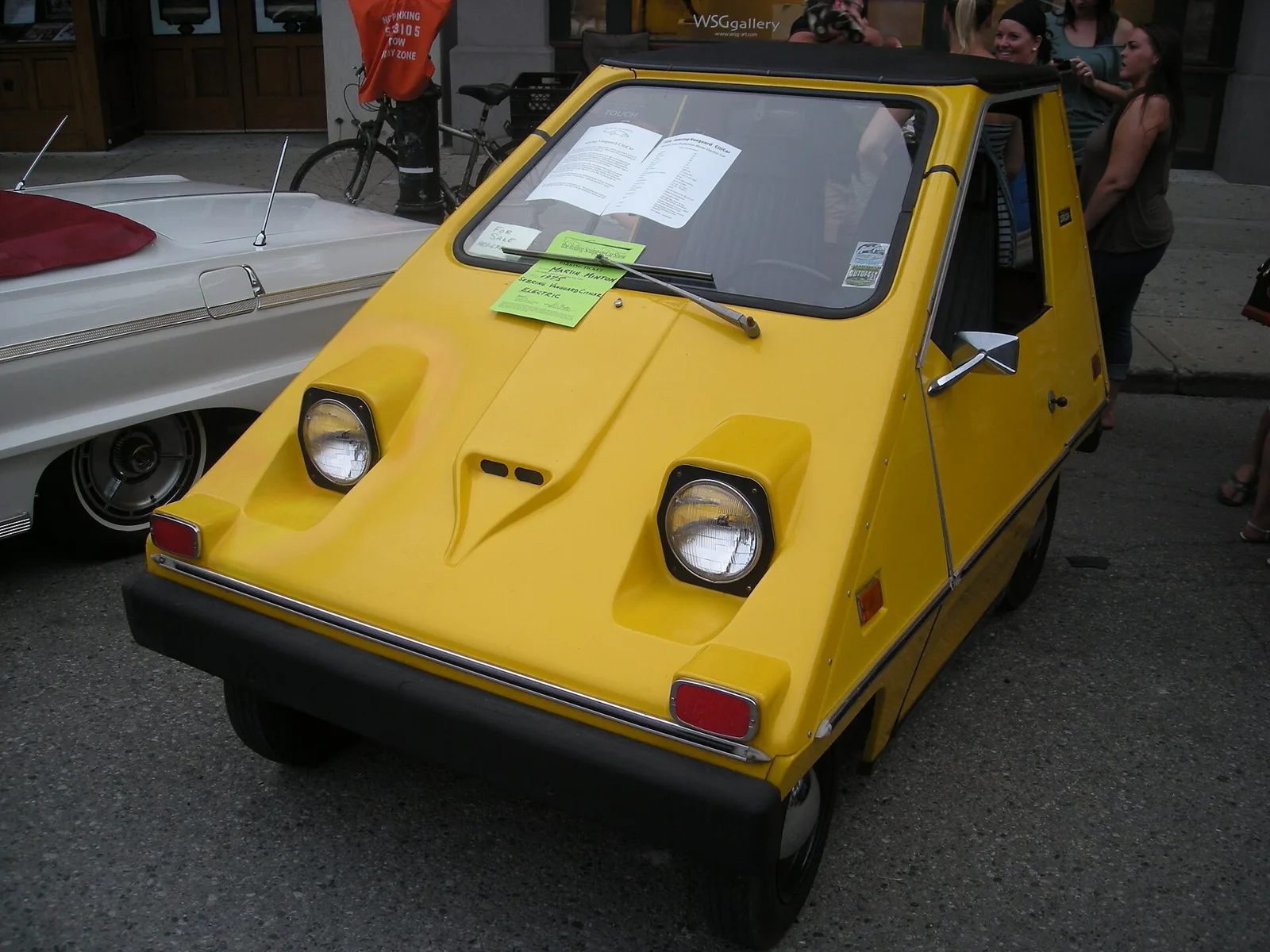
A golf-cart derived runabout that was the sixth-largest US carmaker in 1976, an Indian micro car sold as the G-Wiz and a California sedan reworked from a Chinese petrol car.
A neighborhood electric vehicle is a US category of battery car, usually limited to 40 km/h (25 mph) and 1,400 kg (3,000 lb). The CitiCar of 1974 to 1977, the Indian REVAi sold as the G-Wiz, and the 2012 Coda each tried to make small electric cars work.
In 1976 a wedge-shaped electric runabout derived from a golf cart made a small Florida firm the sixth-largest car maker in the United States, behind GM, Ford, Chrysler, AMC and Checker, and ahead of Excalibur and Avanti. The CitiCar was as basic as a people mover could be. The CitiCar, the Indian REVAi sold in Britain as the G-Wiz and the short-lived Coda from California each tried a different route to the small electric car, and the REVAi fits the US legal category called the neighborhood electric vehicle.
What is a neighborhood electric vehicle?
A neighborhood electric vehicle, or NEV, is an American category of battery electric vehicle, usually built with a top speed of 40 km/h (25 mph) and a maximum loaded weight of 1,400 kg (3,000 lb). The term was coined in 1992 by the entrepreneur and designer Dan Sturges. Depending on state law, NEVs are limited to roads with posted limits of 56 km/h (35 mph) or less, and in some states 72 km/h (45 mph). They fall under the US Department of Transportation's low-speed vehicle classification, and the battery recharges from a standard electrical outlet.
The low-speed vehicle class was created in 1998 under Federal Motor Vehicle Safety Standard 500. It covers four-wheeled vehicles with a gross weight rating under 1,400 kg (3,000 pounds) and a top speed between 32 and 40 km/h (20 and 25 mph). Dealers cannot legally sell one to go faster than 40 km/h (25 mph), although a buyer can easily modify it to reach 56 km/h (35 mph); at that point it becomes subject to the safety requirements of passenger cars.
Those limits exist because NEVs cannot carry the safety equipment that federal rules demand of full cars; a typical NEV manages 48 km (30 miles) between charges and a battery pack that lasts about three years. Makers must still fit lap or three-point belts, headlights, running and brake lights, reflectors, mirrors and indicators. Wipers are not required, and doors are often optional.
In 1976 a wedge-shaped electric golf-cart derivative made Sebring-Vanguard the sixth-largest US car maker.
Where can you drive a neighborhood electric vehicle?
State rules vary. Federal law lets states add requirements; New York asks for windshield wipers, a window defroster, a speedometer, an odometer and a back-up light. In general an NEV needs a title and registration and a licensed driver. With no airbags required, it is normally kept off highways and freeways. As of February 2012, NEVs were street-legal in 46 states. Ohio classes them as low-speed vehicles, and golf carts as under-speed vehicles.
You see them mostly where there are separate routes for them or slow traffic is the norm. Places designed with NEVs in mind include Avalon in California, Celebration, Lady Lake and The Villages in Florida, and Peachtree City in Georgia. California classes NEVs as zero-emissions vehicles, and has offered a purchase rebate of up to $1,500 for those bought or leased on or after 15 March 2010.
How did the CitiCar start?
Sebring-Vanguard built its first electric vehicle, the Vanguard Coupe, in 1974. The Club Car golf cart was the model, and the 1970s fuel crisis was part of the reason. It was not an immediate success, so the company's founder and president, Robert G. Beaumont, worked with designer Jim Muir to come up with the CitiCar, which still borrowed many mechanical features from the Club Car. Built in Sebring, Florida, it was a small wedge with a flat diagonal front, flat roof and flat, almost vertical back. Early versions had no extra features and were an experiment in minimalist design.
Production ran until 1977, with about 2,300 CitiCars built. Commuter Vehicles, Inc. then bought the design and renamed it the Comuta-Car, producing an estimated 2,144 Comuta-Cars and Vans from 1979. Across all variants, 4,444 units were built up to 1979, more than any electric car assembled in North America since 1945, until the Nissan Leaf overtook it in 2011. Its styling shows up again in the Danish Kewet and the later Norwegian Buddy.
How did the CitiCar models differ?
| Model | Motor | Notes |
|---|---|---|
| SV-36 (first) | 2.5 hp (1.9 kW) | 36 V battery pack; top speed about 40 to 45 km/h (25 to 28 mph) |
| SV-48 (second) | 3.5 hp (2.6 kW) | 48 V battery pack; top speed about 55 to 61 km/h (34 to 38 mph); range about 64 km (40 mi) |
| Transitional (1976 1/2) | 6 hp (4.5 kW) | Improved drive train, heater vents, and on some a better door style with sliding windows |
| Postal Comuta-Van | 12 hp (8.9 kW) | 72 V battery pack; right-hand drive; 3-speed transmission; 3,607 mm (142 in) long |
All vehicles used space frames of welded aircraft-grade aluminium tube and ABS plastic bodies, with solid axles and leaf springs front and rear. The SV-48 measured 2,413 mm (95 in) long and weighed 570 kg (1,250 lb), with eight 6-volt flooded lead-acid batteries. It took 6.2 seconds to reach 25 mph and had a turning circle of 6.7 m (22 ft). The Comuta-Car shifted the batteries out from under the seat into boxes behind the bumpers, which made it about 410 mm (16 in) longer than the 2.4 m (8-foot) CitiCar, and extra frame supports met new DOT standards.
The Postal Comuta-Van was first built under a contract with the United States Postal Service, with one right-hand driver's seat, although some reached the public with a passenger seat and more storage. Comuta-Car production stopped in 1982, and the last factory-built Comuta was a special-order 72 V pick-up in 1986.
What was the REVAi, or G-Wiz?
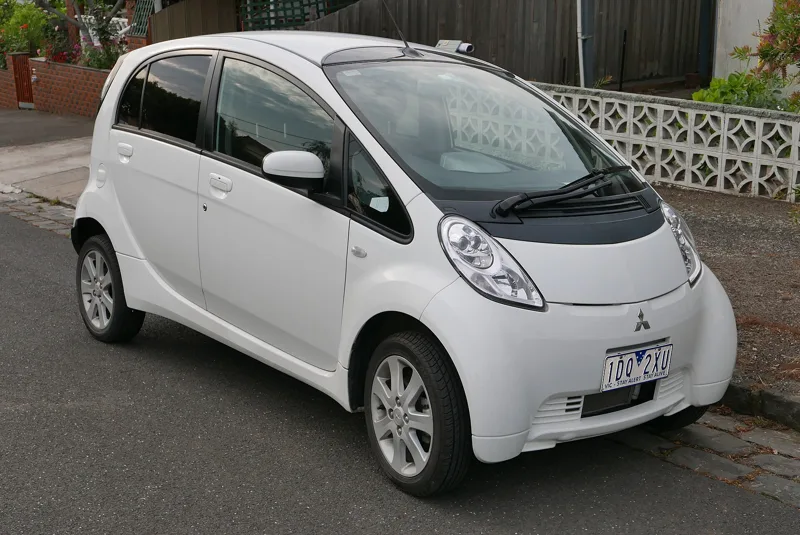
The REVAi was a small electric car made by the Indian Reva Electric Car Company from 2001 to 2012, and sold in the United Kingdom as the G-Wiz. By late 2013 Reva had sold about 4,600 vehicles in 26 countries. India accounted for 55% of sales, 40% of them in Bangalore, and the UK was a leading market, where the G-Wiz was the top-selling electric car for several years, particularly in London. Sales in Britain ended by the end of 2011, and the Mahindra e2o replaced the car in 2012.
It is a three-door hatchback measuring 2.6 m (8 ft 6 in) by 1.3 m (4 ft 3 in) by 1.5 m (4 ft 11 in), with room for two adults and two children and a maximum payload of 270 kg (600 lb). In many countries it does not qualify as a highway-capable car, and it is a neighborhood electric vehicle in the United States and a heavy quadricycle (category L7) in Europe. For the US it could be exported with a speed limiter at 40 km/h (25 mph).
The first model, built from 2001 to 2007, had a 4.8 kW (6.4 hp) DC motor, with eight 6 V, 200 Ah lead-acid batteries under the front seats wired to give 48 V. In January 2008 the REVAi arrived with an AC drive system and a 13 kW (17 hp) peak, raising the top speed to 80 km/h (50 mph). A boost switch gives 40% extra torque. The car weighs 665 kg (1,466 lb), including 270 kg (600 lb) of batteries, and the nominal range is 80 km (50 mi). The REVA L-ion followed in January 2009 with lithium-ion batteries, a lighter 565 kg (1,246 lb) curb weight, a six-hour charge time and a nominal range of 120 km (75 mi).
What did the G-Wiz cost, and what did critics say?
In the UK it started at approximately 9,995 pounds, and as an electrically propelled vehicle it qualified for exemption from the London congestion charge. Prices elsewhere included 11,500 euros for the standard REVA in Ireland and US$13,000 in Costa Rica. In India it sold for 350,000 rupees.
Reception was harsh. Many critics found the car underpowered, unsafe and ugly. The BBC's Top Gear named the G-Wiz its Worst Car of 2007 and blew one up in the same programme, and twenty more were destroyed on The Grand Tour in December 2016.
Was the REVAi safe?
Most European crash test rules do not apply to it, since its low weight and power put it among the heavy quadricycles instead of cars. The UK Department for Transport still crashed a G-Wiz into a deformable barrier at 56 km/h (35 mph) on 24 April 2007, as production cars are tested, and reported serious safety concerns. A Top Gear Magazine test to Euro NCAP specifications at 64 km/h (40 mph) concluded that occupants would suffer serious or life-threatening injuries.
In October 2010 a G-Wiz and a Skoda Octavia collided in London, and the G-Wiz driver was killed. The coroner said the vehicle had been destroyed in a way he had not seen a vehicle destroyed before, but did not recommend further action on its design, and the government went on to order an inquiry into how safe small electric vehicles are. Later REVAi and L-ion models have a reinforced chassis crash tested at 40 km/h (25 mph) in India by ARAI, with front disc brakes and a collapsible steering column, developed in conjunction with Lotus Engineering.
What was the Coda electric car?
The Coda was a four-door, four-passenger electric car made by Coda Automotive, an attempt to cut cost by re-engineering an existing gasoline-powered car, the Hafei Saibao III, rather than building from the ground up. Pininfarina designed the body, which appeared at the 2004 Beijing Auto Show, and the underlying chassis derives from a Mitsubishi Lancer of the late 1990s. The Coda debuted in 2008 as the Miles XS 200 prototype, and in 2009 completed two of the tests needed for Federal Motor Vehicle Safety Standards certification: a full frontal impact at 56 km/h (35 mph) and a 40% offset test at 72 km/h (45 mph).
The Coda had a 31 kWh lithium iron phosphate battery, substantially larger than others in its class, giving the EPA's rated range of 142 km (88 mi), though the company estimated up to 201 km (125 mi) in favourable conditions. The EPA's rating of 73 mpg-e made it the most efficient electric car available in the US by early 2012. Top speed was limited electronically to 137 km/h (85 mph). A 6.6 kW on-board charger worked at twice the rate of the Nissan Leaf and Chevrolet Volt, charging from empty in under six hours on a level-two supply.
What happened to the Coda?
Delays came first. Deliveries first planned for December 2010 slipped to the second half of 2011, then late 2011, then February 2012. The first retail deliveries in the United States were on 19 March 2012, in California only; sales planned for Oregon and Florida in 2013 never took place. The 2012 Coda began at US$37,250, and a larger-battery option priced at US$39,900 was never offered. A total of 78 units were recalled for air bag deployment problems, and the NHTSA stated that both side curtain airbags in all 117 cars sold had to be replaced.
Coda Automotive filed for Chapter 11 on 1 May 2013 with 117 cars delivered in California, saying it would abandon car manufacturing and focus on energy storage. In September 2013 the remaining stock was bought by Club Auto Sales and Ready Remarketing, which offered 50 cars and 100 gliders at a discount, though 11 of the 50 are not legal in the US because of their larger battery. Mullen Technologies later sold the rest as the Mullen 700e until 2019.
How big are the markets for low-speed electric cars?
An estimated 478,771 NEVs were on the world's roads in 2011, according to Pike Research, and the largest markets that year were the United States, with 14,737 sold, and France, with 2,231. The Global Electric Motorcars GEM led in North America, with more than 50,000 sold worldwide since 1998. The Renault Twizy, a heavy quadricycle launched in March 2012, topped plug-in sales in Europe during 2012, and almost 22,000 had been sold by December 2018.
China dwarfs them. Low-speed small electric cars sold 200,000 in 2013, 750,000 in 2015 and 1.2 million in 2016, helped by affordability and the fact that they can be driven without a licence. Most use lead-acid batteries, and the government does not count them as new energy vehicles because of safety and environmental concerns. Their stock was estimated at 3 to 4 million by December 2016. About 1.4 million were sold in 2018, against about 1.1 million normal passenger electric vehicles.
What became of the three cars
The REVAi gave way to the Mahindra e2o in 2012. Coda said it would pivot to energy storage, and its leftovers lived on as the Mullen 700e until 2019. In China, low-speed models were 15 times the sales of normal plug-in passenger cars in 2014, about four times in 2016 and 2.5 times in 2018.