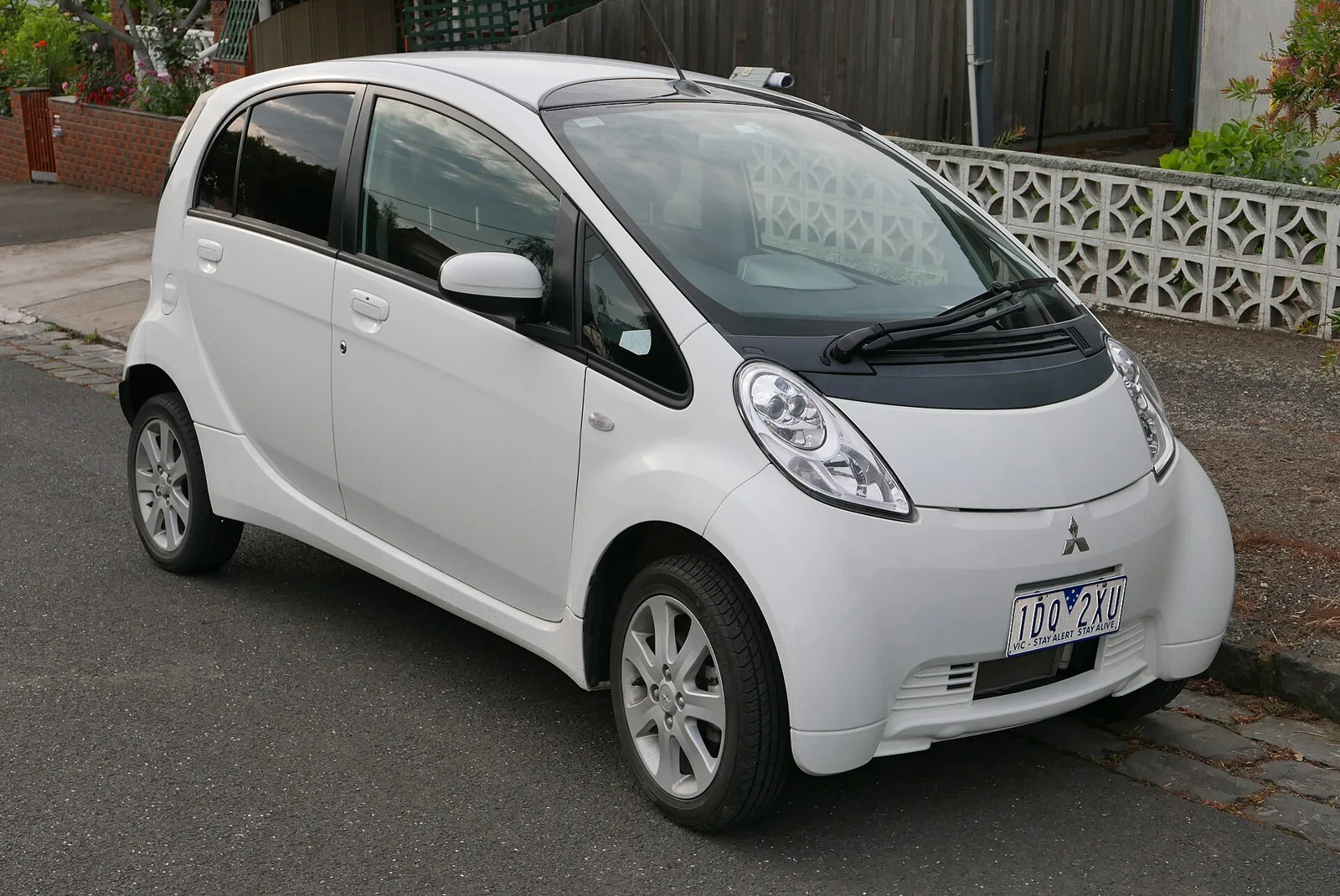
A five-door battery car from 2009 with a 16 kWh pack, a 130 km/h (80 mph) top speed and sales that passed 50,000 units.
Built by Mitsubishi Motors in the 2010s, the i-MiEV was an electric city car with a five-door body, based on the i kei car. Peugeot and Citroen sold rebadged versions in Europe. It paired a 16 kWh battery with a 49 kW motor, reached 130 km/h (80 mph), and passed 50,000 sales worldwide.
The Mitsubishi i-MiEV was a five-door electric city car that Mitsubishi Motors built through the 2010s. It was the battery version of the Mitsubishi i kei car, and Peugeot and Citroen sold rebadged twins under the iOn and C-Zero names, mainly in Europe. Worldwide sales passed 50,000 units before production ceased in March 2021.
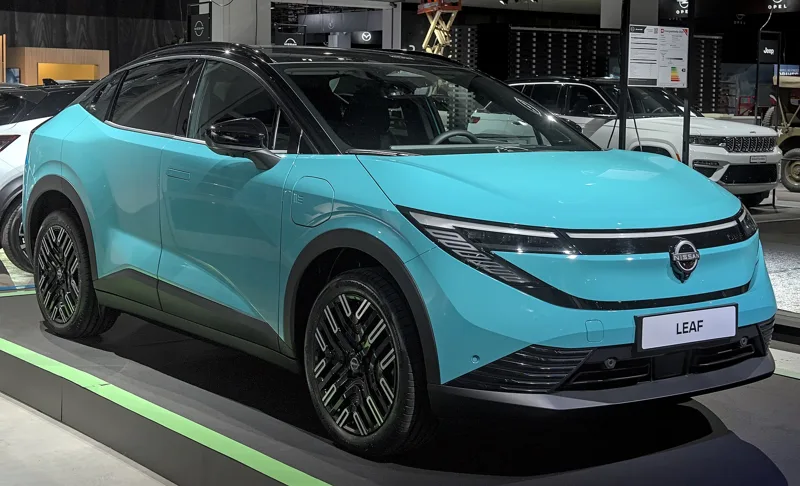
Japan was the largest single market, with 10,011 cars sold by July 2014. A record for passing 10,000 units was reached in February 2011, and the Nissan Leaf later overtook the i-MiEV as the best-selling all-electric car.
What was the Mitsubishi i-MiEV?
The i-MiEV is a five-door hatchback built on the Mitsubishi i kei car. Its name stands for Mitsubishi innovative Electric Vehicle. Rather than in-wheel motors, Mitsubishi placed conventional batteries and a single motor where the rear midship engine and fuel tank once sat.
Mitsubishi first exhibited the car at a battery and electric vehicle symposium in Yokohama. Before the public launch, it had supplied vehicles to power companies in 2006 and 2007 so they could study fast-charge infrastructure. Five power companies then ran fleet tests in 2007.
Early prototypes came with two battery sizes. A 16 kWh pack gave a range of 130 km (80 mi), while a 20 kWh pack lifted it to 160 km (100 mi). The 130 km/h (80 mph) top speed carried over to the production car.
An early electric city car that passed 50,000 sales worldwide before a decade of production came to an end.
How did the i-MiEV reach showrooms?
Fleet customers in Japan received the first cars in July 2009, and public retail sales in Japan began on 1 April 2010. International sales followed during 2010 in Asia, Australia and Europe, while US and Canadian deliveries began in December 2011.
Mitsubishi set an early target of up to 1,400 vehicles by March 2010. Cumulative output at the Mizushima plant reached 5,000 units by November 2010, so the company moved quickly from prototypes to a working production line.
A May 2011 target called for 25,000 vehicles worldwide in fiscal 2011. By March 2013 more than 33,000 had been built, counting the rebadged versions that PSA sold in Europe.
How far could the i-MiEV go on one charge?
Range depended on the test cycle used. Japan quoted 160 km (100 mi), the US EPA rated the 2012 model at 62 miles (100 km), and the European NEDC figure was 150 km (93 mi). Australia's Green Vehicle Guide estimated 155 km (96 mi).
Under the EPA's LA4 city cycle, the American car was rated at 98 miles (158 km). Its combined rating of 112 MPGe (2.1 L/100 km) helped it top the EPA 2012 Annual Fuel Economy Guide, a title the Honda Fit EV later took over in June 2012.
On the NEDC cycle, consumption was 97 Wh/km. In everyday use, range falls with driving style, hills, speed and the use of cabin heating or cooling, and following winds make a noticeable difference.
How was the battery built?
The 16 kWh lithium-ion pack held 88 cells under the base floor, arranged in twelve modules connected in series at a nominal 330 V. The cells were named LEV50 and were developed by Mitsubishi and GS Yuasa, giving the whole pack a specific energy of 80 Wh/kg.
Forced air cooling stops the pack overheating during hard charging and discharging, and an optional heater helps in cold weather. During rapid charging, the car's air conditioning refrigerates air that is blown across the pack to keep it cool.
A Japanese variant used SCiB cells from Toshiba instead, a lithium titanate design that gave the car a different charging profile. Other markets kept the original LEV50 family of cells throughout the model's life.
How did the i-MiEV charge?
The i-MiEV had two inlets. A CHAdeMO socket on the left-hand side took rapid DC charging and brought the pack to 80% in 30 minutes from empty. The right-hand socket handled fast AC charging at 16 A, taking five hours from depletion.
For home use the car came with a non-captive lead. It was limited to 10 A, so a full charge from depletion on 230 volts took eight hours. An in-line control box in the lead limited current and cut power when the plug was removed.
Because rapid DC charging starts the air conditioning automatically, the battery is kept within a sensible temperature band while the car takes on energy. This is the same cooling path described for the pack, and it is why fast charging on a hot day still works as intended.
Could the i-MiEV power a home during a blackout?
Yes, with an optional accessory. The MiEV Power Box converted battery DC into 100-volt AC, powering up to 1,500 W of small equipment for roughly 5 to 6 hours. Mitsubishi said that matched about one day of power for an average Japanese home.
Mitsubishi brought the device forward after the 2011 Tohoku earthquake and tsunami. It was due by the end of April 2012 at JPY 149,800 (US$1,800), though its wider availability was unclear by November 2013.
Mitsubishi also described its Home Energy Management System, known as HEMS, as the vehicle-to-grid system linked to the car, which offered a different route to home power from the Power Box.
How did the driver manage regeneration?
A lever between the front seats looks like an automatic gear selector, but it reverses the motor and sets how strongly the car regenerates. Positions D, B and C adjust regeneration for city, hilly and flat driving, and North American cars label the third mode Eco.
Lifting off the accelerator also triggers regeneration, and light pressure on the brake pedal does the same. A gauge around the digital speedometer shows power use to the right of neutral and regeneration to the left.
Correct use of the regeneration control can influence the car's range, so the choice of mode mattered on most journeys.
How many i-MiEVs were sold?
Global sales of the i-MiEV family, including the minicab versions sold in Japan, passed 50,000 units by early March 2015. Japan led the market, while the US had sold 1,893 cars through December 2014.
Norway registered 4,920 units by July 2014, France 4,710 and Germany 2,419. US sales reached 1,029 in 2013, after 588 in 2012 and 80 in 2011, and the car was discontinued there in August 2017.
Japanese sales show the car's early trajectory: 986 units in 2009 rose to 2,340 in 2010, then held at 2,290 in 2011 and 2,295 in 2012 before falling to 1,491 in 2013 and 1,021 in 2014. Cumulative Japanese sales reached 10,423 units by December 2014.
What did the iOn and C-Zero twins do?
PSA sold rebadged versions in Europe, the Peugeot iOn and Citroen C-Zero. Mitsubishi began supplying the cars to PSA in 2010, and a PSA commitment to buy 100,000 i-MiEVs sat behind that supply arrangement.
Supply was suspended in August 2012, when PSA sales had slowed. By early August 2012, PSA had sold 6,575 iOns and C-Zeros since their 2010 launch in Europe, leaving the French carmaker with more than 4,400 unsold electric cars.
What did the i-MiEV cost in Australia and the UK?
In Australia the car sold for A$48,800 from August 2011 through specialist Mitsubishi dealers. In the UK the price was cut to GBP 28,990 in August 2010, and 862 units had been registered there by June 2013.
Australian fleet customers could lease the car from August 2010 at A$1,740 a month for 36 months, and 252 cars had been sold in Australia by December 2013.
What awards did the i-MiEV win?
The car won the Japan Automotive Hall of Fame Car Technology of the Year award in 2009 and was a finalist for the 2012 Green Car of the Year. The American-spec model was ranked first in the EPA 2012 Annual Fuel Economy Guide.
The American-spec car also topped the Greenest Vehicles of the Year list for 2012, published by the American Council for an Energy-Efficient Economy.
Why did production of the i-MiEV end?
Production ceased in March 2021. The Dutch importer had already discontinued the model in January 2019, and US and Canadian sales had ended by 2018, after the car had been withdrawn from the UK in June 2016.
Across the decade, the car was built in Japan and sold across several continents, so its end reflected falling demand in individual markets rather than one single event.
Mitsubishi i-MiEV specifications
The table lists the core figures for the standard car and the market-specific ranges. Where a figure belongs to a particular trim or test cycle, the table says so, so the figures do not blend together.
| Specification | Detail |
|---|---|
| Type | Five-door electric city car |
| Motor | Permanent magnet synchronous, 49 kW (66 hp) peak |
| Torque | 180 Nm (130 lb ft) from 0 to 2,000 rpm |
| Battery | 16 kWh lithium-ion, 88 cells, 330 V nominal |
| Japanese test range | 160 km (100 mi) |
| US EPA range (2012) | 62 mi (100 km) |
| Top speed | 130 km/h (80 mph) |
| DC charge | 80% in 30 minutes |
| Combined economy | 112 MPGe (2.1 L/100 km) |
| Production ended | March 2021 |
How did the braking and safety systems work?
The i-MiEV used conventional power-assisted hydraulic brakes, with discs at the front and drums at the rear. An anti-lock braking system and traction control were fitted, and the cable-operated handbrake acted on the rear wheels, which carry the drive.
Because there is no manifold vacuum, an electric vacuum pump sat under the rear loading platform to supply brake assistance. Some models had interlocks that let the car start only when the brake pedal was pressed.
An emergency cutoff for the main battery sat under the front left seat, and a collision-triggered switch operated by G forces cut the high-voltage supply after an impact.
How did the European version differ?
The European i-MiEV was introduced at the 2010 Paris Motor Show with new front and rear bumpers to meet EU regulations. Its centre stack was rearranged, and Active Stability Control, side airbags and curtain airbags came as standard on the version built for European buyers.
Its NEDC range was 150 km (93 mi), and the launch price ranged from EUR 33,000 to EUR 35,000 across markets. Mitsubishi aimed for a final cost under EUR 30,000 after government incentives.
Frequently asked questions
How far could the Mitsubishi i-MiEV go on a single charge?
The Japanese test cycle gave 160 km (100 mi) for the standard car, while the 2012 US model was rated at 62 miles (100 km) by the EPA. Real-world range varied with driving style and conditions.
Was the i-MiEV sold in the United States?
Yes. Deliveries began in December 2011, and US sales reached 1,893 cars through December 2014. The American version was 285 mm (11.2 in) longer than the Japanese car.
Did the i-MiEV carry a spare wheel?
No. The car carried a roadside repair kit with a 12-volt compressor instead, and its front and rear wheels were different sizes.
What safety rating did the i-MiEV earn?
Euro NCAP awarded four stars, and ANCAP scored the car 28.35 out of 37 for four of five stars. NHTSA also gave the 2012 US model four of five stars.
_hatchback_(2015-11-11)_01.jpg)