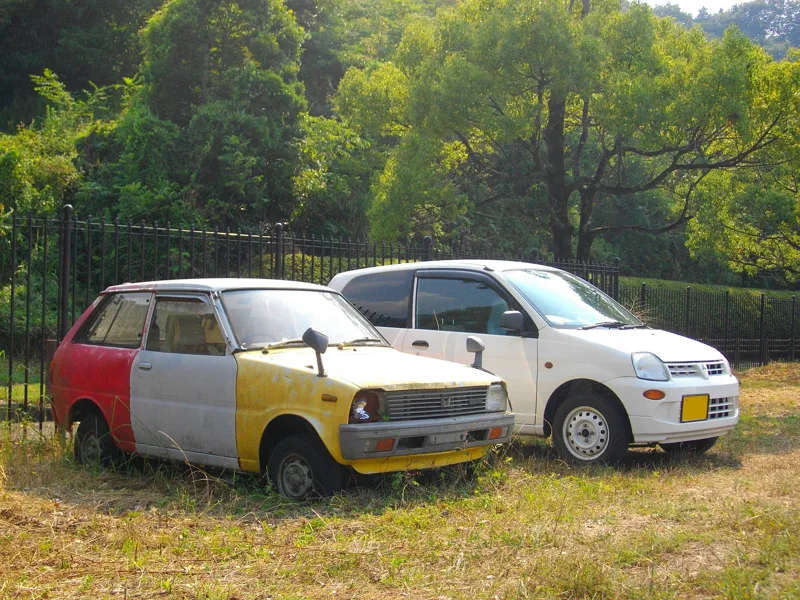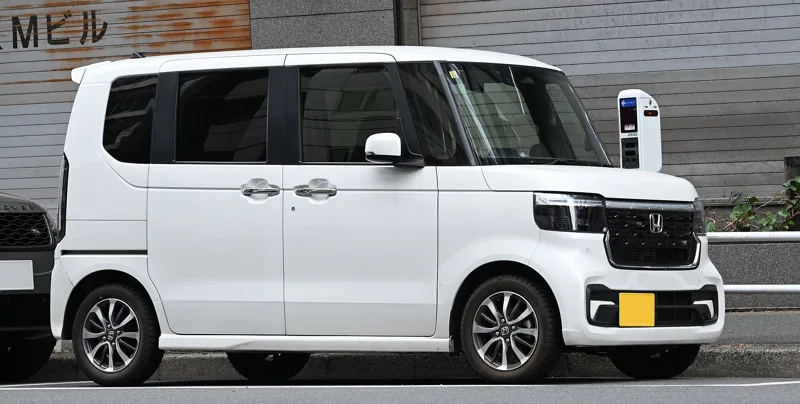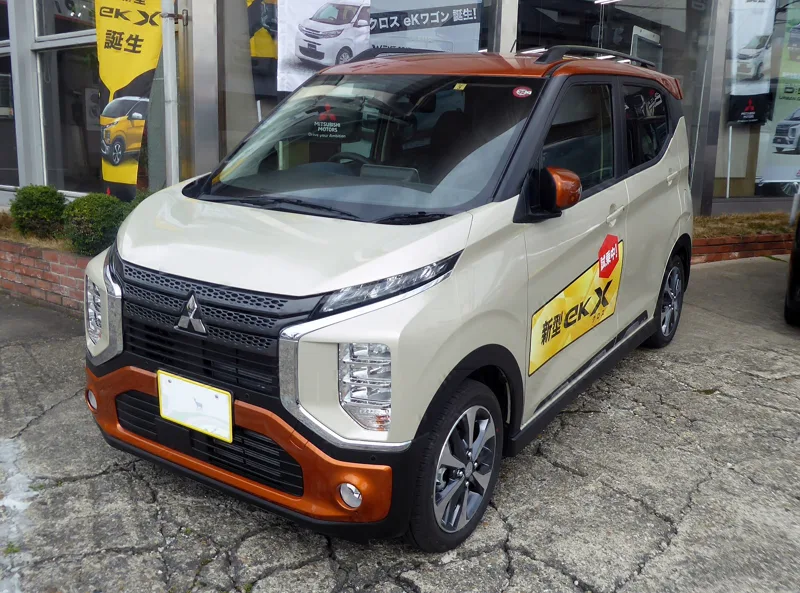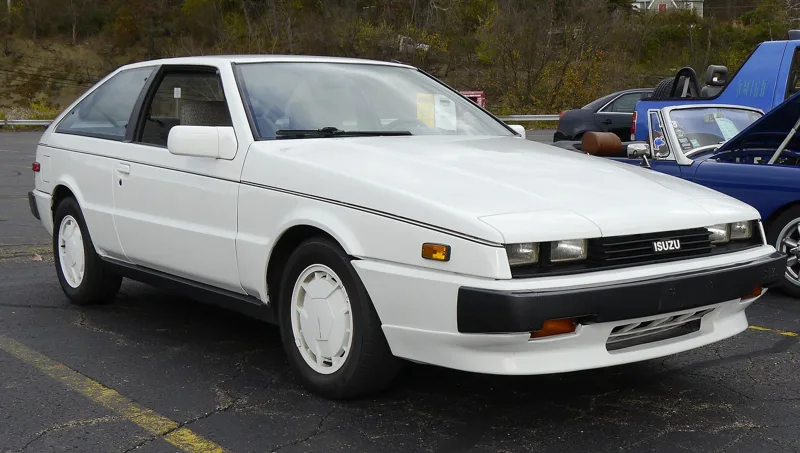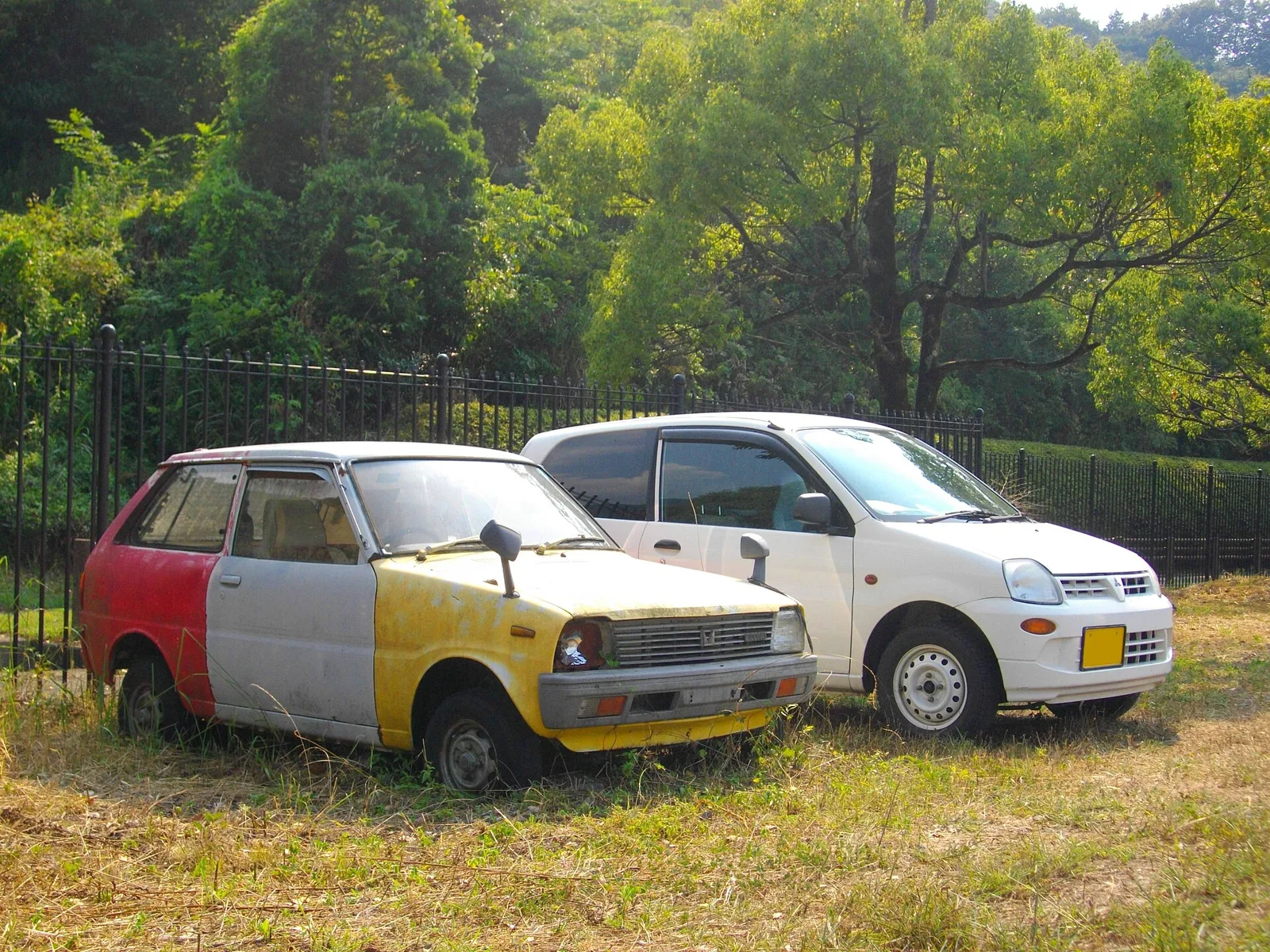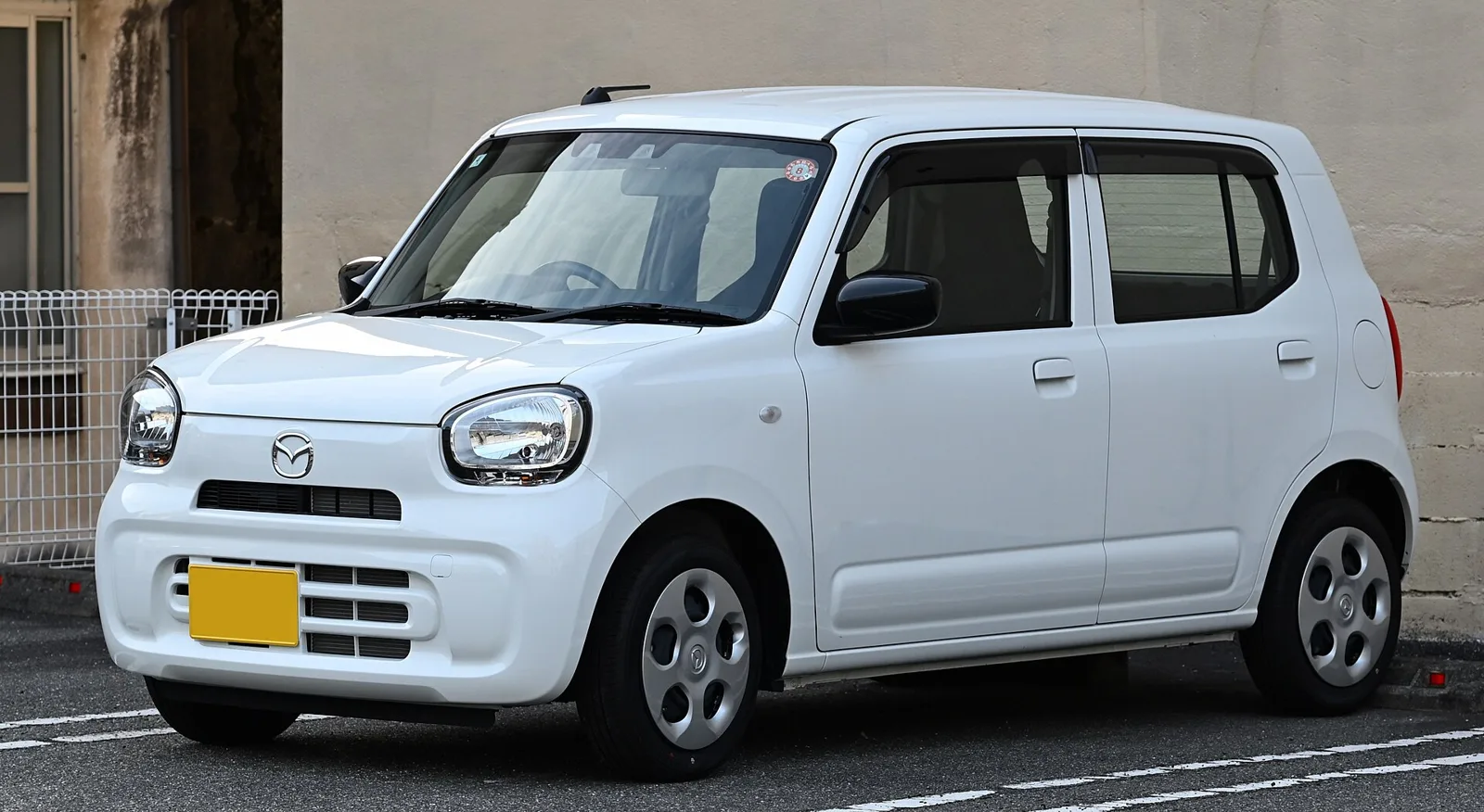
The Mazda Carol, Nissan Dayz and Moco, Mitsubishi eK and Toppo and Suzuki MR Wagon show how Japan's smallest cars are traded between brands.
Kei car makers in Japan often swap platforms and badges: Mazda sells a Suzuki Alto as the Carol, Nissan's Dayz and Otti are Mitsubishi eK models, the Nissan Moco was a Suzuki MR Wagon, and the Mitsubishi Toppo grew from the Minica before moving onto eK underpinnings.
Mazda has sold two completely different cars called the Carol. The first, launched in 1962, was a Mazda-designed four-seater with a 358 cc four-cylinder engine in the back that won 67% of kei sales in its opening year. The second, sold since 1989, is a Suzuki Alto built by Suzuki. The change says a great deal about how Japan's smallest cars are made.
How do kei cars share platforms and badges?
One maker builds a small car and a rival sells it under a different name, often changing little more than the grille and the badge. The Mazda Carol is a Suzuki Alto, the Nissan Dayz is a Mitsubishi eK, and the Moco that Nissan sold was a Suzuki MR Wagon. Kei rules cap size and power, so the cars end up close relatives.
Mazda has sold two different cars called the Carol: its own design from 1962 and a Suzuki Alto rebadge since 1989.
Who builds what in the kei car family?
| Badge | Built by | Same car as | Years |
|---|---|---|---|
| Mazda Carol | Suzuki | Suzuki Alto | From 1989 |
| Nissan Otti | Mitsubishi | eK Wagon and eK Sport | 2005 to 2013 |
| Nissan Dayz | Mitsubishi and Nissan joint venture | eK Wagon | From 2013 |
| Nissan Moco | Suzuki | Suzuki MR Wagon | 2002 to 2016 |
| Maruti Suzuki Zen Estilo and Estilo | Suzuki, in India | First-generation MR Wagon | 2006 to 2014 |
| Mitsubishi Toppo | Mitsubishi | Minica, later second-generation eK Wagon underpinnings | 1990 to 2004; 2008 to 2013 |
What was the original Mazda Carol?
The Mazda P360 Carol arrived in February 1962 as the company's first four-passenger car, a grown-up companion to the R360. It matched the R360 at 2,980 mm (117.3 in) long but had a far longer 1,930 mm (76.0 in) wheelbase and weighed 525 kg (1,157 lb) against 380 kg (838 lb).
Its rear-mounted, water-cooled 358 cc engine made 18 PS (13 kW). It was one of the smallest four-cylinder engines in history; only Honda's 356 cc unit, used in a small truck, was smaller. The Carol was perhaps over-engineered, with a strong monocoque body, a five-bearing crankshaft and torsion-bar suspension at all four wheels. Costs and weight rose and the cabin stayed cramped, but customers loved it.
A DeLuxe version appeared in May 1962, and in September 1963 a four-door arrived together with a 20 PS (15 kW) engine. An October 1966 facelift moved the spare wheel out of the front luggage space and gave the car a fully synchronised gearbox. Production stopped in August 1970 after 265,226 Carol 360s, and Mazda sold no kei passenger car for two years until the Chantez of 1972.
A bigger Carol 600 joined it in the autumn of 1962 with a 586 cc engine and a 3,200 mm body, though the extra length came from larger bumpers and rear passengers got no more room. About 8,800 were built before it ended in November 1964, after the roomier Familia 800 sedan arrived.
How did the Carol become a Suzuki?
When Japan revived the kei class in the late 1980s, Mazda brought the Carol name back in October 1989 on its youthful Autozam brand. Suzuki built the car on the Alto's platform and mechanicals, though the interior and rounded body were mostly its own. Round headlights followed Nissan's Be-1 and Pao.
The 547 cc three-cylinder F5B engine made 40 PS (29 kW) at 7,500 rpm, with front or all-wheel drive. The car had a 2,335 mm (92 in) wheelbase, was 3,190 mm (126 in) long and 1,295 mm (51 in) wide, and used front discs and rear drums. Production of the 550 cc version lasted four months, which makes those cars rare.
New rules for 1990 allowed a bigger engine and 10 cm more length, so the AA6 Carol of February 1990 grew 6 cm and took a 657 cc F6A engine with 52 PS (38 kW). A 61 PS (45 kW) turbo arrived in 1991, and in 1992 the car grew to 329 cm. The 1995 generation was a three-door hatchback with a turbocharged version that lacked a rev counter and with retro-styled Carol Custom and Carol Classic models.
In 1998 the Autozam badge was withdrawn and the car became simply the Mazda Carol. The fourth generation of October 1998 resembled the Alto closely, with a 657 cc F6A or a new 658 cc DOHC engine, and it shared its roots with the AZ-Offroad and AZ-Wagon. From then on the Carol has been a badging exercise, replaced whenever Suzuki replaces the Alto.
The sixth generation, shown at the 2009 Tokyo Motor Show, offered all-wheel drive and a CVT. The eighth, based on the ninth-generation Alto, went on sale in January 2022 as a hybrid only, in GS, GX and GL grades that were renamed in a 2025 facelift.
What is the Mitsubishi eK?
The Mitsubishi eK is a Mitsubishi Motors and Nissan kei series that grew out of the longtime Minica, introduced on 11 October 2001. The name is short for "excellent keijidosha", pronounced "ee kay", a pun on the Japanese for good kei car.
Its first generation came as the eK Wagon, then the eK Sport in September 2002, eK Classy in May 2003 and the crossover eK Active in May 2004. The Wagon used a 50 PS (37 kW) three-cylinder 3G83 engine, with a 64 PS (47 kW) turbo available on other models.
It won a Good Design Award in 2001. Mitsubishi aimed to sell 10,000 a month, sold 13,000 in the first four days, and reached 20,000 by the end of October. Sales to 2005 came to roughly 480,000, making it Mitsubishi's biggest seller at home, through the Car Plaza dealer chain.
The eK Active sat 10 mm higher on 14-inch wheels, with seats 45 mm higher and grey body cladding for an off-road look. A Thanks Edition celebrated 200,000 sales in May 2003. The second generation of 13 September 2006 added a passenger-side sliding door, unusual for the class and dropped on the third generation.
How did Nissan end up selling the eK?
Nissan agreed on 16 January 2005 to expand its small-car range with Mitsubishi cars and released the Otti on 17 June, sold only through Red Stage and Blue Stage dealers. From 8 June 2005 it took 36,000 eK Wagons a year. Apart from the grille and body colours, the Otti differed little from the eK Wagon or eK Sport.
The Dayz replaced the Otti on 6 June 2013, with the eK Custom sold as the Dayz Highway Star. A tall sliding-door model, the eK Space, followed in 2014 along with a Nissan version, the Dayz Roox. The second-generation Dayz of 19 March 2019 was the first Nissan kei car to offer ProPILOT lane-keeping.
Mitsubishi unveiled the fourth-generation eK Wagon on 14 March 2019 and put it on sale on 28 March, with a 52 PS (38 kW) BR06 three-cylinder engine or a 64 PS (47 kW) turbo and a CVT only. The eK X crossover brought Mitsubishi's first lane-keeping assist, MI-PILOT, and the battery eK X EV, sold with the Nissan Sakura, followed on 20 May 2022.
What was the Mitsubishi fuel economy scandal?
Mitsubishi Motors disclosed in April 2016 that it had found improper fuel-economy testing on several kei models, including the eK, eK Space and the Nissan Dayz and Dayz Roox that it supplied. About 625,000 vehicles were affected. The company's share price fell sharply, and an investigation led by the government found that such practices had gone on for decades on some models.
President Tetsuro Aikawa resigned in June 2016. Production continued through the NMKV joint venture, with later generations redesigned to meet updated efficiency and safety standards, and sales restarted in July of that year.
What does MR Wagon stand for?
Magical Relax. The Suzuki MR Wagon is a four-seater kei car sold only in Japan, and the name is misleading because it does not have the mid-engine, rear-drive layout often shortened to MR. Nissan sold the same car as the Moco through an OEM supply deal. The first model appeared in 2001, and the third generation arrived in 2011.
The first generation, shown at the 1999 Tokyo Motor Show, went on sale on 4 December 2001 with Suzuki's K6A engine in naturally aspirated 54 PS (40 kW) or turbo 60 PS (44 kW) form. A hydrogen fuel cell version, developed with General Motors, was shown in 2005. The Moco went on sale on 10 April 2002, with a wing grille, and sold 3,000 to 4,000 a month, more than the Suzuki.
The Indian market received it as the Maruti Suzuki Zen Estilo in December 2006, with a 1.1-litre four-cylinder engine of 64 PS (47 kW). It became the Estilo in August 2009 with a 1.0-litre three-cylinder, and made way for the Celerio in February 2014. In Indonesia it was the Suzuki Karimun Estilo from 2007 to late 2012.
Why was the second MR Wagon designed around mothers?
Suzuki showed a concept called Mom's Personal Wagon at the 2005 Tokyo Motor Show, with a front bench, food trays and pillarless left-hand doors. Most of that did not reach production, but the idea shaped the car that went on sale on 20 January 2006, and the Moco followed on 1 February.
Designers studied how four-year-olds climb into cars. The result was a step next to the rear seat, a wide armrest to help children in and out, an upright rear pillar, and a door that opens to 80 degrees rather than 66. It also had keyless entry and start, and the gear lever moved to the instrument panel.
The third generation of 20 January 2011 used a new Suzuki R engine, with variable valve timing and a very high 11.0:1 compression ratio. By 2013, stop-start made it the most fuel-efficient wagon in its class. The Wit arrived in July 2013 and the Moco Dolce followed in October. Suzuki announced in December 2015 that production would end, and sales finished on 31 March 2016, with the Moco running until 31 May.
What is the Mitsubishi Toppo?
The Toppo is a light recreational vehicle that Mitsubishi built from 1990 until 2004 and again from 2008 to 2013, derived from the Minica. Its name combines the English "top" for roof and the Japanese "noppo", meaning lanky, and it describes the tall three-door body introduced in February 1990.
The first Toppo came out before the 1990 kei regulations were final, so it ended up 4 cm shorter than other kei cars, a fault fixed in a January 1992 facelift. Its body was asymmetric, with a longer door on the kerb side for rear entry. The 657 cc engine made 40, 46 or 52 PS depending on version, and a 64 PS (47 kW) turbo joined in 1992.
A special edition, the Q-Bo, went on sale in October 1990 in a run of 2,000, in San Marino Yellow with a white roof or Ivy Green topped in pearl white, and was repeated through 1993. The Flower Express of March 1991 was a two-seater van aimed at florists. The January 1992 update added side impact protection, three-point rear belts and a rear bumper step.
A second generation ran from 1993 to 1998, and the Toppo BJ followed in October 1998. The BJ Wide, a non-kei variant with a 1.1-litre engine and five seats, ran from January 1999 to March 2001. The eK replaced the Toppo in 2001, although both were sold until 2004.
The fourth-generation Toppo, the H82A, went on sale on 17 September 2008. It reused third-generation door panels and sheet metal over the second-generation eK Wagon's underpinnings, and came as S, M, G and turbocharged T models. Production ended in June 2013 and Mitsubishi dropped the name.