One Koenigsegg engine makes 1,280 hp on petrol and 1,600 hp on E85, while Lotus gets 1,500 kW from four motors, and the list rules decide who counts.
Among the most powerful production cars covered here are the Lotus Evija, rated at 1,500 kW (2,011 hp) from four electric motors, and the Koenigsegg Jesko, which makes 1,193 kW (1,600 hp) on E85 but 954 kW (1,280 hp) on petrol.
The same Koenigsegg engine makes 1,280 hp on ordinary petrol and 1,600 hp when it is fed E85 biofuel. That one detail explains why the question of the most powerful production car has no single number as an answer, and why the answer matters less than you might think on a real road.
What counts as the most powerful production car?
The most powerful production cars are the unmodified road cars that make the greatest verified power, and the list that ranks them starts at 600 kilowatts. Among the cars with the highest outputs, the Lotus Evija is rated at 1,500 kW (2,011 hp) and the Koenigsegg Jesko at 1,193 kW (1,600 hp) on E85.
The list that keeps this ranking uses two possible definitions of a production car. Under the first, the car is built principally for retail sale to consumers, at least 25 examples are made by the original manufacturer and sold new, and the car is street-legal in its intended markets. The second is stricter: the car must be on sale to the public in exactly the form used for the record, made by a manufacturer whose identification code is on the VIN, and be street-legal under United States, European Union or Japanese rules. It must also be sold in more than one national market, and pre-1981 cars have to come unmodified from the original maker.
One entry per model
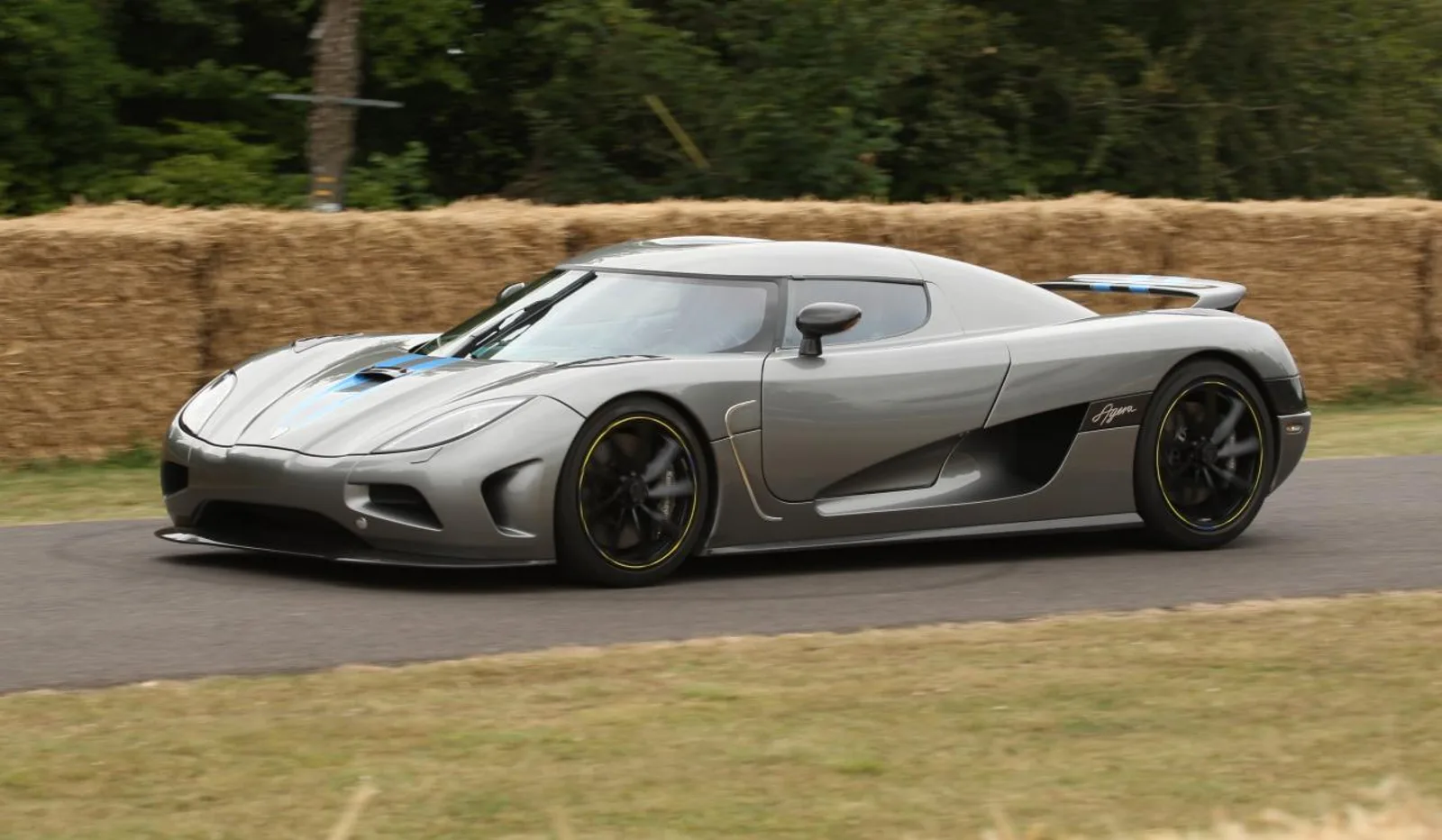
To keep the list manageable, only models with at least 600 kW qualify. A model with several power levels appears only in its most powerful form: the Agera RS is listed instead of the standard Agera, even though the ordinary Agera also makes more than 600 kW.
One engine, two fuels and two very different numbers: power depends on the conditions it is measured in.
How does the Koenigsegg Jesko make its power?
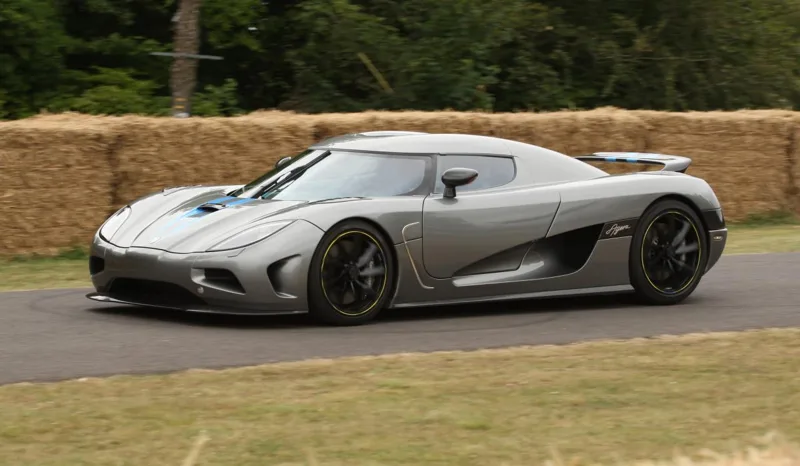
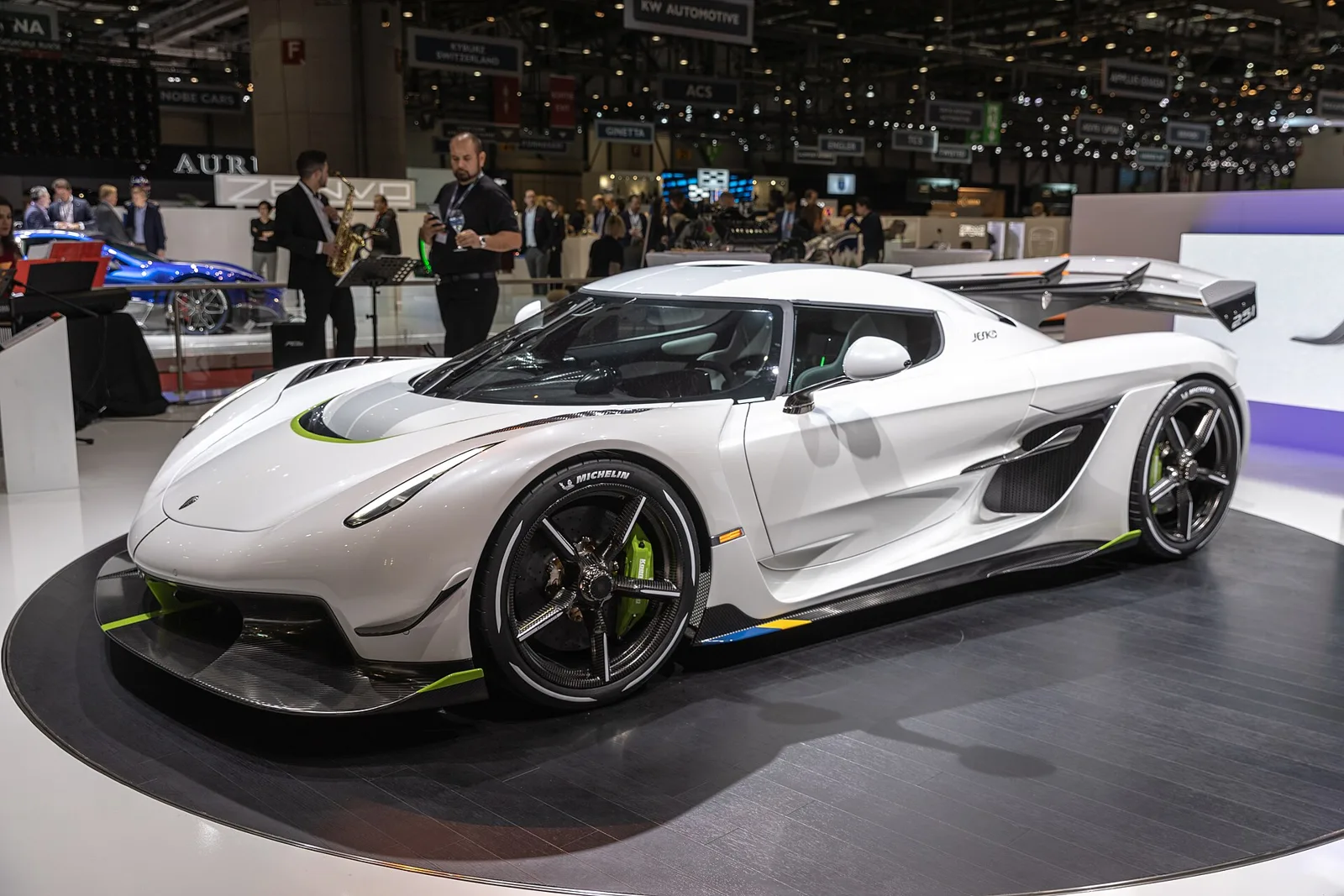
Sweden's Koenigsegg Automotive AB builds the Jesko in small numbers, with its engine mounted behind the driver. It debuted at Geneva in 2019, had no build slots left before the show was over, and succeeds the Agera. Its name pays tribute to Jesko von Koenigsegg, the father of the company's founder.
Its engine is a development of the Agera's 5.1-litre (5,065 cc) twin-turbocharged V8, with four valves per cylinder, a bore and stroke of 92 mm by 95.25 mm and a compression ratio of 8.6:1. On petrol the rating is 1,280 hp (1,298 PS; 954 kW), reached at 7,800 rpm, plus 1,000 N-m of torque between 2,700 and 6,170 rpm. On E85 the output jumps to 1,600 hp (1,622 PS; 1,193 kW), and 1,500 N-m of torque arrives at 5,100 rpm.
Why a different fuel changes the power
The figures differ because the engine is the same but the fuel is not. The Jesko's maker rates the car on both, so the biofuel number is the one that makes the headlines and the petrol number is the one most owners will see on a normal fill-up.
What did Koenigsegg change inside the engine?
Several details matter more than raw size. A new 180-degree flat-plane crankshaft saves 5 kg and lifts the redline from 8,250 to 8,500 rpm. The Jesko also borrows active rubber mounts from the Regera, which reduce the vibration reaching the cabin, and it has a pressure sensor for each cylinder so the multipoint fuel injection can be monitored in real time.
The turbocharger system contains the most inventive part. A turbo is slow to respond when you first press the throttle, a delay known as lag, because it needs exhaust gas to spin up. Koenigsegg fits a 20-litre carbon fibre air tank and an electric compressor that feeds pressurised air to the two large turbochargers at 20 bar (290 psi). It is a bit like blowing up a balloon in advance, so that when you let it go, the air is already there.
A gearbox with no flywheel
The engine is paired with a 10-speed multi-clutch transmission developed in-house, called the Light Speed Transmission (LST). It weighs 90 kg (198 lb) and is at least 50 per cent shorter than the 7-speed dual-clutch unit that came before. It has 9 forward gear combinations and changes gear without interrupting the power flow, because clutches open and close in overlapping sequence. The crankshaft connects directly to the LST, which uses the rotating mass of its own parts instead of a conventional flywheel, and shifts take 20 to 30 milliseconds. A mode named Ultimate Power on Demand can pick the optimal gear directly instead of stepping through each one in order.
What are the three versions of the Jesko?
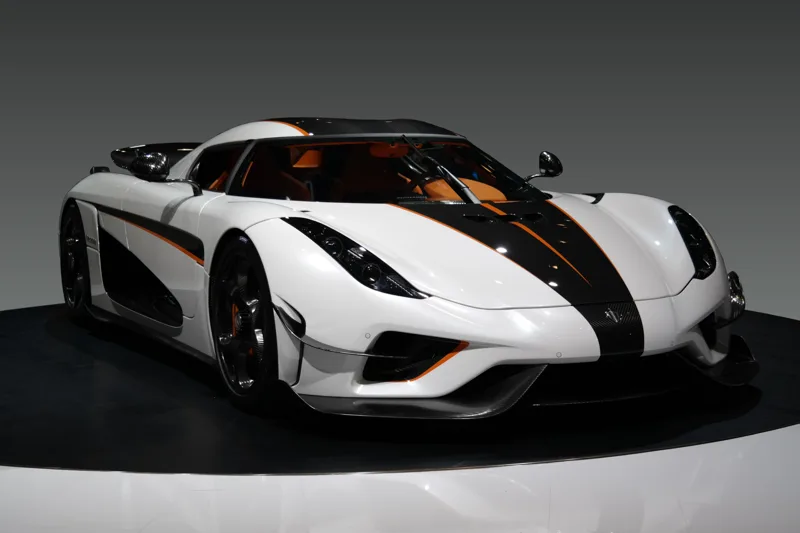
The Attack is the standard Jesko, tuned for downforce, with a large rear wing and a front splitter. Koenigsegg claims 800 kg (1,764 lb) of push onto the road at 249 km/h (155 mph), then 1,000 kg (2,205 lb) at 275 km/h (171 mph), and 1,400 kg (3,086 lb) once it is flat out. It lapped the Gotland Ring in 2:56.97, nearly seven seconds quicker than a Porsche 911 GT3 RS Manthey-Racing edition, and the Laguna Seca circuit in 1:24.86.
The Jesko Absolut, unveiled online beside the Gemera on 3 March 2020, goes the other way. The rear wing is replaced by two fins, cutting downforce from 1,400 kg to 150 kg (331 lb) and giving a drag coefficient of 0.278. Engineers spent 3,000 hours on aerodynamic analysis and another 5,000 on design and engineering. The manufacturer puts the likely maximum at 500 km/h (310 mph), and says theoretical speeds could reach as much as 531 to 563 km/h (330 to 350 mph).
The third, Sadair's Spear, is a track-focused car named after a horse that Jesko von Koenigsegg rode in his last race as a jockey. Its 5.0-litre twin-turbo V8 makes up to 1,300 hp (969 kW), or 1,625 hp (1,212 kW) on E85, and it is limited to 30 units with a top speed narrowed to 360 km/h (224 mph). On the Gotland Ring it already beats the Attack by 1.1 seconds.
How does the Lotus Evija compare?
The Lotus Evija does it without a single combustion event. It is the first electric car introduced and built by Lotus, which is Chinese-owned and British-based. It was unveiled in July 2019 and has a production limit of 130 units, priced at US$2.3 million before options and taxes. The name comes from Eve and refers to the Hebrew word for alive.
Four individual electric motors sit at the wheels, each rated at 375 kW (510 PS; 503 hp). The combined total is 1,500 kW (2,039 PS; 2,011 hp), accompanied by 1,704 N-m (1,257 lb-ft) of torque. Four motors at the wheels is like having a small engine at each corner of the car. The battery began as a 70 kWh pack developed with Williams Advanced Engineering, and in 2022 Lotus changed to a 93 kWh pack that Unipart's Hyperbat is said to supply.
A prototype went through high-speed testing in November 2019, and Lotus put out a video on 21 November that year before showing the car at the Guangzhou Auto Show. More road testing was planned, on circuits in Europe and on Lotus's own track at Hethel. It claims 0-100 km/h (62 mph) in under 3 seconds and 0-300 km/h (190 mph) in 9.1 seconds, with a top speed limited to 349 km/h (217 mph). Magnesium wheels carry Pirelli Trofeo R tyres, and AP Racing supplies the carbon-ceramic brakes.
What is the Jesko like to live with?
More civilised than its numbers suggest. The carbon body tub is 40 mm (2 in) longer and 22 mm (1 in) wider than the one on the previous car, and the redesigned structure includes an aluminium monocoque for stiffness, which makes more room for the occupants. The standard wheels are forged aluminium, 20 inches at the front and 21 inches at the rear, on Michelin Pilot Sport Cup 2 tyres in 265/35 and 345/30 sizes. Carbon fibre wheels weighing 5.9 kg (13 lb) at the front and 7.7 kg (17 lb) at the rear are an option, and the brakes are ventilated carbon-ceramic discs.
Weight saving was a priority inside, yet the car still has climate control, a 9.0-inch infotainment screen with Apple CarPlay, USB charging, small screens in the steering wheel spokes and a 5.0-inch driver display. Koenigsegg's Autoskin system, carried over from the Regera, opens the doors and bonnet remotely, and the front and rear axles can be raised hydraulically for extra ground clearance. The Attack variant uses Triplex dampers at both ends alongside conventional Ohlins units, with a horizontal rear damper that stops the back of the car squatting under hard acceleration, and active rear-wheel steering adds stability. The roof has screws so that it stays in place at high speed.
How do the numbers compare?
| Car | Power | Notes |
|---|---|---|
| Lotus Evija | 1,500 kW (2,011 hp) | Four motors, 1,704 N-m, production limited to 130 |
| Koenigsegg Jesko, E85 | 1,193 kW (1,600 hp) | 5.1-litre twin-turbo V8, 1,500 N-m at 5,100 rpm, production limited to 125 |
| Koenigsegg Jesko, petrol | 954 kW (1,280 hp) | Same engine on ordinary fuel, 1,000 N-m |
| Jesko Sadair's Spear, E85 | 1,212 kW (1,625 hp) | 5.0-litre twin-turbo V8, limited to 30 units |
What do these figures mean on the road?
Power is only half of the story. Torque is the twisting force that moves the car off the line, and power describes how much work the engine can sustain at speed. The Jesko's peak torque of 1,500 N-m appears at 5,100 rpm on E85, while on petrol 1,000 N-m is available between 2,700 and 6,170 rpm, so the engine delivers a wide band of strong pulling force.
Where does the power race go next?
For the Jesko, the production run is limited to 125 units at 40 to 50 a year. Koenigsegg showed the first pre-series car in July 2021, expected customer cars in spring 2022, and delivered the first car in June 2023. Top Gear named it Hypercar of the Year in 2022. On 26 June 2024, the Jesko Absolut is reported to have broken the 0-400-0 km/h record with 27.83 seconds at Orebro Airport in Sweden with the factory test driver Markus Lundh at the wheel, and on 7 August 2025 it is reported to have improved that to 25.21 seconds.
Lotus announced in 2020 that production would start that summer, and in 2022 it said eight cars were in build, all sold, with first deliveries early in 2023. The first car went to Jenson Button in August 2023, and in December 2024 Lotus said customer deliveries were under way.