From a 1904 speed record to tank diesels and Toyota's linear generator, two piston layouts that break the one-piston, one-cylinder, one-crankshaft rule.
An opposed-piston engine puts a piston at both ends of each cylinder with no cylinder head, which cuts weight and heat loss but needs the pistons geared together. A free-piston engine has no crankshaft and takes power from a turbine, compressor or linear alternator.
On 31 March 1904 a French car with a very odd engine became the first in the world to travel faster than 150 km/h. The Gobron-Brillie reached 152.54 km/h (95 mph), and a few months later it was the first to top 100 mph (161 km/h) over a flying kilometre. Inside it was an opposed-piston engine, in which every cylinder had a piston at each end and no cylinder head at all.
That arrangement has outlived most of the cars that tried it. It still powers ships, tanks and locomotives, and an American company has a contract to develop a modern diesel on the same principle. A cousin of the design drops the crankshaft entirely, leaving pistons that move on the push of combustion gas and the pull of a spring of air.
How does an opposed piston engine work?
Picture a syringe with a plunger at each end. In an opposed-piston engine the combustion happens in the middle of the tube, between the two plungers, and both of them are driven outwards by the burning mixture. There is nothing above the combustion space, because the second piston takes the place of the cylinder head.
That change removes a whole layer of machinery. Without a head or a valve-train, the engine sheds weight, complexity and cost, and it loses less heat and less energy to friction than a conventional two-stroke with one piston per cylinder. Gas also moves through the cylinder in one direction, a pattern known as uniflow scavenging, which avoided the weaknesses of the older crossflow designs. The engine ends up lower than a conventional one.
The price is mechanical. The two pistons work against each other, so they have to be tied together, and the usual solution is two crankshafts joined by gearing, turning in the same direction or in opposite ones. The gearing adds weight and complexity compared with a single-crankshaft engine, and that has been the design's main burden.
In the best-known layouts one piston uncovers the intake port and the other uncovers the exhaust port, so engineers speak of intake pistons and exhaust pistons. The Koreyvo, Jumo and Napier Deltic engines worked this way. Gas passes along the length of the cylinder instead of across it, which gives better scavenging and makes the piston crowns easier to design. The Jumo 205 gave the exhaust job to its top crankshaft and the intake job to the bottom one. In multi-bank versions a single big end bearing carries the rods of one inlet piston and one exhaust piston, the exhaust piston's rod being forked to straddle it.
Picture a syringe with a plunger at each end, with the combustion happening in the middle of the tube.
Who built the first opposed-piston engines?
The idea is older than the motor car. One of the first was the 1882 Atkinson differential engine, which fired once for every turn of the crankshaft, where the contemporary Otto engine fired once every two turns. It was not a commercial success. In 1898 a two-stroke Oechelhauser engine rated at 600 hp (447 kW) went into the Hoerde ironworks, and it was built under licence by Deutsche Kraftgas Gesellschaft in Germany and by William Beardmore & Sons in the United Kingdom. The Kansas City Lightning engines of 1901 were far smaller, making 4-25 hp (3-19 kW).
Road use came early. Around 1900 the French company Gobron-Brillie produced an opposed-piston car engine with a crankshaft at one end only, the far piston being driven through a crosshead. In Scotland, Arrol-Johnston fitted an opposed-piston engine to a 10 hp buckboard from about 1900 and showed a 12-15 hp car at the 1905 Olympia Motor-Show. It was a two-cylinder four-stroke, with opposed pistons in each cylinder joined by lever arms to a two-throw crankshaft underneath.
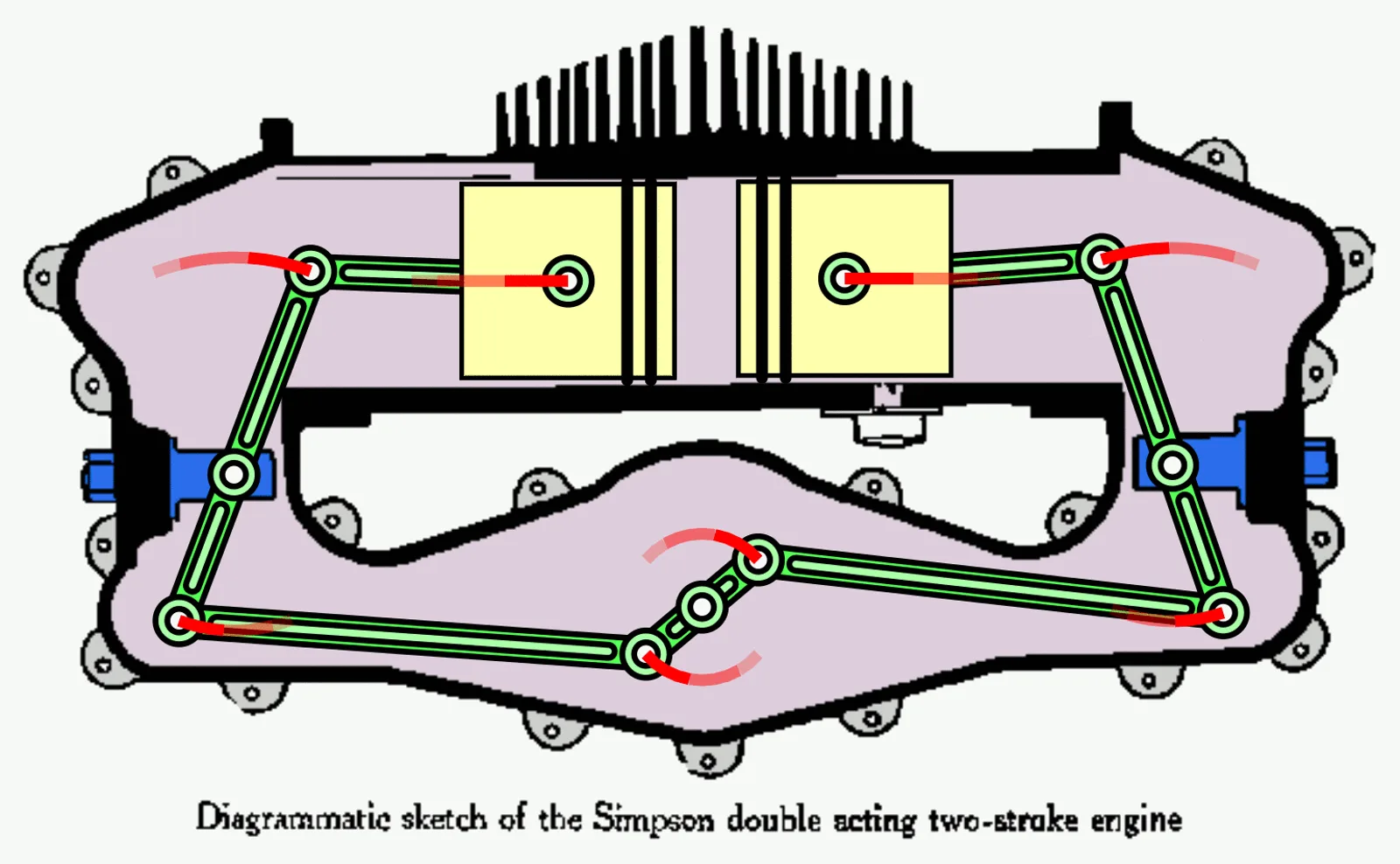
The first opposed-piston diesel was a prototype built at the Kolomna Locomotive Works in Russia. Its designer, Raymond A. Koreyvo, patented it in France on 6 November 1907 and displayed it at international exhibitions, but it never reached production. A motorcycle engine of 1914, the Simpson's Balanced Two-Stroke, took another route: one crankshaft slung below the middle of the cylinders, with levers linking both pistons to it. The layout avoided the deflector crowns most two-strokes of the time had to carry on their pistons.
Where did opposed pistons find their place?
| Engine | Year | Use and figures |
|---|---|---|
| Oechelhauser | 1898 | Ironworks, 600 hp (447 kW) |
| Gobron-Brillie | c1900-1904 | Car, 152.54 km/h record in 1904 |
| Doxford | From 1921 | Ships, up to 20,000 hp (14,914 kW); UK production ended 1980 |
| Junkers Jumo 205 | 1932 | Aircraft diesel with two crankshafts |
| Lancia Tipo 89 | 1933-1938 | Military truck, 3,180 cc, four opposed pistons, two-stroke diesel |
| Napier Deltic | 1954 | Military boats, locomotives, mine sweepers; three crankshafts |
| Leyland L60 | 1959 | Chieftain tank, 19 L six-cylinder diesel |
| Malyshev 5TD | 1963-1987 | Soviet T-64 tank, opposed-piston diesel |
Doxford Engine Works in the United Kingdom specialised in big marine engines. The first went into a ship in 1921, with one crankshaft at one end and a crosshead working the far piston. After the First World War, models such as the P and J series reached 20,000 hp (14,914 kW). Production in the UK stopped in 1980.
Junkers brought two crankshafts back with the Jumo 205 aircraft diesel of 1932, which was not based on the single-crankshaft Gobron-Brillie pattern. From 1933 to 1938 Lancia built the Tipo 89 under licence from Junkers, for the Lancia Ro NM military truck. It had four horizontally opposed pistons and displaced 3,180 cc (194 cu in) as a two-stroke diesel. Lancia then added two more pistons for the 4,770 cc (291 cu in) Tipo 90 in the updated Ro-Ro. When the Lancia 3Ro replaced the Ro in 1939, the company changed to an inline five-cylinder diesel, the first of its kind fitted to an automobile.
The Fairbanks Morse 38 8-1/8 diesel was designed in Germany in the 1930s. American submarines used it in the 1940s and 1950s, boats have used it from the 1930s to the present, and it has powered locomotives since 1944. The November 2021 version, the FM 38D 8-1/8, keeps the extra-heavy-duty construction and is rated to last more than 40 years in service. It also burns gaseous and liquid fuels, and falls back to straight diesel automatically when the gas runs short.
The Commer TS3 three-cylinder truck diesel of 1954 kept its crankshaft below the middle of the cylinders and linked both pistons to it with levers. The Napier Deltic of the same year went the other way. Three crankshafts sat at the corners of a triangle, and between them ran three banks of double-ended cylinders. The Deltic powered British Rail Class 55 and Class 23 locomotives, as well as fast patrol boats and Royal Navy minesweepers. From 1962 it also drove the pumps on the New York fire department's super pumper, which Gibbs designed with Mack Trucks, with DeLaval Turbine commissioned to build a multistage centrifugal pump powered by a Napier-Deltic T18-37C.
On land, the Leyland L60 of 1959, a 19 L six-cylinder diesel, powered the British Chieftain tank. The Soviet T-64, built from 1963 to 1987, used the 5TD opposed-piston diesel from the Malyshev Factory in Kharkiv. After the Soviet Union dissolved, Malyshev carried on with opposed-piston engines for armoured vehicles, including the three-cylinder 3TD in the BTR-4 Butsefal and the six-cylinder 6TD for the T-64BM2 and BM Oplot. Lighter work has gone to the Diesel Air Dair 100, a two-cylinder 100 hp (75 kW) diesel made in Olney, Buckinghamshire, for airships, home-built kitplanes and light aircraft.
Who is working on opposed-piston diesels now?
Cummins, Achates Power and Fairbanks-Morse Defense are the current manufacturers. A 2014 technical paper from Achates Power reported a 30% fuel economy gain over a next-generation diesel fitted with advanced technologies. Volvo filed a patent in 2017. In July 2021 the United States Army awarded Cummins an $87M contract to complete the Advanced Combat Engine, a modular and scalable diesel built on opposed-piston technology.
What is a free piston engine?
The free-piston engine is a straight-line internal combustion engine with no crankshaft to dictate where the piston goes. Its motion comes from a balance of three forces: the pressure of the combustion gases, a rebound device, for instance a piston working in a sealed cylinder, and a load device such as a gas compressor or a linear alternator.
Because there is no crank, power leaves the engine in other ways. Exhaust gas pressure can drive a turbine, the pistons can work an air compressor as a straight-line load, or a linear alternator built into the pistons can make electricity directly. Engines are classed as single-piston, dual-piston or opposed-piston types, according to the number of combustion cylinders. Most work as two-strokes, since a power stroke is needed on every pass forward and back, although a four-stroke variant with a split cycle has been patented as GB2480461 and published in November 2011.
The concept was first patented in 1934, and in those early engines the pistons were pushed back after each firing by air being squeezed and released in a second cylinder. R.P. Pescara proposed the modern form, first as a single-piston air compressor, and founded the Bureau Technique Pescara to develop it. Robert Huber served as its technical director from 1924 to 1962.
What were free-piston engines first used for?
Interest ran strong from 1930 to 1960, and several makers sold commercial units. Without exception the first generation were opposed-piston engines whose two pistons were mechanically linked to keep their motion symmetrical. They offered compactness and a design free of vibration.
Air compressors were the first success. Compressor cylinders were attached to the moving pistons, frequently in multiple stages, and some designs used the air left in the compressor cylinders to push the piston back, which removed the need for a separate rebound device. The German Navy was among the users, attracted by high efficiency, small size and low noise and vibration.
Gas generators came next. Here the engine drives nothing itself, and the power is taken from an exhaust turbine that can turn a pump, propeller or generator. The engine's only load is supercharging its own inlet air. Many were built for stationary and marine power stations. Attempts to propel vehicles with them, for example in gas turbine locomotives, did not succeed.
What is a free piston linear generator?
The modern interest is in electricity. Free-piston linear generators put electrical coils into the piston and the cylinder walls and dispense with the heavy crankshaft, and several research groups are studying them as range extenders for hybrid electric vehicles. The Stelzer engine and the Free Piston Power Pack from Pempek Systems are examples. The German Aerospace Center, known as DLR, demonstrated a single-piston unit in 2013.
Most of these are dual-piston types, which makes a compact unit with a high power-to-weight ratio. Finding an electric machine light enough is one challenge, and big swings from one cycle to the next are another, a problem reported for engines with two pistons.
In June 2014 Toyota announced a prototype it called the Free Piston Engine Linear Generator. On the power stroke the piston travels down through windings in the cylinder and produces a burst of three-phase alternating current. It generates on both strokes, which cuts the losses at the dead ends. The engine is a two-stroke, with exhaust poppet valves operated hydraulically, petrol direct injection and electronically controlled valves, and it can be adapted for hydrogen, natural gas, ethanol, petrol or diesel. A two-cylinder version is balanced by its nature.
Toyota claims a thermal efficiency of 42% in continuous use, well above the 25-30% average of today's engines. It demonstrated a unit 24 inches long and 2.5 inches in diameter producing 15 hp (more than 11 kW). Hydraulic free-piston engines, usually single-piston types where the hydraulic cylinder acts as both load and rebound device, are aimed at off-highway vehicles, and excellent part-load performance has been reported for them.
Why is a free-piston engine hard to control?
Freedom from the crank is both the attraction and the trouble. Without a crank to fix the stroke, the compression ratio can vary, which may allow higher part-load efficiency and operation on several fuels. It also means the ends of the stroke must be controlled with great accuracy, to make sure the fuel ignites and burns efficiently, to avoid excessive cylinder pressure and, worst of all, to stop the piston hitting the cylinder head. One method pauses the piston at bottom dead centre with a controllable hydraulic cylinder, a scheme called Pulse Pause Modulation.
There are gains. With fewer moving parts, friction losses and manufacturing costs fall, and the engine needs less maintenance and should last longer. The purely linear motion puts very low side loads on the piston, so it needs less lubrication. The fast power stroke near top dead centre helps mix fuel and air and leaves less time for heat to escape or for temperature-dependent emissions such as NOx to form. The burn is also well suited to homogeneous charge compression ignition, with nearly constant-volume combustion and the option of lean mixtures.
The weaknesses are just as clear. Lacking a flywheel to store energy, a free-piston engine is more likely to stop after a minute change in cycle timing or pressure. If it fails to build up enough compression, it may misfire or stall. Vibration can be reduced by running several engines in parallel, though that needs accurate speed control, or by adding counterweights, which makes the engine bigger, heavier and more complex. Control is described as fully solved only for single-piston hydraulic engines, while dual-piston engines still need work on cycle-to-cycle variation and transient behaviour. Accessories that a crankshaft engine drives directly, such as an alternator or air conditioning compressor, could instead take their rotation from a turbine in the exhaust stream.
Who is still researching these engines?
In the 21st century, research on free-piston engines continues and patents have appeared in many countries. Newcastle University in the United Kingdom is studying them, and DLR is developing a free-piston linear generator. At West Virginia University in the United States, researchers are working on a single-cylinder prototype with mechanical springs that runs at 90 Hz.
For opposed pistons, the Army contract for Cummins to complete its Advanced Combat Engine runs alongside the work of Achates Power and Fairbanks-Morse Defense.