How the COE quota licence works, what happens after ten years, how ERP gantries charge drivers, and what the road rules and licensing look like.
Singapore buyers must win a certificate of entitlement in a monthly auction before registering a car, and it lasts 10 years. Electronic Road Pricing gantries charge drivers at peak times through an In-Vehicle Unit and CashCard. Together with licensing and parking rules, they shape ownership costs.
In May 2026, Singapore received 5,042 bids for 3,260 certificates of entitlement. That is more people than licences, in a single month, for the right to put a car on the road for ten years. When demand runs high, the certificate alone can cost more than the car it licenses.
The certificate of entitlement, known as the COE, is the centrepiece of a system built to keep a small, crowded island moving. Add road pricing, strict licensing and a few local driving rules, and you have the full picture of what it takes to own a car in Singapore.
What is the certificate of entitlement?
A COE is a quota licence for owning a vehicle. It is won in an open-bid, uniform-price auction, and it gives the holder the legal right to register, own and drive one vehicle in Singapore for a first period of 10 years. The system began on 1 May 1990, introduced by the transport unit of the Public Works Department.
The reasoning was simple. Rising affluence had pushed up use of the land transport network, and an earlier attempt to curb ownership by raising road taxes had not slowed growth in the vehicle population. Land is scarce, with roads and car parks competing against the need to provide homes, and the fear was that runaway demand would produce gridlock.
The COE works alongside a congestion charge called Electronic Road Pricing (ERP), and together they are key pillars of the country's traffic strategy. In their place, the government has encouraged people to use the Mass Rapid Transit, Light Rail Transit and public buses, and to embrace what it calls a car-lite society.
In May 2026 there were 5,042 bids for 3,260 certificates, for the right to run a car for ten years.
How does the COE auction work?
Before buying a new vehicle, a prospective owner must bid for a COE through the Land Transport Authority (LTA). The supply is set by the Vehicle Quota System, announced each April, then looked at again in October in case adjustments are needed for the year that begins in May. Roughly one-twelfth of the annual quota goes under the hammer every month, as sealed bids in a uniform-price auction, so every successful bidder pays the lowest winning bid.
The quota is calculated every six months from three inputs: the number of vehicles taken off the road, the growth in the vehicle population the government will allow, and adjustments for temporary COEs that expired or were cancelled. In the formula, the total quota equals the allowed growth rate applied to the previous year's vehicle population, plus projected de-registrations, plus any quota left unallocated in the previous year. Projections of de-registrations have been used since the 1999 to 2000 quota year.
Bidding opens on the first and third Monday of each month and typically runs for three days, to the following Wednesday, though public holidays can extend it. Results are published the same day in the local media or on a website.
What decides the COE price in Singapore?
Demand against the quota, above all. The more bidders there are, the higher the lowest winning bid climbs. The LTA has also adjusted the categories to control prices. In September 2013 it added a new test for Category A cars: engine power must not exceed 97 kilowatts (about 130 brake horsepower), on top of the older limit of 1600 cubic centimetres. From bidding exercises starting in February 2014, cars above 97 kW (130 hp) were classed in Category B even with engines under 1600 cc. The aim was to separate mass-market from premium cars within Category A and to rein in prices that had been hovering ever closer to S$100,000.
| Category | Covers | Transfer |
|---|---|---|
| A | Cars up to 1600 cc and 97 kW | Non-transferable |
| B | Cars above those limits | Non-transferable |
| C | Goods vehicles and buses | Individuals once within 3 months; companies never |
| D | Motorcycles | Non-transferable |
| E | Open category | Individuals once within 3 months; companies never |
The system began with eight categories and was cut to five after many revisions. Taxis used to sit in Category A, but COE issuance for them has been unrestricted since August 2012. Bids in categories A, B and D must be made in the buyer's name and the vehicle registered to the bidder.
What happens when a COE runs out?
After 10 years the owner must scrap or export the car, or renew the COE at the prevailing rate. Revalidation, for either 5 or 10 years, costs the Prevailing Quota Premium: a three-month moving average of the premium in the owner's category. Nobody has to bid again. A 10-year renewal can be repeated indefinitely, but a 5-year one cannot be renewed again, so that car's ownership ends at 15 years.
Cars that reach this cut-off, known as time-expired vehicles, are typically de-registered and sold abroad, usually to neighbouring ASEAN countries. Some, especially luxury ones, travel further to right-hand-drive markets such as Australia and New Zealand, which have traditionally imported cars from Japan. Others go to Kenya, South Africa, Jamaica and Trinidad and Tobago. Singapore ranks second to Japan among the world's used-car exporters, and since the cars are often only about ten years old, their good condition keeps demand high. Owners who export receive financial incentives, among them a Preferential Additional Registration Fee (PARF) incentive, a measure meant to reduce congestion alongside ERP.
Could the COE be bid for differently?
The auction has long had critics who propose a different currency for bids. In 1994, the academics Winston Koh and David Lee, both at the National University of Singapore, suggested that applicants bid a percentage of the vehicle's price instead of dollars. The IMF economist Tan Ling Hui repeated the idea in 2003, and it resurfaced in the media in 2023, as COE prices surged. Its supporters argue that it is fairer than bidding in dollars.
How does Singapore's ERP work?
Electronic Road Pricing is run by the LTA to deter congestion on certain roads at peak hours. Electronic gantries stand over the road at set points, and every car carries an In-Vehicle Unit, a rectangular device fixed inside the windscreen at the bottom right from the driver's view. The unit deducts the toll from a CashCard, which must be inserted in the device, and driving without one inserted breaks the law. At certain non-peak times, entering the area costs nothing. The same CashCard can pay for parking in many upgraded car parks, so no attendant is needed.
Singapore pioneered the idea. The Area Licensing Scheme, introduced in the core central business district in 1975, is regarded as the world's first congestion pricing scheme. It was extended in 1995 and converted to fully free-flowing electronic charging in September 1998, and prices have varied with congestion levels since 2007. ERP is one part of a wider package of demand management that also includes a high annual road tax, customs duties and registration fees on new vehicles, the quota system and heavy investment in public transport.
Ownership stays low for a rich country. Per capita income is among the highest in Asia, yet fewer than 30% of households own cars, and car ownership stands at about 12 cars per 100 people, or one car per 8.25 people. A 2016 study found a rise in public transport use after congestion pricing arrived, and that real estate prices fell by 19% inside the priced zone relative to the area outside it.
How other places compare
Few cities have followed. Notable examples elsewhere are London's congestion charge, Stockholm's congestion tax, Milan's Area C and the toll lanes for high-occupancy vehicles in the United States. A Hong Kong electronic road pricing trial ran from 1983 to 1985 with positive results, but public opposition stalled permanent adoption, and proposals were raised again in 2012. Oslo's toll scheme reduced traffic by around 5%. Sydney's variable tolls on the Harbour Bridge from January 2009 trimmed traffic by only 0.19%.
Other cities ration cars at the point of registration. Shanghai has limited new registrations to 50,000 a year since 1998 and sells them by public auction; prices reached as much as US$5,000 in 2006. Beijing hands out new plates by lottery, and its authorities set a ceiling of 6 million units for 2017.
What is driving in Singapore like?
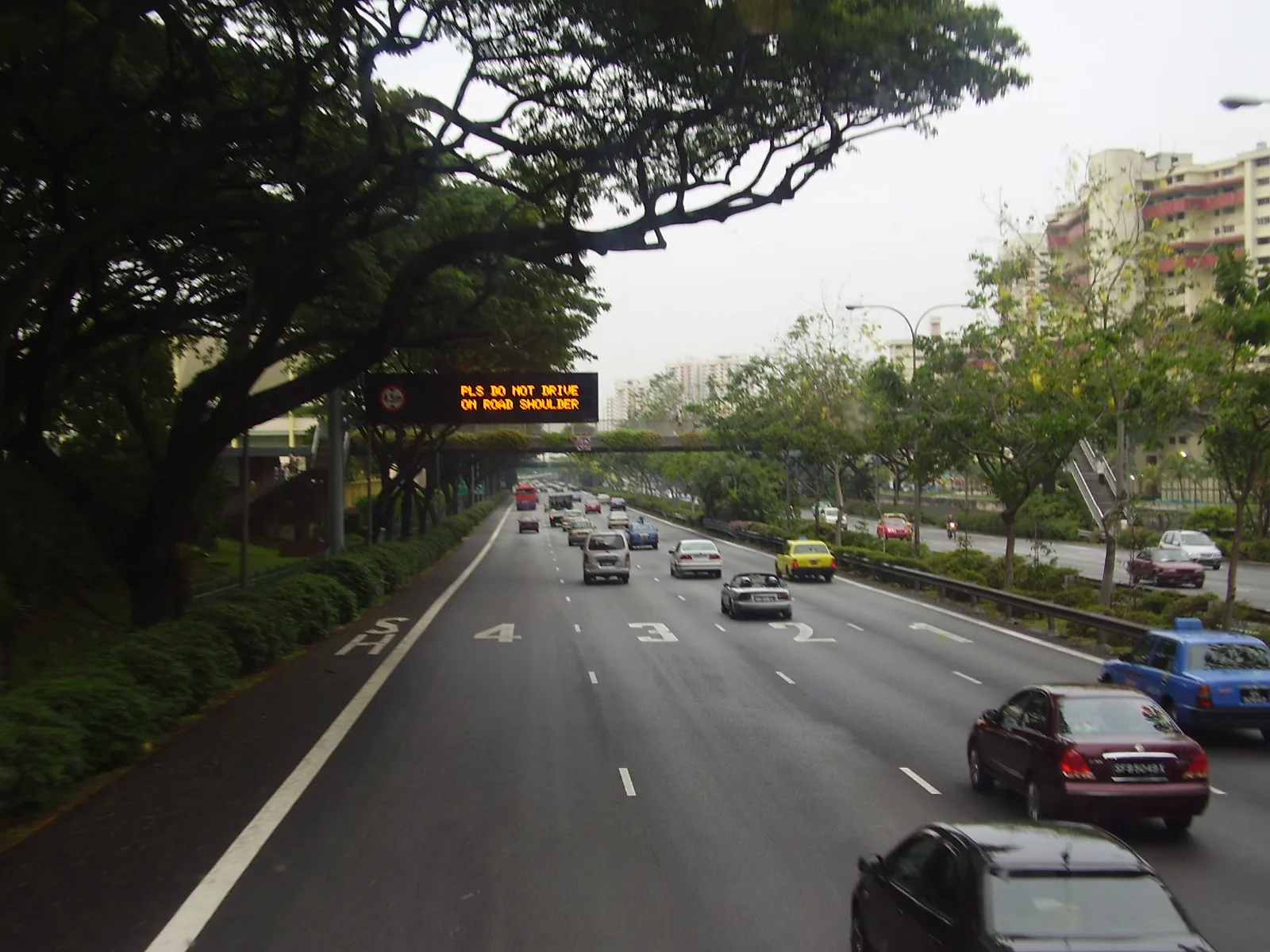
Traffic keeps to the left, a legacy of British colonial rule, and most cars are right-hand drive. Foreign left-hand-drive vehicles must either carry a sign saying LEFT-HAND-DRIVE or be towed. Most road signs follow British patterns, with red triangles for warnings and blue circles for mandatory instructions, though Singapore uses its own typeface and abbreviates names heavily, so road becomes Rd and Avenue becomes Ave. Expressways are named rather than numbered and shown by three letters: PIE stands for the Pan Island Expressway and ECP for the East Coast Parkway. Turning left on a red light is illegal unless a Left Turn on Red sign says otherwise, which is now rare, and turning right on red is always illegal. A few selected roads are even designated as emergency runways for aircraft.
A class 3 licence covers cars under 3,000 kg unladen with up to seven passengers, while class 3A is restricted to cars without a clutch pedal. Drivers must be 18. After passing the Basic Theory Test they need a Provisional Driving Licence, valid for 2 years since 1 December 2017 (it was six months before), then the practical test. The theory tests have 50 questions to answer in 50 minutes, with 45 correct needed to pass. Foreign residents need a valid foreign licence and must be at least 18, and visitors need an International Driving Permit, valid for a year, though ASEAN countries are exempt.
Citizens and permanent residents need not renew their licence. Drivers over 80 who reach 12 demerit points face early termination of the licence, no new drivers over 79 are accepted, and random medical checks apply to those over 62. Under the Driver Improvement Points System, 24 demerit points within two years bring a three-month suspension, and a driver suspended before may collect fewer than 12 points in 12 months. Speeding and unbelted passengers both earn points. Drinking and driving, phone use, dangerous driving and racing are all illegal, with disqualification and prosecution in court.
Importers have a straightforward route on safety. The EU and Japanese crash safety standards are both recognised, so cars from those markets need no further testing. A car can be imported privately with an EU Certificate of Conformity or a Japanese Completion Inspection Certificate.
Parking has its own habits. Some car parks have overhead sensors showing which spaces are free. At Housing and Development Board car parks, red-marked lots, usually on the lower decks, are for season parking holders, and some car parks that are away from town centres or shopping malls offer free parking on Sundays and public holidays from 7:30am to 10:30pm when an orange banner is displayed.
Where this goes next
The quota keeps being tuned: the LTA reviews it every October, with adjustments possible for the year starting in May. Percentage-based bidding, proposed in 1994 and revived in 2003 and 2023, remains a proposal rather than policy. The government continues to promote public transport and the car-lite society as its alternative to private ownership.