A beam about a metre wide, a reading that takes a third of a second and a long arms race between speed guns and the gadgets sold to beat them.
Radar guns send radio waves that spread widely, so detectors can pick up stray signals. Lidar guns fire a narrow infrared beam, give almost no warning, and are invisible to radar detectors. Laser jammers try to blind them, detector detectors hunt detectors, and legality varies by country and state.
A police lidar gun often takes about a third of a second to read a car's speed, through a beam only one to two metres wide at 300 metres. A detector on your windscreen has almost nothing to hear. Everything drivers have tried against it, from detectors to jammers, has to deal with that one fact.
Radar guns and lidar guns catch cars in different ways, and each defeats a different kind of gadget. The physics of each explains why detectors, jammers and even detectors of detectors work as they do, and why the law treats them so differently.
How does a police radar gun measure speed?
A radar gun fires a radio wave at a vehicle and measures how much the frequency of the reflected wave has changed. That shift, the Doppler effect, gives the relative speed. Police use it in hand-held guns, from patrol cars and from fixed objects such as traffic signals.
The weakness is the width of the beam. A radar signal spreads, so the gun cannot single out one car; it registers the speed of anything in its field, including a swaying tree or an aircraft passing overhead. That is why radar operators need skill, training and certification to judge by eye which vehicle in a stream is the offender, and why an accused driver can argue that another vehicle was the culprit.
The detector hears stray radiation. A lidar gun leaves almost none to hear.
How do radar detectors work?
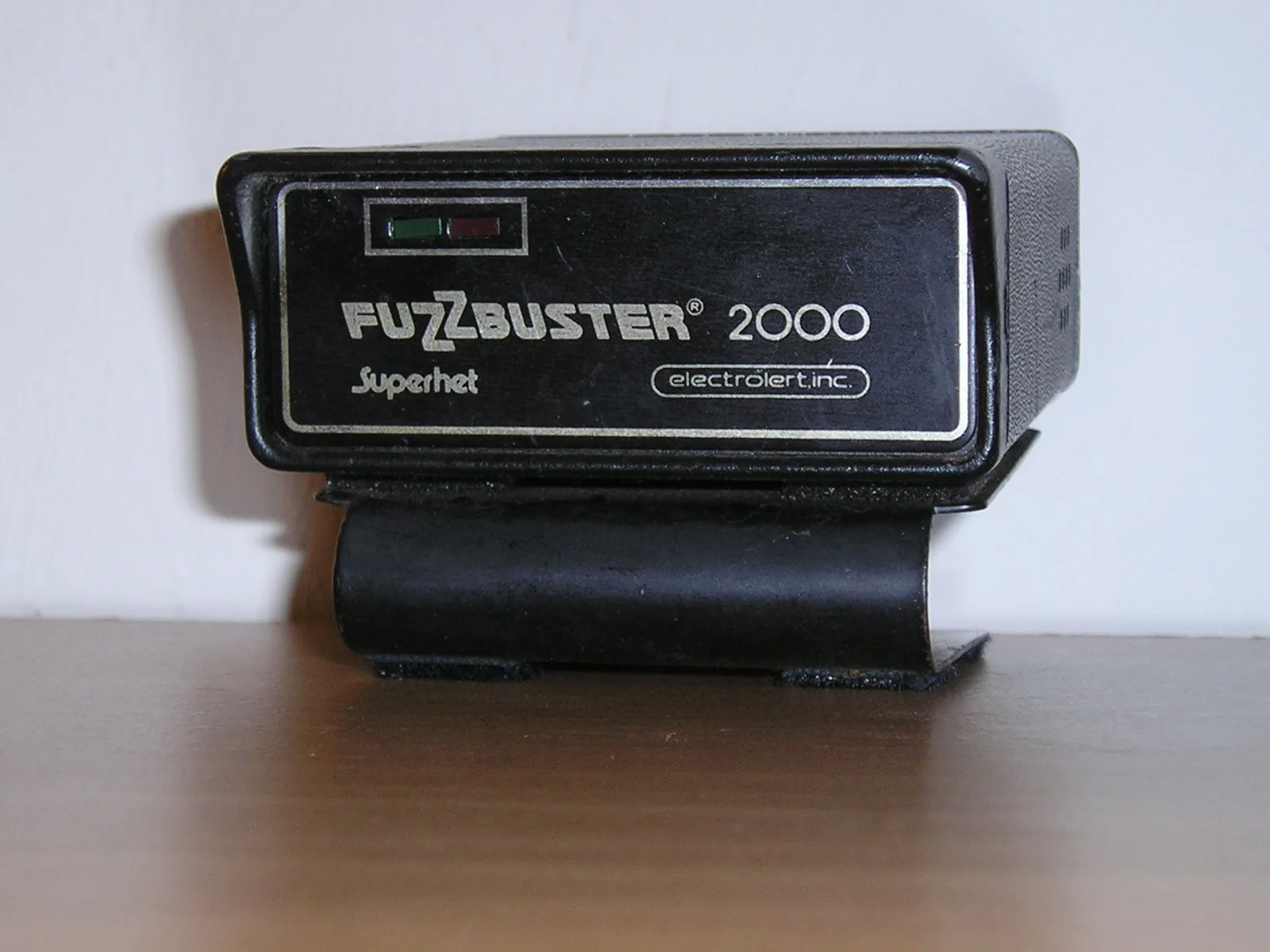
A radar detector is a receiver tuned to the same radio bands as the guns. It uses a superheterodyne receiver to pick up the emissions and sounds an alarm. Most detectors cover the X, K and Ka bands, and in Europe the Ku band is common too.
The trick that makes it work is the same widening beam. Because radio waves cannot be squeezed into a pencil line, the detector picks up stray and scattered energy from the edge of the beam, usually early enough for the driver to ease off. It can only hear a gun that is transmitting. Visual methods such as ANPR or VASCAR cannot be detected in daylight, and are vulnerable only at night when an infrared spotlight is in use. There are no reports of piezo sensors being detected at all.
Why do detectors cry wolf?
Plenty of everyday gadgets share the radar frequencies. Automatic door openers at supermarkets and chemists, speed display signs, blind spot monitoring systems and adaptive cruise control can all set off an alarm, as can a poorly designed detector. Modern units answer with GPS. A driver presses a button to mark a spot where police often sit, and the unit sounds off the next time the car approaches. Sites of repeated false alarms can be stored and ignored, either by hand or automatically.
Many can also be set to stay quiet below a chosen speed, since door openers and speed signs are most often met at low speeds. Some download the coordinates of speed cameras and red-light cameras, so the warning comes from a database rather than a radio.
How does a lidar speed gun measure speed?
Lidar swaps radio for light. The gun sends out short pulses of infrared laser and times how long each takes to bounce back. Think of shouting across a valley and counting the seconds to the echo, then repeating it hundreds of times and noting how the echo delay shrinks or grows. The change in distance over time is the speed.
The numbers are tiny. A typical device approved by the US National Highway Traffic Safety Administration (NHTSA) emits pulses 30 nanoseconds long, at a wavelength of 905 nm and a power of 50 milliwatts, with a beam spread of 3 milliradians. Light travels about 30 centimetres in a nanosecond, so a pulse is about nine metres long, and at a range of 300 metres the round trip takes 2,000 nanoseconds. The gap between pulses is no less than a million nanoseconds, leaving ample time to work out each distance. Up to several hundred readings are taken in under half a second.
The receiver listens only between 899 nm and 909 nm, and an internal algorithm throws out readings that look wrong. Evasion gadgets usually try to overload that filter so a good reading is discarded. The power is low enough that no eye damage occurs.
| Feature | Radar gun | Lidar gun |
|---|---|---|
| Signal | Radio wave, Doppler shift | Pulsed infrared laser |
| Beam spread at 1,000 feet (300 m) | Up to 85 feet (26 m) across | About 6 feet (1.8 m) |
| Picking one car from traffic | Needs operator skill and visual estimation | Targets a single car, up to 9,500 feet (2,900 m) |
| Use from a moving police car | Possible | Not possible; the operator must aim at each vehicle |
| Cost and spread | Lower price, large installed base | Costs falling, ease of use approaching radar |
| Detector needed | Radar detector | Lidar detector |
| US regulator of the emission | FCC (radio waves) | FDA (light) |
How common are lidar guns?
Jeremy Dunn of Laser Technology Inc. built a police lidar unit in 1989, and the company's 20-20 model made lidar enforcement increasingly common from the 1990s. In 2004 lidar made up 10% of US sales of traffic enforcement devices, and by 2006 the share was 30%, with sophisticated radar units still selling alongside.
Current units pack five jobs into one: speed detection, an operator viewfinder that works in poor conditions, imaging synchronised with the reading, court-ready evidence and a download to an external device. They can run in automatic mode, attended or not. Some models photograph the registration plate at the instant of the offence, with location and time. Certain devices can also measure the gap between vehicles to catch tailgating.
Why can a radar detector miss a lidar gun?
A radar detector listens for radio waves, and a lidar gun gives off infrared light, so an ordinary radar detector is deaf to it. A separate lidar detector is needed, and even that is generally less effective, because lidar emissions are shorter, tighter and scatter less than radar's. A driver may have no time to react to the burst.
Geometry does the rest. At 1,000 feet (300 m) a radar beam can be 85 feet (26 m) wide, but a lidar beam is only about 6 feet (1.8 m). An officer aiming at the centre of the car or at a headlight is pointing the beam away from a detector mounted on the windscreen, so it may not alert at all. Current lidar devices have a horizontal beam of one to two metres at 300 metres, against a registration plate 30 centimetres wide, so little signal strays onto following traffic.
Skilled operators help their own cause. An expert uses the viewfinder to pick the likely offender before triggering a reading, so very little signal escapes to warn other cars. At long range they steady the aim on a stationary tripod, hold the pulse on one point for the whole reading and wait for an audible tone confirming a good return. The registration plate is the preferred target, though any part of the vehicle will do.
Why the plate matters
Plates are built to help enforcement. A Californian plate, for example, is 6 inches tall and 12 inches wide, with a reflective surface especially sensitive to infrared. That lets cameras image it at night, supports automatic plate recognition and gives a lidar gun a strong return. Police prefer to read from the front, watching oncoming traffic, which also lets them wave an offender over without a high-speed chase. Some jurisdictions require no front plate, and many exempt vehicles such as motorcycles.
Modifying the vehicle to deflect, absorb or scramble the signal is hard because the plate is usually the aiming point. Altering the plate is easily spotted and may be illegal, and feeding the gun a false return signal will be picked up by current police lidar and may be illegal as well, depending on the jurisdiction.
What does a laser jammer do?
A laser jammer detects the gun's infrared light, normally at 904 nm, and answers with light of the same wavelength at a higher intensity. The aim is to confuse the gun into returning no speed at all. Newer models detect the gun's pulse rate and copy it, which makes an accurate reading harder still. Jammers are not the same thing as radar jammers.
The makers of guns have responded. Many lidar devices now have anti-jamming modes, and some guns show "jam codes" when they detect interference, though those work against some jammers and not others. Even without a code, an officer can often tell, because the gun simply shows no reading.
Drivers have a counter-counter-move, known as JTK, for "jam to kill": slow down to the limit, then switch the jammer off. Experienced officers watch for a gun that will not lock on a speed, together with a car decelerating suddenly. They may pull it over, look for jammers on the front of the vehicle and consider an obstruction of justice charge.
What is a radar detector detector?
The superheterodyne receiver inside a radar detector has a local oscillator that leaks a little radiation, usually at the frequency of the radar being detected plus about 10 MHz. That leak can be heard, so a device can be built to detect detectors. The VG-2 Interceptor came first, followed by the Spectre III and the Spectre Elite, which overtook it. The Spectre range was built in Australia by Stealth Micro Systems and handled in America by Applied Concepts, Inc. Production has ended.
The contest escalated. Because detector detectors use a similar receiver, many early stealth radar detectors carried a circuit that shut down the main receiver the moment a detector detector's signal appeared. In the early 1990s, BEL-Tronics of Ontario found that the local oscillator frequency could be shifted out of the VG-2's range. Manufacturers followed, and detectors immune to the Spectre Elite are now available.
The wider pattern runs through the whole field. When a new radar frequency arrives, detectors are blind to it until updated. Transmissions have been made shorter and weaker to lower the odds of detection, and that in turn produced more sensitive receivers and smarter software. Detectors increasingly pair GPS with a database of known speed-trap spots to improve their odds.
Are radar detectors and jammers legal?
It depends on the country. Some make it illegal to use or own a radar detector or jammer, with fines, confiscation of the device or both as the penalty. The reasoning given is that a driver using a detector poses a greater accident risk than one who does not. The history goes back a long way: radar-trap warning devices were already being manufactured in the United Kingdom in 1967, and were ruled illegal under the Wireless Telegraphy Act 1949. In Canada, most provinces prohibit detector use.
Actively transmitting devices meant to jam radar are illegal to sell or own in many countries. In the United States, transmitting on an FCC-licensed frequency without a licence breaks FCC rules, with fines of up to $10,000 and up to one year in prison possible.
Laser jammers fall into a different gap. The FCC regulates radio waves and the Food and Drug Administration oversees light, so the federal rules against radar jammers do not reach devices that block laser light. Several states have written their own bans. California, Colorado, Illinois and Iowa have them, as do Minnesota, Oklahoma, South Carolina, Tennessee, Texas, Utah and Virginia, where penalties can be severe. Washington, D.C. bans radar detection and jamming equipment, though the rule predates laser technology and does not name laser jammers. Nebraska is often listed as a ban, but its law targets radar transmission devices and says nothing of laser jammers.
Can a lidar reading be wrong?
It can, under particular conditions. Ordinary weather has a negligible effect on the device but can make it harder to aim, as with the sun directly behind the target, at night, or through a dirty windscreen in a stationary police car. Heavy fog makes it unusable, and many modern guns have weather modes that raise the minimum range to cope with rain reflection. Like radar, lidar suffers from cosine error. Sweeping the gun across traffic, or along the side of a car, can return a false reading, as can a pulse that bounces off a wing mirror, hits something reflective and returns to the mirror a second time.
Precipitation, smoke and airborne moisture can produce erratic readings. A further limit is that lidar cannot be used from a moving police car, because the operator must actively aim at each target, while radar can be used on the move.
Courts have looked hard at the technology. In 2008 a D.C. Superior Court ruling let lidar evidence stand after a four-day hearing that covered the science of lasers, the reliability of the guns, other pulses nearby, target identification, plates, windscreen glass and possible malfunction. The court added that no court holding a full hearing had found lidar unreliable, while over a dozen jurisdictions had accepted it as reliable.
Where this goes next
Radar remains the more widespread tool because it costs less and so much equipment is already in service. Lidar needs an officer who stays put and aims precisely, which limits it. Even so, its use is growing: costs are falling, ease of operation is approaching that of radar, and existing radar kit is reaching the end of its service life and being rotated out.
On the other side of the contest, the Spectre detector-detector line is out of production and detectors immune to it are on sale.