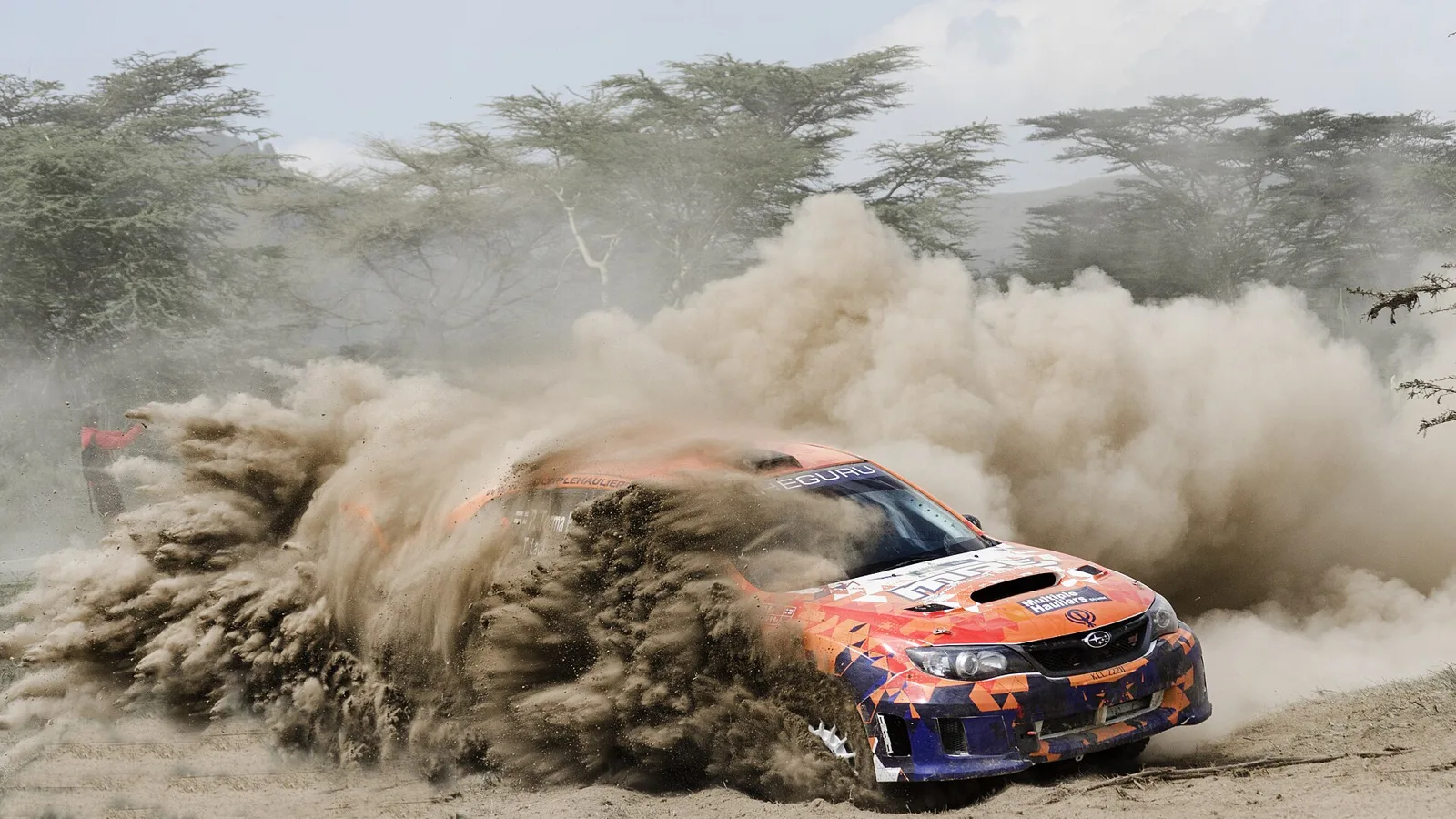
Kenya's 5,000 km open-road marathon and Greece's dusty, rock-strewn mountain stages, and why drivers compared them for toughness.
The Safari Rally in Kenya covered about 5,000 km of sand, mud and rocky tracks on open roads, while the Acropolis Rally in Greece pounded cars with dust, heat and rock-strewn mountain stages. Both were rated among the toughest events in the World Rally Championship.
In 1996 the winner of the Safari Rally finished with more than 12 hours of accumulated time penalties, and still won. That is how brutal Kenya's marathon was: the driver with the least lost time took the prize, and the clock kept running through sand, mud and mechanical repairs. Greece's Acropolis Rally punished cars differently, with rock, dust and heat, yet drivers compared the two.
What is the history of the Safari Rally?
Kenya's Safari Rally began as the East African Coronation Safari, run between 27 May and 1 June 1953 across Kenya, Uganda and Tanganyika to mark the crowning of Queen Elizabeth II. In 1960 it became the East African Safari Rally, and from 1974 simply the Safari Rally. It counted towards the World Rally Championship from 1973.
Championship status lapsed after 2002 and came back in 2021. Historically the Safari has ranked among the hardest rallies in the series, and among the best loved in Africa. A historic edition has run every second year since 2003.
In 1996 the Safari winner's total time penalty was above 12 hours.
What made the Safari such a punishing test?
The route stretched for 5,000 km (3,100 mi) and mixed almost every hazard a road can offer. There was fesh fesh, a very fine powdered sand, plus fast farm tracks and very rough roads climbing or dropping through the Great Rift Valley. In heavy rain the roads turned to thick, deep mud.
The rally ran on open roads, and every kilometre of it counted. The winner was whoever had piled up the least penalty time between time controls. Average speeds were historically over 100 km/h (62 mph), which made it one of the fastest events in the championship, but the rough ground and long stages tended to reward the most dependable driver, or the quickest one who drove carefully.
Danger was not confined to the surface. In later years leading teams used helicopters to fly ahead of the cars, warning of animals or other vehicles on the route.
How were Safari cars built to survive?
Crews turned up in cars built specially for the job: reinforced, with bullbars, snorkels so they could cross rivers and powerful lights to warn animals. Through the 1990s Toyota Team Europe stationed a permanent test team in Kenya to prepare and try out its cars.
Repairs were part of the event. Cars needed fixing again and again on the way, and every stop added to the elapsed time. Tyre mousse, an insert that lets a tyre keep working after a puncture, eventually let drivers attack flat out, even over such a long route.
What changed on the Safari in 1996?
The 1996 rally switched to special stages and banned helicopter servicing. Until 2002 it contained around 2000 km of timed running, split into stages that were often well over 60 km (37 mi) each. Most rallies had under 500 km (310 mi) of timed distance in total. Roads were still open to other traffic.
The change showed up in the results. The winner's penalty topped 12 hours in 1996 and had shrunk to two seconds under 8 hours by 2002. For 2003 the rally was dropped from the championship calendar because money and organisation were lacking.
How did the Safari come back?
From 2003 the rally became part of the African Rally Championship and was modernised, with shorter stages and closed roads like other World Championship rallies. The 2007 and 2009 editions also counted towards the Intercontinental Rally Challenge. In 2013 Kenya's President Uhuru Kenyatta announced a plan to return it to the world championship.
On 27 September 2019 organisers announced that the 2020 edition would join the World Rally Championship, but it was cancelled because of the COVID-19 pandemic. The comeback finally came in 2021, after eighteen years away, from 24 to 27 June at Naivasha in Nakuru County, on the floor of the Rift Valley. Sebastien Ogier and Julien Ingrassia won in a Toyota Yaris WRC.
Who has won the Safari most often?
Two Kenyans lead the way: Shekhar Mehta and Carl Tundo, with five outright victories each. Mehta won in 1973 and again in each of the years 1979 to 1982, when the rally counted for the world championship. Tundo's five came in 2004, 2009, 2011, 2012 and 2018, when it belonged to the African Rally Championship.
Tundo has reached the podium twelve times, three more than Ian Duncan, another Kenyan, on nine. The classic version, first held in 2003 to mark the 50th anniversary, lasts nine days over 5,000 km (3,100 mi) and is open to cars built before 1985. The 2017 edition had joint winners, because Richard Jackson and Carl Tundo recorded exactly the same time.
What is the Acropolis Rally?
The Acropolis Rally of Greece belongs to the World Rally Championship and runs over fast, dusty, rocky mountain roads on the Greek mainland, normally in the height of summer. Harsh surfaces and heat are its trademarks. The Greek motoring club ELPA has organised it since the early 1950s, which makes it one of the oldest fixtures in world rallying.
Among the names on the winners' list are Walter Rohrl, Bjorn Waldegard, Ari Vatanen and Stig Blomqvist, Juha Kankkunen, Carlos Sainz and Colin McRae.
Why is the Acropolis so hard on cars and crews?
It mixes rough, twisty, fast mountain stages with blistering heat and choking dust, and it is regarded as one of the toughest rallies on the European and world circuits. Cars need extra sturdiness to cope with fast stages strewn with rocks, and drivers and co-drivers face pounding terrain and summer temperatures that often reached 50 degrees Celsius inside the cockpit.
Drivers have judged it a trial of skill, patience, courage and stamina, and some set it alongside the Safari for sheer difficulty. Even the best-loved stages come with a warning. The fast, flowing tests in Phthiotis and Phokis, around the Parnassus and Giona mountains, let cars reach their potential, yet pushing hard is risky because the hard surface can cause heavy damage. The Ymitos stage is known as a car breaker.
Individual stage names have become shorthand for the rally. Bauxites/Karoutes, Drosohori, Pavliani, Kaloskopi, Elatia, Rengini, Eleftherohori and Moschokarya are recent favourites with drivers and fans alike. Others with a following include Kineta and Aghi Theodori in Corinthia, Prodromos, Livadeia and Thiva in Boeotia, Parnonas in the Peloponnese and the fast, beautiful Parnitha, while the Meteora stage, last used in the late 1980s, was spectacular.
Several stages pass historic sites, such as Klenia-Mycenae, which includes the archaeological site of Mycenae. Many other classic tests were later asphalt-paved and dropped, because the Acropolis is mainly a gravel event.
Which is the hardest rally in the world?
Neither can be named the hardest outright. They were hard in two different ways. The Safari tested endurance and reliability over distance, with penalties piling up for hours, while the Acropolis attacked a car with rock and heat on stages where one wrong push could end the day.
Even so, drivers who knew both made the comparison themselves, and both events earned a reputation as among the toughest on the world circuit. The Safari's reputation came from distance, wildlife and weather. The Acropolis earned its from heat, dust and stones.
Safari and Acropolis compared
| Feature | Safari Rally | Acropolis Rally |
|---|---|---|
| Country | Kenya | Greece |
| Terrain | Fesh fesh sand, farm tracks, Rift Valley roads, deep mud | Dusty, rocky mountain gravel |
| Main hazards | Wildlife, river crossings, long distances | Heat, dust, rock-strewn stages |
| First held | 1953 | Early 1950s |
| Classic version | Biennial since 2003, cars built before 1985 | Historic Acropolis Rally since 2002 |
What was the Tarzan stage?
Tarzan was an unusually difficult 30.3 km test in Evritania, originally called the Fourna and Rentina stage. Its name comes from Giorgos Burgos, a police officer from Fourna who lived in Athens. Ill with tuberculosis and told he had only months left, he moved to Fourna and lived to the age of 92.
The rally passed his hut from the 22nd edition in 1975, and the stage took the Tarzan name in the 26th rally, in 1979, in honour of the local resident and rally fan. It appeared in full every year until the 42nd running in 1995, and a later route called Rentina-Tarzan used the second half of the old stage, finishing in Tsoukka.
Drama followed it. In June 1991 Didier Auriol wrecked a wheel rim and his suspension there and lost both the lead and the victory, yet he later named Tarzan his favourite Acropolis stage. A cut-down 20.65 km version, New Tarzan, ran twice in 2003 to mark the 50th anniversary, and the stage came back in 2021 as the Power Stage.
How has the Acropolis changed?
It began in the early 1950s as a marathon and endurance event. After joining the World Rally Championship in 1973, crews faced up to 800 competitive kilometres on some of the most gruelling stages imaginable. Until the late 1980s the route roamed across Greece, taking in Kalambaka and Meteora, the foothills of Mount Olympus, Attica, Central Greece and the Peloponnese. The traditional start was under the Acropolis in Athens, with the finish ceremony in the Panathenaic stadium.
As the championship moved to shorter sprint events, the Acropolis based itself in one area. Headquarters were in Lamia and Itea in the 1990s and early 2000s. The base then shifted to the Athens Olympic Sports Complex in 2005, the Markopoulo Olympic Equestrian Centre in 2007 and Tatoi military airport in 2008, the final year the rally was centred on Attica. Loutraki, near the Corinth Canal, became headquarters in 2009, and Lamia took the event back for the 2016 European season.
Super special stages became a signature. A superspecial stage held in the Athens Olympic Stadium in 2005 was the highlight of that year's calendar, with a packed arena atmosphere, and the rally was named Rally of the Year. Two superspecials were held in the stadium in 2006. In 2018 one returned to Markopoulo, and in 2022 the rally opened with a superspecial in the Olympic Stadium again.
Where this goes next
The Acropolis began its revival in August 2020, when Prime Minister Kyriakos Mitsotakis said the government was ready to support the organisers financially. In late December the Hellenic Ministry of Sport reached agreement with the organising committee on a revival, and in March 2021 the return to the World Rally Championship was announced for September of that year, with Lamia as host. The 2026 edition is due to be held in Loutraki, and the Historic Acropolis Rally, held since 2002, is part of the European Historic Rally Championship.
For the Safari, the WRC contract runs until 2026, and the classic East African Safari Rally continues to be held every second year.