From the Thomson Road Orient Year Grand Prix of 1961 to the 2008 night race on the Marina Bay streets, with lighting, layout changes and every winner to 2019.
The Singapore Grand Prix returned to Formula One in 2008 on the Marina Bay Street Circuit, hosting the sport's first night race under about 1600 floodlights. The earlier Thomson Road race ran from 1961 to 1973. Marina Bay has been reprofiled several times, and the race contract now runs until at least 2028.
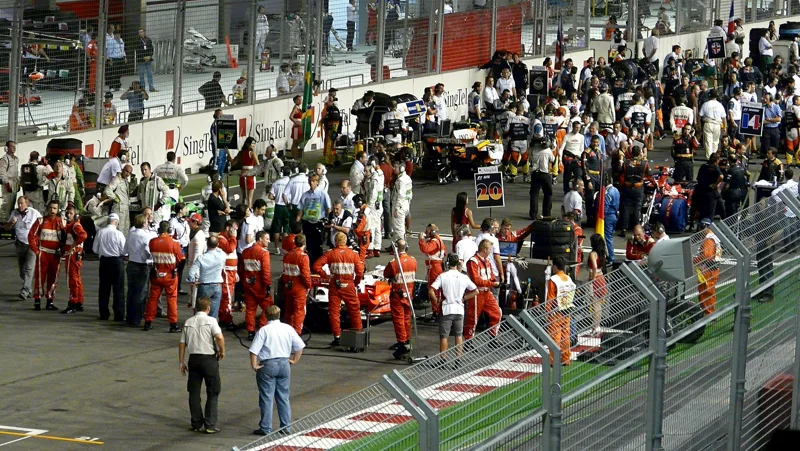
The first Formula One race ever held at night, in 2008, was also the 800th World Championship race since the series began in 1950, and its winner's victory has been tarnished ever since. Renault was later found to have ordered Nelson Piquet Jr. to crash so that the safety car would help Fernando Alonso.
That race, on the Marina Bay streets of Singapore, set up a spectacle the sport has kept ever since: some 1600 floodlights, a harbourside circuit among skyscrapers, and a track so unforgiving that every race until 2024 had at least one safety car. The story runs from a 1961 road circuit to a government-funded bid and a layout rebuilt repeatedly since.
How did the Singapore Grand Prix begin?
The Singapore Grand Prix started in 1961 as the Orient Year Grand Prix at the Thomson Road circuit, run to Formula Libre rules. It was renamed the Singapore Grand Prix in 1966, soon after Singapore became a sovereign country in 1965. The event stopped after 1973, and the reasons suggested include heavier traffic, the danger and unsuitability of the track, the inconvenience of closing roads and fatal accidents in the 1972 and 1973 races.
The Grand Prix returned in 2008 as a round of the Formula One World Championship at Marina Bay, a street circuit that was the first in Asia designed for Formula One and hosted the sport's first night race.
That race set up a spectacle the sport has kept ever since: some 1600 floodlights and a harbourside circuit among skyscrapers.
How did Singapore win a Formula One race?
A five-year agreement came together in 2008 between Singapore GP Pte Ltd, the Singapore Tourism Board and Bernie Ecclestone. The telecommunications company Singtel was announced as title sponsor in November 2007, which made the official name the Formula 1 SingTel Singapore Grand Prix. The Government of Singapore covered 60 per cent of the bill, S$90 million of a total S$150 million.
Around 110,000 tickets were released for the country's first Formula One race. Corporate hospitality went on sale at the end of November 2007, three-day passes followed in February 2008 and single-day passes a month later. Every ticket sold. The Amber Lounge after-party was held at the 2008 race, and in 2010 Singapore became the second place to host the Amber Lounge Fashion show.
Contracts and sponsors
The race has been repeatedly extended. On 22 September 2012 the AP reported that Ecclestone and the organisers had agreed to keep the Grand Prix on the calendar until 2017. Singapore Airlines took over sponsorship from 2014, announced on 15 April 2014. A day before the 2017 race came news of an extension through 2021, and a further deal announced in 2022 keeps the race on the calendar until at least 2028.
What does racing under floodlights involve?
About 1600 custom-made floodlights are spread around the 5.067 km (3.148 mi) Marina Bay circuit. The lights are four times brighter than those at a regular sports stadium, and they are designed to minimise glare and surface reflection while meeting Formula One's television broadcasting standards. In 2008 a set of projectors also lit the track, adapting their output to the course's outline.
The night schedule had a second purpose. It meant the race could be shown live at a convenient hour for television audiences outside the Asia-Pacific region. For drivers it brought hot, humid conditions, a bumpy surface and little rest. Lewis Hamilton, the 2008 world champion, said the circuit was twice as hard as Monaco and unexpectedly physical, demanding double the energy over a single lap.
Why is Marina Bay so demanding?
Marina Bay Street Circuit, sometimes called the Singapore Street Circuit, winds around the bay through the planning areas of Downtown Core, which holds turns 4 to 19, and Kallang, which holds turns 1 to 3. It is 4.928 km (3.062 mi) long since the 2023 layout change, having been 5.063 km (3.146 mi) before it, and its harbourside setting resembles the Circuit de Monaco and the Valencia Street Circuit. KBR designed it, modifying an original layout first proposed by Hermann Tilke, and it holds an FIA Grade 1 licence. Until the 2024 race at least one safety car appeared in every Grand Prix, with 24 deployments across 16 races.
The pits sit on an empty plot off Republic Boulevard beside the Singapore Flyer. From there the track runs along Raffles Boulevard, Nicoll Highway, Stamford Road and St Andrew's Road around the Padang, past City Hall. It then crosses Anderson Bridge, passes the Fullerton Hotel, and turns tightly left onto Esplanade Drive beside Merlion Park before rejoining Raffles Avenue.
A lap in numbers
| Part of the lap | Speed |
|---|---|
| Pit straight, under Benjamin Sheares Bridge | 308 km/h (191 mph) |
| Turn 1 | 146 km/h (91 mph) |
| Turn 3 | 90 km/h (56 mph) |
| Republic Boulevard, turn 4 | Up to 260 km/h (160 mph) |
| Raffles Boulevard, fastest point | Up to 320 km/h (200 mph) |
| Turn 7, after heavy braking | 127 km/h (79 mph) |
| St Andrews Road | 276 km/h (171 mph) |
| Turn 13 hairpin | 67 km/h (42 mph) |
| Esplanade Bridge | 290 km/h (180 mph) |
| Turns 18 and 19, by the Singapore Flyer | About 180 km/h (110 mph) |
The lap starts on a specially built pit straight with the first DRS zone. Turns 1, 2 and 3 form an S, and the cars then rush down Republic Boulevard to a right-hander at turn 5, at 145 km/h (90 mph). Raffles Boulevard carries the second DRS zone and the circuit's fastest stretch, with turn 7 a hard braking point from 320 to 127 km/h (199 to 79 mph). Later come turn 8 at 81 km/h (50 mph), turn 9 at 140 km/h (87 mph) and a left-hander at turn 10 at 150 km/h (93 mph).
Cars cross Esplanade Bridge, the third DRS zone, and turn 14 almost meets turn 8 before leading onto Raffles Avenue. Since the 2023 reprofile a long straight on that avenue, with a fourth DRS zone, replaces turns 16 to 19 and bypasses the technical section once known as the Float. Turn 16 is now a massive braking point, a hard right followed by a left at turn 17. Most drivers leave turn 17 close to the wall, because that exit decides how fast they approach turn 18. They pass the 165 m (541 ft) tall Singapore Flyer before turns 18 and 19 are taken flat out.
How has the Marina Bay layout changed?
The kerbs at the turn 10 chicane worried drivers from the first weekend. Sebastien Bourdais and Alonso voiced concern, and Felipe Massa compared them to little tortoises that would wreck a car. The drivers feared suspension or tub damage, or being thrown into the outside wall. FIA race director Charlie Whiting agreed to lower the kerbs before Friday practice and again for Saturday qualifying and the race. The pit entry, which begins at the penultimate corner, was called difficult and dangerous by several drivers because cars entering the pits and cars staying out shared a racing line at very different speeds. The pit entry line was extended before Saturday qualifying so drivers had to commit earlier.
In March 2009, a competition among local fans named three corners. Turn 1 became Sheares, honouring Singapore's second president, Benjamin Henry Sheares. Turn 7 became Memorial, because it sits near a civilian memorial from the Second World War, and turn 10 became the Singapore Sling. Turns 1, 2 and 3 were modified for 2009 to aid overtaking, and turn 10 was changed because its high kerbs had caused many accidents in 2008.
Turn 10 was reprofiled again in 2010, but Hamilton said that made the entry smaller and the chicane more dangerous, calling it the worst corner in Formula One. For 2013 the FIA approved removing the Singapore Sling altogether. A single-apex left-hand bend replaced it, entry speed rose by about 40 km/h (25 mph), and an extra layer of TecPro barriers was added to the end of the run-off. In 2015 changes to turns 11 to 13 moved the track to the left side of Fullerton Road and onto the other side of Anderson Bridge, with the turn 13 hairpin widened by a metre to help overtaking. In 2018 turns 16 and 17 were reprofiled, trimming the length from 5.065 to 5.063 km (3.147 to 3.146 mi).
The floating platform and a new asphalt surface
Turns 16 to 19 had sat on the Marina Bay Floating Platform since 2008. In August 2020 Prime Minister Lee Hsien Loong announced plans to turn the platform into a community space called NS Square, which meant another re-profile. That did not happen in 2022 but was made before the 2023 race, as a temporary change that cut the length to 4.928 km (3.062 mi) and was expected to take about 20 seconds off lap times. Works began in June 2022 to resurface most of the circuit's asphalt in order to ease the porpoising seen on the 2022 cars. George Russell holds the quickest qualifying lap, 1:29.158, from the 2025 event.
Who won the Singapore Grand Prix in its first years?
| Year | Winner | Team | Pole position |
|---|---|---|---|
| 2008 | Fernando Alonso | Renault | Felipe Massa, Ferrari |
| 2009 | Lewis Hamilton | McLaren | Lewis Hamilton |
| 2010 | Fernando Alonso | Ferrari | Fernando Alonso |
| 2011 | Sebastian Vettel | Red Bull | Sebastian Vettel |
| 2012 | Sebastian Vettel | Red Bull | Lewis Hamilton |
| 2013 | Sebastian Vettel | Red Bull | Sebastian Vettel |
| 2014 | Lewis Hamilton | Mercedes | Lewis Hamilton |
| 2015 | Sebastian Vettel | Ferrari | Sebastian Vettel |
| 2016 | Nico Rosberg | Mercedes | Nico Rosberg |
| 2017 | Lewis Hamilton | Mercedes | Sebastian Vettel |
| 2018 | Lewis Hamilton | Mercedes | Lewis Hamilton |
| 2019 | Sebastian Vettel | Ferrari | Charles Leclerc |
In 2008 Massa took the first pole, in 1:44.801, and dominated until a pit stop went wrong. He was released early, broke his fuel rig and dropped to last. Alonso won the 61 laps in 1:57:16.304, with Kimi Raikkonen setting the fastest lap. A year later, Hamilton, the reigning champion, won from pole in the McLaren, with Timo Glock second for Toyota and Alonso third in Renault's first race after receiving a suspended disqualification for manipulating the previous year's race.
In 2010 Alonso became the first man to win twice in Singapore, taking his 25th career victory for Ferrari. Michael Schumacher was 13th, and Heikki Kovalainen jumped out of his burning Lotus T127 and put the fire out with a borrowed extinguisher. In 2011 Vettel, eight times a winner before Marina Bay, led the championship by over 100 points and won from the 11th pole of his season. Hamilton retired with gearbox problems in 2012, leaving Vettel to win and dedicate the victory to Sid Watkins, who had died shortly before the race.
Vettel's third straight win in 2013 was his 33rd in Formula One, by more than half a minute, and Alonso stopped his Ferrari to give Mark Webber a lift when Webber's burning Red Bull stopped at turn 7. In 2014 the new turbocharged hybrid cars replaced the 2.4-litre power units, a ban on radio communications dominated the build-up, and Hamilton took his seventh win of the season to become Singapore's third multiple winner.
A spectator on the track and a title swing
In 2015 Vettel took his first Ferrari pole and his fourth win at Marina Bay. During the race a 27-year-old spectator climbed through a gap in the fencing and walked onto the straight after Anderson Bridge as Vettel and Daniel Ricciardo sped past, and he was arrested by Singapore police. Nico Rosberg was making his 200th start in 2016 and won to keep alive the title fight with his Mercedes team-mate Hamilton, which he went on to win.
The 2017 race swung the championship. Vettel started on pole but collided at the first corner with Raikkonen and Max Verstappen, and all three retired. Hamilton won from fifth on the grid and stretched his lead over Vettel from 3 to 28 points. In 2018 he took pole in 1:36.015 (189.832 km/h) and won again, with Verstappen second and Vettel third, which put him 40 points clear. The 2019 race went to Ferrari. Charles Leclerc took pole, Vettel won what proved to be his last career victory, and Ferrari scored its first 1-2 finish since the 2017 Hungarian Grand Prix, with Verstappen third.
Beyond Formula One, the circuit has hosted Porsche Carrera Cup Asia, and its former events include GP2 in 2012 and 2013, TCR International in 2015 and 2016, Ferrari Challenge Asia-Pacific from 2017 to 2019, W Series in 2022 and F1 Academy in 2024 and 2025.