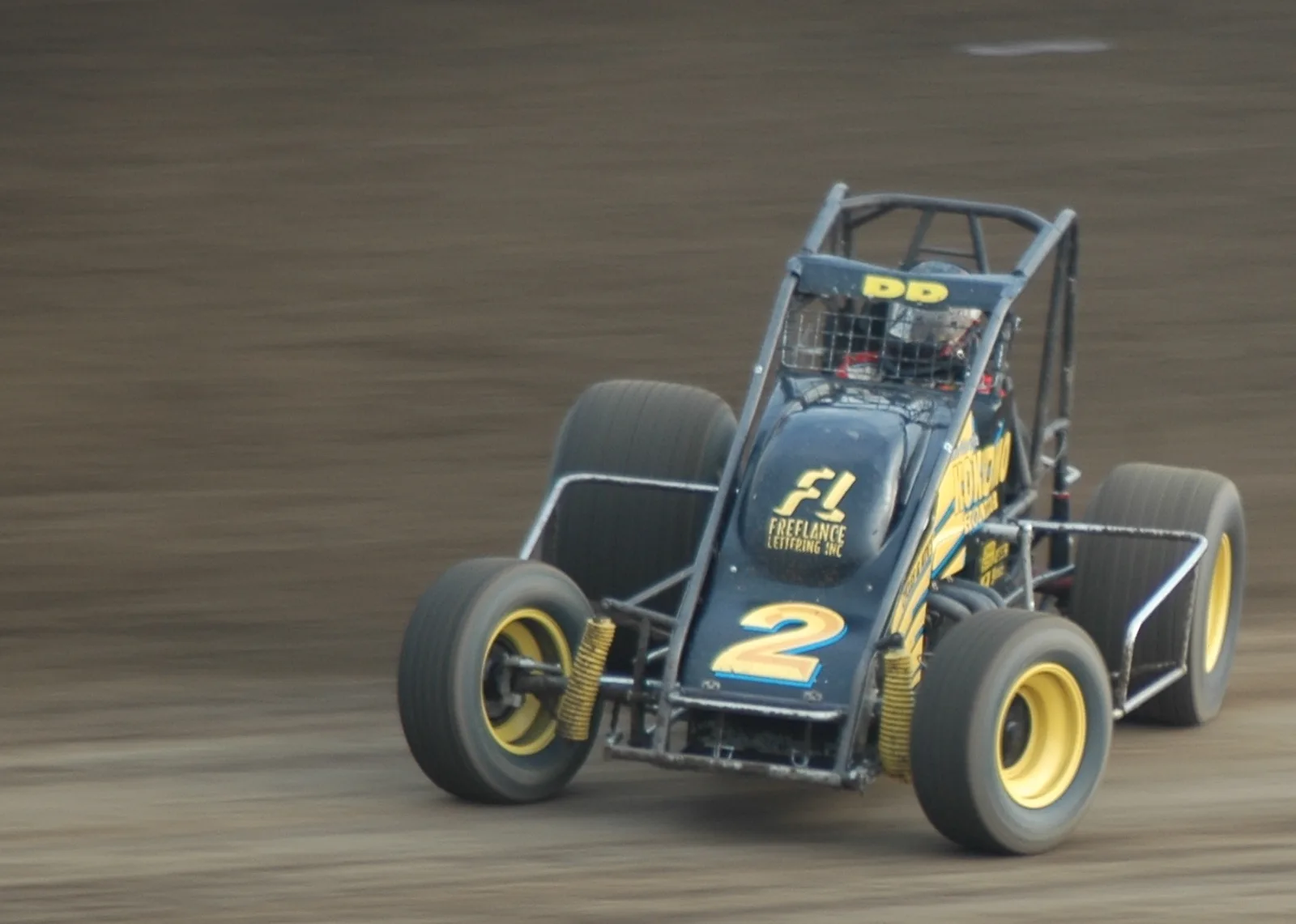
Sprint cars weigh about 640 kg with the driver, produce over 900 horsepower and have to be pushed to start. They also trained a long list of Indianapolis 500 winners and NASCAR champions.
Sprint car racing is open-wheel oval racing on dirt. The cars weigh about 640 kg with the driver, make over 900 horsepower and are push-started with no starter motor. Winged cars began in 1958, and many Indianapolis 500 winners and NASCAR champions used sprint cars as a stepping stone.
A modern sprint car has no starter motor and no battery, and the top-level World of Outlaws cars have no clutch either. Before each race it has to be pushed down the track by a quad bike or a truck. Once running, it weighs about 1,400 pounds (640 kg) with the driver aboard and makes more than 900 horsepower (670 kW), a power-to-weight ratio that on those numbers beats a contemporary Formula One car. It does all this on clay or dirt, usually on an oval no longer than half a mile.
Those machines are the top of a dirt racing ladder that runs from go-karts with roll cages to 850 horsepower late models. The racing began in America before World War I, now fills hundreds of local tracks across several continents, and has produced a long list of famous graduates.
What is dirt track racing?
Dirt track racing is held on clay or dirt surfaced banked ovals. It began in the United States before World War I and became widespread through the 1920s and 1930s, using both cars and motorcycles. It travelled to Japan, often running on horse racing tracks, and has followings in Canada and Mexico, in Argentina, Brazil and Chile, and in Australia, New Zealand, South Africa and the United Kingdom. The cars range from open-wheel sprint cars and modifieds to fendered stock cars.
Most experienced dirt racers prefer a moist, properly prepared clay oval. Preparing one is both a learned craft and long, complex labour. After an event, a grader smooths the rutted surface back into the track's shape and crews tamp loose soil into the soft spots. A cultivator or rototiller then breaks up the compacted top layer, to help water soak in, and a watering truck wets it. Outdoor dirt tracks are typically aerated about 12 inches deep. On race morning the track is rolled and watered again, with a final light watering just before the cars pack the surface with their wheels.
No starter, no battery, and more power per kilogram than a Formula One car.
How big are the tracks?
In North America nearly all dirt tracks are ovals shorter than a mile (1.6 km), and most are half a mile (800 m) or less. The usual sizes are half a mile, three-eighths of a mile (600 m), a third of a mile (540 m), a quarter of a mile (400 m) and an eighth of a mile (200 m). Longer tracks let cars reach higher speeds, up to 160 mph (260 km/h), and spread them out. That cuts the chance of a crash but raises the damage and injury risk when one happens.
Elsewhere the scale differs. Great Britain's ovals are normally grass, from 400 m to 800 m, with four-lap qualifying heats that eliminate the slower drivers before a final. Mainland Europe's long tracks may be grass, sand or cinder and reach a kilometre. Australia's dirt racing dates to the 1920s and 1930s, with most tracks around 400 to 540 m on clay, dolomite or sand and clay mixes. A few were paved with asphalt in the 1970s and early 1980s, but each eventually reverted to its former surface.
What is a sprint car?
Sprint cars are open-wheel machines designed for short oval tracks, dirt or paved. They were once simply called big cars, to separate them from midget cars. They are popular mainly in the United States and Canada, and also in Australia, New Zealand and South Africa.
The engine is typically a naturally aspirated, methanol-injected overhead valve American V8 of 410 cubic inches (6.7 L) turning up to 9000 rpm. A cheaper and very popular class uses 360 cubic inch (5.9 L) engines making up to 775 horsepower. Depending on setup and track, the fastest can exceed 160 mph.
The missing pieces explain the rest. Instead of a conventional transmission, a sprint car has a box that is simply in or out, plus rear differentials built for quick swaps, so a crew alters the gearing only now and then. With no electric starter and no electrics beyond an ignition magneto, it needs a push to start. The World of Outlaws cars go further, with no flywheel, clutch or transmission at all, only a direct drive that the driver engages or disengages from the cockpit. That is done for weight reasons and for tradition.
The other end of the ladder
| Class | Engine | Figures |
|---|---|---|
| 410 sprint car | 410 cu in (6.7 L) V8 | Over 900 hp, about 1,400 lb (640 kg) with driver |
| 360 sprint car | 360 cu in (5.9 L) V8 | Up to 775 hp; the United Racing Company quotes about 650 hp (480 kW) |
| Super late model | V8, Chevrolet, Chrysler or Ford based | About 850 hp, 2300 lb, complete car about $70,000 |
| Midget | Four-cylinder | About 350 hp (260 kW) |
| Micro sprint | Motorcycle engines, 600 cc common | About 140 hp, minimum 775 lb winged |
| SpeedSTR | Honda K20 C1 Turbo | 1,250 lb, 72 inch wheelbase |
| Outlaw kart | 250 cc to 550 cc | 150 lb to 500 lb, about $5,000 |
Why wings changed sprint car racing
Wingless sprint cars are the traditional ones, dating back to the 1930s and 1940s. Today winged and wingless cars are essentially the same vehicle, and many wingless frames have stub outs for attaching a wing. Their tuning and gearing differ because they work at lower rpm, and so do their chassis setups and tyres. Without a wing they have less downforce and less top speed, yet many fans find them more entertaining because they are harder to control through corners and more prone to spectacular accidents.
Jim Cushman drove the first winged race car seen on a small track, at Columbus Motor Speedway in Ohio in 1958. The wing was made by Gene and Floyd Miller, and Cushman won with it. By 1959 up to half of the field at Columbus was running wings. In the early 1970s many sprint car drivers started fitting wings with sideboards at the front and on top. Think of an upside-down aircraft wing: downforce presses the car into the dirt, and the sideboards, pushing in the opposite direction, help turn the car in corners.
Wings also matter for safety. The extra downforce makes airborne moments less likely, and when a car does leave the ground, the wing hits first and breaks off or crumples, reducing the impact on the driver. Teams can often replace a wing during the stoppage and carry on when the race resumes.
Who runs the series?
Ted Johnson founded the World of Outlaws in 1978 as the promoter of winged sprint cars. Running from February to November across the United States, it is the premier dirt sprint car series. Its cars have 15 inch (380 mm) wide right rear tyres and mechanical fuel injection. Famous tracks on the schedule have included Eldora Speedway in Rossburg, Ohio, Lernerville in Sarver, Pennsylvania, Knoxville Raceway in Iowa and Williams Grove in Mechanicsburg, Pennsylvania. The Knoxville Nationals take place every August. The main event, the A-main, begins with cars lined up four wide as a salute to the crowd, a tradition that produced the track announcer's line about the best being four abreast.
The All Star Circuit of Champions was founded in 1970 and sanctions 410 winged races in states from Ohio to Florida, about 40 a year from February to October. USAC runs a wingless 410 national championship on asphalt and dirt, plus regional 360 series. The United Racing Company began in 1948 with 11 races and grew to 28, running winged 360s on alcohol fuel in the north-east. The American Sprint Car Series, started by promoter Emmett Hahn, moved its headquarters from Tulsa to Concord, North Carolina, in 2024 after World Racing Group bought it. Gary Wright holds its record of 127 A-main wins. The International Motor Contest Association, organised in 1915, is the oldest active sanctioning body in the country.
Sprint cars in Australia
Australia followed in 1987 with the World Series Sprintcars, founded by Adelaide sedan driver and Speedway Park promoter John Hughes. Venues have included Speedway Park and later Claremont and Perth Motorplex in Western Australia, Valvoline Raceway in Sydney, Archerfield in Brisbane and Premier Speedway in Warrnambool, Victoria. A single-meeting Australian Sprintcar Championship has run since 1963 and has had its current name since 1979. Overseas drivers may enter the series and state championships, but only Australians can race in the national championship meeting.
The Grand Annual Sprintcar Classic at Warrnambool is described as the biggest sprint car meeting anywhere. In the 2014-15 season the 2015 Classic drew more entries than the Knoxville Nationals. Australia also changed its engine rules. Until the early 2000s its sprint cars were limited to 6,200 cc (380 cu in) V8s, against 410 cu in in the United States and New Zealand. Brian Healey, owner of Parramatta City Raceway, pushed for the switch in 2003. Now the country has both 410 and 360 formulae, each with its own championship.
The sport has held only one unofficial world championship. In 1987, at the one-third mile Claremont Speedway in Perth, drivers from Australia, New Zealand, Canada and South Africa met several World of Outlaws regulars. The winner was Sydney veteran Garry Rush, ten times Australian Sprintcar champion.
Which champions came out of sprint cars?
Many IndyCar and NASCAR drivers have used sprint cars as a stepping stone to higher-profile series. Among Indianapolis 500 winners, A. J. Foyt and Mario Andretti came through sprint cars, as did Johnny Rutherford, Parnelli Jones and Johnnie Parsons, and both Al Unser Sr. and Al Unser Jr. On the NASCAR side the Cup champions Jeff Gordon, Tony Stewart and Kyle Larson did the same. The National Sprint Car Hall of Fame and Museum in Knoxville, Iowa, tells the story of winged and wingless cars.
Smaller cars, stock cars and late models
Below the full-size sprint car sit several cheaper steps. Midgets, which date to the 1930s, are smaller versions without wings and have four-cylinder engines of about 350 horsepower. Mini sprints have upright chassis and centre-mounted, chain-driven four-cylinder motorcycle engines from 750 to 1200 cc. Micro sprints are a starter class, with 250/270cc two-strokes and 600 cc engines the most common, tracks of a fifth of a mile or less, and minimum weights of 775 lb with a wing and 725 lb without. They are cheaper than mini sprints or midgets, but can cost as much as a full-size sprint car.
Outlaw karts are go-karts with roll cages and wings, and cost around $5,000, among the cheapest competitive race cars. Beginner divisions use pull-start clone motors, the intermediate class uses 250 cc dirt bike engines and the open division runs 450 cc four-strokes, 500 cc two-strokes or 550 cc four-strokes.
Modifieds are a hybrid. Their rear wheels have fenders but the front wheels are exposed, and sanctioning bodies such as Super DIRTcar, IMCA and USMTS set the rules. Full-bodied cars, often called stock cars, cover everything from lightly altered road cars in Pure Stock and Street Stock to Super Stocks built from scratch. At the top sits the super late model, a steel tube frame car with an aluminium body that weighs 2300 pounds and makes about 850 horsepower from a V8 that turns more than 9,000 rpm. Complete race-ready, one costs around $70,000. A chassis alone, without engine or transmission, runs $20,000 to $30,000, and the engine can cost up to $40,000.
To make races fair, most series offer different motor options with different minimum weights. An open motor has no displacement limit and the car must weigh at least 2,350 lb (1,070 kg). A spec motor is capped at 358 cubic inches (5.87 L), with cars at 2,300 lb (1,000 kg). An all-steel motor is capped at 362 cubic inches (5.93 L) and the car weighs 2200 or 2150 pounds depending on the series.
What it means for someone who wants to race
The money tells the story. An outlaw kart costs about $5,000, a micro sprint can match a full-size car on price, and a complete super late model costs around $70,000. Each track or sanctioning body publishes a rule book for every class, and the requirements are usually coordinated across tracks so that a car can compete at many venues. That coordination lets drivers race widely, and helps associations build series that interest fans.
Where this goes next
One recent shift is organisational: the American Sprint Car Series moved its headquarters east in 2024, after World Racing Group bought it. Australia runs both its 410 and 360 formulae with separate national championships, and Warrnambool continues to host the Grand Annual Sprintcar Classic.