How a Queensland holiday strip became a race track in 1991, lost its Indy cars in 2008, and grew into the two-driver Gold Coast 600 and today's single-driver Gold Coast 500.
The Surfers Paradise Street Circuit is a temporary track in Queensland, opened on 15 March 1991 for IndyCar racing. The Gold Coast Indy 300 ran until 2008, after which Supercars became the main attraction, and the event became the Gold Coast 600 in 2010 and the single-driver Gold Coast 500 in 2022.
Every year part of a busy Gold Coast holiday suburb is turned into a race track, complete with bridges, concrete walls and kilometres of fencing. The circuit at Surfers Paradise opened in 1991 for an IndyCar race, lost its Indy cars in 2008, and now stages the Gold Coast 500 for Supercars.
What is the Surfers Paradise Street Circuit?
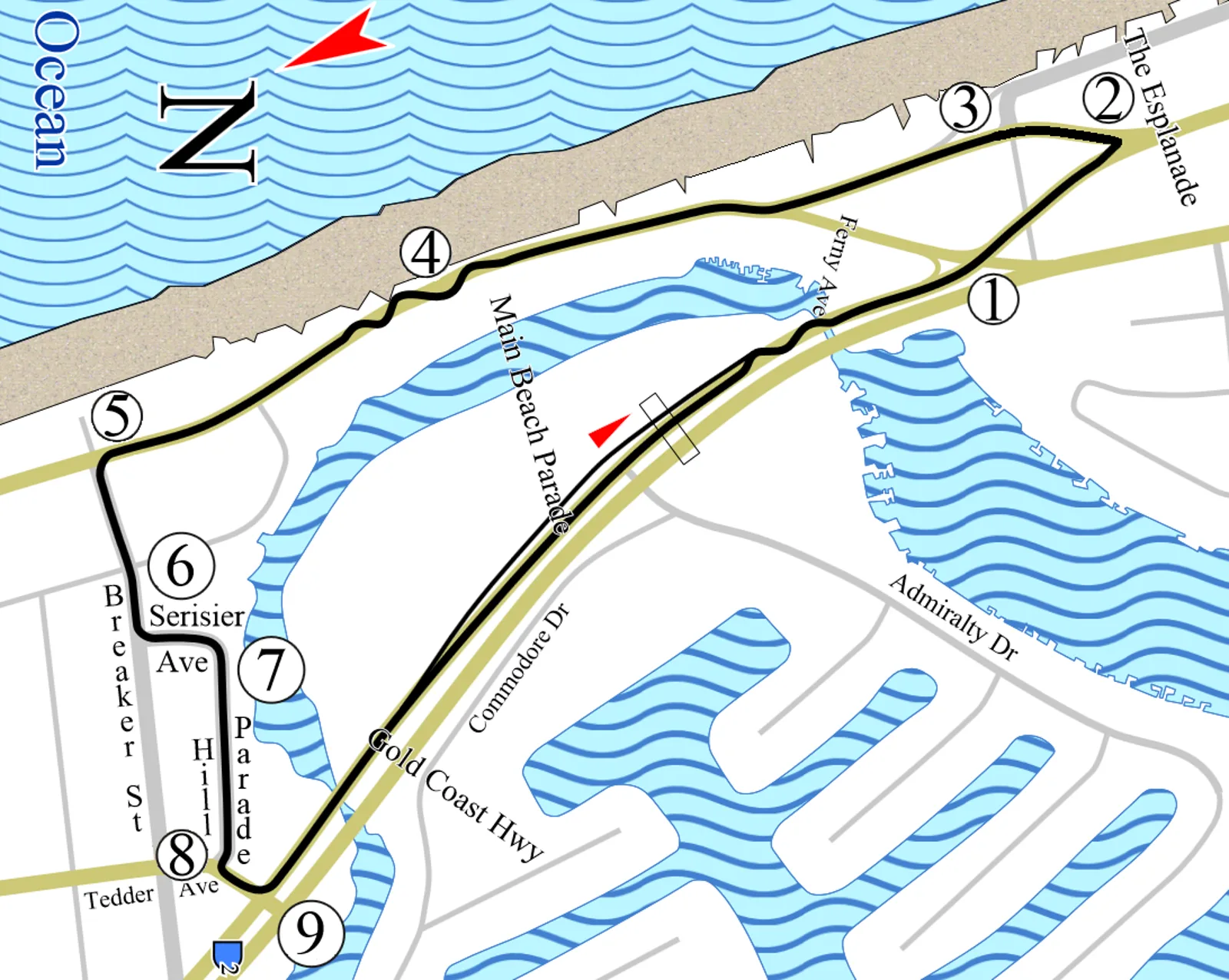
This is a temporary track laid out on public streets at Surfers Paradise in Queensland. It runs beside the beach for 2.960 km (1.839 mi), with several fast sections and two chicanes, after being cut in 2010 from its original 4.470 km (2.778 mi). Two earlier venues came before it on the Gold Coast: the Southport Road Circuit of 1954 to 1955 and Surfers Paradise International Raceway, open from 1966 to 1987.
The whole town is the paddock: seven bridges, 2,515 barriers and 16 km of fencing go up around a holiday district.
How did Surfers Paradise win the Indy race?
Ron Dickson, president of D3 Motorsport Development, held the international rights to CART in the 1980s. Queensland businessmen lobbied hard, and a short meeting with Premier Joh Bjelke-Petersen settled it: the event was confirmed for the state, and the Gold Coast resort was picked over the capital, Brisbane.
Dickson drew the track himself, and it was the fourth concept offered for the area. In the first approved version, what is now the second chicane came first. Late in 1990 the plan was altered to add the chicane now known as the first, since cars would reach speeds at the southern and northern ends that the available run-off could not safely handle. Groundwork started in 1988, and racing began on 15 March 1991 with the Gold Coast IndyCar Grand Prix.
How is the street circuit built?
Think of it as a stage set the size of a suburb. Each year a residential, commercial and holiday district becomes a place able to host fast racing and hundreds of thousands of spectators, and the planning alone fills 12 months. The result is praised worldwide and treated as a benchmark for temporary street circuits. A local firm, iEDM, which specialises in motorsport venue engineering, has managed the work since 2009.
Look at what the first build required over two months: seven bridges and 2,515 concrete barriers, with 11,500 seats in the grandstands, over 140 corporate suites, 10 km (6.2 mi) of fencing to catch debris and 16 km (9.9 mi) to keep the public out, plus large power and telecommunications systems. Both the FIA and the Confederation of Australian Motorsport praised its safety standards. Late in the Champ Car era the debris fencing went up to double height, with 610 more panels in high-impact areas added in 2005.
Why was the Surfers Paradise circuit shortened?
From 2010 the Supercars Championship has run a much shorter track. At the Turn 2 chicane it now swings into a left-hand hairpin and meets the old route again at the Esses. Tony Cochrane, who was chief executive of V8 Supercars, suggested it once the A1 Grand Prix cars pulled out of the 2009 event, hoping to trim costs for a race without an international drawcard.
The shorter loop needs less time and fewer materials to build, and it disturbs residents and holidaymakers less. In any case the full circuit is no longer possible, because the G:link light rail line now runs over part of it.
The Surfers Paradise event through the years
| Year | Event | What changed |
|---|---|---|
| 1991 | Gold Coast IndyCar Grand Prix | Opening round of the 1991 IndyCar season |
| 2002 | Gold Coast Indy 300 | V8 Supercars gain championship status after exhibition races |
| 2009 | Replacement for the planned A1GP weekend | Four 150 km (93 mi) races, 600 km (370 mi) in total |
| 2010 | Gold Coast 600 | Shorter track; two drivers per car; one 300 km (190 mi) race each day |
| 2022 | Gold Coast 500 | Single-driver event after two years off the calendar |
What was the Gold Coast Indy 300?
It was the American open-wheel race that opened the 1991 IndyCar season at Surfers Paradise and stayed until 2008, an eighteen-year run. After the IRL and the Champ Car World Series merged in February 2008, the race was at first guaranteed until 2013 as an IRL IndyCar Series round. In the end it was dropped after one demonstration race.
Touring cars were on the bill regularly. V8 Supercars and the Group 3A class before them supported the Indy cars in 1994 and every year from 1996, but it was 2002 before the race earned championship points. In 2003 to 2007 they were co-headliners with the Champcar World Series, and in 2008 with the Indy Racing League.
What happened to the A1 Grand Prix plan?
Talks with the IRL broke down, and on 11 November 2008 the Queensland Government signed a five-year agreement with A1 Grand Prix. The first A1GP race was meant to run on 25 October 2009. The Indy name belongs to the Indianapolis Motor Speedway as a registered trademark, so the entire four-day meeting was rebranded the Nikon SuperGP.
On 17 October 2009 A1GP chairman Tony Teixeira revealed that the British arm of the series had gone into liquidation in June. Reaching the cars and paying suppliers had become difficult, and the cars were impounded in Britain. A1 Grand Prix never turned up, and extra V8 Supercar races filled its slot.
That made V8 Supercars the headline category for the first time in the event's history. Race day became a 600 km programme of four 150 km races, two on the Saturday and two on the Sunday, with points from each pair deciding the winner for the day. Supercars were now the major category at the event and have remained so, which marked the start of an endurance era at the Gold Coast.
How did the Gold Coast 500 take shape?
The Gold Coast 500, run under the Boost Mobile name, is the annual Supercars meeting at the circuit and has belonged to the championship since 2010. COVID-19 kept it off the 2020 and 2021 calendars. It came back in 2022 as a 500 km race for solo drivers, replacing the two-driver Gold Coast 600.
The weekend runs from Friday to Sunday. Friday has two thirty-minute practice sessions, and Saturday and Sunday each begin with a fifteen-minute qualifying session and a top-ten shootout that set the grid for the 250 km races. A 2018 idea for the following year would have created one 500 km race on Sunday, with two qualifying races on Saturday, following the pattern of the Sandown 500, but teams would not back it and it fell away. The 2021 round was due as the finale in December before COVID-19 moved it to 2022.
Sponsors have shaped the name: Armor All Gold Coast 600 from 2010 to 2013, Castrol Edge in 2014, plain Castrol in 2015 and 2016, Vodafone from 2017 to 2019, and Boost Mobile from 2022.
Why did the Gold Coast 600 need international co-drivers?
The rule was meant to set it apart from other endurance races. In 2010 every team had to field at least one co-driver with an international reputation, and from 2011 every car did. Australians qualified if they had a strong record abroad, as Will Power did in IndyCar. Each of the two 300 km races needed the co-driver at the wheel for at least a third, which meant 34 laps.
The 2010 meeting is remembered for a duel between Jamie Whincup and Shane van Gisbergen that Whincup won. In 2011 the event took place a week after the death of Dan Wheldon in the IZOD IndyCar World Championship crash. Wheldon had been due to share a Holden Racing Team car. Will Power, co-driver at Ford Performance Racing, was hurt in the 15-car pile-up, and his close friend Tony Kanaan, who was to drive for Brad Jones Racing, pulled out. The International Driver Trophy, launched in 2010 for the best-performing overseas driver of the weekend, was renamed after Wheldon, the British IndyCar and Indianapolis 500 champion, before the weekend, and the rules on overseas drivers eased.
The requirement ended in 2013 because hiring overseas drivers was getting too expensive. Instead the race became the third leg of the newly formed Pirtek Enduro Cup, alongside the Sandown 500 and the Bathurst 1000, and the format did not change. The trophy itself was discontinued after 2012.
Who has won at Surfers Paradise?
Sebastien Bourdais stands alone. He won in Champ Car in 2005 and 2007 and returned to take the Supercar race in 2011 and 2012, and no one else has won in both kinds of car. The 2012 start was chaotic: Ricky Taylor was flipped into a barrel-roll moments after the lights went out, which brought a red flag, and a third attempt at the start was needed after Nicolas Minassian and Franck Montagny clashed on the second.
Debut victories followed. In 2013 David Reynolds won for the first time in V8 Supercars, sharing with Dean Canto, and in 2015 Jack Perkins did the same alongside James Courtney, who was back after nine weeks recovering from rib and lung injuries from an accident away from the track at a Super Sprint round at Sydney Motorsport Park. In 2016 it was van Gisbergen again, a winner for the third year running, this time with France's Alexandre Premat, who scored his first Supercars win and became the second Frenchman to win at the event after Bourdais.
Chaz Mostert took back-to-back Saturday wins in 2017 and 2018, with Steve Owen and then James Moffat. A severe thunderstorm stopped the second race of 2018, and because under half the distance had been completed no points were given. In 2019 Mostert wrecked his car in the Saturday shootout. Series leader Scott McLaughlin could have clinched the title with two rounds in hand, but crashed hard in Sunday qualifying and missed the second race. Triple Eight Race Engineering finished first and second in each.
What else happens at the Gold Coast 500?
The October weekend also hosts the Porsche Carrera Cup Australia, the SuperUtes Series and Aussie Racing Cars. In earlier years it has staged Stadium Super Trucks in 2015, 2016 and 2019, the V8 Ute Racing Series in most seasons between 2001 and 2017, and the S5000 Tasman Series in 2022.
Other categories have come and gone. Australian Formula 3 raced here in 2002 and 2004, Formula Ford in 2009 to 2011 and 2013, the Australian GT Championship in 2012 and 2019, Formula 4 from 2015 to 2017, the Australian Mini Challenge in 2009 and 2010, and the Nations Cup and Performance Car championships from 2000 to 2003. More recent visitors include Touring Car Masters in 2011, the National Sports Sedan Series in 2023 and the Toyota Gazoo Racing Australia 86 Series in 2024 and 2025.
Away from the track the Superfest is designed to build local excitement in the days leading up to the race. It typically brings driver signings, a transporter parade, a billycart race down Burleigh Hill, wheelie-bin racing branded Fast and Ludicrous, and concerts. Since COVID-19 it has been cut back sharply, with many of its events on hold or cancelled for good.