A trike that took deposits and never built the car, an electric three-wheeler that reached production, and a Dutch lean-in-the-corner system that survived its makers.
Elio Motors, Arcimoto and Carver each tried to turn the three-wheeler into a commuter car. Elio took deposits but never produced its P4, Arcimoto built the electric FUV from 2019 until trouble in 2023, and Carver used its tilting system on the Carver One and an electric scooter-class model.
Elio Motors collected deposits of more than US$28 million between 2013 and 2018 for a three-wheeled commuter car that never reached production. Reservations stopped at 65,341 in 2017, the base price target was $7,450, and its advertising suggested up to 84 mpg on the highway. Three wheels promised a car half the width and weight of a normal one, with the fuel bills of a motorcycle. A small group of companies bet they could make that work, with very different results.
Why build a three-wheel car at all?
The idea behind the tilting three-wheeler, also called a tilting trike, leaning trike or tilter, is a vehicle with a narrow track whose body or wheels lean into a turn. Because they lean, such vehicles can corner without rolling over, even though their wheels are close together. They balance the roll force from cornering with an opposite roll force from gravity, exactly as bicycles and motorcycles do. They are also called man-wide vehicles.
A narrow body means a small frontal area and less aerodynamic drag, so fuel efficiency can improve. Leaning also keeps the combined force on rider and vehicle lined up with the middle of the machine, so frame, wheels and tyres avoid large side loads, and many riders find it more pleasant. The centre of mass no longer needs to sit near a wide axle, which leaves engineers free to place it for ride quality or braking.
The drawbacks are real. A tilting mechanism needs more parts than a two-wheeler, while the independent suspension of a rigid trike may be more complex. Control also needs either an automated system or different behaviour from the rider, such as countersteering.
How a Carver-style trike stays upright
Take a corner in an ordinary car and the body is flung outward by centrifugal force. The faster you go, the stronger the push. A narrow vehicle with its wheels close together tips over at far lower speeds than a car, which is why cars have wide wheelbases, and a wide car presents a big frontal area and drag. Banking into the bend solves it, as motorcyclists do, and as fast animals do in nature.
A motorcyclist works in three modes: at speed the rider steers and relies on the gyroscopic effect of the wheels, while at low speed and standstill the rider uses body and feet. A driver sealed inside an enclosed vehicle cannot put a foot down. So a mechanism has to hold the vehicle upright when slow, yet let the body lean when fast. Enclosed vehicles therefore need active tilt control, automatic or rider-operated, to stay upright when stopped. Open ones can get away with free or passive tilt, because the rider's foot goes down at the lights.
A tilting trike leans into a corner the way a cyclist does, without relying on a wide axle.
What was the Elio P4?
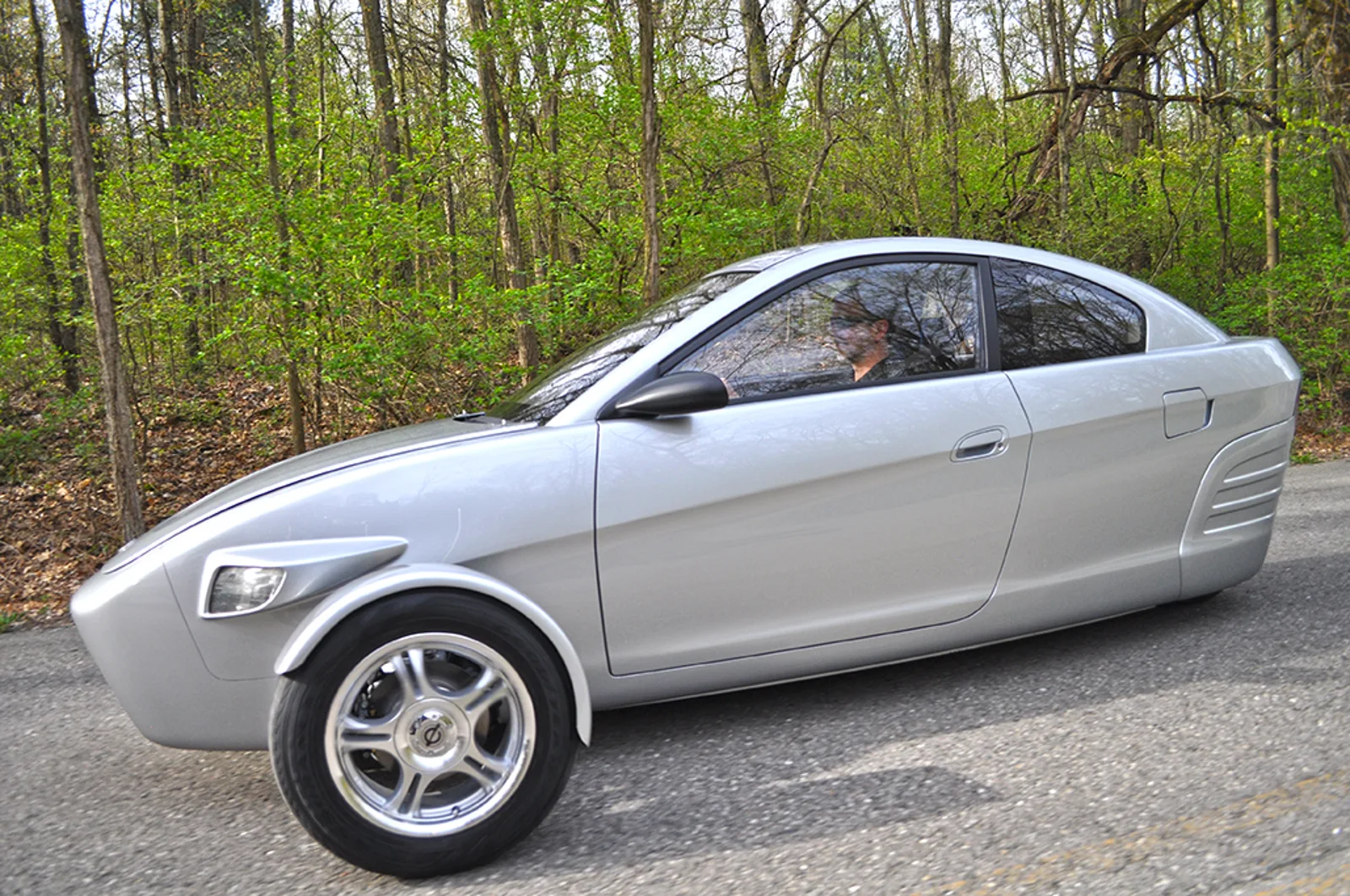
Paul Elio founded Elio Motors in 2009 to design and build a three-wheeled, enclosed autocycle. The petrol concept, marketed as the Elio P4, put two wheels at the front and one at the back, with steel unibody construction, crumple zones, anti-lock brakes and traction control. Advertisements in 2017 pointed to a base price of $7,450 and fuel economy of up to 84 mpg-US (2.8 L/100 km) at highway speed and up to 49 in town. The equipment list promised power windows, power door locks, cruise control and air conditioning, and the design list also included three airbags, a reinforced steel roll cage, side intrusion beams and stability control. Continental AG designed a tyre for it.
The designers aimed at a weight of 610 kg (1,350 lb), power from an inline 0.9-litre three-cylinder engine of 55 horsepower (41 kW) developed by IAV for the car, and front-wheel drive. The targets were a top speed of 107 mph (172 km/h) and 0-60 mph in about 10.8 seconds. The planned dimensions were 160.5 inches (4.08 m) long, 54.2 inches (1.38 m) high, with a 66.8 inch (1.70 m) front track and a 110 inch (2.8 m) wheelbase.
The autocycle shortcut
Elio's designs were said to satisfy motorcycle standards, since an autocycle falls inside the US government's motorcycle category. That mattered because motorcycle rules can bring helmet laws and endorsement requirements. The company lobbied in most states to change those rules, and in many it sought to end the demand for a motorcycle endorsement on the driver's licence.
Money, dates and the end of the road
By June 2017 Elio had built basic test mules and three validation vehicles, coded E1-A, E1-C and E1-D, to test safety, aerodynamics and durability, and said it could use 80% soft tooling. It planned to build at a Shreveport, Louisiana, plant that was part of a former General Motors site, with upwards of 1,500 jobs on site and another 1,500 in the supply base, and projected that 90% of parts could come from North America. None of this happened. In its August 2017 filing for an initial public offering, which aimed to raise $100 million, Elio said the car could not be produced until about 76 weeks after it secured enough funding.
The release date kept moving. It was originally 2012. In December 2016 it was announced as 2018, in a November 2017 social media reply it was 2019, and a December 2019 target passed with no progress. By the end of 2017 Elio had just US$7,155 in the bank and deficits of US$49,674,327. Its own estimate was that US$376,600,000 plus a further US$110,500,000 in reservation deposits would be needed to go into production. Analysts doubted that it could bring a product to market, and critics compared it with the Lit Motors C-1 and Aptera Motors, which ran into the same wall of funding needs. Elio offered advance reservations to try to secure a Department of Energy loan.
In September 2021 it warned the Securities and Exchange Commission that its ability to stay afloat was in substantial doubt. It then announced that an electric version would be its focus, with a gas option to follow and a possible price of $15,000. The projections did not include a range figure, and the price was double the original target. As early as 2015 The New York Times described what Elio was selling as a place on a waiting list and, more broadly, a dream. A fine of $7.5 million followed for failing to deliver the jobs it had promised in Louisiana. By May 2022 the company had still not come near production, and in 2024 its website went inactive.
What was the Arcimoto FUV?
Arcimoto of Eugene, Oregon, took a more concrete route. Its Fun Utility Vehicle, the FUV, seats two in tandem on three wheels and runs on electricity, with four variations on sale. Founder Mark Frohnmayer unveiled the Pulse prototype on 23 September 2009 at an estimated $20,000, taking pre-orders for $500. A fifth prototype, the first SRK, followed on 23 April 2011 with 89 hp and four body designs on one chassis. The name came from the actor Nathan Fillion, who after driving it said it felt like driving a shark, according to Frohnmayer. A Generation 7 car was judged too large and heavy to make a viable market solution, so the company built an eighth prototype generation with handlebars instead of a steering wheel.
Arcimoto listed on NASDAQ as FUV in 2017 and soon began delivering its first production vehicle. It leased its first factory, the Arcimoto Manufacturing Plant, from 1 October 2017, held a grand opening on 29 November 2017, and started production on 19 September 2019. The building was fitted out for up to 5,000 units a year. In 2021 it bought a second site, about a city block away, with 185,000 square feet, roughly five times bigger, from which it hoped to produce 25,000 vehicles.
FUV specification
The FUV had an EPA-rated range of 102 city miles (164 km) and a rating of 173.7 MPGe at city speeds. It could use freeways, topping out at 75 mph (121 km/h). The battery was 19.2 kWh of nickel-manganese-cobalt pouch cells from Farasis Energy, wired as 28 groups in series of six cells in parallel, with a smaller 12 kWh pack also described. It accepted level 2 charging. Arcimoto's CEO said the cars used off-the-shelf controllers and cells, switched reluctance motors and a two-stage reduction gearbox built in house, claims not confirmed by a third party.
Several variants shared the platform. The Rapid Responder carried emergency lights, a siren and scene lighting for emergency services, and went into pilot programmes with Eugene's city government, its fire department and the city of Eastvale, California. The single-seat Deliverator, for last-mile delivery, offered 350 pounds of carrying capacity and 28 claimed cubic feet of storage. The Roadster dropped the roof and roll cage and was priced from $23,900. The Cameo had a rear-facing seat for camera operators. The Modular Utility Vehicle, or MUV, replaced the back seat with a flatbed and an optional weatherproof steel storage box, but only prototypes were ever made and testing was minimal because of mass layoffs.
What went wrong
Arcimoto failed to scale production in a way that cut the unit price. At its peak in February 2021 it held a market capitalisation of $1.2 billion, which fell to $3,690 by July 2024. In mid-January 2023, short of cash, it idled its factory and raised the prospect of bankruptcy. Its third-quarter 2023 report showed $9.5 million of overdue bills and $232k on hand. It defaulted on several judgements and was delisted from NASDAQ. Its website was offline from April 2024 to May 2025.
What was the Carver and its tilting system?
Carver was the Dutch company that took the tilting idea furthest. In 1990 Ton van den Brink, a company director stuck in Paris traffic, questioned whether a conventional family car was needed for everyday transport. His research found that 90% of cars carried one or two people. His son Chris van den Brink and Harry Kroonen led the engineers, and Brink Technologies Group B.V. was founded in September 1994. A first concept shown in 1993 used side wheels for stability and was not viable. In 1994 the team developed the Dynamic Vehicle Control, or DVC, system, patented internationally in 1995.
With DVC, the bodywork moves independently of the rear wheels and engine, and the system automatically adjusts the tilt angle to the vehicle's speed and acceleration so it is always in balance. It is proactive rather than reactive: the Carver tilts before the corner, much as an aeroplane banks to one side to turn that way. The Dutch RDW approved the Carver One for road use in May 1997, and in June 1997 DVC won Invention of the Year from the Dutch Innovation Group. The company showed at the IAA Frankfurt Motor Show in 1999.
The Carver One
Carver launched 24 limited-edition Vandenbrink Carvers in 2003, which got attention including from BBC's Top Gear, then refined it into the Carver One. The first were delivered in 2007, and the car had its official launch at the Geneva show on 7 March 2007. It was built in collaboration with Prodrive in the UK and assembled in Germany by ACU, part of the Mosolf Group.
The Carver One was 3,400 mm (130 in) long, 1,300 mm (51 in) wide and 1,400 mm (55 in) high, and weighed 643 kg (1,418 lb). It could tilt up to 45 degrees, decided by the cornering force applied rather than by steering angle. A 660 cc 16-valve, turbocharged and intercooled inline-four gave 65 bhp (48 kW) at 6,000 rpm and 100 N-m (74 lbf-ft) at 3,200 rpm through a five-speed manual. The front wheel was 17 inches and the rear wheels 15. Top speed was 185 km/h (115 mph) and 0-100 km/h took 8.2 seconds. In the European Union it could be driven on a normal car licence, though in most countries it was licensed as a motorcycle.
Reviewers loved it. Jeremy Clarkson said on Top Gear in 2002 that he had never had so much fun in a car, and racing driver Jenson Button said in 2004 it was possibly the weirdest thing he had driven. Then, in early 2009, Toyota stopped selling Daihatsu engines to outside firms. That included the 660 cc unit in the Carver One, so production had to halt. In June 2009 Carver Europe declared bankruptcy because of a lack of demand at its 30,000 euro price. About 200 Carver Ones were made. Carver Technology and the patents were excluded from the bankruptcy.
The electric Carver and what comes next
From 2010 Carver Technology focused on licensing DVC to others, among them PAL-V, which developed an autogyro that first flew in April 2012. Venture Vehicles, renamed Persu Mobility in December 2008, had earlier taken a North American licence. In 2015 Carver started building its own electric vehicle, and a prototype was tested in 2017. Pre-orders opened in April 2018, and the launch slipped from fall 2018 to early 2019. The electric Carver went on sale in late 2019 and is legally a scooter, so a scooter licence is enough to drive it, yet it is driven like a car in an enclosed cabin with removable windows, steering wheel and pedals. It has one wheel in front and two behind.
The base model (R) is 2.89 m long, 0.98 m wide and 1.49 m high and weighs 260 kg, with a top speed of 45 km/h reached in 8 seconds and a range of up to 130 km. The S+ is slightly wider at 1.06 m and heavier, and reaches 80 km/h with up to 100 km of range. A 5.4 kWh lithium iron phosphate battery sits inside, and an hour of charging adds about 20 km. Reaching 80% takes about 4.2 hours and a full charge about 5.2 hours. There is space for two people plus 75 litres of luggage.
Carver went bankrupt in July 2024, and its website was taken offline.
What happens next for the three-wheel idea?
Carver's story is not quite over. After the bankruptcy, LYNX ApS took over the rights to build the Carver along with its patents and intellectual property. Together with KERV Automotive, a Belgian firm it co-owns, it has said it intends to continue the Carver. Arcimoto's website came back in May 2025 in a pared-down version that lists just the FUV and MUV. Elio, for its part, said in September 2021 that an electric motor design was its focus, to be followed later by a gas option.
What wheel layouts do tilting trikes use?
The wheels can be arranged in many ways. There are two main layouts: delta, with a single wheel at the front and a pair at the back, and tadpole, the reverse. Rear-wheel steering tends to be directionally unstable, so most trikes steer at the front. Toyota's i-Road is the notable exception. Controls matter too: free or passive tilters are steered like a bicycle with countersteering, whereas active tilters set the lean through sensors and actuators. In free tilters, there is no roll stability at rest and a loss of traction can mean a lowside, but active-tilt vehicles stay stable and will not lowside.
| Layout | Notable examples |
|---|---|
| Delta, one wheel in front, two behind | Ariel 3, MEV Tilting Trike, Honda Canopy, Vandenbrink Carver, CLEVER |
| Tadpole, two wheels in front, one behind | Piaggio MP3, Yamaha Tricity, Toyota i-Road |
| Rider-controlled lean | General Motors Lean Machine (foot pedals), Tripendo (hand lever) |
| Forced tilt without operator countersteering | Carver |
A rule in EU-aligned countries treats two wheels on one axle as a single wheel if their contact patches sit no more than 460 mm (18 in) apart, which lets such vehicles be classed as motorcycles.
How do the four compare?
| Vehicle | Powertrain | Headline figure | Outcome |
|---|---|---|---|
| Elio P4 | 0.9-litre three-cylinder, 55 horsepower (41 kW) | Target of up to 84 mpg-US on the highway | Never reached production |
| Arcimoto FUV | Electric, 19.2 kWh battery | 102 city miles (164 km); 75 mph (121 km/h) | Production from 19 September 2019; stopped in 2023 |
| Carver One | 660 cc turbo four, 65 bhp (48 kW) | 185 km/h (115 mph); 45 degrees of tilt | About 200 built; bankrupt June 2009 |
| Carver (electric) | Electric, 5.4 kWh battery | 45 km/h (R) or 80 km/h (S+) | Launched late 2019; bankrupt July 2024 |