A fuel crisis put right turns on red across America, a courts administrator's tidy-up gave cyclists the rolling stop, and every country has its own idea of who may pass whom.
Right turns on red are generally allowed in the United States and Canada after a full stop, and rare elsewhere. Idaho's 1982 law lets cyclists treat stop signs as yield signs, and overtaking rules vary from the Vienna Convention's opposite-side rule to bans on passing on the inside.
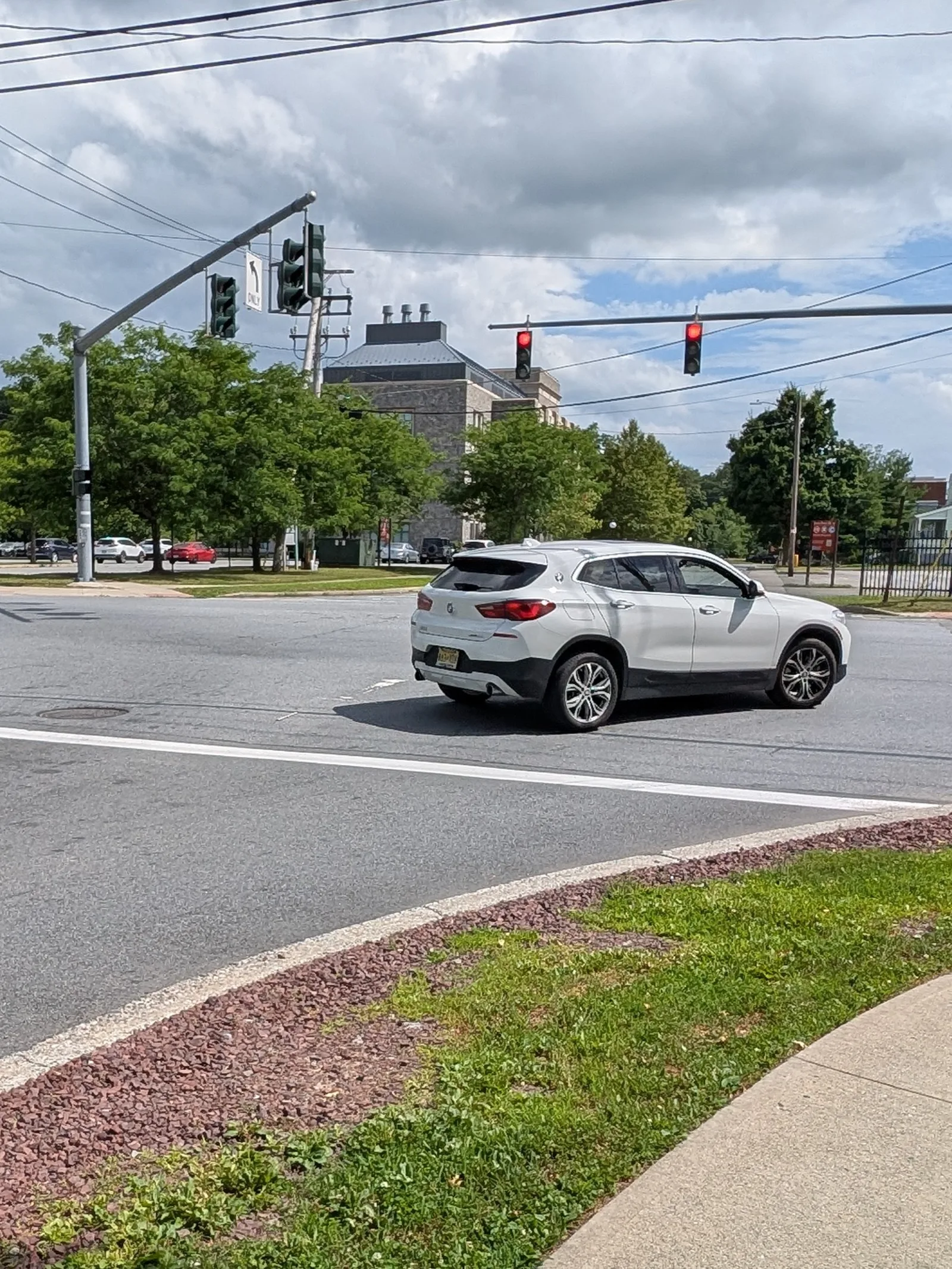
Massachusetts was the last American state to allow a right turn on a red light, and when the law took effect on 1 January 1980, about 90% of the state's signals promptly sprouted signs banning it, in protest. The rule it was resisting came from a fuel crisis, not a safety study, and decades later cities are rolling it back as pedestrian deaths climb. The same few seconds at a junction decide whether a driver may turn against the light, whether a cyclist may roll through a stop sign, and, once the road opens up, who may pass whom and on which side.
Where can you turn on red?
Turning on red means a vehicle facing a red signal may go into the nearer stream of traffic without waiting for green, nearly always after a full stop and only when the way is clear. Few major countries permit it as a general rule, and Canada and the United States are two of them. In a country that drives on the right it means a right turn, and in one that drives on the left, a left turn.
The American story starts in California, though the date is disputed: California is variously said to have legalised right-on-red in 1939 and in 1947. Western states followed in the 1950s and 1960s. The big push came from the 1973 oil crisis: eastern states changed their laws in the 1970s as a claimed fuel-saving measure, and the Energy Policy and Conservation Act of 1975 told states that they would only qualify for federal help with conservation programmes if they permitted right turns on red. Since 1980 all 50 states, Guam and Puerto Rico have allowed the turn except where a sign forbids it. Federal law has framed the requirement since 1992 as permitting a right turn at a stop light, and a left from one one-way street into another, once the vehicle has stopped and so far as safety allows.
How a right on red is supposed to work
A right turn asks the driver to watch only two nearby crosswalks, at least one of which should show "don't walk", and traffic approaching from one side. A left turn or a move straight ahead means watching two crosswalks and traffic from several directions. The driver normally has to yield to traffic from the left and to the crosswalk parallel to it. Many places allow the turn from any lane, even the outer lane of a double or triple right-turn lane. Some junctions are unsafe for it, such as one with a train running alongside the road and synchronised with the signals, so signs ban it where it would otherwise be allowed by default.
Left turns on red are rarer. As of December 2018, 38 US states allowed them only when both the street you leave and the one you enter are one-way, five allowed a left into a one-way street from either a one-way or two-way road, and ten states and territories banned them altogether.
The rollback
Pedestrian fatalities rose across the United States after 2020, and some localities proposed or introduced bans. New York City has prohibited the turn since the state legalised it in 1977, with a few suburban pockets on Staten Island the exception, and New York State also bars school buses from turning on red. Washington, DC fully banned it from 1 January 2025. Atlanta voted to restrict it downtown, in midtown and in Castleberry Hill, effective in 2026, and Seattle requires "no turn on red" signs by default whenever an intersection is updated, unless an engineer justifies an exception. Quebec, meanwhile, allowed right turns on red only after a pilot study in 2003 found no significant rise in accidents, but the Island of Montreal still bans them, with large signs at every bridge entrance.
The rule that lets you turn against a red light came from a fuel crisis, not a safety study.
How turn on red differs around the world
| Country | Rule for turning on red |
|---|---|
| United States | Right turn allowed after a stop unless signed; left only between one-way streets in most states |
| Canada | Right turn after a complete stop unless signed; Montreal Island bans it |
| Brazil and Chile | Only where a sign permits it |
| Germany | Only where a sign is at the signal, after a complete stop |
| Poland, Czech Republic, Slovakia, Hungary, Romania | Only with a lit green arrow or supplementary signal |
| Russia | Only with a separate green arrow, giving way to all traffic |
| France | Without stopping when a separate amber arrow flashes, but without priority |
| United Kingdom | Prohibited; separate green filter arrows serve left turns |
| Hong Kong | Left turn on red always prohibited |
Some British junctions also have left-turn lanes with no signal at all, cut off from the main flow by islands and marked with give-way signs.
Germany has the most colourful history. The rule began in East Germany in 1978, where West Germans mocked it as the "socialist right turn", and after reunification in 1990 plans were made to get rid of it. A public backlash stopped that, and in 1994 the practice spread across the whole country. By 2002 there were 5,000 such intersections, and half sat in the former West. Lithuania offers a modern parallel: its green-arrow signs were due to disappear by 31 December 2019 for safety reasons and were removed on 1 January 2020, but many city administrations had no alternatives ready, public outrage followed, and the government let the arrows return, each one to be approved by the Transportation Literacy Agency after an assessment of safety and capacity.
Since 2021 Switzerland has let bicycles and small mopeds go right at certain red lights, without a full stop but yielding to pedestrians and crossing traffic, after a pilot with no accidents. Slovenia uses the German sign, and its drivers turn on red at all times but never with right of way.
What is stop as yield, and what is the Idaho stop?
Stop-as-yield laws let a cyclist slow and roll through a stop sign, giving way as at a yield sign. Their cousin, red-light-as-stop, lets riders treat a red light like a stop sign, usually with significant limits. Idaho passed the first law in 1982, which gave the idea its name, the Idaho stop. Nobody copied it until Delaware adopted a restricted version, the Delaware Yield, in 2017, and in April 2019 Arkansas became the second state to legalise both rules. In France and Belgium, some junctions carry red-light-as-yield signs.
The aim is to fix several problems at once. Traffic light sensors may not notice a bicycle, and rules that let riders use calmer, low-traffic streets can persuade them off faster main roads. Studies in Delaware and Idaho have reported significant drops in crashes at stop-controlled intersections.
How Idaho came to write it
The origin was bureaucratic rather than idealistic. Idaho House Bill 541 in 1982 was part of a sweeping revision of traffic law, which turned many minor offences from crimes into "civil public offences" to free up court time. Carl Bianchi, the courts' administrative director, used the chance to draft a modern bicycle code in line with the Uniform Vehicle Code. Magistrates were worried about "technical violations" of traffic control rules clogging their courts, so the draft let cyclists roll through stop signs as if they were yield signs. It passed despite objections from some cyclists and officers. In 2006 the law was amended to make clear that cyclists must stop at red lights, and an education provision was dropped in 1988 because young riders adapted quickly and respected a law that legalised how they actually rode.
Wider interest followed a 2001 essay, "Why Bicyclists Hate Stop Signs", by the Berkeley physicist Joel Fajans and the editor Melanie Curry. An Oregon bill passed the House in 2003 but died in a Senate committee. The phrase "Idaho Stop" took off in 2008 during the San Francisco proposal, popularised by the blogger Richard Masoner.
Does it work?
A March 2023 briefing from the US road safety regulator, NHTSA, says such laws brought added safety benefits for cyclists in the states that evaluated them. A 2010 study found a 14.5% fall in cyclist injuries after Idaho's original law, and a Delaware state study found the Delaware Yield cut injuries at stop-sign intersections by 23%. A 2013 survey of Colorado localities where stop-as-yield is legal reported no increase in crashes, and an Idaho transportation official said in 2015 that the state's statistics showed no discernible rise in injuries or deaths. Paris trials found that letting cyclists move more freely reduced collisions, including those caused by a car's blind spot.
The opposition has a different case. Some argue that children learn more easily when every road user follows the same rules, and that separate rules for cyclists make them less predictable. California's governor vetoed a bill in 2021 over worries that it would confuse children, and a 2022 bill was withdrawn when a second veto looked likely.
Where the laws now stand
The map has filled in quickly. After Delaware (2017) and Arkansas (2019) came Oregon, signed on 6 August 2019 and effective on 1 January 2020, then Washington State in October 2020, Utah and North Dakota in March 2021, and Oklahoma, whose law took effect on 1 November 2021. Colorado passed a statewide law in April 2022, replacing a patchwork of local rules that began in 2011 with the towns of Dillon and Breckenridge. The capital, Washington, DC, passed the Safer Streets Amendment Act in December 2022, which lets cyclists make a right on red after halting while banning the same move for drivers. Minnesota followed in May 2023, New Mexico in March 2025 and South Carolina in May 2026, where supporters call it the "Palmetto Stop".
Related rules abound. "Dead red" laws in many states let cyclists and motorcyclists proceed through a red light that never changes because in-road sensors cannot detect them. Belgium's B22 and B23 signs let cyclists turn right or go straight on red while giving way, and France began with trials in Bordeaux, Strasbourg and Nantes, then a three-year trial in Paris from 2012 before changing national law. Paris put up around 1,800 of its M12 signs in 2015, and Lyon had 1,153 by 2019.
What are the rules for overtaking?
Overtaking, or passing, is one vehicle going past a slower one travelling the same way. The lane used is generally the one farther from the shoulder: on the left where traffic drives on the right, on the right where it drives on the left.
On a single carriageway, the passing lane is often the same one that oncoming traffic uses, so the overtaker needs a clear view of the road ahead for the whole move plus a margin. New Zealand's Road Code wants a driver to see 100 metres (330 ft) of empty road ahead at the moment the pass ends, and the UK Highway Code covers passing in rules 162 to 169. Road markings do much of the work. A broken centre line allows overtaking in either direction, and a solid line alongside it forbids the move from that side, though the UK and New Zealand use line style only to say whether crossing is allowed. Australian drivers may cross a solid centre line to pass a cyclist.
On dual carriageways any lane can serve for overtaking, but in many places, Germany included, passing on the side farthest from the centre line is prohibited. Double lines mean no lane changes at all, as in tunnels or sometimes on HOV and HOT lanes, which cars that do not meet the lane's criteria may not overtake in except on police direction.
Ireland shows how road design shapes overtaking. Many of its national primary roads were widened in the 1990s and 2000s to give extra room for a very common manoeuvre, but the false sense of safety that wide two-lane roads gave led planners to prefer 2+1 roads where traffic suits: three lanes, a central crash barrier, and an overtaking lane that alternates sides every 2 km. Denmark and Sweden have used the layout since the 1990s, and a pilot on the N20 near Mallow, County Cork, was a success.
The sign everyone recognises, and the rules behind it
The no-overtaking sign looks alike across most of Europe, but the law behind it differs. In some countries it bans only vehicles with three or more wheels, which leaves motorcyclists free to pass cars. In the Netherlands, overtaking two-wheeled vehicles is not forbidden despite the sign. Many places specify a safe gap when passing pedestrians, cyclists, riders on horseback, motorcyclists or e-scooter users: Germany and the United Kingdom both require at least 1.5 metres (5 ft) sideways.
The Vienna Convention on Road Traffic sets a common outline in its article 11. A driver must overtake on the side opposite to the direction of traffic, after checking that the vehicle behind is not already overtaking, that nobody ahead has signalled the same intention, that the road is empty far enough ahead, and that there is room to return. Overtaking may be forbidden near a hill crest or by road markings, is usually forbidden at crossings and where a pedestrian crossing is marked, and the driver being overtaken must not speed up. Local governments may vary the rules.
The Netherlands took the most dramatic step, ruling out overtaking on 95% of its single-carriageway primary roads. Before 1990 many fatal accidents were traced to unsafe passing in which drivers underestimated the speed of oncoming traffic. The response in the 1990s was a road design known as Duurzaam Veilig, or Sustainable Safety, built on the idea that the road itself, not the driver, should shield people from death or injury by designing out common mistakes. It divides roads into three kinds, local access, regional distributor roads and national through roads, each with its own edge markings so that drivers can tell what they are on. On regional roads a wide double centre line, often without a break, creates sideways space between the two directions and discourages passing. Supporters point out that fatal accidents fell dramatically as the design was rolled out.
Passing on the inside
Undertaking, passing on the kerb side of the vehicle ahead, is a driving offence in many countries, although most separate involuntary undertaking in heavy traffic from a deliberate attempt to get ahead. Practice varies. Australia and New Zealand allow it on multi-lane roads or beside a car indicating a turn across the traffic. Denmark, Finland, France, Germany, the Netherlands, Romania and Spain prohibit it with listed exceptions such as inner-city traffic, queues, roundabouts or vehicles waiting to turn. Ireland permits it in three prescribed cases. Russia made it legal in 2010 by introducing the term "passing" for overtaking that does not use the oncoming lane, unless the shoulder or pavement is involved. The United States generally allows it on multi-lane roads or to pass left-turning vehicles, though state laws vary.
The United Kingdom takes a softer line. Rule 268 of the Highway Code discourages passing on the left on motorways, with exceptions for congestion, and rule 163 advises overtaking on the left on other roads only if the vehicle ahead is signalling a right turn. That wording is advisory and will not by itself lead to prosecution, though it can be used as evidence of liability. Passing on the left aggressively or recklessly could be treated as careless or dangerous driving, both enforceable offences.
On a racing circuit a car may pass on either side, and the move counts as inside or outside according to where the car sits at the next bend. Defenders usually shut the inside line, because passing round the outside is riskier.