Water wedges under the tread, friction can fall to a fraction of the dry figure, and braking distance grows with the square of the speed.
Aquaplaning happens when a tyre meets more water than its grooves can clear and a wedge of water lifts it from the road. Cars generally start to aquaplane above 72 to 93 km/h (45 to 58 mph). Total stopping distance is reaction distance plus braking distance, and braking distance rises with the square of speed.
Electronic stability control cannot stop a car from aquaplaning. The system works by braking individual wheels, and a wheel riding on a sheet of water has no road contact to brake against. That one fact explains why aquaplaning is treated as a problem for tyres, speed and judgement long before it is a problem for electronics.
Water is only half of what makes wet-road driving different. The other half is distance: a car that slows well on a dry road needs far more room when friction falls, and the stopping distance is built from two parts that can each be pulled in a different direction.
What is aquaplaning, or hydroplaning?
Aquaplaning, also called hydroplaning, happens when a layer of water builds up between a vehicle's tyres and the road. Traction is lost and the vehicle stops answering to the controls. If it happens at every wheel at once, the car becomes in effect an uncontrolled sled.
It is a separate matter from the ordinary loss of grip in the wet, where water acts as a lubricant. Traction is reduced on wet pavement even when aquaplaning is not happening at all.
Electronic stability control cannot stop a car aquaplaning, because it relies on wheels that touch the road.
Why does a tyre lose contact with the road?
Everything a car does to change direction or speed depends on friction between rubber and road. The grooves in a tyre exist to push water out from beneath it, which keeps friction high in the wet. Aquaplaning starts when the tyre meets more water than the grooves can clear.
Water pressure builds at the front of the wheel and pushes a wedge of water beneath the front edge of the tread, floating it off the surface. The tyre then skates on a film with little or no direct contact. If several tyres go, the car may lose directional control and slide until it hits something or slows enough for rubber to touch the road again.
The risk climbs with the depth of standing water, with speed, and with how sensitive a particular vehicle is to depth.
How fast can a car go before it aquaplanes?
There is no precise equation. Rules of thumb come from testing, and in general cars begin to aquaplane at speeds above 72 to 93 km/h (45 to 58 mph). One rough approximation gives the speed in mph as 10.35 times the square root of the tyre pressure in psi; for a tyre at 35 psi, that suggests 61 mph as the speed at which contact with the road would be lost.
It is only a rough guide. Resistance to aquaplaning is governed by vehicle weight, tyre width and tread pattern, because those decide how much pressure the tyre puts on the road over its contact patch. A narrow tyre with a lot of weight on it and an aggressive tread resists at far higher speeds than a wide tyre on a light car with minimal tread, and the likelihood rises drastically with water depth.
| Factor | Effect on aquaplaning risk |
|---|---|
| Worn tread | Easier to aquaplane; half-worn treads aquaplane at speeds 4.8 to 6.4 km/h (3 to 4 mph) lower than full tread |
| Underinflation | The tyre deflects inward and lifts its centre, so the tread cannot clear water |
| Contact patch shape | Longer and thinner is safer; small-diameter wide tyres carry the greatest risk |
| Vehicle weight | More weight on a properly inflated tyre lengthens the patch, but the effect reverses if it is underinflated |
| Towing and trailers | Uneven weight distribution; an unloaded trailer aquaplanes before the cab pulling it |
| Water depth | Likelihood increases drastically |
Motorcycles are less exposed in principle, since narrow tyres with round, canoe-shaped contact patches spread weight over a small area and push water aside. That edge shrinks on light bikes with naturally wide tyres, such as the supersport class. A car driver can often catch a slide; the same slide on a motorcycle will generally put the rider on the ground.
The road matters as much as the tyre
Water depth depends on the road. Heavy vehicles wear ruts that let water pool. Concrete can resist rutting better than hotmix asphalt, though that depends on the age of the surface and how it was laid, and it needs enough texture. Wider roads need a steeper cross slope, the extent to which the road cross-section resembles an upturned U, to drain as well.
Grade affects drainage as well. Vehicles are less likely to aquaplane going uphill and far more likely at the trough between two hills, where water collects. Cross slope and grade combine in a figure called the drainage gradient, and most road design manuals require it to exceed 0.5 percent so a thick film does not form in or after rain.
The weak points are the entrance and exit of banked outer curves, where the drainage gradient may dip below that limit. These hot spots are typically less than 1 percent of road length, yet a large share of skid crashes occur there. Designers can move the cross slope transition onto a straight section and place it on a slight slope, and the UK road design manual calls for an artificially created slope if one is needed. Permeable asphalt or concrete can also improve drainage there.
What to do if you hydroplane
What the driver feels depends on which wheels lose grip. Travelling straight, the car may feel slightly loose and road feel may suddenly diminish, and small corrections do nothing. If the drive wheels float, the engine revs and the indicated speed rise with an audible jump. In a broad highway bend, front wheels that lose grip send the car drifting to the outside, rear wheels that lose grip make the back slew sideways, and with all four gone the car slides straight towards the outside of the bend. When grip returns there may be a sudden jerk in the direction the wheels are pointing.
Control inputs tend to make things worse. On a straight road, lifting off the accelerator may shed enough speed for the tyres to bite again, whereas any steering movement risks a skid that is hard or impossible to recover from. If braking cannot be avoided, it should be smooth, with instability expected. When the rear wheels float and cause oversteer, the driver steers in the direction of the skid until the rear tyres bite, then steers quickly the other way to straighten up.
Prevention is simpler. Correct tyre pressure, narrow and unworn tyres, a speed lower than would be judged moderate in the dry, and steering clear of standing water all reduce the risk. Cruise control has no place on wet or icy roads, because pooled water and changing conditions can call for a smooth and timely drop in speed.
What braking distance and stopping distance mean
Braking distance is how far a vehicle travels from the moment its brakes are fully applied until it stops. It depends mainly on the starting speed and the coefficient of friction between tyres and road, and hardly at all on rolling resistance or air drag. The type of brake system matters only for trucks and other heavy vehicles that cannot supply enough force to match the static friction.
It is one of two parts of total stopping distance. The other is reaction distance, which is speed multiplied by the driver's perception-reaction time. Braking distance should not be confused with stopping sight distance, a road design standard that assumes slippery conditions, a deceleration of 0.35g and a slow-responding driver with a time of 2.5 seconds.
The physics is short. The kinetic energy is half the mass times the square of the speed, and the work done by braking is the friction coefficient times mass times gravity times distance. Setting them equal gives braking distance as the square of the speed divided by twice the friction coefficient and gravity. Because speed is squared, distance grows much faster than speed does, and friction sits underneath, so a lower coefficient lengthens the distance.
Stopping distance in rain: the numbers behind it
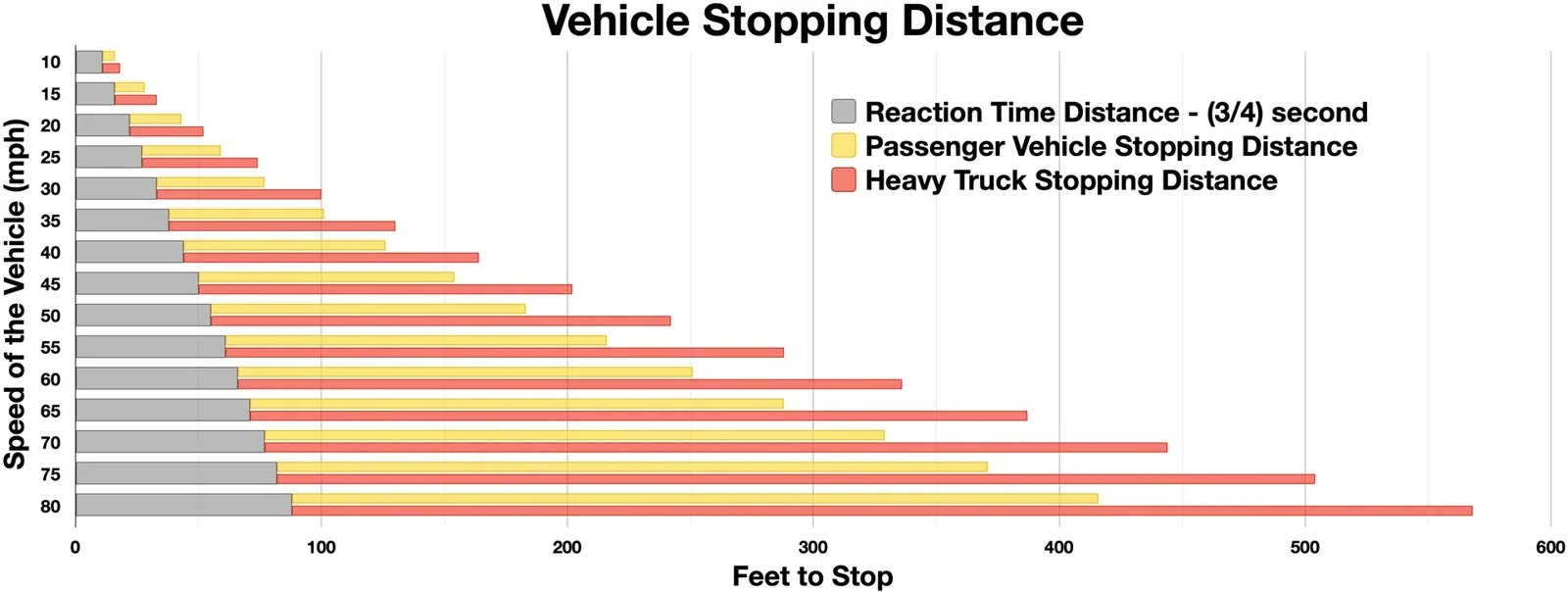
Stopping distance charts use a baseline of a 1.5-second perception-reaction time and a friction coefficient of 0.7, values meant to cover the vast majority of drivers in normal conditions. A keen driver can react in well under a second, and a modern car with computerised anti-skid brakes may reach a coefficient of 0.9, or exceed 1.0 on sticky tyres.
Wet roads pull the other way. The coefficient may be 0.25 or lower on wet or frozen asphalt, which is far below the 0.7 baseline, so under the formula the braking distance would be more than twice as long. Anti-skid brakes and season-specific performance tyres may offset some of the loss, but only somewhat.
Reaction time has its own history. Experts once used 0.75 seconds, and now count perception as well, with an average of 1 second, 2 seconds to represent the elderly or novices, and 2.5 seconds for very elderly, debilitated, intoxicated or distracted drivers. In legal settings, 1 second corresponds to a preponderance of evidence, 1.5 seconds to clear and convincing, and 2.5 seconds to beyond reasonable doubt. The actual total can differ from the baseline when road and tyre conditions or the driver's cognition are very different; to find it, one would measure the friction at the exact spot and the person's real reaction time. Among other details, friction for car tyres decreases as the car's mass increases, and it depends on whether the wheels are locked or rolling, the rubber temperature and the speed.
| Speed | Typical total stopping distance in the Highway Code, Rule 126 |
|---|---|
| 20 mph | 12 m (40 ft) |
| 30 mph | 23 m (75 ft) |
| 40 mph | 36 m (118 ft) |
| 50 mph | 53 m (175 ft) |
| 60 mph | 73 m (240 ft) |
| 70 mph | 96 m (315 ft) |
Rules of thumb for stopping distance
In miles per hour and feet, take the first digit of the speed and square it, add a zero and halve the result, then add twice the speed. At 50 mph that gives 125 plus 100, or 225 feet.
In Germany, the rule for a city in good conditions is the 1-second rule: the distance covered in a second should be no more than the gap to the vehicle ahead, which at 50 km/h is about 15 m. Up to about 100 km/h outside built-up areas a 2-second rule applies, giving about 50 m at 100 km/h. A near-equivalent, known as halber tacho or half the speedometer, says the stopping distance should be the speed divided by 2, so about 50 m at 100 km/h. German driving schools also teach a formula for total stopping distance: take the speed divided by ten, multiply by three, and add the square of the speed divided by ten.
What this means for anyone driving in the wet
Tyre condition and pressure sit squarely in the driver's hands. Tread depth decides how much water the grooves can clear, pressure keeps the centre of the tread on the road, and speed is the lever that works on both aquaplaning and stopping distance. A car that stops comfortably in the dry has a lower friction number to work with in the wet, and the formula shows the cost of that. Stability control and anti-lock brakes help recovery and stopping, though they do not remove the risk of aquaplaning.
How are road standards changing for slower drivers?
Road standards are being adjusted. Most old roads were engineered around a defunct three-quarter-second reaction time, and recent changes to road standards aim to make modern roadways more accessible to an increasingly ageing population of drivers. On the drainage side, designers can use permeable asphalt or concrete to improve cross slope transitions.