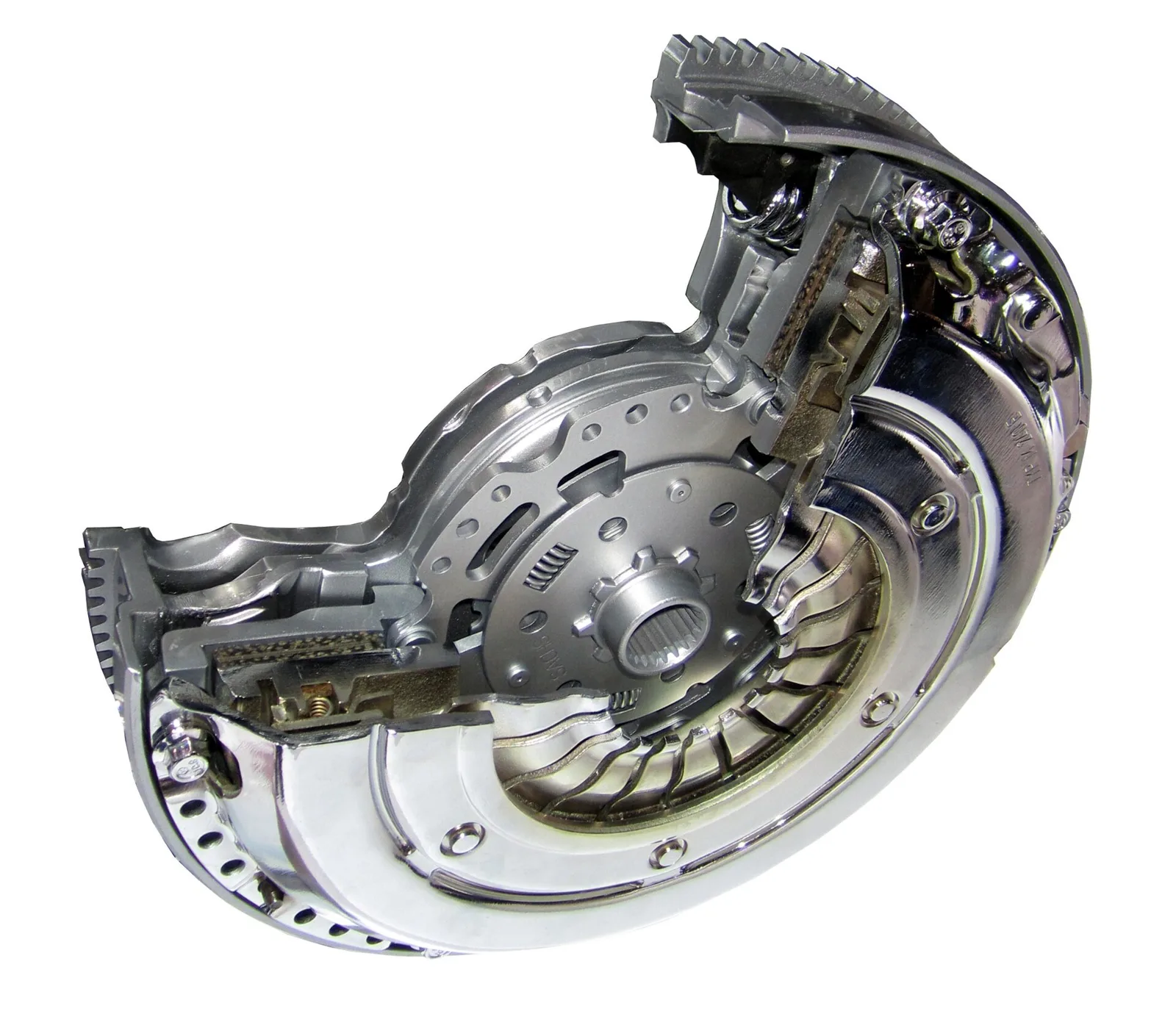
Two half masses and a set of arc springs soak up the vibration of modern low-rev torque. A solid flywheel hands that job back to the clutch disc.
A dual-mass flywheel is a flywheel split into two masses joined by arc springs. It stores and releases rotational energy like a normal flywheel, but also damps sudden changes in torque that cause vibration. It was developed for engines with few cylinders and strong low-rev torque.
Engines with three cylinders, or even two, can now deliver more torque at low revs than their predecessors, and they shake in a way an ordinary clutch disc cannot soak up. The dual-mass flywheel is the part that deals with that shake.
What does a flywheel do in an engine?
A flywheel stores rotational energy and hands it back when the engine needs it. In a reciprocating engine it smooths the rapid speed fluctuations of the crankshaft. It soaks up energy when a firing piston pushes on the crank, then returns that energy to compress the next charge of air and fuel.
Smoothing is the flywheel's whole trick. When the power going in drops, its stored energy supplies a surge to fill the gap, and when the input spikes, it absorbs the excess as extra rotation. Engineers describe it as a low-pass filter for speed: slow changes pass through, while small, quick wobbles are ironed out.
The principle is far older than the car. The same idea turns up in the Neolithic spindle, the potter's wheel and circular sharpening stones, and in the early eleventh century Ibn Bassal used flywheels in water-lifting machines. The German artisan Theophilus Presbyter, who lived around 1070 to 1125, recorded flywheels as a way to equalise rotation speed. In the Industrial Revolution James Watt refined the flywheel for the steam engine, and James Pickard paired one with a crank to turn reciprocating motion into rotary motion.
The physics is straightforward. A flywheel's stored energy depends on its moment of inertia and on the square of its rotational speed. Moment of inertia measures resistance to a twisting force on a spinning object, so the higher it is, the slower the flywheel is to accelerate. Pushing mass out towards the rim raises the inertia for a given weight, which is why a potter's wheel, with its heavy edge, keeps turning after the potter stops pushing.
Car-engine flywheels are cast from iron or nodular iron, or made of steel or aluminium. Steel ones on conventional bearings are generally limited to a few thousand rpm, whereas high energy density designs in carbon fibre composite with magnetic bearings can reach up to 60,000 rpm. A car engine is a different case from a laboratory design, because its flywheel runs at a specified speed and must fit into a limited space, so the aim there is to store as much energy as possible per unit of volume.
The dual-mass flywheel exists because engines got smaller and torquier at low revs, and shook harder than a clutch disc alone could absorb.
How does the flywheel work with the clutch?
In a manual car, the clutch links the engine to the transmission, and it is usually mounted directly on the face of the flywheel. The large steel disc is already there, so it doubles as one driving plate of the clutch. A friction disc is pressed against it by a spring mechanism, and the wheels receive power only while the two are in contact.
Moving the friction disc away from the flywheel by lever stops the drive, so engine speed no longer depends on the speed of the driven wheels. The majority of manual-transmission clutches are dry clutches, operated by hydraulics, cable or mechanical linkage. Both clutch and flywheel sit inside a conical bellhousing, and the usual friction material is an organic resin compound faced with copper wire, or a ceramic.
Some slip is needed when pulling away from a standstill, but it should be kept to a minimum to avoid extra wear. Some clutch discs also carry springs that shift the disc's natural frequency, which cuts noise, vibration and harshness in the cabin. That is the traditional place for vibration control, and it matters again in a moment.
Automatic transmissions do without all of this. A torque converter does the clutch's job, although the transmission may include internal clutches, including a lock-up clutch that reduces energy loss.
How do dry, wet and multi-plate clutches differ?
A dry clutch transmits power through dry friction, such as a friction disc squeezed against the flywheel. A wet clutch runs its friction material in an oil bath that cools and lubricates it, which can mean smoother engagement and longer life, though some energy goes into the oil. A multi-plate clutch stacks several friction plates.
Each has a home. Drag cars lean on multi-plate clutches to meter power onto the wheels from a standing start, and some racing clutches use small multi-plate packs that sit apart from the flywheel. Motorcycles typically use a wet clutch that rides in the same oil as the transmission. Because wet surfaces can be slippery, stacking several discs compensates for the lower friction.
The idea behind every one of them is the same. Take an electric drill: the clutch lets the bit spin at motor speed when engaged, turn more slowly when slipping, or stay still while the motor runs when disengaged. A car clutch does that between engine and gearbox, with the flywheel as the engine's side of the arrangement.
What is a dual-mass flywheel?
A dual-mass flywheel, or DMF, is a flywheel built as two half masses with arc springs between them. It does what a conventional flywheel does, but it also damps any violent variation of torque or revs that could cause unwanted vibration. A compact DMF often includes the whole clutch, pressure plate and friction disc.
The two masses and springs work as an energy store with a built-in cushion. Energy accumulates in the two half masses over a period, held back by the springs at a rate that suits the engine, and is released at a much higher rate over a short time. Power hammers and riveting machines use the same trick, with a flywheel building up energy slowly and spending it in a burst. Think of towing a car with a stretchy strap instead of a steel bar: the jerks are absorbed in the stretch instead of being passed straight along.
The main type is the planetary DMF, in which a planetary gear and a torsional damper are built into the main flywheel. The flywheel is divided into a primary and a secondary mass connected through pinions, and bent springs sit between them. The designs come in four forms.
Why were dual-mass flywheels developed?
They were developed to cope with ever-higher torque and power, above all at low revs. Environmental concern and stricter regulations pushed makers towards more efficient engines with as few as three or even two cylinders, delivering more low-rev torque. The side effect is vibration that traditional clutch discs cannot absorb.
That trade-off explains almost everything about the part. A small, high-torque engine firing at low revolutions sends bigger pulses through the driveline, and the dual-mass flywheel plays a key role in making these engines viable. It does the job that, in an older layout, was left to a clutch disc and the springs inside it.
How do the arc springs inside a DMF differ?
| Spring arrangement | Construction | Behaviour |
|---|---|---|
| Individual bent spring | One standard arc spring | The simplest form |
| One-phase, in parallel | Outer and inner arc springs of almost equal length, side by side | The individual characteristic curves are added to give the curve of the pair |
| Two-phase, in parallel | Two curved springs, one inside the other, the inner one shorter | Outer spring acts first; inner spring joins in when torque reaches its maximum |
| Three-phase | An outer spring plus two inner springs of differing stiffness, linked in series | Combines parallel and series connection for optimal torsional compensation at each value of torque |
The two-phase layout is the most carefully tuned of the parallel types. Its softer outer spring is shaped to stiffen from the moment the engine fires up, and it acts alone in the range where resonance is a problem. When torque rises to its maximum, the shorter inner spring also comes into play, and the two work together. The collaboration gives good acoustic isolation at all engine speeds.
What are the symptoms of a worn dual-mass flywheel?
A DMF's ability to absorb vibration depends on its moving parts, and those parts wear. Wear shows up chiefly as freeplay and sideplay, the latter also called rock. Both should be measured to decide whether the flywheel is still serviceable. Other ways it can fail: a badly grooved or damaged clutch mating face, lost grease and cracking.
The checking routine is simple to state. The DMF should be inspected for wear every time the clutch is replaced, because the two components sit together and the clutch work exposes the flywheel. The permitted wear limits are published in the vehicle or flywheel manufacturer's documentation, so a measured figure can be compared with a known limit.
Each failure mode points to a different part of the assembly. A grooved or damaged mating surface is the face where the friction disc runs. Grease loss concerns the lubricant inside the unit, which the springs and masses rely on. Cracking is the most serious, because the general physics of any flywheel is that stress rises with speed, and a flywheel breaks apart if the stress exceeds the strength of its material.
Can a solid flywheel replace a dual-mass flywheel?
A conventional flywheel keeps the engine's power delivery smooth, but it has no arc springs between two masses. It stores energy and returns it, and nothing more. The reason dual-mass units were developed is that modern engines produce more vibration than traditional clutch discs can absorb, so removing the DMF returns that task to the clutch disc.
The clutch disc is the other half of the argument. Some discs carry springs of exactly that kind, tuned to move the disc's natural frequency. A solid flywheel relies on features like these, plus the engine's own character, to keep vibration in check. How that balance works in any one car is a matter of how much low-rev torque and how few cylinders the engine has, which are the very things behind the DMF's development.
Where this goes next
Separately, high-strength steel and composite flywheels have been put forward as energy stores and braking aids for vehicles. That is a proposal, not a production fitment.