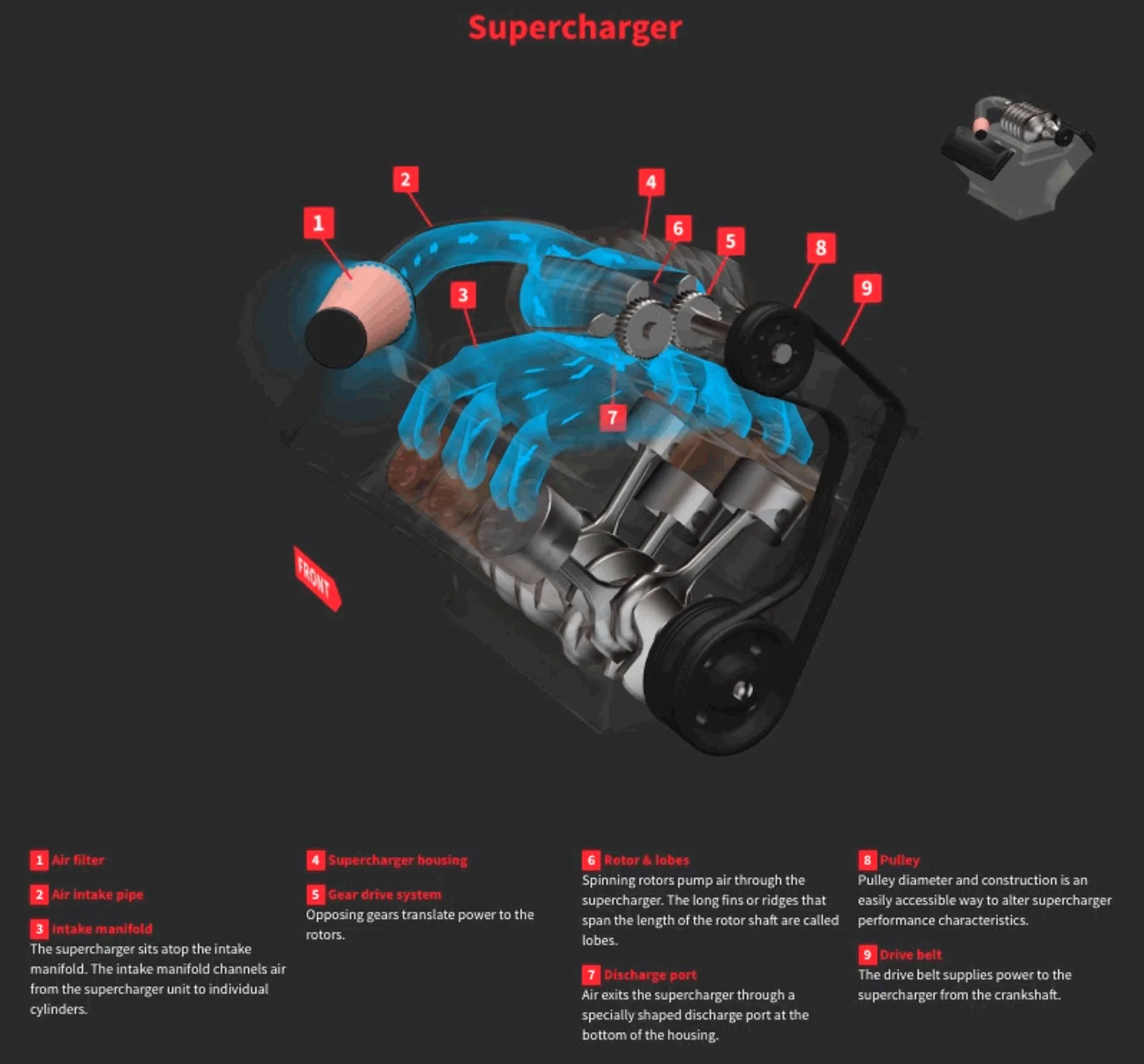
Roots, twin-screw and centrifugal blowers all force extra air into an engine from the crankshaft. That is the secret of their response and the root of their thirst.
A supercharger is a mechanically driven air pump, usually belt-run from the crankshaft, that forces extra air into an engine for more power. Roots, screw and centrifugal types all respond instantly because they need no exhaust flow, but the engine pays for the drive in fuel economy.
Until the middle of the 20th century, a turbocharger was not a rival to the supercharger at all. It was called a turbosupercharger and counted as one kind of supercharger. The split that car people now take for granted, belt-driven blower on one side and exhaust-driven turbo on the other, is a fairly recent habit of language.
What is a supercharger?
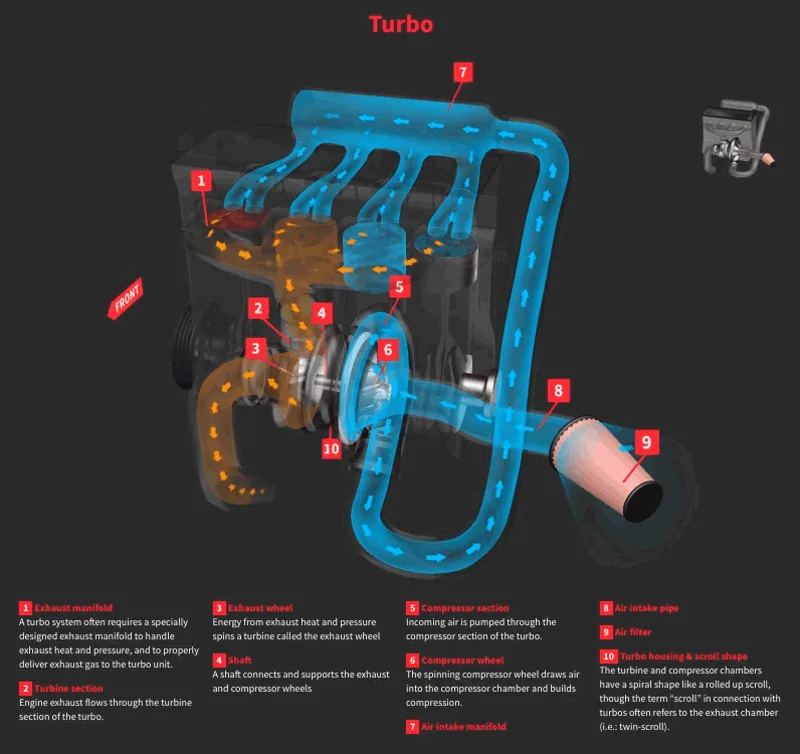
A supercharger compresses the air going into an engine so that more of it fits into the cylinders, which lets the engine make more power than its displacement would otherwise allow. It belongs to the family of forced induction, and what sets it apart is the way it is powered. A supercharger is driven mechanically, usually by a belt from the crankshaft. A turbocharger is driven by the kinetic energy of the exhaust gas.
The idea is old. The first supercharged engine was built in 1878. Aircraft engines picked it up in the 1910s, often to make up for the thinner air at altitude, and car engines followed in the 1920s. The first series-produced supercharged cars were the 1.6 litre Mercedes 6/25 hp and the 2.6 litre Mercedes 10/40 hp, both in production from 1923. Mercedes marketed them as Kompressor models, a name that stayed in use on various cars until 2012.
Today mechanical supercharging is less common. Manufacturers have moved to turbochargers to cut fuel use and raise power, especially from smaller engines, and almost every diesel now has a turbo. A newer variant, the electric supercharger, replaces the belt with an electric motor. It gives immediate throttle response and removes turbo lag.
A supercharger is always connected to the crankshaft, so the boost is there the instant the throttle opens.
How does a supercharger work?
Every supercharger is a pump that raises the pressure of the air before it enters the engine. Where they differ is in how they move the air, and that sorts them into two main families. Positive displacement designs trap a measured volume of air and carry it through, so they deliver a nearly constant boost at all engine speeds. Dynamic designs accelerate the air to high speed and then slow it down, converting that velocity into pressure, so their boost climbs exponentially with engine speed once it passes a threshold. A third family, the pressure wave supercharger, is rarely used.
The drive can be a V-belt, a synchronous belt or a flat belt, or it can be a direct, gear or chain drive. Some designs use a variable ratio.
How does a Roots supercharger work?
The Roots design is the most common positive displacement type, and it is surprisingly simple. Two lobed rotors, shaped like stretched gears, turn against each other. Pockets of air form around the lobes, and the turning rotors ferry each pocket across from the inlet to the outlet. It is not compressed on the way. The volume that goes in is the volume that comes out, so strictly speaking a Roots unit is a blower and not a compressor.
The name comes from the brothers Philander and Francis Marion Roots of the Roots Blower Company in Connersville, Indiana, who took out a patent on the basic design in 1860, intended as an air pump for blast furnaces and other industry. A lobe pump had been made in 1849 by G. Jones of Birmingham to ventilate coal mines. In 1900 Gottlieb Daimler included a Roots-type blower in one of his patented engines.
Modern Roots units use three or four lobes with a slight twist along the rotors. That smooths the pulses in the air entering and leaving the pump, and a twist is impractical with two lobes because even a small one could open a free path through the unit at certain angles.
The strength of the Roots blower is low-speed boost. It can build positive manifold pressure at low engine speed more effectively than the alternatives, which is why it became a popular choice for passenger cars, with peak torque available by about 2,000 rpm. Its weakness is heat. Measured against the other two basic types, the Roots has historically been the least thermally efficient, especially at high pressure ratios.
The sizing numbers come from diesel history. A GMC blower rating describes how many two-stroke cylinders of a given size the unit was designed to scavenge. A 6-71, for instance, was built for six cylinders of 71 cu in (1.16 L), a 426 cu in (7.0 L) engine, although the blower itself pumps 339 cu in (5.6 L) per revolution. Ratings run up to 16-71. The blowers on top fuel dragsters and funny cars descend from those General Motors Coach Division diesel units, and hot rodders use reproduction 6-71s.
Twin-screw and rotary-screw superchargers
A rotary-screw unit, sometimes called a twin-screw, is also positive displacement. German engineer Heinrich Krigar won the first screw-compressor patent in 1878, but his design never reached production. In 1935 the Swedish engineer Alf Lysholm patented a rotary-screw compressor that used five female rotors and four male ones. A Lysholm-style blower can come close to the efficiency of a dynamic supercharger, but only across a narrow band of load, speed and boost that the system has been specifically designed around.
Sliding-vane and scroll types complete the positive displacement group.
How does a centrifugal supercharger work?
A centrifugal supercharger is the best-known dynamic design. The compressor side of a turbocharger is a centrifugal design too, and the relationship runs deep: a turbocharger is a specific kind of centrifugal supercharger, one driven by a turbine. Four components do the work: a volute, which is the compressor housing, a diffuser, an impeller and a transmission.
The drive turns the impeller, a small rotating wheel. The impeller pulls air into the volute and flings it outward by centrifugal force into the diffuser. What leaves is air at high pressure but low speed. A step-up transmission between the crankshaft-driven input shaft and the impeller makes this possible, and impeller speeds can exceed 100,000 rpm. At that speed, the gears, bearings and seals are machined and ground to extremely close tolerances.
Centrifugal units are usually attached to the front of the engine by a belt or gear drive. Mounting one off to the side, on a bracket, keeps it away from the engine's heat, which helps. A twin-screw or Roots blower nested in the valley of the engine absorbs heat from the block and heads, and the hotter the intake air, the smaller the gain in power and the greater the risk of detonation.
That layout also makes intercooling easy, either air-to-air or air-to-water. The design is compact, affordable for the horsepower it adds, and popular as an aftermarket bolt-on.
Roots, screw and centrifugal compared
| Type | Family | Efficiency | Character |
|---|---|---|---|
| Roots | Positive displacement | 40-50% at high boost; about 70% to a pressure ratio of two | Strong low-speed boost, peak torque by about 2,000 rpm |
| Rotary screw (Lysholm) | Positive displacement | Nearly matches dynamic units over a narrow design range | Needs specific design for load, speed and boost |
| Centrifugal | Dynamic | 70-85% | Less heat, boost rising with engine speed, weaker low in the rev range |
Supercharger vs turbocharger
The two differ in where the energy comes from. A supercharger draws its power straight from the crankshaft. A turbocharger gets it from the pressure of exhaust gases that the engine was going to throw away anyway.
That is the root of every trade-off. Because it is always connected, a supercharger puts a constant extra load on the engine, so supercharged engines are typically less efficient on fuel. In return the boost is there the moment the throttle opens. A turbocharger can suffer lag at low revs, when exhaust flow is initially too weak to spin the turbine and reach the intended boost, causing a delay in response. Often the cause is a turbo that is oversized for the engine. That is why supercharged engines are common where throttle response is the priority, such as drag racing and tractor pulling.
Packaging also differs. A supercharger has simple piping: air in, through the unit, into the engine. A turbocharger needs both intake and exhaust piping brought together in a crowded engine bay. Turbo engines are also more prone to heat soak, because very hot exhaust and turbo parts sit right next to the intake air system. An intercooler can fix that, and turbocharged engines use intercoolers more often than supercharged ones.
Heat is a limit for both. Compressing air raises its temperature, and intake temperature becomes a ceiling on performance. Very high temperatures invite pre-ignition or knock, which costs performance and can wreck an engine, and the risk grows with hotter ambient air and higher boost. An intercooler adds complexity but can raise power output by packing more charge into each cycle, as if the engine were larger. Above about 5 psi (35 kPa) the benefit of intercooling can become dramatic.
Fuel matters as well. Higher octane fuel resists autoignition and detonation, so the boost can be increased. The development of 100-octane aviation fuel in the United States in the 1930s allowed higher boost pressures in high-performance aircraft engines, and later wartime fuels reached a nominal 150-octane rating. With such fuels engines such as the Rolls-Royce Merlin 66 and Daimler-Benz DB 605 DC reached as much as 2,000 hp (1,500 kW).
Can you have both? Twincharging
Lancia tried exactly that in the 1985 and 1986 World Rally Championships. The Delta S4 carried a belt-driven supercharger and an exhaust-driven turbocharger. A set of bypass valves and an electromagnetic clutch meant the supercharger supplied boost at low engine speeds, both systems shared the work in the middle of the rev range, and the supercharger was disconnected at the highest revs. The aim was to keep each system's advantages and lose its disadvantages. The price was complexity, which affected the car's reliability in rallies and added weight to the engine ancillaries.
Twincharging has appeared occasionally in production cars, including the Volkswagen 1.4 litre engine of 2005-2013 and select Volvo B4204T 2.0 litre four-cylinder engines from 2014.
Supercharged cars through the decades
The first supercharged car to compete in and win a Grand Prix was the 1923 Fiat 805-405. Others followed in quick succession: the 1923 Miller 122, the 1924 Alfa Romeo P2, a 1924 Sunbeam, then a Delage in 1925 and the Bugatti Type 35C of 1926. Among the most famous road cars is the Bentley 4 1/2 Litre, the Blower Bentley of 1929.
In the 21st century, road cars with superchargers have thinned out. Mercedes-Benz dropped its Kompressor engines of the early 2000s, among them the C 230 Kompressor four-cylinder, C 32 AMG V6 and CL 55 AMG V8, and replaced them around 2010 by turbocharged engines in cars like the C 250 and the CL 65 AMG. There are exceptions. Audi introduced its supercharged 3.0 TFSI V6 in 2009, the year Jaguar moved its supercharged AJ-V8 to the Gen III version.