Frank Williams once ran his team from a telephone box because the line at the office had been cut off. It went on to win nine constructors' championships, and the FW14B remains its high point.
Williams F1 was founded in 1977 by Frank Williams and Patrick Head after Williams's earlier team failed. It won nine Constructors' Championships between 1980 and 1997, a record until Ferrari's tenth, and seven drivers' titles. The FW14B of 1992, with active suspension, was its most dominant car.
Frank Williams once ran a Formula One team from a telephone box, because the phone at his office had been cut off over unpaid bills. Within a few years of founding the operation that bears his name, he was winning grands prix, and by 1997 the team had collected nine Constructors' Championships, a record that stood until Ferrari took its tenth in 2000.
Williams F1 history: how Frank Williams started from nothing
Sir Frank Williams was born in South Shields on 16 April 1942. A friend gave him a ride in a Jaguar XK150 in the late 1950s, and that was enough to catalyse an interest in fast cars. After a short career as a driver and mechanic, he founded Frank Williams Racing Cars in 1966, paying for it by selling groceries on the road.
He entered drivers, among them Piers Courage, in Formula Two and Formula Three, then bought a Brabham chassis that Courage drove through the 1969 Formula One season, finishing second twice. Courage died at the Dutch Grand Prix in 1970. In 1972 the Williams works built its first car, the Politoys FX3, designed by Len Bailey, and Henri Pescarolo wrecked it beyond repair on its race debut.
Money was always short. Williams looked to Marlboro and the Italian car company Iso Rivolta for sponsorship, and both pledged support that did not arrive in time. In 1976 he took on a partner, the Canadian oil magnate Walter Wolf, and although the team kept running, it no longer belonged to him. The cars, now racing as Wolf-Williams, still were not competitive.
In 1977 Williams walked away, taking an engineer named Patrick Head with him. The pair took over a vacant carpet warehouse at Didcot, in Oxfordshire, and launched Williams Grand Prix Engineering. Williams hired Neil Oatley, then a graduate, and later brought in Frank Dernie, previously of Hesketh Racing, who understood suspension geometry and aerodynamics and could write his own computer programs, a very unusual talent in those days. The Williams-Head partnership was born.
None of Williams's Drivers' Champions went on to win another title in Formula One.
How did Williams win its first races?
It made its debut at the 1977 Spanish Grand Prix. It ran a March 761 for lone driver Patrick Neve, who contested 11 races without scoring a point. His best finish was seventh, at the Italian Grand Prix.
For 1978 Head drew the team's first own-built car, the FW06, and the team signed Alan Jones. Jones had won the 1977 Austrian Grand Prix for Shadow after the death of that team's lead driver, Tom Pryce. His first Williams race, in Argentina, ended after 36 laps with a fuel system failure. The first points arrived two races later, with fourth place in South Africa, and the first podium followed in the United States, where Jones came home second, 20 seconds adrift of Carlos Reutemann's Ferrari. Williams ended the year ninth in the Constructors' Championship with 11 points.
The step up came in 1979 with the FW07. Head drew the chassis and gearbox, and Dernie handled suspension, aerodynamics and skirt design. This was Williams's initial ground-effect design, a concept Colin Chapman and Team Lotus had pioneered. Membership of the Formula One Constructors' Association encouraged two cars per team, so Clay Regazzoni joined Jones.
Points did not come until the seventh round, at Monaco, where Regazzoni took second, beaten by winner Jody Scheckter by under a second. The team's first win followed at its home race, the British Grand Prix, when Regazzoni finished 25 seconds clear of the field. Williams then took a 1-2 in Germany, Jones in front with Regazzoni two seconds behind. Jones won in Austria, with Gilles Villeneuve's Ferrari left half a minute behind, and again in the Netherlands, making four straight wins for the team. Scheckter ended the run at Monza and Jones won in Canada, the penultimate race.
Williams constructors championships: the Jones, Rosberg and Honda years
Reutemann replaced Regazzoni for 1980, and Jones won the opening race in Argentina, then in France, Britain, Canada and, in the final round, the United States. That made him the opening member of a group of seven Williams champions, with a margin of 17 points over Nelson Piquet's Brabham. The Constructors' Championship came to Williams for the first time too, on 120 points, close to double what runner-up Ligier managed. The next year brought four wins and a second constructors' title, 95 points and 34 clear of Brabham.
In 1982 Jones retired and Keke Rosberg arrived from Fittipaldi, where he had failed to score a point. Rosberg won the title with a single victory, in Switzerland. Reutemann quit after just two races, Mario Andretti filled in once, and Derek Daly drove through to the end. Williams ended fourth in the Constructors' standings, 16 points behind Ferrari.
Frank Williams then looked to Honda, which was developing a turbocharged V6, and a deal was settled early in 1983. Rosberg won at Monaco that year, the team's last victory with Ford power, and the Honda engine made its debut at the season finale in South Africa. In 1984 came the FW09, a win at the Dallas Grand Prix, and the final year with Saudia Airlines backing. The team placed sixth in the constructors' table with 25.5 points.
The FW10 of 1985 was the first Williams built from carbon-fibre composite, a material McLaren had pioneered in racing. Nigel Mansell joined Rosberg. The team won four races, Rosberg at Detroit and in Australia, Mansell in the European and South African rounds, and finished third in the Constructors' Championship with 71 points. In qualifying for the British Grand Prix Rosberg lapped in 1:05.591, an average of 160.938 mph (259.005 km/h), then the fastest lap in Formula One history. The year also began a relationship with the backer Canon that lasted nine seasons.
In March 1986 Frank Williams was in a road accident near Nice that left him tetraplegic, and for close to a year he stayed away from the pit lane. His team carried on without him. Nelson Piquet arrived to partner a returning Mansell, Piquet won four races and Mansell five, and Williams dethroned McLaren in the constructors' table.
The drivers' title went down to the final round in Australia. Mansell led the points, and fourth place or better would have clinched it. Running third with nineteen laps left, he had a tyre burst on the main straight, ending his race. Piquet, now leading, was called in by the team out of concern that his tyres might fail the same way. Alain Prost took a lead that proved insurmountable and won both the race and the title, two points ahead of Mansell. Piquet finished the season third, one point behind his teammate. The year after, in 1987, Piquet delivered the only Drivers' crown the Williams-Honda partnership ever won.
What made the Williams FW14B so dominant?
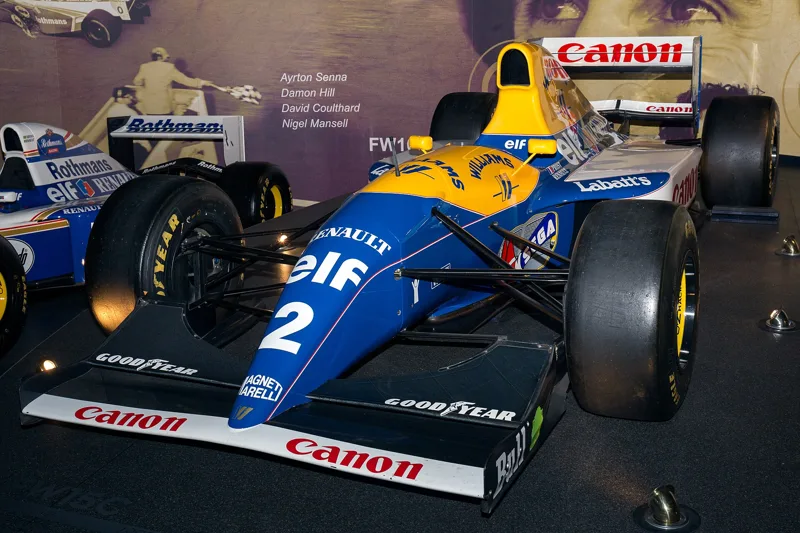
The FW14B was the 1992 development of a car designed by Adrian Newey, and it made the rest of the grid look slow. The FW14 had been prompted by two seasons of underachievement, in 1989 and 1990, in which Williams was competitive without winning enough. Newey, an aerodynamicist who had earlier designed efficient, cost-effective cars for March, joined in mid-1990 and began work on a completely new design, only the engine carried over. The promise was enough to bring Mansell back from Ferrari and delay his retirement plans.
The engine was a 3.5-litre V10 from Renault, its design and development directed by Bernard Dudot. The first FW14 debuted at the 1991 United States Grand Prix. On paper it was the most sophisticated car in the field, yet the first season was uneven. Mansell and Patrese recorded seven wins between them, yet Ayrton Senna took the title in the more reliable McLaren MP4/6, and McLaren narrowly beat Williams to the Constructors' Championship. Mansell suffered several retirements from the new semi-automatic gearbox, often while in a position to win.
For 1992 the B-specification car added further development work on the gearbox and aerodynamics, plus electronics: traction control and an active suspension system. In plain terms, a conventional car rides on springs and dampers that react to the road. An active system lets electronics decide how each wheel moves, so the car can be kept in the attitude where its aerodynamics work best. The design of the system is credited to Dernie, while Newey was responsible for the aerodynamics. At times the car also had anti-lock brakes.
The result was a car well ahead of its rivals, among them the McLaren MP4/7A, the Ferrari F92A and the Lotus 107. It was so successful that its planned successor, the first FW15, available midway through 1992, was never used. In many races Mansell and Patrese gained two seconds a lap over the field, especially in the early laps. At Silverstone Mansell's pole time beat Patrese's by two full seconds, while Patrese in turn had a second in hand over Senna, third on the grid.
Mansell secured the 1992 Drivers' title with nine wins in a season, then a record, and Patrese added a victory at the Japanese Grand Prix. Williams were clear winners of the constructors' title. Patrese liked the car less, preferring the passive suspension of the earlier chassis, whereas the extra downforce of the B-spec suited Mansell's aggressive driving. The visible differences were two bulbous protrusions above the front pushrods, which housed the active suspension, and a longer nose.
The season ended on a sour note. Mansell left the team after Prost was signed, and Patrese moved to Benetton for his final season in 1993. Between them the two versions of the car won 17 Grands Prix, 21 pole positions and 289 points. Because current regulations ban many of the technologies they used, they are counted among the most sophisticated cars Formula One has seen.
Its afterlife is busy. On 2 June 2017 Karun Chandhok drove an FW14B for the first time since 1992 at Silverstone, during the team's 40th anniversary celebrations. In 2020 it emerged that Sebastian Vettel had bought Mansell's number 5 chassis, the one that won the 1992 title, and he drove it at the 2023 Goodwood Festival of Speed. Another chassis, FW14/8, sold for 2,703,000 pounds at a Bonhams auction on 5 July 2019. The car has appeared in several F1 video games, and a Lego Icons set (number 10353), including a Nigel Mansell minifigure, was released on 1 March 2025.
Who were Williams's drivers' champions?
Seven drivers won the Drivers' Championship with Williams. Only three of them defended the title while still at the team, and none went on to win another one in Formula One, though Mansell did win the CART title at the first attempt.
| Driver | Title | What happened next |
|---|---|---|
| Alan Jones | 1980 | Defended while still with Williams |
| Keke Rosberg | 1982 | Defended while still with Williams, then left for McLaren in 1986 |
| Nelson Piquet | 1987 | Moved to Lotus |
| Nigel Mansell | 1992 | Left Formula One for the CART series, winning that championship in his first season |
| Alain Prost | 1993 | Retired |
| Damon Hill | 1996 | Moved to Arrows |
| Jacques Villeneuve | 1997 | Defended while still with Williams |
The same decade brought darker moments. In May 1994 Ayrton Senna died at Imola driving the Williams FW16. Frank Williams was charged with manslaughter in Italy and acquitted in 1997. From the 1995 FW17 until 2021, every chassis bore a small tribute to Senna, a logo on the front wing supports or close by.
Engines mattered as much as drivers. Williams worked with many manufacturers, most successfully with Renault, which powered five of its nine constructors' titles. At the 1997 British Grand Prix, Villeneuve scored the team's 100th race victory. That made Williams one of just five teams to reach 100 wins, the others being Ferrari, McLaren, Mercedes and Red Bull Racing. Williams also sits in a group of four teams, with Ferrari, McLaren and Renault (formerly Benetton), that won every Constructors' Championship from 1979 to 2008 and every Drivers' Championship from 1984 to 2008.
What happened to Frank Williams?
On 8 March 1986 Williams was at the wheel of a rented Ford Sierra, heading from the Paul Ricard circuit to the airport at Nice with the team's sponsorship manager, Peter Windsor. A keen runner, he had a half marathon in London to tackle the next day. He lost control on a slight left-hand kink, clipped a low stone wall and the car rolled down an eight-foot (2.4 m) drop. Williams stayed conscious but knew at once that he could not move. The fourth and fifth vertebrae had fractured. His wife Virginia flew to France with Patrick Head, believing he was about to die, and arranged his urgent return to England. Doctors at the Royal London Hospital performed a tracheotomy that let his lungs be drained, which almost certainly saved his life. He used a wheelchair and needed constant care from then on.
He stayed at the head of the team for decades more. In March 2012 he announced he would leave the board, to be replaced by his daughter Claire, though he remained as team principal. He was appointed CBE, and knighted in 1999. France made him a Knight of the Legion of Honour for his work with Renault engines. He died on 28 November 2021, at the age of 79.
At the next race, the 2021 Saudi Arabian Grand Prix, the teams carried a special Frank Williams Racing Cars logo livery and held a moment of silence. A mass of thanksgiving at Westminster Cathedral on 4 July 2022 drew more than 600 people.
Where is Williams now?
The company is Williams Grand Prix Engineering Limited, and it competes in 2026 as Atlassian Williams F1 Team. The base is a 60-acre (24 ha) site at Grove, in Oxfordshire. Its engineering arms, Williams Advanced Engineering and Williams Hybrid Power, take technology developed for Formula One and adapt it to commercial uses. GKN bought Williams Hybrid Power in April 2014.
Dorilton Capital bought the team in August 2020, and Frank and his daughter Claire left its management at that point.