The engineer behind the 1901 Lohner-Porsche hybrid, the Volkswagen Beetle, the Auto Union racers and the Porsche 356, and the wartime work that still divides opinion.
Porsche was an engineer from Bohemia who designed the Beetle and founded Porsche AG. Early hybrid work in 1901 and racing cars for Auto Union set his reputation. His wartime military vehicles remain a central part of how he is judged today.
Ferdinand Porsche was an Austrian-German engineer who founded Porsche AG and designed the Volkswagen Beetle. He built an early petroleum-electric hybrid in 1901 and went on to design racing cars for Austro-Daimler, Mercedes-Benz and Auto Union. His work for Nazi Germany during the Second World War is central to how his legacy is judged today.
Who was Ferdinand Porsche?
Ferdinand Porsche was born on 3 September 1875 in Maffersdorf, in northern Bohemia, then part of Austria-Hungary. He died on 30 January 1951. He is best known for creating the Lohner-Porsche hybrid, the Volkswagen Beetle, the Auto Union racing cars and the Mercedes-Benz SS and SSK, and he was the founder of Porsche AG.
His honours included an honorary doctorate from the Vienna University of Technology in 1916 and another from the Stuttgart Technical University in 1924. He was inducted into the International Motorsports Hall of Fame in 1996 and in 1999 was named Car Engineer of the Century, a title awarded posthumously.
A pioneer of hybrid drive whose wartime work for Nazi Germany still shapes how his legacy is judged.
How did Porsche's early life lead to engineering?
Porsche was the third child of Anton and Anna Porsche, and his father was a master panel-beater. Ferdinand showed an aptitude for technology from a young age, particularly in electricity. While still helping in his father's workshop by day, he attended classes at the Imperial Polytechnical College in Reichenberg at night.
In 1893, aged 18, he took a job with the Bela Egger electrical company in Vienna, now part of ABB. He studied part-time at what is now the Vienna University of Technology but did not complete a formal engineering education. During his five years with Egger he built the company's first electric wheel-hub motor, based on a concept by the American inventor Wellington Adams, and he raced it in 1897.
What was the Lohner-Porsche hybrid?
The Lohner-Porsche Mixte of 1901 was a series hybrid in which a Daimler petrol engine drove a generator that powered electric motors in the wheel hubs. A small battery pack served as a backup. It is recorded as the first petroleum-electric hybrid vehicle, and its design avoided heavy batteries as the main energy store.
Porsche's earlier Egger-Lohner of 1898 had two electric motors in the front wheel hubs, powered by batteries. Its 1,800 kg (4,000 lb) of lead-acid batteries made it slow on hills and limited its range. A four-motor example was ordered by the Englishman E. W. Hart in 1900, and a one-off version appeared at the Paris World Exhibition that December under the name La Toujours Contente.
Over 300 Lohner-Porsche chassis were sold up to 1906, but most were two-wheel drive trucks, buses and fire engines. The vehicles reached speeds of up to 56 km/h (35 mph), broke several Austrian speed records and won the Exelberg Rally in 1901, with Porsche driving a front-wheel drive hybrid himself. In 1905 he received the Potting prize as Austria's most outstanding automotive engineer.
In 1902 Porsche was drafted into military service and served as chauffeur to Archduke Franz Ferdinand, the heir presumptive to the Austro-Hungarian throne.
How did Porsche's racing cars make his name at Austro-Daimler and Mercedes?
In 1906 Austro-Daimler recruited Porsche as chief designer, and he later advanced to managing director by 1916. His best-known Austro-Daimler car was built for the 1910 Prince Henry Trial. The streamlined 85 horsepower (63 kW) car won the first three places, and it is still better known by its nickname than by its model name, Modell 27/80.
His 1922 design won 43 of 53 races. In 1923 he left Austro-Daimler over differences about the direction of car development, and Daimler Motoren Gesellschaft in Stuttgart hired him as technical director. There he produced several successful race cars, and the supercharged series that led to the Mercedes-Benz SSK dominated its class of racing in the 1920s.
In 1926 Daimler-Motoren-Gesellschaft and Benz merged into Daimler-Benz. Porsche's idea for a small, lightweight Mercedes-Benz car was not popular with the board, and he left in 1929 for Steyr Automobile. The Great Depression later made him redundant there.
Why did Porsche found his own design company in 1931?
Porsche returned to Stuttgart in April 1931 and founded the consulting firm Dr. Ing. h.c. F. Porsche GmbH. Financial backing came from his son-in-law, the Austrian attorney Anton Piech, and from Adolf Rosenberger. He recruited former colleagues including Karl Rabe, Erwin Komenda and his son Ferry Porsche.
The firm's first project was a middle-class car for Wanderer, followed by other commissions. Porsche then began work on a small car of his own, financed with a loan secured on his life insurance. Zundapp and NSU briefly sponsored the work before losing interest, and the design became the base for later projects.
Commissions were scarce in the depressed economy, so Porsche set up a subsidiary, Hochleistungs Motor GmbH, to build a racing car for which he had no customer. The experimental P-Wagen followed the 750 kg formula, which set a minimum weight of 750 kg for the car without driver, fuel, oil, water and tyres. Its layout drew on the mid-engined Benz Tropfenwagen of 1923.
What were the Auto Union racing cars?
In 1932 Auto Union was formed from the struggling manufacturers Audi, DKW, Horch and Wanderer. Its chairman, Baron Klaus von Oertzen, wanted a showpiece project and met Porsche, who had done work for him before. The driver Hans Stuck joined the approach to the German Chancellor, and the result was a state-backed racing programme.
At the 1933 Berlin Motor Show Adolf Hitler announced a state-sponsored racing programme to develop a high-speed German motor industry. Hitler agreed to split the funding between Mercedes-Benz and Auto Union, with 250,000 RM (Reichsmark) to each company, and the decision led to a heated rivalry between the two companies on and off the track.
Auto Union bought the P-Wagen project from Hochleistungs Motor GmbH for 75,000 RM and moved the company to Chemnitz. As Porsche became more involved in the Volkswagen factory at Wolfsburg, he handed the racing work to his son Ferry. The Silver Arrows of both brands dominated until the outbreak of war in 1939 stopped the racing.
How was the Volkswagen Beetle commissioned?
In June 1934 Porsche received a contract from Hitler to design a people's car, the Volkswagen. The first two prototypes were completed in 1935, and several pre-production batches followed from 1936 to 1939. Tatra, whose designer Hans Ledwinka had similar models, sued for patent infringement, and the case was interrupted by the invasion of Czechoslovakia.
Porsche was praised by the regime as a great German engineer. He filed to give up Czechoslovak citizenship in 1934, and in 1937 he joined the Nazi Party and the SS. By 1938 he was using SS personnel as security and drivers at his factory, and he later reached the rank of SS-Oberfuhrer in 1942.
The car later known as the Beetle went into mass production after the war. Porsche received a royalty on every one. More than 20 million Type I cars were built, which gave him a comfortable income in later years.
What military vehicles did Porsche design?
In January 1938 officials from the Heereswaffenamt asked him to design an inexpensive, lightweight transport vehicle that could operate on and off road. Full production of the Type 82 Kubelwagen started in February 1940, and 50,435 were built by the time Volkswagen production ceased at the end of the war.
The Schwimmwagen, which shared mechanicals with a four-wheel drive Kubelwagen prototype, was produced from 1941 to 1944. Its 15,584 examples make it the most-produced amphibious car in history. By the end of the war Volkswagen had built 66,285 vehicles, of which only 630 were for civilian use.
Porsche became chairman of the Panzerkommission, an advisory group of engineers and industrialists, at the start of the war on 1 September 1939. He was removed in 1943 after his tank designs were widely considered a failure, and a competing Henschel design was chosen for the heavy tank.
Ninety of the chassis already built were converted into self-propelled anti-tank guns, known as the Ferdinand, in 1943. The Ferdinand had a hybrid electric drive and a long-barrelled gun, and it had a kill ratio of nearly 10:1. Lack of supplies made maintenance a serious problem, and crews often had to destroy their own vehicles when they broke down.
In March 1942 Porsche received a contract for a 100-ton tank, the VK 100.01, later known as the Maus. Only two prototypes were produced, and as of 2025 it is the heaviest fully enclosed armoured fighting vehicle ever built. Porsche also worked on an artillery tractor that became the Skoda RSO, of which only 206 were built.
What did Porsche's wartime work involve in terms of labour?
Porsche's operation used forced labour during the war, with approximately 300 forced labourers, including Poles and Russians. Volkswagen as a whole used a large number of Soviet workers. By early 1945 German nationals made up only 10 percent of the Volkswagen workforce.
None of the 336,000 savers who paid into the Volkswagen scheme received a car, and their combined savings of over 380 million Reichsmark went to the war effort. In 1961 some depositors received a partial credit toward a new Volkswagen.
What happened to Porsche after the war?
In November 1945 Porsche was asked to continue the Volkswagen design in France, but the project stalled. On 15 December 1945 French authorities arrested Porsche, Anton Piech and Ferry Porsche as war criminals. Ferry was freed after six months, but Ferdinand and Anton were held in Baden-Baden, Paris and Dijon.
The French government required a payment of one million francs for their release, described as ransom or bail. The family raised the money through a contract with Piero Dusio's Cisitalia company, which built a Grand Prix car that never raced. Ferry kept the business running during his father's captivity.
How did the Porsche 356 begin the Porsche car range?
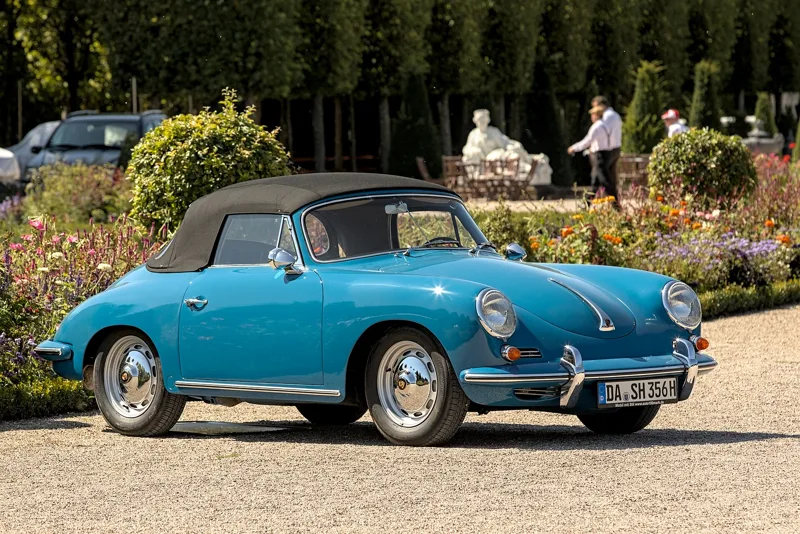
At Gmund in Carinthia the company built the Porsche 356, the first car to carry the Porsche name, and made 49 cars by hand in an old sawmill. In 1949 the family returned to Stuttgart with no bank credit, so Ferry took a 356 to Volkswagen dealers and asked them to pay in advance.
The series production 356 had a steel body. More than 78,000 were built over the following 17 years. Porsche himself visited the Wolfsburg factory for the first time since the war in November 1950, but a few weeks later he suffered a stroke. He died on 30 January 1951.
| Year | Vehicle or milestone | Detail |
|---|---|---|
| 1898 | Egger-Lohner (C.2 Phaeton) | Two electric motors in the front wheel hubs |
| 1901 | Lohner-Porsche Mixte | Petroleum-electric hybrid, first on record |
| 1910 | Prince Henry (Modell 27/80) | 85 hp (63 kW), first three places in the trial |
| 1922 | Racing design | 43 wins from 53 races |
| 1935 | Volkswagen prototypes | First two prototypes completed |
| 1940 | Kubelwagen Type 82 | 50,435 built by the end of the war |
| 1941-1944 | Schwimmwagen Type 166 | 15,584 built |
| 1943 | Ferdinand (Panzerjager Tiger (P)) | Ninety chassis converted |
| 1942 | Maus (VK 100.01) | Two prototypes |
| 1949 onwards | Porsche 356 | More than 78,000 built |
How is Porsche's legacy viewed today?
Views of Porsche have been polarised since the war. He was honoured for his contributions to engineering, and the Volkswagen Group, which his heirs control, became one of the largest car makers in the world. He was also criticised for his role in the Nazi war economy, through the military vehicles and weapons systems he helped produce.
In 2013 local authorities in Maffersdorf, now Vratislavice nad Nisou, changed a museum display after complaints from a survivors' group. The display now mentions his Nazi Party and SS membership as well as his automotive achievements. The local Porsche owners' association criticised the change, and Porsche AG withdrew the show cars it had lent to the museum.
The story of Adolf Rosenberger, the Jewish co-founder of Porsche, is part of the record too. Rosenberger was arrested after Hitler came to power and was imprisoned at the Kislau camp near Karlsruhe. His ownership stake was taken under the Nazi policy of Aryanisation, and Porsche and Piech acquired it at a nominal value. They settled with him after the war, but his founding role was never fully recognised.
In December 2022 the city council of Linz renamed Porscheweg, citing Porsche's central role in the Nazi war economy. Porsche AG said it did not support the renaming.