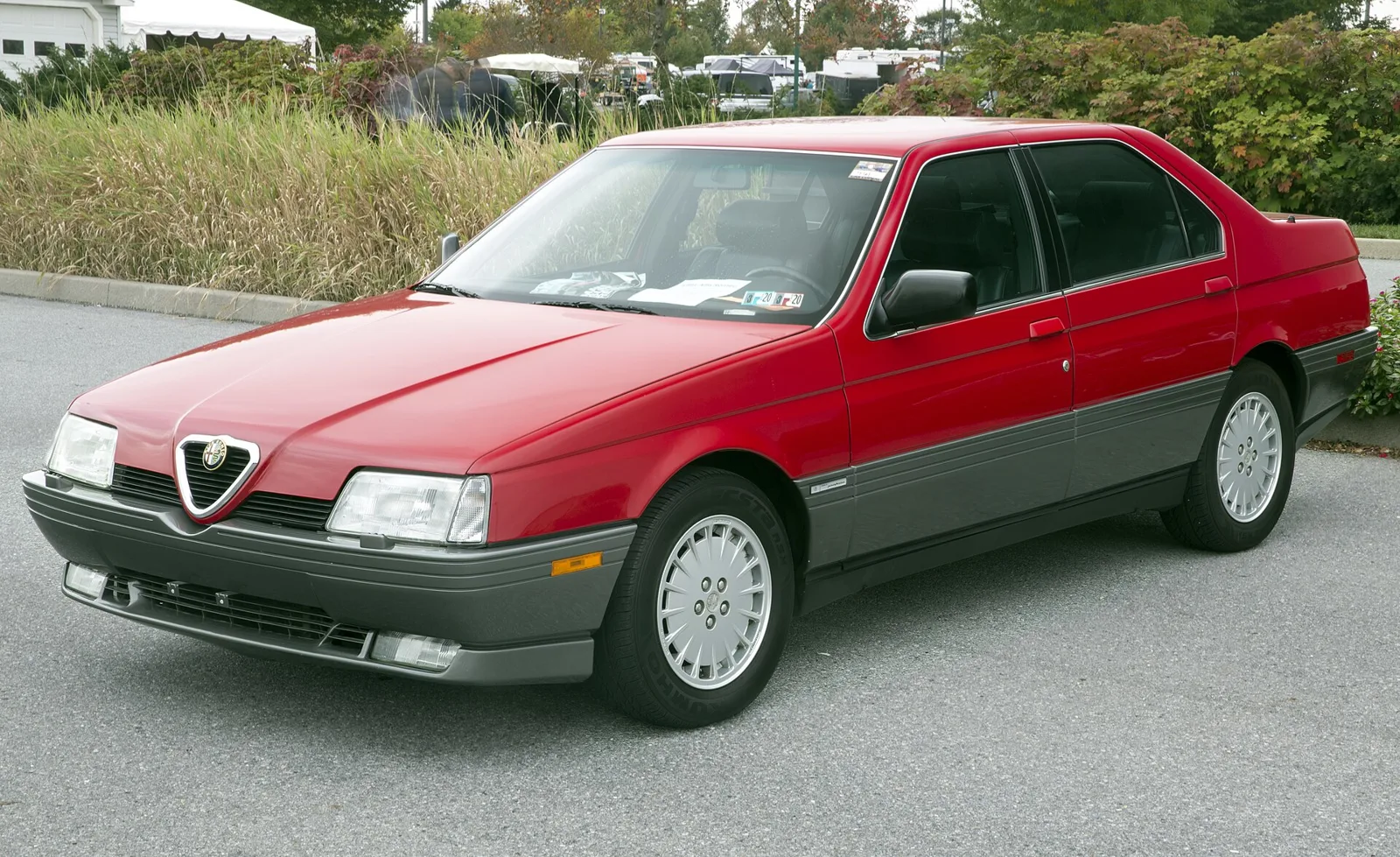
A 1987 Pininfarina saloon that shared its platform with cousins from Fiat, Saab and Lancia and was the last Alfa sold in the US until the 2015 Giulia.
The Alfa Romeo 164 was a four-door executive saloon built from 1987 to 1998. Pininfarina styled it, and it shared its platform with the Fiat Croma, Saab 9000 and Lancia Thema. It was the last Alfa sold officially in the United States until 2015, and production reached 273,857 units.
The 164 was Pininfarina's design for an executive saloon, built on a platform it shared with the Fiat Croma, the Saab 9000 and the Lancia Thema. It was unveiled at the 1987 Frankfurt Motor Show, and it was the last Alfa developed before the company passed fully under Fiat's control.
Over its life the model reached a combined production total of 273,857 units. It also marked a turning point for Alfa's American business, because the company withdrew from the US after the 1995 model year.
Where did the Alfa Romeo 164 come from?
The 164 began life as Project 156 in 1980, a proposal from engineer Filippo Surace for a modular range of cars. The project was meant to replace the Alfa Sud and the Alfetta, and it aimed at a fresh line-up for the company's core models.
When the Italian government cut funding, the project was shelved. Surace then talked with Lancia engineer Sergio Camuffo about a joint venture, and that partnership brought Alfa into the Fiat Tipo Quattro platform, which Fiat and Saab had developed together.
Project 156 was never the car that reached showrooms, yet some of its design elements carried over into the Alfa Romeo 75. That history explains why the 164 looked different from its platform mates, since its styling came from a separate design path.
A Pininfarina saloon that closed out Alfa's independent era and carried its wedge shape through the next generation.
Who styled the Alfa Romeo 164?
Enrico Fumia of Pininfarina styled the car, and his proposal was approved for production in 1984. The design was unveiled at the 1987 Frankfurt Motor Show, which put the 164 in front of European buyers as the newest Alfa in the range.
The first 1:1 scale model was produced in 1982, and design cues were previewed on the Alfa Romeo Vivace concept at the 1986 Turin Motorshow. Those cues then fed into the production car's final shape.
Its wedge shape gave the car a drag coefficient of Cd 0.30. The styling later influenced the rest of the Alfa Romeo range, beginning with the 33 from 1990 and culminating with the 155.
What did the launch range include?
The launch line-up in 1987 offered four engines: the 2.0i Twin Spark, a turbocharged 2.0 Turbo, a 3.0i V6 with 12 valves and a 2.5 turbodiesel. The Turbo was derived from the Lancia Thema and used an eight-valve engine, giving buyers a different balance of performance from the naturally aspirated cars.
In 1990 the range added the 3.0i V6 Quadrifoglio Verde, which took the badge QV or S. The 1993 update brought the range the Super name and chrome trim on the bumpers.
The Q4 joined the line-up in 1993 with the strongest engine on offer. It used the 24-valve version of the V6, which was the most powerful engine fitted to the 164, and it was the only all-wheel drive variant the company offered.
What engines did the 164 offer?
The base engine was the 2.0 L Twin Spark inline-four, which had two spark plugs per cylinder and Bosch Motronic fuel injection. Turbo, V6 and turbodiesel options sat above it, with the 3.0 L Busso V6 at the top of the range.
The Twin Spark block dated back to the 2.0 L that had powered Alfa's road and race cars since the 1930s. Its chain-driven DOHC head and two-stage valve timing were notable features, and the two-stage timing arrived before Honda's VTEC.
The Busso V6 was designed by Giuseppe Busso for the Alfa 6. It started with 12 valves and was upgraded to 24 valves for the QV and Q4 models. The turbodiesel from VM Motori produced 92 kW (125 PS; 123 hp) and gave a top speed of 200 km/h (124 mph).
Italian tax rules shaped the range as well. Engines over 2000 cc paid a 38% rate of VAT instead of 18%, which made the larger engines more expensive to sell at home.
How did the QV and Q4 variants differ?
The Quadrifoglio Verde was added in 1990 as the top model of the range. Its output rose from 184 to 200 hp (135 to 147 kW), and in some markets, including Australia, it was the only 164 offered with a manual transmission.
The Q4 arrived in 1993 as the only all-wheel drive variant. It used the most powerful 24-valve V6 fitted to the 164, and its four-wheel-drive system was co-developed with Steyr-Daimler-Puch. A Getrag 6-speed manual was fitted to the Q4.
The Viscomatic system was more advanced than many systems of its time, and it set the Q4 apart from the rest of the line-up. The QV, meanwhile, kept the sporting character of the range.
What did the North American range look like?
The US received the 164 with the 3.0-litre V6 as the headline engine. The 1991 L model was rated 183 hp (136 kW), and the 1991 S model reached 200 hp (149 kW). By 1992 the LS was rated 210 hp (157 kW) and the S reached 230 hp (172 kW). The figures show the power rising within the US range over those two model years.
The V6 gave American buyers a noticeably stronger car than the four-cylinder versions sold in Europe, and the power figures show a steady climb across the two model years.
Alfa withdrew from the United States after the 1995 model year because of reliability concerns and slow sales. The car did not return to the US until the Giulia arrived in 2015.
The 164 was rebadged as the 168 for Taiwan, Hong Kong and Malaysia. The number 164 carried a negative Chinese homophone, while 168 carried the opposite meaning, so the name was changed for those markets.
What was the interior like?
The 164 came with velour seating as standard, and leather trim was available on some models. The sporting QV and 164S were the cars that received electronically controlled damping, which adjusted the suspension to suit conditions.
Inside, the car's three onboard computers handled air conditioning, instrumentation and engine management. That made the cabin technically ambitious for its time, and it was a clear sign of how much electronics the company had built into the model. Electronic damping and the computer network together show how the company used technology to set its executive saloon apart.
How did the 164's engineering stand out?
The 164 was the first Alfa Romeo to benefit from extensive computer aided design, which was used to calculate structural stresses. The result was a chassis that was very rigid yet still relatively light. Those choices show the company applying modern design methods to a new car.
Galvanised steel went into the chassis and several body panels, a first for the brand. That change helped build quality improve over earlier Alfas, which had been a weak point for the company.
The car also used a platform shared with the Croma, the 9000 and the Thema, but it kept unique front suspension geometry. That geometry, along with the body's distinctive styling, separated the Alfa from its cousins.
What concept cars came from the 164?
The 1988 164 Pro-Car was a mid-engined experiment with a 3.5 L V10 delivering 620 hp (462 kW; 629 PS). It weighed 750 kg (1,653 lb) and reached 340 km/h (211 mph), with a quarter mile time of 9.7 seconds.
The Pro-Car was a one-off style of experiment rather than a production plan. Only one rolling chassis was built for it, and the car stayed a concept.
The Proteo concept of 1991 offered all-wheel drive but was never built. The Scighera concept of 1997 used the 164's 3.0-litre engine with two turbochargers, pointing to another use for the platform.
Alfa also built a two-door fire brigade pick-up, shown for rescue teams at racing circuits. It is now exhibited at the Alfa Romeo Museum, and it shows how the brand supplied specially modified vehicles for trackside work.
What is the legacy of the 164?
The 164 was the last model Alfa Romeo developed while it was a fully independent company. Its launch came after the Fiat takeover, so the car sat on the boundary between two eras for the brand.
The wedge shape carried into the rest of the range. Its influence reached the 33 from 1990 and the 155 later, which means the 164's styling reached showrooms well after the car itself had gone out of production.
Its electronics were advanced but troublesome. The car had three onboard computers and the most complex wiring harness fitted to any Alfa Romeo at the time, and that complexity made faults harder to track down.
The successor, the 166, followed in 1998 and ended the 164's run. By then the car had sold 273,857 units across its life, a total that reflected a respectable if difficult career. That figure was reached across the whole run of the model.
What are the Alfa Romeo 164 specifications?
The table gathers the core figures for the 164 range, from engine choices and aerodynamics to US power ratings and total production. Imperial figures appear in brackets alongside metric ones wherever the original data gives both, and every entry matches the figures set out earlier.
| Specification | Detail |
|---|---|
| Type | Type 164, four-door executive saloon |
| Years built | 1987 to 1998 |
| Launch engines | 2.0 L Twin Spark, 3.0 L V6 12-valve, 2.5 L turbodiesel |
| Turbodiesel output | 92 kW (125 PS; 123 hp) |
| QV output | 200 hp (147 kW) |
| US L model (1991) | 183 hp (136 kW) |
| US S model (1992) | 230 hp (172 kW) |
| Drag coefficient | Cd 0.30 |
| Boot capacity | 510 litres |
| Pro-Car V10 | 3.5 L, 620 hp (462 kW; 629 PS) |
| Total production | 273,857 units |
The table shows a range that grew from a simple launch line-up into a broader family, with the V6, QV and Q4 extending the car well beyond its original engines.
Frequently asked questions
What replaced the Alfa Romeo 164?
The 166 followed in 1998, which brought the 164's production run to an end. The combined total for the 164 stood at 273,857 units, and the newer saloon carried the company's executive car work into a new generation.
Did any 164 come with all-wheel drive?
Yes. The Q4 was the only all-wheel drive variant, introduced in 1993 with the most potent engine in the line-up. It used the 24-valve 3.0-litre V6, a Getrag 6-speed manual gearbox and a four-wheel-drive system co-developed with Steyr-Daimler-Puch.
How fast was the Pro-Car?
The Pro-Car reached 340 km/h (211 mph) and ran the quarter mile in 9.7 seconds. It weighed 750 kg (1,653 lb) and was powered by a 3.5 L V10 producing 620 hp, which made it a striking concept for the brand.
Why did Alfa leave the US market?
The company withdrew after the 1995 model year, citing reliability concerns and slow sales. The brand did not return until the Giulia arrived in 2015, so the 164 remained the last Alfa officially sold there for many years.
.jpg)