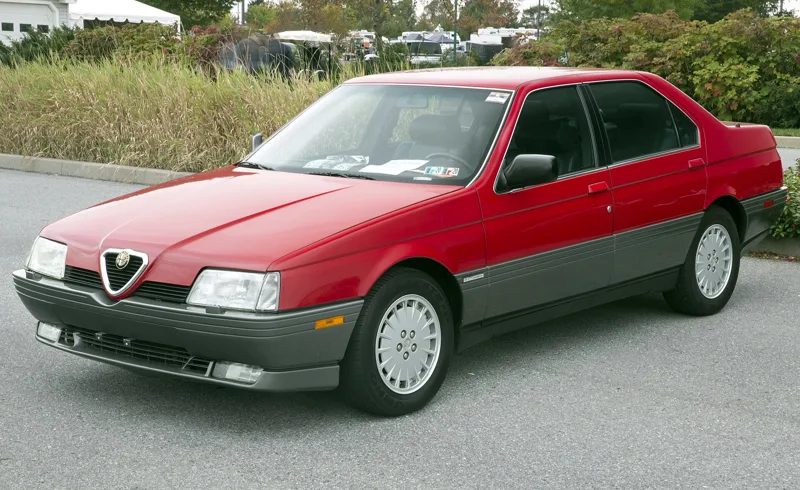
A Fiat-shared platform, turbo engines and an Aero flagship that gave Saab its first real foothold in the executive market.
The Saab 9000 was a Swedish executive car built from 1984 to 1998, developed alongside Fiat's Type Four platform. It came as a hatchback or saloon, with turbocharged and naturally aspirated fours and a 3.0-litre V6 from 1995. Saab built 503,087 examples before the 9-5 replaced it.
Saab's 9000 was the Swedish firm's bid for the executive market, built from 1984 to 1998 on a platform it shared with Fiat. It came as a five-door hatchback or a four-door saloon, always with petrol engines. Across its production run Saab built 503,087 of them.
Where did the Saab 9000 come from?
The 9000 was Saab's entry into the executive car market, developed after the turbocharged 99 and 900 had proven the brand's strengths. It shared a joint Type Four platform with Fiat, which sold its own Croma, Thema and Alfa Romeo 164 versions. Saab first showed the car to the press on 24 May 1984.
Fiat's own derivatives of the platform were only partly shared with the Saab, and only seven parts could be swapped between the cars. Fiat had designed the Croma without American crash test requirements in mind, which meant the Saab needed its own reworked front end.
Early production cars failed the American crash test standards, and Saab worked to fix that through the life of the design. The first car to reach the press was called the Saab 9000 Turbo 16.
A Swedish executive car that shared its platform with Fiat, then rebuilt its body around crash protection.
What engines did the Saab 9000 use?
The 9000 used a 2.0-litre turbocharged four-cylinder with 16 valves, rated 175 hp DIN (129 kW) in early European form without a catalytic converter. A naturally aspirated sibling followed, and in 1990 Saab introduced the enlarged B234 2.3-litre unit that year.
For the 1986 model year the turbo moved to American specification, with a catalytic converter and 160 hp DIN (118 kW). A fuel-injected naturally aspirated version, rated 125 hp DIN (92 kW) with its catalyst, joined the range at the same time.
Engine management evolved steadily. Saab Direct Ignition arrived in 1988 with the B202 turbo, and from the 1993 model year Trionic 5, later Trionic 7, took over turbo management. Trionic used resistor spark plugs to detect engine knock.
The B234 turbo reached 195 hp DIN (143 kW) from autumn 1990. In 1995 a 3.0-litre V6 from General Motors, rated 210 PS (154 kW), became standard on the CDE and optional on the CSE. It was not offered in every market, which limited its reach.
DIN ratings were the European convention of the period, and they read lower than the SAE figures used for American cars. Readers comparing older brochures should keep that difference in mind.
Comfort technology also moved on. In 1991 Saab fitted R134a air conditioning, the first system of its kind in the world.
How much interior space did the Saab 9000 have?
The 9000 offered 3.5 cubic metres (120 cu ft) of interior space, with 0.67 cubic metres (24 cu ft) in the boot. Folding the rear seats expanded the load area to 1.6 cubic metres (57 cu ft). Its wheelbase was longer than the 900 even though the car was shorter overall.
That interior earned the car an EPA large car classification, a distinction it shared in America only with Rolls-Royce. The engine sat transversely rather than longitudinally as in the 900, which helped the car offer more room.
The ignition switch stayed on the steering column. For the time, the drag coefficient of Cd 0.34 was very competitive. The drag coefficient, written Cd, measures how easily a body moves through the air, and lower figures mean less resistance.
How many Saab 9000s were built?
Saab manufactured 503,087 examples of the 9000. The CC hatchback accounted for 216,385 cars, the CS hatchback for 174,525 and the CD saloon for 112,177. Those shares were 43%, 34.7% and 22.3% of total output, in that order, which means the hatchbacks dominated the range.
The CC and CD overlapped between the 1988 and 1991 model years, and the CS took over the hatchback role from 1992. Taken together, the two hatchbacks made up the bulk of output, with the saloon the smallest share. Production figures like these give a clearer view of the model's reach than the special editions, which were always a small part of the total.
Which body styles did the Saab 9000 come in?
The 9000 came as the CC hatchback, the CD saloon and the CS hatchback. The CC was the original five-door Combi Coupe, the CD a four-door saloon introduced in Nice in January 1988, and the CS an updated hatchback for the 1992 model year in Europe.
A notchback is a saloon with a separate boot lid, while a hatchback opens at the rear with the window and tailgate in one piece. That distinction matters because the CD was a notchback, and the CC and CS were hatchbacks.
The CD saloon's redesigned rear gave it about 20% more torsional rigidity, and its front design arrived with the saloon in 1988.
The CS was introduced in Europe in autumn 1991 for the 1992 model year. It was an updated hatchback, and it marked the start of the CS name for the body.
What changed across the Saab 9000's model years?
Major changes arrived in 1988 with the CD saloon and Direct Ignition, in 1990 with the B234 engine, and in 1993 with Trionic management. The 1995 model year added a 3.0-litre V6 from General Motors, and the 1997 Anniversary edition marked Saab's 50th anniversary before production closed.
From 1993 the CS and CD were offered in CS/CSE and CD/CDE grades. The Griffin name returned in 1995 for some European markets, paired with the V6.
The Anniversary edition arrived in 1997 with leather seats embossed with an aircraft-inspired logo. It was offered in the final years of the car, before production closed in 1998.
What was the Saab 9000 Aero?
The Aero arrived in 1993 after its unveiling at the Paris Motor Show in October 1992. Manual cars used a 225 PS (165 kW) version of the B234 with a larger Mitsubishi turbocharger, while automatics were limited to 200 PS (147 kW). It rode on 16-inch Super Aero wheels and Recaro-designed heated seats.
In penalty tax markets such as Italy, the Aero came only with the 185 hp B202 turbo engine. Its appeal was in-gear performance, a point that the Hemmings comparison below makes clear. Penalty tax regimes charged higher rates on larger engines, so some markets received a smaller-engined version of the same car.
Was there a Carlsson or Griffin special?
The Carlsson, named after the rally ace Erik Carlsson, carried a paint-matched airflow body kit and spoiler. Its tuned turbo produced up to 225 PS in 1991 and 1992. Outside the UK the same special was sold as the Talladega, from 1990 to 1992.
The Griffin, the top CD for 1992, combined the 2.3 Turbo engine with its top-level specification. Only 400 Griffins were built, and the name returned in some European markets from 1995 with the V6 engine.
Did Saab build prototypes of the 9000?
Yes. Saab built several one-offs, including a Finnish convertible, a seven-seat MPV and a Prometheus test car. The MPV reached full-scale model stage in May 1985, two months after the idea first came up. The prototypes show how far the platform could be stretched and adapted.
The Prometheus prototype replaced the steering wheel with a centre-mounted joystick. That removed the risk of injury from the wheel in an accident. The programme was a pan-European traffic and safety effort, and Jeremy Clarkson tested the car on Top Gear. Prototypes were a common way for manufacturers of the period to test new concepts before committing to production.
Finnish company Valmet built the convertible prototype. British coachbuilder Coleman and Milne stretched several 9000s into limousines. Saab also readied a four-wheel drive Ecosport concept for the 1992 Geneva Motor Show, but General Motors stopped the four-wheel drive reveal.
How did the Saab 9000 perform in endurance tests?
The 1986 Talladega project lasted 20 days and 20 nights. All three Turbo 16 cars passed 100,000 km (62,000 mi) in 21 days, and the lead car broke 21 international and two world speed records. The event was repeated in 1996 with NG 900 models.
Those results gave the Talladega name to special editions, honouring the 19 endurance records set by three standard 9000s. In the UK the same kind of special was sold as the Carlsson.
Talladega Superspeedway is a high-banked oval, built for sustained high-speed running rather than short sprints. That is why a 20-day endurance attempt there made sense as a test of durability.
A contemporary Hemmings review claimed the Aero beat a Ferrari Testarossa between 50 and 75 mph, which shows how the car was sold on in-gear pace rather than outright top speed.
What were the Saab 9000 specifications?
The Saab 9000 ranged from a 175 hp DIN turbocharged four to a 225 PS Aero, with a 3.0-litre General Motors V6 added in 1995. Its drag coefficient was Cd 0.34, and the interior offered 3.5 cubic metres (120 cu ft). The table below lists the main figures across the production run.
| Specification | Detail |
|---|---|
| Production years | 1984 to 1998 |
| Total built | 503,087 |
| Launch engine | 2.0-litre turbocharged four, 175 PS DIN (129 kW) |
| Naturally aspirated | 125 hp DIN (92 kW) with catalytic converter |
| Aero, manual | 225 PS (165 kW) |
| Aero, automatic | 200 PS (147 kW) |
| Drag coefficient | Cd 0.34 |
| Interior space | 3.5 cubic metres (120 cu ft) |
| Boot | 0.67 cubic metres (24 cu ft) |
| V6 (from 1995) | 3.0-litre B308, 210 PS (154 kW) |
How did production of the Saab 9000 end?
Production of the CD saloon ended in summer 1997, and the Aero was discontinued the same year. Only 1,400 units were built for the 1998 model year, and 400 of those were exported to the United States. The 9-5 replaced the car in late 1997.
Some final cars were built into 1998. That last run of 1,400 units was a small fraction of the 503,087 built across the whole life of the model.
What is the Saab 9000's legacy?
The 9000 won the Best Prestige Car 1985 award from the French magazine L'Action Automobile. Early cars had weak structural rigidity and a reputation for cracks and fatigue. Its crash-tested body and executive focus defined Saab's entry into the prestige segment.
The production run of 503,087 examples spanned three body styles and several special editions. The Aero and Anniversary cars came late in the run, shortly before the 9-5 arrived.
Frequently asked questions
How powerful was the manual Aero?
The manual Aero produced 225 PS (165 kW) from a 2.3-litre B234 with a larger Mitsubishi turbocharger. Automatic versions topped out at 200 PS (147 kW), and penalty tax markets such as Italy received the 185 hp B202 instead.
Did the 9000 come with a V6?
Yes. From 1995 a 3.0-litre V6 from General Motors was offered, rated 210 PS (154 kW). It was standard on the CDE, optional on the CSE, and it was not sold in every market.
What boost pressure did the turbo run?
The Garrett T25 low-pressure turbo ran a base boost of 0.4 bar (6 psi). Full pressure turbos reached between 0.7 and 1.02 bar (10 to 15 psi), and the peak varied by year and transmission.
Which special was sold in the UK?
The UK knew the sporting special as the Carlsson, while most other markets used the Talladega name. Both were offered as CC and CD versions from 1990 to 1992.
How many Griffin saloons were made?
Only 400 Griffin notchbacks were built from 1992. The name returned in 1995 for some European buyers, paired with the V6 engine.