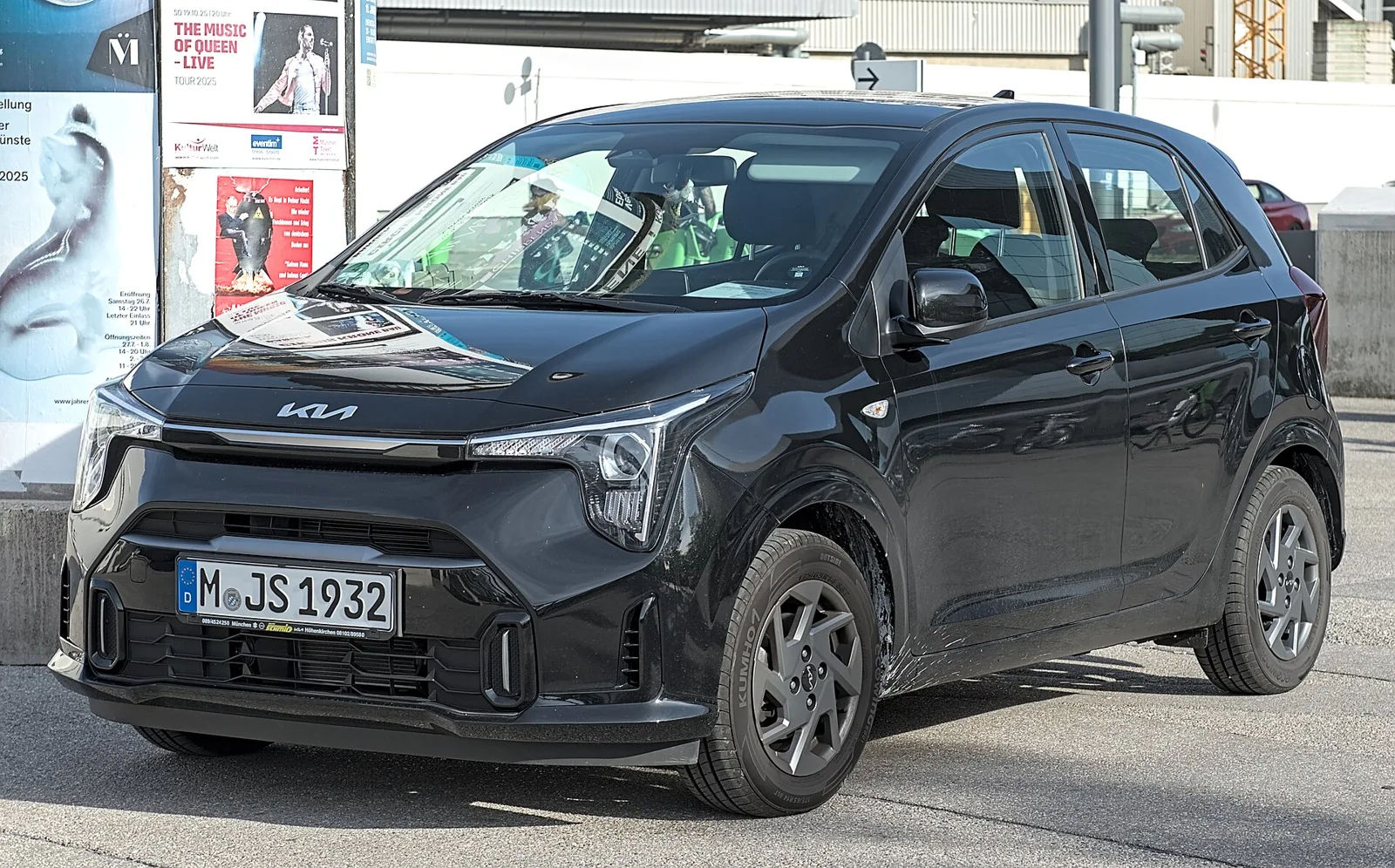
A small South Korean hatchback that became Kia's best seller in Europe, took on three generations of design and earned a place in motorsport.
Kia's Picanto first arrived in 2003 as a small hatch and found a strong following in Europe. It moved through three generations, gaining turbocharged engines, a revised safety kit and a place in regional one-make racing. Under its Morning name it remains a familiar sight in South Korea.
The Kia Picanto is a city car that Kia has produced since 2003, sold as the Morning in South Korea and several other markets. It was developed to fit South Korea's light car category, and it became the brand's best-selling vehicle in Europe in the mid-2000s. Three generations have followed, each adding technology and safety equipment to a small and affordable body.
Why is it called the Picanto and the Morning?
The name Picanto relates to the Spanish and Italian words for spicy, while the Korean Morning name may trace back to the idea of the Land of Morning Calm. That nickname for Korea dates from 1886, when a book by Percival Lowell sold strongly in the United States and helped make the country known abroad.
Kia uses different names in different places. The car was called Kia Morning in South Korea, Hong Kong, Taiwan and Chile, while in Taiwan the first generation was sold as the EuroStar. In Vietnam it became the New Morning, and in Malaysia the first car was sold as the Naza Suria or Naza Picanto.
A small city car that became Kia's best seller in Europe and carried its Morning name across three generations.
How did the first Picanto arrive?
The first generation was revealed at the 2003 Frankfurt Motor Show. It was based on a shortened platform from the Hyundai Getz, and it measured 3,495 mm (137.6 in) long as a five-door hatchback. The car was built mainly at the Donghee joint-venture plant in Seosan, South Korea.
To suit South Korea's light car category, the car stayed below 3,600 mm (141.7 in) in length and 1,600 mm (63.0 in) in width. Those limits brought tax incentives at home, which helped shape a small, efficient design from the start.
What engines did the first generation use?
The first Picanto was offered with two petrol engines, a 1.0 litre with 61 hp (45 kW; 86 Nm) and a 1.1 litre with 65 hp (48 kW; 97 Nm). Both used multi-point injection, and an automatic gearbox with a torque converter was available on the petrol units.
In Europe a 1.1 litre three-cylinder diesel was added, based on the Cerato's 1.5 litre four-cylinder unit. It used direct injection and a variable geometry turbocharger, and it produced 75 hp (55 kW) and 153 Nm of torque.
What did the first car's equipment include?
European buyers received a CD player with MP3 playback, air conditioning, electric windows and remote central locking as part of a package that was pitched for the market. The features were advertised in a short-lived campaign starring the rally driver Marcus Gronholm.
The first generation also received facelifts in 2007 and 2009. The 2007 update changed the light clusters, bumper and front grille, while the 2009 car gained a tiger nose grille. That 2009 version was not exported to Europe.
What did the second generation change?
The second generation debuted at the 2011 Geneva Motor Show. Kia's European design team in Frankfurt, under Peter Schreyer, drew the new car, and it was longer in both wheelbase and overall length than its predecessor. Europe received an exclusive three-door variant that had the same length as the five-door.
The second-generation engine range was built around a 1.0 litre three-cylinder and a 1.25 litre four-cylinder. The Europe-spec 1.25 used ecoDynamics start-stop, and a petrol and LPG version of the 1.0 was also offered. In Brazil a flex fuel version ran on petrol or ethanol.
The 2015 facelift brought redesigned bumpers and fog lamps, along with a turbocharged 1.0 litre that lifted output from 69 hp to 106 hp and met Euro 6 standards. The facelifted car debuted at the 2015 Geneva Motor Show in March and went on sale across Europe later that month.
How did the third generation handle safety?
The third generation made its global debut at the 2017 Geneva Motor Show. It used the 1.0 litre Kappa II three-cylinder in multi-point injected and turbocharged forms, and a 1.2 litre four-cylinder. Autonomous emergency braking and forward collision warning arrived with the car, alongside torque vectoring brake control and straight line stability.
The 2020 facelift updated the styling, with restyled headlights and grille, plus a 4.2-inch instrument panel and an 8-inch infotainment system with Apple CarPlay and Android Auto. A five-speed automatic replaced the older four-speed unit, and lane keeping aid and an emergency stop signal were added to the safety list.
Was the Picanto reliable?
In January 2013 the Picanto was named the most reliable car in the UK, based on data from Moneysupermarket.com and Warranty Direct. Its reliability index score was 3.00 out of 100, where a lower number means fewer problems reported by owners.
The car's sales success backed up that reputation. From 2004 to 2006 the Picanto was Kia's best-selling vehicle in Europe, accounting for a third of brand volumes during those years.
How did the Picanto perform in safety tests?
Results varied by market and by test. Global NCAP gave an African version with a driver airbag and no ABS three adult stars in 2018. Latin NCAP gave the most basic Latin American configuration zero adult stars in 2016, and a South Korean-made car tested under Latin NCAP 3.0 in 2020 also scored zero stars.
In Europe, the 2015 facelift enlarged the front discs from 241 mm (9.5 in) to 252 mm (9.9 in) for the optional brakes, which improved the car's stopping performance on the faster variants.
Did the Picanto race?
The Picanto is an official race car in Poland's Kia Platinum Cup, which began as the Kia Picanto Cup in 2006 and changed its title sponsor after 2017. The Morning also races in the Korea Speed Festival, and the Kia Picanto GT Cup was set up in Portugal in 2018.
Those series show how the small hatchback became a cheap and accessible racing entry, with one-make cups giving amateur drivers a route into competition.
Were there copies of the Picanto?
In 2015 the Chinese low-speed electric vehicle maker Yogomo released the 330 electric car, which was a near-exact copy of the second-generation Picanto. The episode became known as a Chinese copy controversy, and it showed how closely the design had been followed.
Several limited editions also stood out. The Picanto R-Cross arrived in November 2013 with a black body kit wrapped around the wheel arches, and only 500 were produced.
What are the Picanto specifications?
The table covers the core figures for each generation, including the first-generation size, the light car limits and the turbocharged 1.0 litre output. Each row names the generation or version it applies to.
| Specification | Detail |
|---|---|
| Launch | 2003, first generation revealed at Frankfurt |
| First-generation length | 3,495 mm (137.6 in), five-door hatchback |
| Light car limits | Below 3,600 mm (141.7 in) long and 1,600 mm (63.0 in) wide |
| First-generation petrol | 1.0 litre, 61 hp (45 kW; 86 Nm); 1.1 litre, 65 hp (48 kW; 97 Nm) |
| Turbo 1.0 litre after 2015 | 106 hp, up from 69 hp |
| Second-generation facelift | Front discs 252 mm (9.9 in), up from 241 mm (9.5 in) |
| UK reliability | Most reliable car in January 2013; index 3.00 out of 100 |
| Third-generation safety | Autonomous emergency braking standard |
Which engines and trims suited the Korean market?
The Morning was built to suit South Korea's light car rules, and its line-up reflected a focus on small, economical units. Korean buyers could also choose a Sport Pack, which added the three-door bumpers to the five-door body.
In 2013 the Morning in South Korea was updated with the European three-door's front and rear bumpers. A new Eco-Plus engine mated to a continuously variable transmission was offered alongside the standard 1.0 litre petrol, giving buyers an efficient option within the light car limits.
How did Kia market the Picanto?
Kia used striking promotions to sell the car. One campaign used over 900 artificial nails and 1,200 bottles of nail polish, applied over 25 days, to create animated images of the Picanto in motion. Each nail took two hours to paint.
In the UK the Picanto became the official sponsor of the ITV dating show Take Me Out, and Kia released viral videos on its YouTube channel featuring the actress Natasha Barrero. The Morning also appeared as a transforming robot, Tobot D, in the South Korean animated series Tobot.
How were the Picanto's awards and reviews?
The Picanto won several design and value awards during its early years. The second generation took the Red Dot award in 2012 and the iF product design award in 2011, while Top Gear named the car its Bargain Car of the Year in 2011.
In Scotland the car was named Best Small Car by the Association of Scottish Motoring Writers in 2011. South Africa's Standard Bank People's Wheels Award went to the Picanto three years in a row, from 2011 to 2013, and J.D. Power and Associates recognised the car in 2016.
The third generation added its own honour, with What Car? naming it Best City Car in its 2018 Car of the Year Awards.
Where else was the Picanto assembled?
Kia built the Picanto in a number of markets through local partners. In Pakistan, Lucky Motor Corporation began assembling the second generation in August 2019, which extended the model's reach beyond Korea and Europe.
The third generation reached Malaysia in January 2018, and it arrived in Indonesia in October 2019 in GT-Line and EX trims. The Indonesian car was discontinued in 2022, while the model continued to sell in other markets.
What names did the Picanto carry around the world?
The Picanto name was adapted for many markets. In New Zealand it was the Picanto 1250, in Colombia the Picanto Ion, and in Ecuador the Picanto R. Brazil used the Picanto Flex name, while Thailand sold the Picanto K1.
In Indonesia the 1.0 litre variant was sold as the Morning 1.0 to separate it from the other Picanto, and that car was sold in 2015 only. The Korean Morning also received a Sport Pack with the three-door bumpers, a detail that sets it apart from other markets.
Frequently asked questions
What is the Kia Morning?
The Kia Morning is the South Korean name for the Picanto city car. It is the name used for the Picanto in South Korea and in several other markets.
How big was the first Picanto?
The first generation measured 3,495 mm (137.6 in) long and was a five-door hatchback based on a shortened Hyundai Getz platform.
Did the Picanto sell well in Europe?
Yes. It was Kia's best-selling vehicle in Europe from 2004 to 2006, accounting for a third of brand volumes in those years.
Did the Picanto race in any series?
The car competes in one-make cups, including the Kia Platinum Cup in Poland and the GT Cup set up in Portugal in 2018.
Was there a copy of the Picanto?
Yes. The Yogomo 330 electric car from China, released in 2015, imitated the second generation very closely.
_IAA_2025_DSC_1271.jpg)