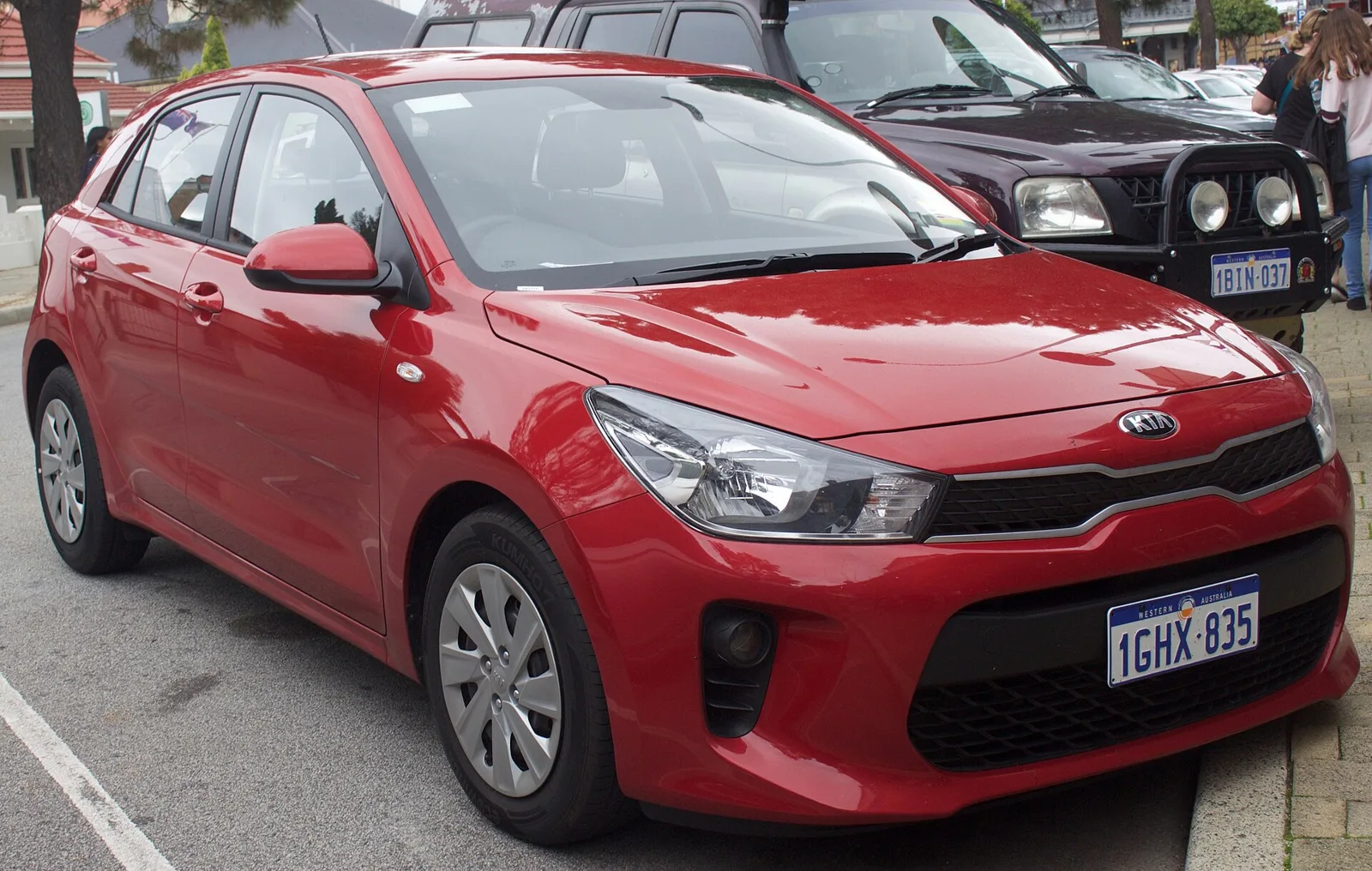
Four generations from the 1999 DC to the 2016 YB, a Russian and Chinese spin-off family, and the K3 that replaced it in 2023.
Kia's Rio was a subcompact car sold from 1999 to 2023 in hatchback and sedan forms. It replaced the Pride, later drew on a platform used by the Hyundai Accent, and was the company's top seller worldwide in 2012 and 2015 before the K3 took over.
The Kia Rio was a subcompact hatchback and sedan that Kia built from 1999 to 2023. It was Kia's best-selling model worldwide in 2012 and 2015, and the second generation shared its underpinnings with the Hyundai Accent.
What did the first Rio replace?
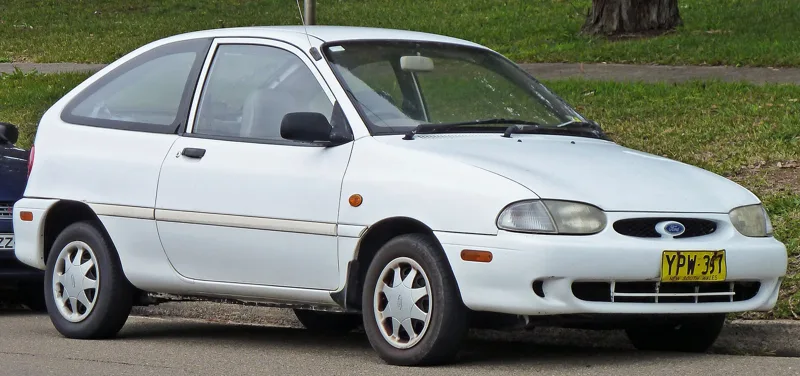
The first Rio replaced the Pride, a rebadged Ford Festiva, and the Avella, which Ford sold under its own badge in certain countries. When it launched in 1999 it was the least expensive mass-produced car sold in the United States, although critics pointed to weak build quality and a poor driving experience.
The first generation came as a four-door sedan and a five-door station wagon. The wagon was sold as the Rio Cinco in the US, the Rio RX-V in Canada and the Rio Look in Chile, while the UK only got the hatchback.
A budget subcompact that grew into one of Kia's biggest sellers worldwide, from 1999 right up to the K3.
Which engines did early Rios use?
In the United States the first generation offered a 1.5-litre DOHC four with 96 hp (72 kW) from 2001 to 2002, then a 1.6-litre DOHC four with 104 hp (78 kW) for the 2003 to 2005 model years. A five-speed manual or four-speed automatic was available throughout.
European buyers could also choose a 1.3-litre SOHC four rated at 75 hp (56 kW), and South Korean cars were tuned for local tax rules that penalised engines over 1,500 cc. Korean JIS ratings were higher, at 84 PS for the 1.3 and 108 PS for the 1.5 DOHC.
What was the Sports-Pac?
The Sports-Pac was a styling package that fitted a bonnet scoop and rear wing, gold-coloured wheels and blue paint, a look borrowed from the Subaru Impreza WRX STi. Mechanically it matched the regular models apart from lowered suspension, and it was offered as an appearance option on the first-generation car.
Safety equipment on the first car was modest. Seat belts and a driver's airbag came as standard, ABS was an option on entry models, and top trims such as the LX in the UK and the LS in Greece had it fitted as standard.
What did the 2002 redesign change?
The 2002 redesign brought a mild update to the engine, suspension and brakes for the 2003 US model year. It also refreshed the exterior and interior styling, and in South Korea the entire range became the Rio SF, with SF standing for Science Fiction and Safety First.
Iranian production by SAIPA began in 2005 and lasted until early 2012, with ABS and airbags only added late in its run. In Europe the 1.3 was uprated to 80 hp (60 kW) at 5,500 rpm, up from 75 hp (56 kW), and torque rose to 86 lb ft (117 N m) at 3,000 rpm.
How did the second generation differ?
The second generation, codenamed JB, arrived in early 2005 in Europe and for the 2006 model year in North America. It was built on a reworked platform also used by the Hyundai Accent, and it swapped the station wagon for a five-door hatchback with a 110 hp 1.6-litre DOHC Alpha II engine.
The 2006 sedan was sold as the Rio with an LX trim, and US buyers could only get the 1.6-litre petrol engine. In Europe a 1.4-litre petrol with 96 hp and a 1.5-litre turbo-diesel with 109 hp were offered, and the common-rail diesel produced 110 PS.
The Rio5 was the US hatchback, offered in SX trim, and an SX trim arrived for the sedan in 2007. For 2008 Kia added an LX trim to the Rio5 and a limited Rio5 SX Tuner edition with Falken FK452 tyres, a Tanabe strut brace and Eibach springs.
What did the 2009 model year add?
For the 2009 model year every Rio and Rio5 trim received Sirius Satellite Radio, with three months of service included, along with radios that had USB and auxiliary ports. The Rio also ranked fifth on Insure.com's list of the 20 least expensive 2009 vehicles to insure.
The 2010 model year brought a facelift with Kia's Tiger Nose grille, a steering wheel borrowed from the Soul and Forte with optional Bluetooth, and red backlit gauges. UK cars matched the US look but were hatchback-only, with 1.4-litre petrol and 1.5-litre diesel engines and a five-speed manual.
The facelifted model was never sold in Central and Southeastern Europe, reportedly because of weak sales and limited production capacity.
How safe was the second-generation Rio?
The 2006 car was rated poor to average by the Insurance Institute for Highway Safety. The 2012 model later earned marginal to good ratings from the same body, which showed a clear improvement in the years between.
Euro NCAP tested a left-hand-drive five-door hatchback from a 2005 registration. Later, Latin NCAP showed how far basic specifications could fall behind: a Korean-made sedan with no airbags, no ABS and no ESC scored zero adult stars.
What changed with the third generation?
The third generation split into two models: a global version code-named UB, and a version for Russia and China codenamed QB. The global car made its debut on 1 March 2011 in Geneva, once more built on the Hyundai Accent platform, and it was designed at Kia's studios in Irvine, California.
Its design featured sloping shoulder lines and a wedge-shaped body, with a slimmer Tiger Nose grille that joined the headlamps and a larger air intake. The wheelbase grew to 2,570 mm (101.2 in), and the three-door version, which was cheaper than the five-door, had longer doors that gave it a sportier look.
What engines and trims did the third generation offer?
The global Rio used 1.4 and 1.6-litre Gamma GDI petrol engines, and Europe added a 1.25-litre petrol plus 1.1 and 1.4-litre CRDi turbo-diesels. The 1.1-litre diesel had the lowest CO2 emissions of any non-electric or hybrid car on sale at the time of writing, at 85 g/km.
UK buyers could choose from seven trim levels over the car's life, from the basic 1 to the top-spec 4. The range started with the 2 and 3 in 2011, the 1 cost from GBP 10,695, and the 4 arrived in 2014 with a sunroof and heated steering wheel.
After the 2015 facelift the 3 and 4 gained a touchscreen with satellite navigation and a reversing camera. The engines were 1.2 and 1.4-litre petrols and 1.1 and 1.4-litre diesels, all from Kia's ECOdynamics range, with the 3 and 4 limited to the 1.4 engines.
Did Russia and China get a different Rio?
Yes. Kia developed a separate QB Rio for Russia, with production starting on 15 August 2011 at Hyundai's Saint Petersburg factory, and the hatchback following in January 2012. The car was also sold in China, badged as the Kia K2.
The fourth-generation FB Rio for Russia was unveiled in June 2017 with improved suspension and electric power steering. Its sedan was 23 mm longer than its predecessor, 40 mm wider and had a 30 mm longer wheelbase.
What did the fourth generation bring?
Kia presented the fourth-generation Rio at the 2016 Paris Motor Show, designed in its California and German studios. It was export-only, since South Korea's domestic market no longer sold the Rio, and in North America it was built alongside the Forte at Pesqueria in Mexico.
Compared with its predecessor, the hatchback grew 15 mm in length and 5 mm in width, but it lost 5 mm of height. For 2020 the 1.6-litre Gamma GDi engine was replaced by a 1,598 cc Gamma II MPi, with output falling from 130 hp (132 PS; 97 kW) to 120 hp (122 PS; 89 kW) while the EPA economy rating improved.
A facelift in May 2020 added a 1.0-litre mild-hybrid engine in Europe, and the US and Canada received their update in December 2020 for the 2021 model year.
How did the Rio's crash results look in the 2010s?
Latin NCAP tested a Korean-made basic sedan with no airbags, ABS or ESC in 2017 and awarded it 0 stars for adults and 1 star for toddlers. A later New Rio Sedan with one airbag received 2 stars for adults and 2 stars for toddlers in August 2017.
The IIHS later gave the 2018 sedan in its top trim the Top Safety Pick+ award. The fourth generation also offered optional rear disc brakes, and Euro NCAP tested a standard-equipment hatchback from a 2017 registration.
What were the Rio's design and crossover variants?
The fourth-generation Rio collected two 2017 design prizes: the Red Dot Award for passenger cars and the iF Design Award. A rugged crossover version was sold in Colombia as the Kia Tonic, and in Panama and Peru as the Rio Cross.
In Russia the crossover-styled Rio X-Line arrived in October 2017, with 10 mm more ground clearance and unpainted plastic cladding. Sales began on 14 November 2017, and in China the KX Cross, shown at Auto Shanghai in 2017, was 30 mm wider and 40 mm longer than the standard hatchback.
What replaced the Rio?
The K3 replaced the Rio in August 2023 in several markets, including Mexico and the GCC countries. The name had earlier belonged to the Forte and Cerato, a segment above the Rio, which the K4 succeeded in 2024.
Almost half a million annual sales flowed from the model, which made it a volume pillar for Kia. Its successor, the K3, took over that role in this class.
Why did the UK Rio have so many trims?
The UK Rio ran through seven trim levels over its life, which let Kia cover budget buyers and those who wanted features such as navigation and a leather steering wheel. The range moved from the basic 1 to the top-spec 4 as the car matured.
Trim names such as the VR7 and SR7 were special editions built on the 1 Air, with 15-inch alloy wheels, rear parking sensors and a leather steering wheel. The SR7 name arrived with the 2015 facelift, and its yellow zest colour was exclusive to that trim.
The 2 gained 16-inch alloy wheels, front fog lights and heated power-folding mirrors over the VR7, though it lacked parking sensors among its standard equipment.
Sales of the Rio in its later years were supported by its place in Kia's global range, where the fourth generation became an export-only model for markets outside South Korea.
How do the generations compare?
The table sets out each generation with its codename, launch point and the detail that most separates it from the one before. Figures for the US and Europe are given where they differ, since the same generation was often sold with different engines.
| Generation | Codename | Launch | Key point |
|---|---|---|---|
| First | DC | 1999 | Sedan and five-door wagon; least expensive mass-produced US car at launch |
| Second | JB | 2005 (Europe), 2006 (North America) | 110 hp 1.6-litre DOHC Alpha II on the Accent platform |
| Third | UB and QB | 1 March 2011 (global) | Wheelbase of 2,570 mm (101.2 in) |
| Fourth | YB and SC | 2016 (Paris show) | Export-only global model |
| Successor | K3 | August 2023 | Replaced the Rio in several markets |
_S_5-door_hatchback_(2017-07-15)_01.jpg)