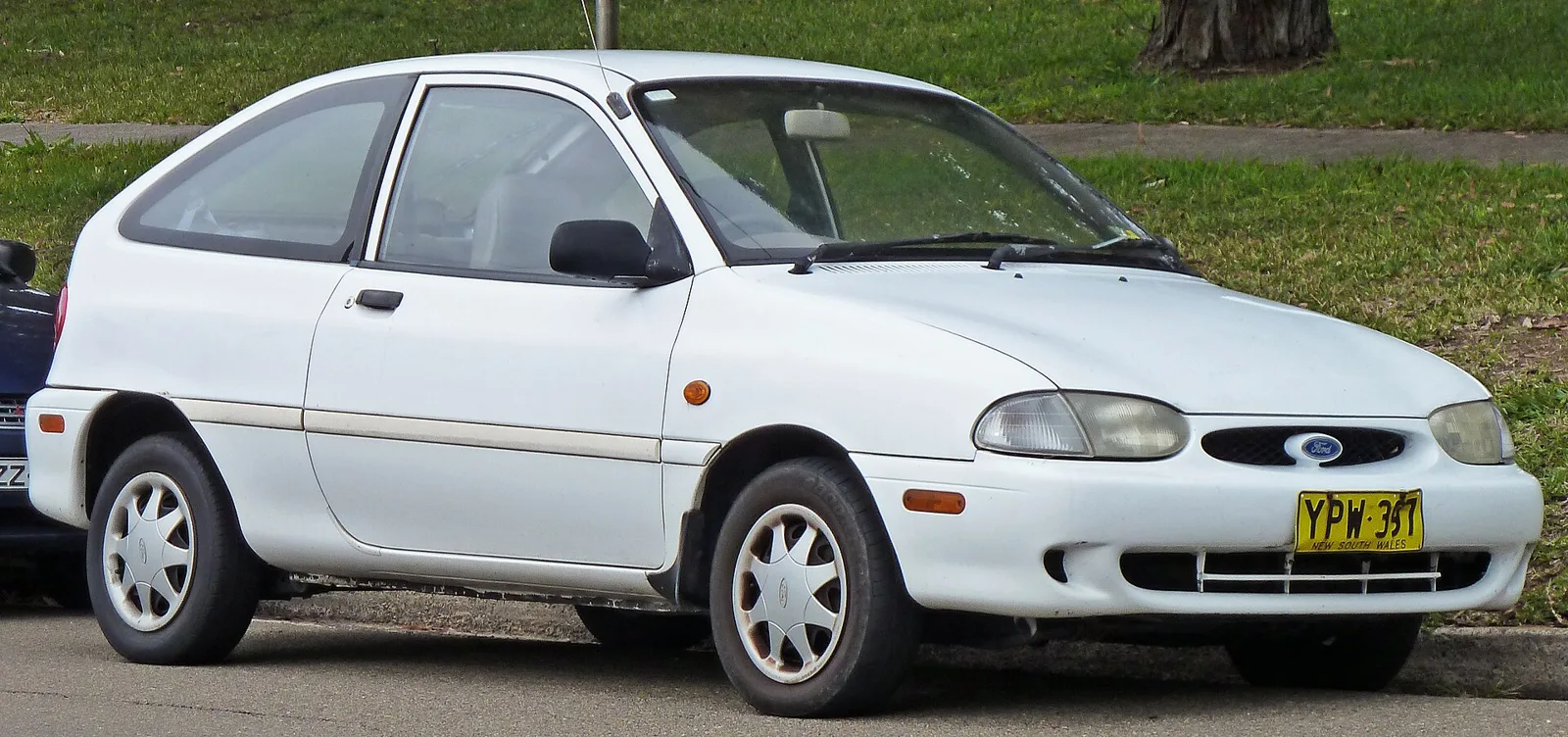
A small front-drive hatchback from Japan in 1986, built by Kia in South Korea and sold as the Mazda 121, Kia Pride, Ford Aspire and Kia Avella.
The Ford Festiva was a Mazda-designed subcompact built by Kia in South Korea and marketed by Ford from 1986 until 2002. Its generations appeared under several names, including Mazda 121, Kia Pride, Ford Aspire and Kia Avella, and sales reached about 350,000 in America.
The Ford Festiva was a small front-drive hatchback designed by Mazda and built by Kia in South Korea, sold under Ford's name in Japan and other markets. It spanned three generations between 1986 and 2002. Its design also reached buyers wearing Kia and Mazda badges, which made the family hard to follow across markets.
Where did the Ford Festiva come from?
Mazda designed and engineered the Festiva at the request of Ford, and the three-door hatchback launched in Japan in February 1986. Kia built the first generation in South Korea under licence, and it was sold as the Mazda 121 in Australia and Europe.
The Festiva used front-wheel drive, with rack and pinion steering and independent front struts on coil springs and a sway bar. At the rear sat a torsion beam. Launch models came in L, L Special, S, Ghia and Canvas Top specification, and Ford sold the Japanese cars through its Autorama dealer network.
Mazda also showed sporty GT and GT-X models at the 1986 Tokyo Motor Show. These had a body kit, a prominent bonnet bulge and a twin-cam 1.3-litre engine, and they went on sale on 1 December 1986. The Festiva Cargo L commercial version was added to the range in the same year.
The Festiva was facelifted in 1989 with a new grille insert and tail lamp lenses. Beginning that year, Autorama also sold left-hand drive five-door hatchbacks built in Korea, but Japanese buyers were not keen. Only 973 cars arrived during 1989, against a target of 2,000 for the following year. Japanese production ended in December 1992.
A Mazda design that Kia built and Ford sold under several names, from a small front-drive hatchback to a Japanese Demio.
What engines did the Festiva use?
The earliest cars used 1.1-litre and 1.3-litre engines, and the second generation ran a 1.3-litre B3 with 73 PS (54 kW; 72 hp). Japanese cars received a 1.5-litre B5 with 100 PS (74 kW; 99 hp), and some versions had a DOHC head.
The B3 was an 8-valve inline-four with fuel injection, producing 100 Nm (74 lb ft) of torque at 3,000 rpm. The B5 was a 16-valve unit that made 88 PS (65 kW; 87 hp) and 134 Nm (99 lb ft) at 4,000 rpm in Asia and Oceania. Japanese B3 cars were tuned to 76 PS (56 kW; 75 hp), so the range had several power levels.
Five-speed manuals were the core transmission, and a three-speed automatic was offered in the United States and Australia. The Ford Aspire's automatic version was noticeably slower than its manual, which is discussed in the Aspire section below.
What was the Kia Pride?
The Kia Pride was Kia's badge for the first-generation Festiva, built in South Korea from March 1987 until January 2000. It came as a sedan, hatchback, wagon and van, and it was sold in the UK from June 1991 with 1.1-litre and 1.3-litre engines.
The five-door hatchback joined the range in June 1988, and the four-door sedan, called the Pride Beta, arrived in November 1990. A van and a five-door wagon followed in February 1992, completing the line-up. In Japan, Korean-built five-door and sedan bodies went on sale as the Ford Festiva 5 and Festiva Beta.
In November 1993 production of the Pride moved to Kia's Asia Motors subsidiary plant in Gwangju, as Kia concentrated on its new Avella. Before late 1990, Kia-badged cars reached only a few smaller export markets.
The Pride was also assembled in Pakistan by Dewan Motors, first as a five-door with the 1.1-litre engine and later as a four-door sedan called the Kia Classic. In Iran, SAIPA built the Pride under licence and sold it in several body styles, and in China Jiangsu Yueda began assembly in 1997.
What changed in the second generation?
The second generation arrived in 1993 as a slightly longer, wider and more aerodynamic car, keeping most of the drivetrain but gaining a rounder body. It was sold as the Ford Aspire in North America, where five-door models appeared for the first time, and as the Kia Avella in South Korea.
Depending on the market, some cars kept the single-overhead-cam throttle-body engine, while others received a DOHC head with multi-point injection designed by Mazda. The 1.3-litre B3 and 1.5-litre B5 were offered in different markets, and the sedan was mainly restricted to South Korea.
A 1997 facelift added an oval grille and reshaped headlamps. Kia then developed the Rio on its own, which ended the Ford relationship. The second generation stayed on sale in Australia until 2000, when the Ford Ka took its place.
What was the Ford Aspire?
Ford's Aspire took over from the Festiva in North America between 1994 and 1997. Dual airbags came as standard, and anti-lock brakes were optional. It was offered as a three-door and a five-door hatchback, with an SE trim available on the three-door.
The SE model had a sporting package with fog lights, a rear spoiler, alloy wheels, a blue-faced instrument cluster with a tachometer, and upgraded interior trim. Slow sales led Ford to drop the SE after 1995, along with its optional equipment. The base car also lost its alloy wheels and rear wiper.
Automatic versions reached 0-60 mph in 16.2 seconds, which made them slower than the manual. The 1997 facelift brought new bumpers, a new radio and new seat facings, but the Aspire was discontinued that year due to slow sales.
What was the Kia Avella?
The Kia Avella was the South Korean version of the second-generation Festiva from March 1994, sold as a sedan and as three- and five-door hatchbacks. Sales totalled 115,576 between 1994 and 1995, then fell to 27,850 in 1998. The model was discontinued in 1999, though some export production ran until 2000.
The name was a made-up word that blended the Latin aveo, meaning desire, with the Spanish ella, meaning she, to suggest a phrase close to I want her. South Korean buyers tended to prefer sedans over hatchbacks, so the Avella was mainly built for export markets carrying Ford badging.
Standard Avellas came with a four-speaker stereo, heated rear glass, anti-lock brakes, a driver's airbag and door impact beams. It was the first Korean-built car in its segment with twin airbags and ABS brakes. The standard engine was the 73 PS 1.3-litre Mazda B3, while higher trims could have the DOHC 1.5-litre engine.
The top DOHC engine, rated 105 PS (77 kW), went only into the four-door Avella Delta, which had a reworked nose. Five-speed manuals and three- or four-speed automatics were offered across the range.
What was the Festiva Shogun?
The Festiva Shogun was a 1990 performance conversion built by racer Rick Titus and engineer Chuck Beck. It used a mid-mounted Yamaha V6 from the Taurus SHO, producing 220 hp (164 kW). Special Editions, Inc. planned 250 cars, but only seven were built, plus the prototype.
Ford displayed the car at the 1990 Monterey Historics in its own tent and weighed supplying SHO engines itself. The deal fell through after executives drove the car and judged it too raucous for the company to endorse. Without official Ford backing, Special Editions bought SHO engines from dealers, which raised the price by more than ten percent.
A cancelled Japanese order and the slowdown during the first Gulf War finished the project. The Shogun remains a curiosity rather than a production model.
How did the Festiva fare in safety ratings?
The 2008 Used Car Safety Ratings from Monash University gave the first generation two out of five stars, placing it in the worse-than-average band among light cars. The second generation also received two stars in 2008, but the 2010 edition cut it to one star.
The ratings did not look only at the occupants. Cyclists, pedestrians and other motorists were counted too, so the score reflected wider community effects.
The comparison group was other light cars of the period, so the rating reflected how the Festiva measured against its class.
How many Festivas were sold?
The first generation reached sales of 350,000 in America over its life, and Kia-built Festivas were marketed widely in the United States. Kia's strategy was to fill the low-cost end of the market that Japanese brands were leaving, and its lower-paid South Korean workforce made its cars cheaper than rivals.
Kia Avella sales totalled 115,576 between 1994 and 1995, but dropped to 27,850 in 1998. The Kia Rio replaced the Pride and Avella in 1999, which closed the chapter for both of them.
The third generation was sold in Japan, where production continued until Mazda ended the equivalent Demio in 2002.
What was the third generation?
The third generation replaced the second-generation Festiva in Japan in 1996 as a badge-engineered Mazda Demio, sold as the Ford Festiva Mini Wagon. It was a single five-door hatchback offered with a 1.3-litre or 1.5-litre engine, and buyers could pick a five-speed manual or an automatic with three or four ratios.
Within Japan the car was the only Festiva on sale after 1996, and it carried the Mazda Demio body and much of its engineering. Ford did not offer it under its own badge in other markets, and the model was built until 2002.
What were the Ford Festiva specifications?
The table covers the Festiva's main figures across its generations and related models. Values differ between markets and engines, so each row marks which version a figure applies to rather than blending them together. Engine data for the first and second generations is kept apart, and sales and safety data sit alongside.
| Specification | Detail |
|---|---|
| Type | Front-drive subcompact hatchback |
| Launch | Japan, February 1986 |
| First-generation engines | 1.1-litre and 1.3-litre (B3) |
| B3 engine | 1.3-litre (1,323 cc), 8-valve inline-four, 73 PS (54 kW; 72 hp) |
| B5 engine | 1.5-litre (1,498 cc), 16-valve, 88 PS (65 kW; 87 hp) |
| Japanese B5 output | 100 PS (74 kW; 99 hp) |
| Torque | B3 100 Nm (74 lb ft) at 3,000 rpm; B5 134 Nm (99 lb ft) at 4,000 rpm |
| Transmission | Five-speed manual; three-speed automatic in Australia and the US |
| Aspire automatic | 0-60 mph in 16.2 seconds |
| Kia Pride production | South Korea, March 1987 to January 2000 |
| Sales | About 350,000 first-generation Festivas in America |
| Safety | Monash UCSR 2008: two out of five stars |
| Festiva Shogun | 220 hp (164 kW) Yamaha V6; seven built plus the prototype |
The table keeps market-specific values apart, so the Japanese and export figures never blend into one another.
Frequently asked questions
Was the Festiva sold in Japan?
Yes. Ford sold it there from February 1986 through Autorama dealers, and Japanese production ended in December 1992. Left-hand drive five-door hatchbacks from Korea arrived in 1989, with 973 cars in that year.
Did Australia receive the Festiva?
Yes, in two forms. Mazda sold the 121 from March 1987 as a three-door, and Ford Australia later imported the Kia-built Festiva from October 1991. Australian cars used the 1.3-litre B3 with a five-speed manual, and the Festiva was discontinued there in 1994.
Did the Festiva have an automatic gearbox?
Yes. Australian and US cars could be specified with a three-speed automatic, and some Japanese-market models offered a four-speed. Automatic Aspires took 16.2 seconds to reach 0-60 mph, a slower time than the manual.
Where was the Festiva assembled outside South Korea?
Taiwan assembled it from 1989 through a local joint venture, and Pakistan assembled the Pride from 1996 to 2005 with Dewan Motors. Iran's SAIPA built Pride-based cars under licence, and China began assembling the Pride in 1997.
_Trio_3-door_hatchback_(2010-07-19).jpg)