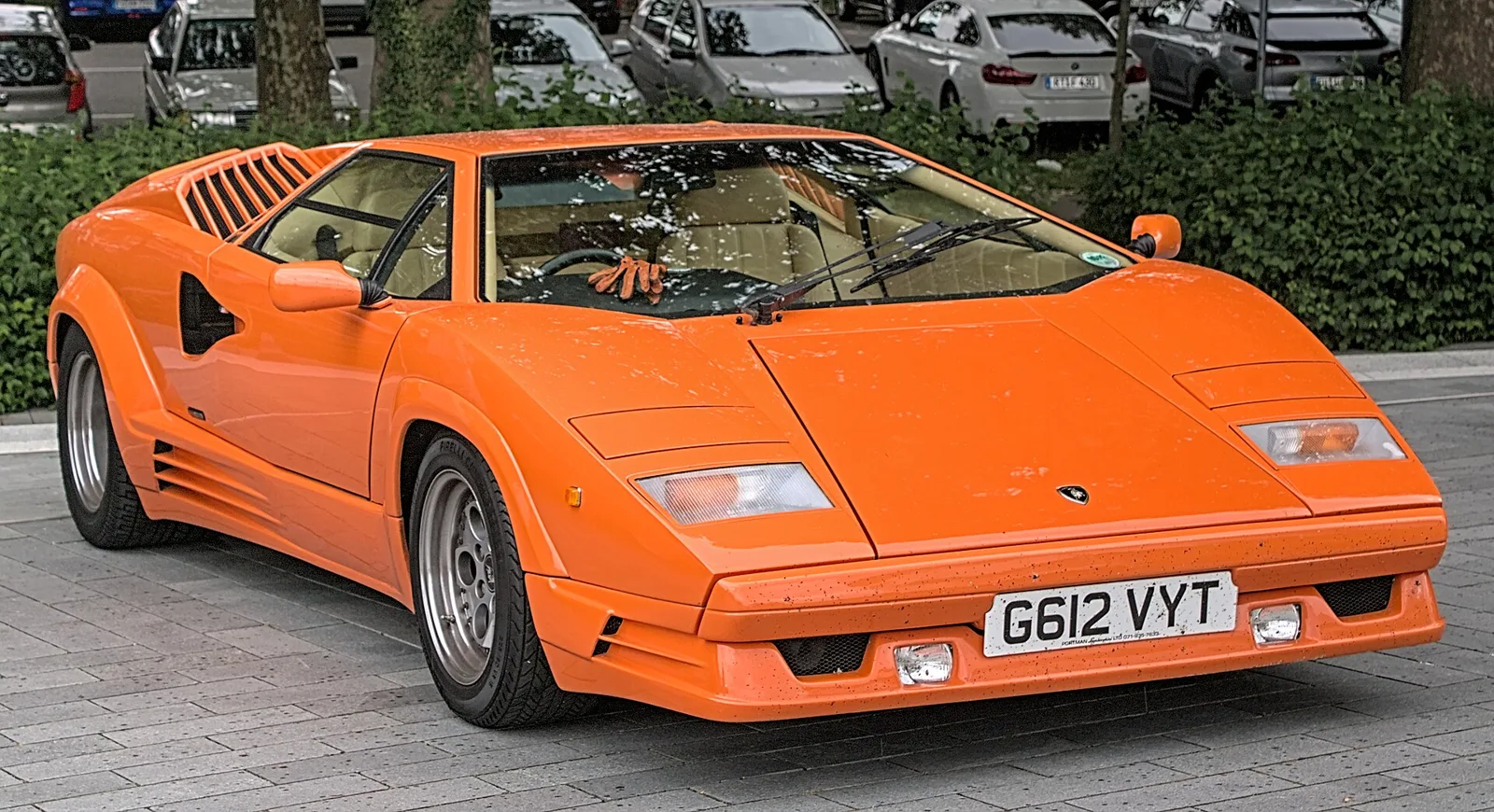
A rear mid-engined V12 with scissor doors, built from 1974 to 1990 and styled by Marcello Gandini at Bertone.
Built by Lamborghini between 1974 and 1990, the Countach was a V12 supercar with its engine mounted behind the cockpit. Marcello Gandini styled it at Bertone, and 1,983 cars were built across its 16-year life. The name later returned on a hybrid.
The Lamborghini Countach was a rear mid-engined, rear-wheel-drive sports car built by Lamborghini from 1974 to 1990. Its sharply angled body, drawn by Marcello Gandini at Bertone, set the template for a generation of supercars. This profile covers the car's origins, engineering, production story and the special versions that followed.
Few cars have made as strong a visual statement as the Countach, and few have been as demanding to live with. Its story is one of brilliant design colliding with practical limits, a theme that runs through its whole life.
What was the Lamborghini Countach?
The Countach was a rear mid-engined sports car from Lamborghini, produced from 1974 to 1990 with a V12 mounted longitudinally. It was styled by Marcello Gandini at Bertone and became one of the defining wedge-shaped supercars. A total of 1,983 cars were built during its 16-year lifetime.
The name came from contacc, a Piedmontese exclamation of astonishment. It broke with Lamborghini's habit of naming its cars after bulls and bullfighting, which had marked the earlier models. The LP code also has a meaning: LP stands for longitudinale posteriore, or longitudinal rear, which described the engine position shared by every Countach.
A wedge-shaped V12 with scissor doors, the Countach set the look that every later supercar was measured against.
Where did the Countach come from?
Development began as a successor to the Miura, which had been widely acclaimed when it arrived. Ferruccio Lamborghini started the project, and chief engineer Paolo Stanzani led the work under the project name LP112. Test driver Bob Wallace joined the core team, and the work brought together mechanical and styling talent in one small group.
Stanzani's team was given room to push boundaries. The resulting car kept the Miura's rear mid-engine, rear-wheel-drive layout but aimed at high-speed stability and easier access, addressing flaws that had shown up in the earlier design.
The prototype was first shown as the LP500 at the 1971 Geneva Motor Show. A lengthy refinement process then produced the production LP400, which debuted in 1974 and set the shape for everything that followed.
How was the Countach styled?
Marcello Gandini styled the Countach at Bertone, building on a series of wedge concepts for Lamborghini, Alfa Romeo and Lancia. The Lancia Stratos Zero of 1970 introduced the wedge idea to the public, and Gandini pushed it into a production shape with trapezoidal details throughout the body.
The LP500 prototype was wide and very low, and it carried no bumpers, spoilers or mirrors. Its dimensions were 185 cm (73 in) wide, 103 cm (41 in) tall and 401 cm (158 in) long, a footprint that made it look more like a concept than a road car.
The production LP400 grew slightly, to 189 cm (74 in) wide and 414 cm (163 in) long. The body gained NACA ducts and a shallower nose, and the headlights sat in retractable housings that flipped down when not in use.
Visibility was a problem from the start. A periscope rear-view mirror, developed by Donnelly Mirrors for an earlier project, gave the driver a view of what lay behind the car on the LP400.
How did the Countach's engine and chassis work?
The Countach used a longitudinally mounted V12, a layout that was a first for a road-going V12. The engine drove a five-speed manual gearbox with Porsche-type synchromesh, and the arrangement placed the mass of the drivetrain close to the centre of the car.
The V12 had been designed in 1963 by Giotto Bizzarrini and was used in several Lamborghinis before the Countach. Its 60 degree bank angle was carried over from the earlier cars, and the original 3.9-litre unit was rated at 276 kW (375 PS; 370 hp) at 8,000 rpm in the LP400.
Engineers wanted more power than the Miura SV's 279 kW (379 PS; 374 hp), so they explored a 5-litre version. A test engine self-destructed in a 1971 road test, and production cars kept the 3.9-litre unit for the LP400.
The LP400 used a full space frame of round steel tubing, with 30 mm, 25 mm and 15 mm members. The frame weighed 90 kg (198 lb), lighter than the 107 kg (236 lb) prototype chassis but heavier than the 75 kg (165 lb) Miura frame. Marchesi of Modena built the chassis.
Why are the scissor doors so famous?
The scissor doors were the car's most famous feature. They first appeared on the 1968 Alfa Romeo Carabo, and on the Countach they lifted up and forward on gas struts. The design made entry easier in a low, wide car and gave the car a dramatic silhouette.
The wedge body had a cost. Rearward visibility was poor, and the periscope mirror reflected that compromise. Lamborghini engineers considered ways to make the doors easier to remove after a rollover, but none reached production.
Owners adapted to the car in their own ways. The wide sills and low seating made the car a challenge to enter in tight spaces, and many drivers developed their own methods for parking and getting out of the car.
How many Countachs were built, and in which versions?
Production reached 1,983 cars over the run. The LP400 production car ran from 1974 to 1978, and the series of changes that followed shaped the car's later identity.
The LP400 S, introduced in 1978, brought 345/35R15 Pirelli P7 tyres and fibreglass wheel arch extensions. Its three series counted 50, 105 and 82 cars, and an optional V-shaped rear wing became a popular choice with owners.
The LP500 S of 1982 used a 4,754 cc (4.8 L) engine with 276 kW (375 PS; 370 hp). Only 321 cars were built. The 5000 QV, introduced in 1985, was bored and stroked to 5,167 cc (5.2 L) with four valves per cylinder, and 610 cars were built in that specification, with 66 of them fuel injected.
What was the 25th Anniversary Edition?
The 25th Anniversary Edition marked Lamborghini's 25th year, and it reworked the body and engine bay around the 5000 QV's mechanics. Its restyling reshaped the rear intakes and bumper, and it looked more refined than the earlier cars.
The anniversary car accelerated from 0-97 km/h (0-60 mph) in 4.7 seconds and reached a top speed of 295 km/h (183 mph). That combination made it one of the quickest Countachs of its period, and it is often cited as the most refined of the breed.
Which special versions and one-offs were built?
Walter Wolf, a wealthy businessman and owner of a Formula One team, commissioned a special version. Dallara modified an LP400 into the Walter Wolf Special, whose engine generated 333 kW (453 PS; 447 hp) at 7,900 rpm.
The Countach Turbo S was a twin-turbo version developed for a distributor. It reached 0-100 km/h in 3.7 seconds and a top speed of 335 km/h (208 mph), and the LP500 S twin turbo weighed 1,515 kg (3,340 lb).
The Countach QVX was a Group C racer built in 1985 with a 5.7-litre engine. Formula One also used the Countach as its safety car between 1980 and 1983, giving it a public role at the Monaco Grand Prix.
The Countach Evoluzione was a one-off testbed with composite panels. It weighed about 397 kg (876 lb) less than the QV and reached 0-97 km/h in about 4 seconds, showing how far Lamborghini could push the car's weight and structure.
What are the Lamborghini Countach specifications?
The table covers the production LP400 and the late 5000 QV, with the special versions noted where they differ. Each row names the variant or era, so the 3.9-litre engine of the early car stays separate from the 5.2-litre engine of the late model.
| Specification | Detail |
|---|---|
| Production | 1974 to 1990, 1,983 cars |
| Designer | Marcello Gandini at Bertone |
| LP400 engine | 3.9-litre V12, 276 kW (375 PS; 370 hp) at 8,000 rpm |
| LP400 production | 157 built by 1978 |
| LP500 S engine | 4,754 cc (4.8 L), 276 kW (375 PS; 370 hp) |
| 5000 QV engine | 5,167 cc (5.2 L), four valves per cylinder |
| Carbureted QV | 335 kW (455 PS; 449 hp) at 7,000 rpm |
| Fuel-injected QV | 313 kW (426 PS; 420 hp) |
| Miura SV comparison | 279 kW (379 PS; 374 hp) |
| Chassis | Full space frame, 90 kg (198 lb) |
| 25th Anniversary | 0-97 km/h in 4.7 seconds; 295 km/h (183 mph) |
Taken together, the figures show steady growth in displacement and power across the life of the car, from the first 3.9-litre engine to the 5.2-litre QV.
How did the Countach reach the American market?
The Countach was never built to US standards at the factory. Owners imported and modified the cars themselves during the grey market era, which ran from 1976 to 1988 and reached 66,900 vehicles in 1985.
In 1985 the 5000 QV became the first US-specification model built by the factory, with larger bumpers and Bosch K-Jetronic fuel injection. Federal law also exempts vehicles older than 25 years from design, safety and emission rules, so original cars can be imported and registered for road use in states that permit it.
Why does the Countach still matter to car design?
The Countach fixed a visual language for supercars: a low wedge, a hard-edged profile and an engine placed behind the driver. Many later designs borrowed those cues in every generation of supercar design that followed, which is why the car remains a reference point.
Its engineering mattered as well. The space frame, the longitudinal V12 and the scissor doors each showed how far a road car could be pushed in its era, even when the result was difficult to live with day to day.
That tension between design ambition and everyday usability is why the Countach remains a favourite among collectors, who tend to value its drama more than its practicality. Few cars of the period still provoke such an immediate reaction from a crowd.
Restorers and enthusiasts have kept the cars running, and recreations such as the LP500 prototype rebuilt by the factory's own restoration division show how strong the appetite for the car remains today. The car's shape also reads as clearly in photographs as it did on the show stands.
The Countach's influence also reached beyond its own era. Its wedge shape and scissor doors became shorthand for the supercar, and that cultural reach has kept the name in circulation for decades.
Frequently asked questions
How many Countachs were made?
A total of 1,983 examples were made, from the first LP400 in 1974 to the last cars of 1990.
Did the Countach sell in the United States?
Yes, mostly through the grey market, which peaked at 66,900 vehicles in 1985. The 5000 QV was the first factory model built to US rules.
Can an original Countach be imported to the US?
Yes. Vehicles older than 25 years are exempt from federal design, safety and emission rules, so an original Countach can be imported and registered for unrestricted road use in permitting states.
Was the name ever revived?
Yes. The LPI 800-4 used the name in 2021 as a limited-production hybrid with a naturally aspirated 6.5-litre V12 and a 48-volt motor.