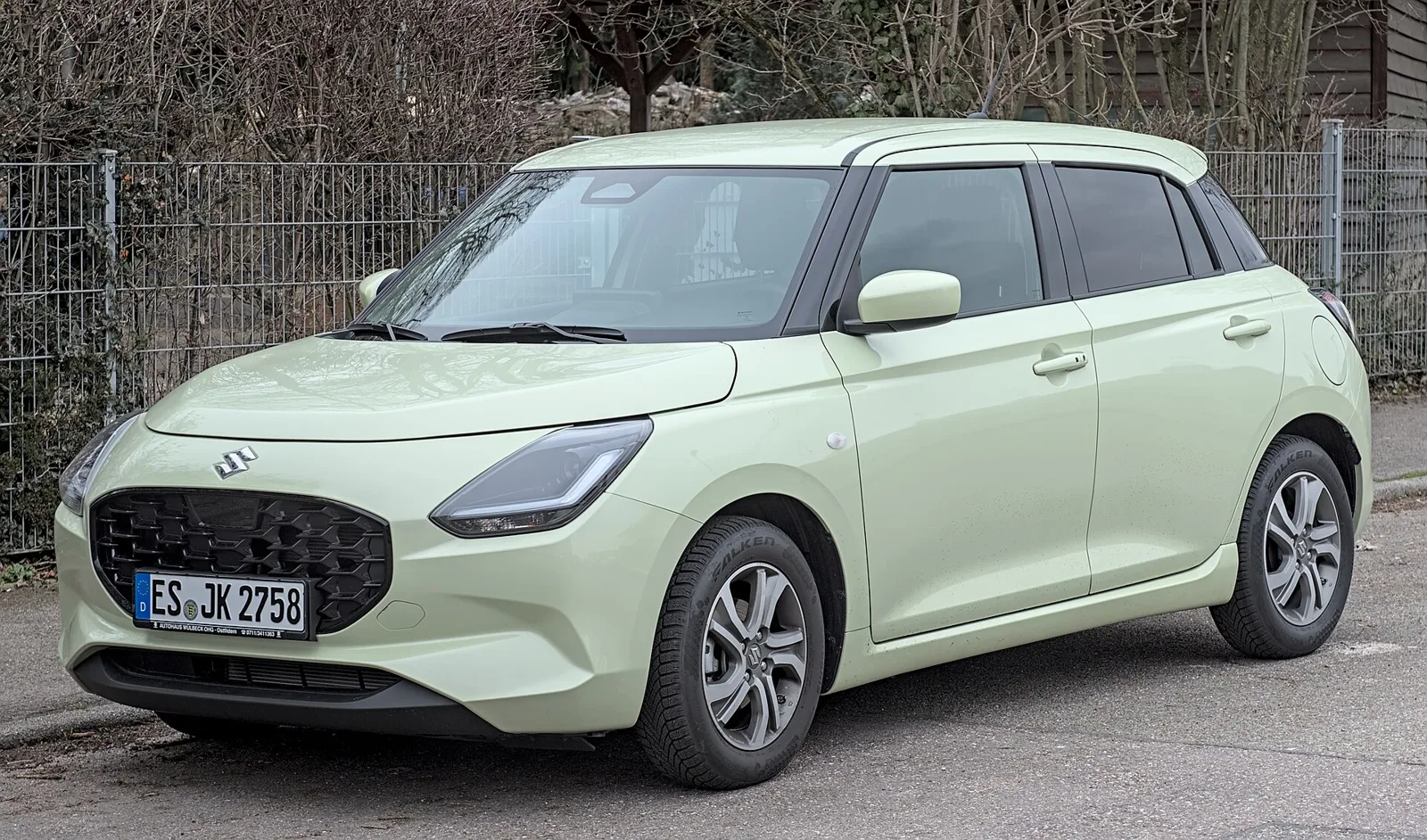
Five generations of a small hatchback that began as a 1984 export name, became a sporty global model in 2004 and has sold 10 million units.
The Suzuki Swift is a B-segment supermini that became its own global model in 2004 after years as the Cultus export name. Five generations later it has sold 10 million units, with India taking about 60 percent. Its Swift Sport variants won rallies and class races.
The Suzuki Swift is a supermini, the small B-segment hatchback that Suzuki has sold since 1983 under a series of names. It became its own global model in 2004, and it has now sold 10 million units across 170 countries. Its biggest market is India, which takes most of the car's sales.
The Swift has been a reliable seller partly because it changed with each generation without losing its core idea. Its sporty Swift Sport versions gave it a hot-hatch edge, while the mainstream cars concentrated on economy and value.
Where did the Suzuki Swift come from?
The Swift nameplate started in 1984 as an export name for the Suzuki Cultus, a supermini built across two generations and three body styles. The Cultus was sold with the Suzuki G engine family and under many names, including Suzuki SA310, Forsa, Chevrolet Swift and Geo Metro.
In Japan the Swift name arrived in 2000 to replace the Cultus. Outside Japan the same car was sold as the Suzuki Ignis. The Japanese cars used the M family of inline-four engines in 1.3 and 1.5-litre sizes, and both three- and five-door bodies were offered.
The Swift became its own model with the global launch in 2004. Suzuki positioned it between the Ignis and the Baleno in its hatchback line, and it has stayed there through each generation since.
A supermini that began as an export name for the Cultus and grew into 10 million sales, with a Sport badge that won rallies.
How did the first-generation Swift launch?
The global Swift made its debut at the Paris Motor Show in September 2004, after its design had been previewed on the Concept S and Concept S2 concept cars. This generation marked a clear break with the Cultus-based models, moving the Swift away from the low-price alternative image.
The chassis was refined through a road-testing programme across Europe, and the car was aimed at European buyers in particular. Its global launch in 2005 was fronted by the footballer Cristiano Ronaldo in many European countries, and sales ran above forecast in most markets.
The first generation was built in several countries. Production took place in Hungary, India, Indonesia, Japan, Pakistan and by Changan Suzuki in China. In India the Maruti Suzuki Swift launched on 25 May 2005, and Changan Suzuki began production in Chongqing from July 2005.
The Swift was offered with 1.3 and 1.5-litre petrol engines in its early form. The 1.3 produced 91 PS (67 kW; 90 bhp), and the 1.5 ranged from 102 to 110 PS. A 1.25-litre diesel supplied by Fiat was also offered in Europe, and four-wheel drive was an option on the petrol cars.
What made the Swift Sport special?
The Swift Sport arrived in Japan in September 2005, and reached most European markets in September 2006. Its engine was an enhanced M16A, a high-revving 1.6-litre naturally aspirated DOHC four with an 11.1:1 compression ratio and chain-driven high-lift cams.
That engine produced 92 kW, or 123 bhp (125 PS), and 148 Nm (109 lb ft) of torque. The car was 70 mm (2.8 in) longer than the standard Swift, with sportier bumpers, a stiffer suspension, twin exhaust pipes and red sport seats, with Recaro seats optional.
The European Swift Sport used a five-speed manual, the three-door body and electronic stability control. Its wheels were 17 inches, with 16-inch wheels also available. In 2008 the car was revised with a shorter final drive ratio and a higher redline, which made acceleration sharper.
Special editions followed. In July 2008 Suzuki Germany launched a limited N'Style Rally edition to pay tribute to its Group N Junior World Rally Championship car, limited to 500 units and finished in black with Suzuki Motorsport decals.
What changed in the second-generation Swift?
The second generation was unveiled on 25 March 2010 and went on sale in Japan on 18 September 2010. Production at Suzuki's plant in Hungary started on 11 June 2010 to supply the European market. The wheelbase was extended by 50 mm (2.0 in), and the look was an evolution of the first car's bold styling.
The new car arrived in Britain in September 2010 and in India in 2011. Its engines included a 1.25-litre VVT petrol and a 1.4-litre VVT unit in some countries,. A later Japanese update introduced Suzuki's Dualjet engine, which channels fuel to two intake ports per cylinder.
The second-generation Swift Sport was previewed as the S-Concept at the 2011 Australian International Motor Show. Its revised 1.6-litre four produced 100 kW (134 bhp), and the 2012 model offered a six-speed manual or a CVT with paddle shifters. A limited SZ-R edition of 100 units went on sale in the UK.
Production was also set up in Thailand, where the car became part of the eco-car programme and was built locally from March 2012. It was later sold in Indonesia from September 2012 and in Malaysia from January 2013, each with its own trim structure and special editions.
What did the third-generation Swift bring?
The third generation debuted in Japan on 27 December 2016. It was built on the HEARTECT lightweight platform, which had appeared in 2015 and was also used by the Baleno and Ignis. The new platform made the car roughly 10 percent lighter than its predecessor, even though it was 40 mm wider.
The hatchback arrived as a five-door, with the rear door handles moved to the C-pillar to give the look of a three-door. Boot space rose by about 20 percent to 246 litres, growing to 579 litres with the rear seats folded. Compared with rivals, the car still offered less room.
This generation was the first to use Suzuki's Boosterjet direct-injection turbocharged petrol engines and its Smart Hybrid Vehicle mild-hybrid technology. The 12-volt and 48-volt systems used a belt-driven starter generator to assist the engine and recover energy under braking.
The Swift Sport version came with a 1.4-litre Boosterjet turbo, unveiled at the 2017 Frankfurt Motor Show. Its 103 kW (138 bhp) output and 230 Nm (170 lb ft) of torque were enough for a sharp hot hatch. In June 2020 a mild-hybrid version followed for European buyers to meet Euro 6d standards.
The Swift was given a facelift in May 2020 for Japan and in September 2020 for Europe. The changes covered the grille, alloy wheels and two-tone colours. The 12-volt mild hybrid also received a bigger battery to improve energy recovery.
What is the fourth-generation Swift like?
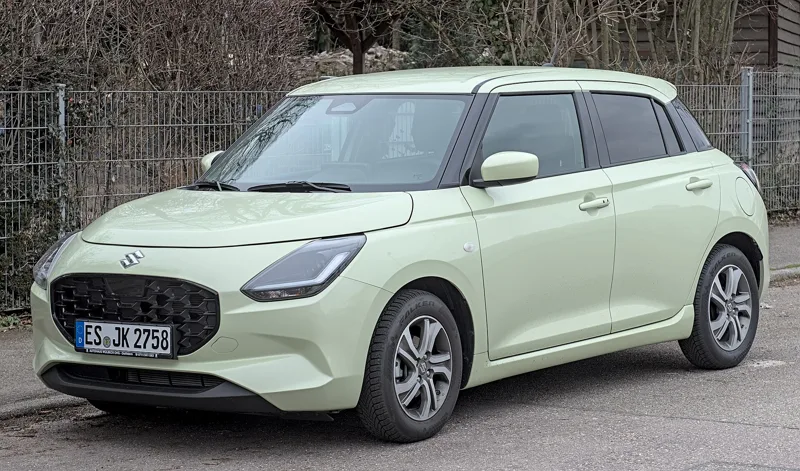
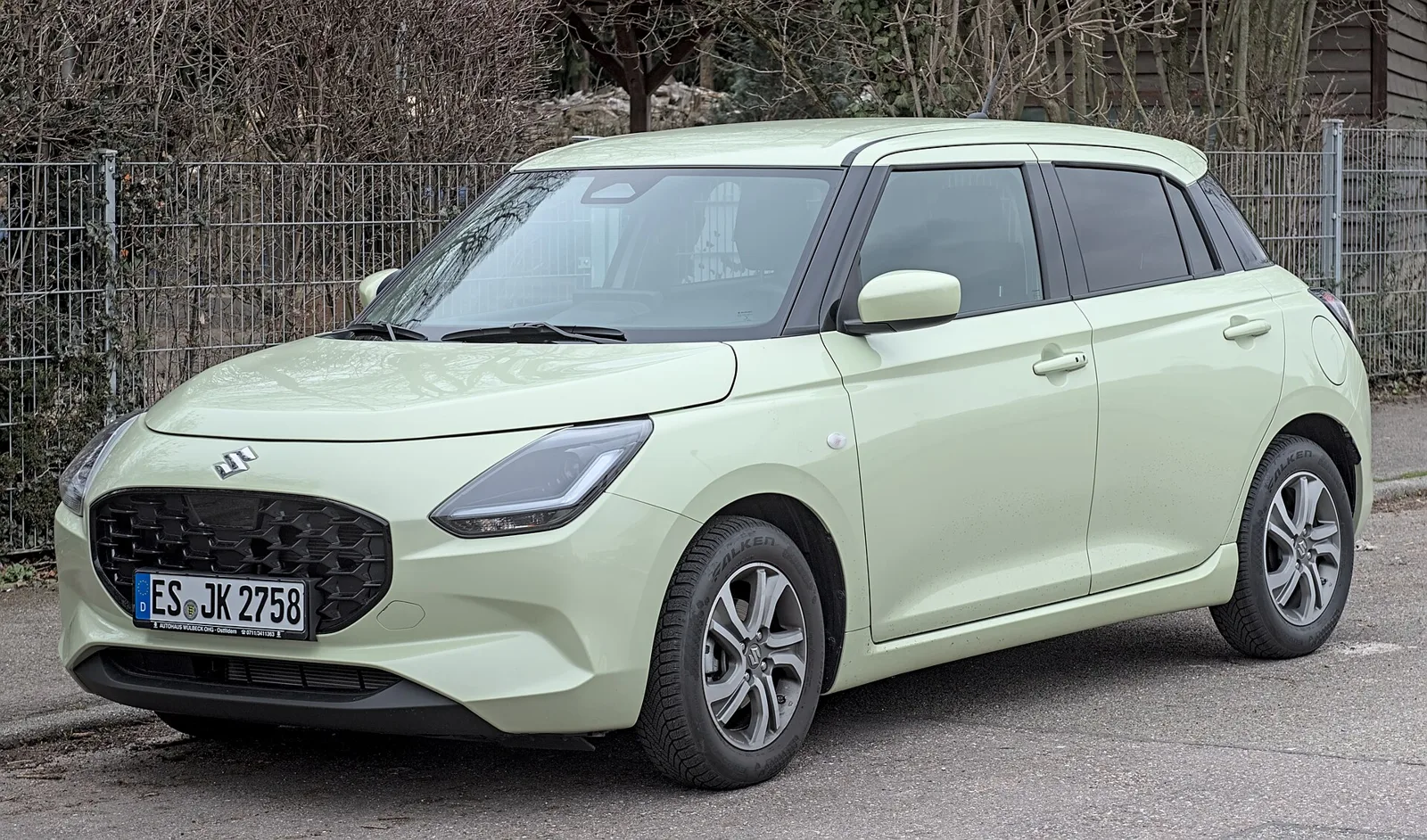
The fourth generation was previewed as a concept on 25 October 2023 and introduced in Japan and Europe on 6 December 2023. It keeps the Heartect platform but was redesigned to appeal to younger buyers. Suzuki says the body is 4.6 percent more aerodynamic than before.
The interior received a new multi-layered dashboard, redesigned door panels and a 230 mm (9 in) LCD screen on the top model. Safety and convenience features were also updated, including front parking sensors, an electronic parking brake and a driver monitoring system.
The car's Indian debut came on 9 May 2024 with five trim levels and a 5-speed manual or AMT gearbox. A new 1.2-litre three-cylinder Z12E engine replaced the earlier four-cylinder units, and it is available as a conventional or mild-hybrid version depending on the market.
The fourth generation spread quickly. It launched in Taiwan in July 2024, Australia on 14 June 2024, New Zealand on 7 June 2024, Mexico on 31 May 2024 and South Africa on 27 September 2024. Singapore followed on 8 August 2025 with two variants of the 1.2-litre mild hybrid.
How many Suzuki Swifts have been sold?
The Swift has sold 10 million units worldwide since its global debut in 2004. Of those sales, 60 percent were in India, 14 percent in Europe, 8 percent in Japan and 18 percent in other countries.
India has been central to the car's success. The Swift was the best-selling car in India in 2012, along with its Dzire sedan variant, and again in 2020 and 2023. Over 350,000 Swifts were sold in China from 2005 to 2019 before Suzuki withdrew from that market.
Did the Suzuki Swift race?
The Swift Sport has been competitive in rallying, especially in the 2.0-litre class. Per-Gunnar Andersson and Aaron Burkart won the JWRC S1600 class in 2007 and 2010, and Luke Pinder won the British Rally Championship R1 class in 2009.
The car also won the All-Japan Rally Championship in the JN1 class from 2016 to 2018 and then in the JN4 class from 2019 to 2023. In 2021 Javier Pardo and Adrian Perez won the European Rally Championship ERC-2 category by taking all six rounds they entered.
In Australia the Swift Sport EZ was raced in the Bathurst 6 Hour from 2018, with the Sorthare Suzuki Racing Team taking class podiums across several years. Michael Hopp and Steve Pittman won class E in 2019 at the event.
What awards has the Suzuki Swift won?
The Swift has won more than 60 awards, including several car of the year titles, since its introduction as a global model. Its awards include Irish Car of the Year in 2006 and RJC Japan car of the year in 2006, 2011 and 2018.
Indian car of the year titles came in 2012 and 2019, and the Swift was also named most fun to drive car in the Japanese car of the year awards in 2006. Those honours reflect its popularity across very different markets.
What are the Suzuki Swift specifications?
The table covers the Sport variants across the generations, plus the key figures for the third-generation boot and the fourth-generation engine. It shows how the performance version developed over time.
| Specification | Detail |
|---|---|
| Global debut | Paris Motor Show, September 2004 |
| First Sport engine | 1.6-litre M16A, 123 bhp (125 PS), 148 Nm |
| Second-generation wheelbase increase | 50 mm (2.0 in) |
| Second-generation Sport engine | 1.6-litre, 100 kW (134 bhp; 136 PS), 160 Nm |
| Third-generation Sport engine | 1.4-litre Boosterjet, 103 kW (138 bhp; 140 PS), 230 Nm |
| Third-generation boot | 246 litres, 579 litres seats folded |
| Fourth-generation engine | 1.2-litre three-cylinder Z12E |
| Sales | 10 million units worldwide |
Frequently asked questions
What was the Suzuki Swift before 2004?
Before 2004 the Swift name was an export name for the Suzuki Cultus. In Japan the Swift name arrived in 2000, and outside Japan the car was sold as the Ignis in that period.
Is the Swift sold in the United States?
Not as a new Swift in its own right. The Swift nameplate was reused on the second-generation Geo Metro in the United States and Canada from 1995 to 2001, and later the Chevrolet Aveo was sold in Canada as the Swift+.
How fast is the Swift Sport?
The first Swift Sport used a 1.6-litre engine with 123 bhp (125 PS) and 148 Nm of torque. The third-generation Sport used a 1.4-litre Boosterjet turbo producing 103 kW (138 bhp; 140 PS) and 230 Nm.
Why is the Swift so popular in India?
The Swift sold strongly in India from its 2005 launch, and it was the country's best-selling car in 2012, 2020 and 2023. India accounts for about 60 percent of the car's total sales, which makes it the model's largest market.
_hybrid_DSC_7922.jpg)