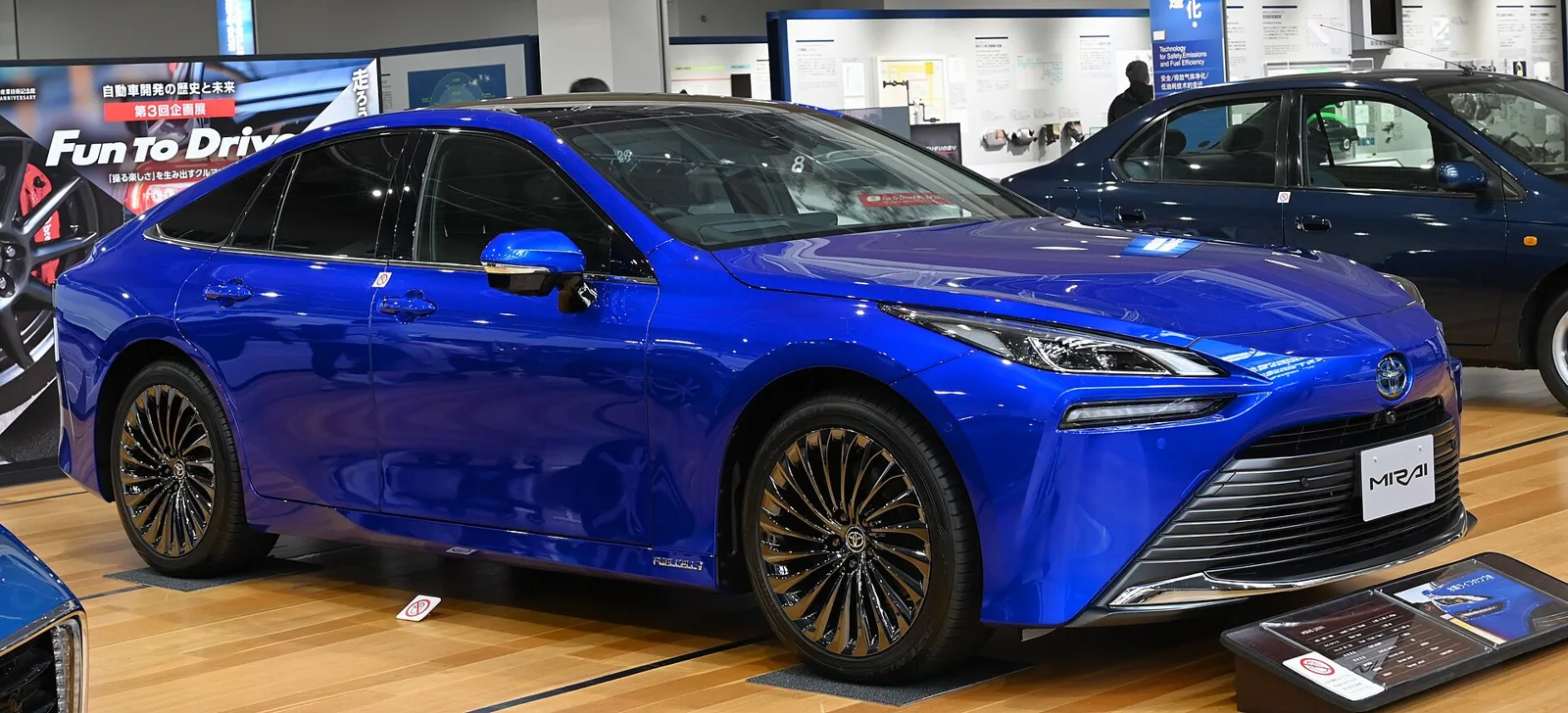
Toyota's mid-size hydrogen sedan was the first fuel cell vehicle built to be sold commercially, with a 502 km (312 mi) EPA range and water vapour at the tailpipe.
The Toyota Mirai is a mid-size hydrogen fuel cell sedan that Toyota launched in 2014 and that became the first fuel cell vehicle to be mass-produced and sold commercially. Its first generation offered a 502 km (312 mi) EPA range, and global sales reached 21,475 units by November 2022.
The Toyota Mirai is a mid-size sedan that runs on hydrogen, with a fuel cell in place of a conventional engine. Toyota built it for ordinary buyers, and its only exhaust is water vapour. The car was first offered in Japan, the United States and a handful of European markets.
Where did the Mirai come from?
The Mirai grew out of a series of Toyota fuel cell concepts. The FCV-R appeared at the 2011 Tokyo Motor Show, and a more production-like FCV sedan followed at the 2013 show. The Mirai name comes from the Japanese word for future.
The FCV concept was a bright blue sedan with a teardrop-like body, a styling idea that underlined how little the car gave off from its tailpipe. It had a large grille and other openings to feed cooling air and oxygen to the fuel cell, and it was similar in size to the Camry.
Toyota expected the FCV to cover about 700 km (430 mi) under the JC08 test cycle, and the concept was designed to accommodate up to four occupants. Two 70 MPa high-pressure hydrogen tanks sat beneath the specially designed body. By June 2014 Toyota had shown a close-to-production car and set an early 2015 target for launch in Japan.
The first mass-produced fuel cell car released only water vapour, and its story is as much about refuelling as engineering.
How did Toyota's fuel cell work begin?
Toyota's fuel cell programme started in 1992, and its early cars were far from the Mirai that reached showrooms. In 2002 a limited run of FCHV fuel cell vehicles went on sale in the US and Japan, with a cruising range of 300 km (185 miles). That was a useful first step, but the programme still had to show that the technology could be sold rather than only demonstrated.
The US government dropped its funding for hydrogen fuel cell cars in 2009, which removed a source of support for the sector. Toyota carried on with its own work, and in 2013 it demonstrated that refuelling took less than three minutes, a result that did much to answer doubts about daily use.
The production car was unveiled at the November 2014 Los Angeles Auto Show, the result of that long run of development. Its official name, Mirai, was announced at the same time.
How does the Mirai's fuel cell system work?
The Mirai combines a fuel cell stack with hybrid technology. The stack generates electricity from hydrogen and oxygen, and a battery works alongside it. At low speeds the car runs mainly on battery power, while at higher speeds the fuel cell alone drives the electric motor.
Toyota carried over Hybrid Synergy Drive parts, including the electric motor and power control unit, to improve reliability and hold down cost. The battery is charged through regenerative braking, and it supports the fuel cell during sudden acceleration. The traction motor delivers 113 kW (152 hp; 154 PS) and 335 Nm of torque.
The energy store is a sealed nickel-metal hydride battery pack rated at 245V and 1.6 kWh, similar to the one used in the Camry hybrid. The approach borrowed heavily from Toyota's mainstream hybrid cars rather than starting from a clean sheet.
The first-generation stack peaked at 114 kW (153 hp; 155 PS). Toyota described its power density of 3.1 kW/L, or 2.0 kW/kg, as world-leading. Each stack comprises 370 cells, and a converter raises the voltage to 650 volts.
Two carbon fibre tanks held 122 litres combined at 70 MPa (10,000 psi). Together they weighed 87.5 kg (193 lb) and stored 5 kg (11 lb) of hydrogen. The H2O button opens a gate at the rear to release the water vapour formed in the fuel cell, and Toyota quoted 240 mL of exhaust water per 4 km of running.
Who was the Mirai aimed at?
Toyota limited the first sales to regions where hydrogen refuelling infrastructure was being developed. The car was therefore sold first in Japan, in California and in a small number of European markets, where stations existed or were planned.
That made the Mirai a car for early adopters with access to a station. Buyers were not just choosing a vehicle; they were also committing to a fuel supply that was still growing, which explains why the sales map looked so uneven in the early years. Those practical factors shaped the car's early sales far more than its specification did.
The Japanese government also planned to support commercialisation of fuel cell vehicles through a subsidy of 2,000,000 yen, alongside the launch price. The subsidy was one of the clearest signs that the state saw hydrogen cars as a policy priority.
How far can a Mirai go on one tank?
The 2016 model year Mirai had an EPA range of 502 km (312 mi) on a full tank, with a combined rating of 66 mpg-US (3.6 L/100 km; 79 mpg-imp). The second-generation car later set a record by covering 1,360 km (845 mi) on one full tank in August 2021.
The first-generation car took 9.0 seconds to reach 97 km/h (60 mph) from rest, and its 40 to 64 km/h (25 to 40 mph) passing time was about 3 seconds. Refuelling took between 3 and 5 minutes, and the official Toyota figure for hydrogen use was 0.8 kg per 100 km on the combined cycle.
Toyota's fuel cell test fleet has covered more than 1,600,000 km (1,000,000 miles) on the road. In Hamburg, one Mirai covered 100,000 km (62,000 miles) in 107 days, which gave the company real-world evidence on durability.
How did the Mirai reach the market?
Japanese sales opened on 15 December 2014, at 6,700,000 yen (~US$57,400) before a government incentive of 2,000,000 yen. US retail sales started in August 2015 at US$57,500, and the first 57 cars reached private buyers in California in October and November 2015.
Japanese demand was strong from the start. Toyota received 1,500 orders in a single month, against a target of 400 for the first 12 months. Production of the fuel cell parts had begun at Toyota Boshoku in November 2014, ahead of the launch.
The European launch came in September 2015, and the UK became the first market outside Japan to sell the car. Germany pricing started at EUR 60,000 (~US$75,140) plus VAT, for a total of EUR 78,540. Pat Cox, a former president of the European Parliament, put Toyota's likely initial loss at between EUR 50,000 and EUR 100,000 for each car sold in 2015.
How many Mirais have been sold?
Global sales reached 21,475 units by November 2022. The United States was the largest market with 11,368 units, Japan took 7,435 and the rest of the world accounted for 2,622.
Sales were concentrated in a few places, which mattered because hydrogen refuelling was limited. By December 2017 global sales had reached 5,300, and sales in California passed 3,000 units in January 2018.
Toyota later reported roughly 640 cars sold in Europe through 2019. Copenhagen added 100 taxis in 2021.
What changed with the second-generation Mirai?
Toyota revealed the second generation in October 2019, and cars reached buyers from December 2020. The target was 30 percent more driving range, with more hydrogen capacity. It also gained Toyota's Teammate level 2 driver assistance system in April 2021.
Teammate offered two modes. Advanced Drive allows hands-free driving on supported roads, and a monitoring system checks that the driver's attention stays on the road. Advanced Park is an advanced parking assistance system.
The second-generation car is built on the rear-wheel drive TNGA platform. In September 2021 Euro NCAP gave it five stars overall, with 33.8 points (88%) for adults, 42 points (85%) for children, 43.7 points (80%) for pedestrians and 13.2 points (82%) for safety assist.
Toyota Mirai specifications at a glance
The table brings together the key figures for the first-generation car and the second-generation distance record. Where a figure belongs to one generation, the table says so.
| Specification | Detail |
|---|---|
| Class | Mid-size hydrogen fuel cell sedan |
| Range (2016 EPA) | 502 km (312 mi) |
| Combined economy (EPA) | 66 mpg-US (3.6 L/100 km; 79 mpg-imp) |
| 0-97 km/h | 9.0 seconds |
| Fuel cell stack | 114 kW (153 hp; 155 PS) maximum |
| Traction motor | 113 kW (152 hp; 154 PS), 335 Nm |
| Hydrogen tanks | Two, 122 litres combined at 70 MPa (10,000 psi) |
| Hydrogen stored | 5 kg (11 lb) |
| Refuelling | 3 to 5 minutes |
| Distance record (second generation) | 1,360 km (845 mi) on 5.65 kg of hydrogen, August 2021 |
Were there recalls or legal challenges?
Yes. On 15 February 2017 Toyota recalled about 2,800 zero-emission Mirais over the output voltage of the fuel cell system, and dealers updated the software at no cost. In June 2023 a lawsuit was filed in California alleging sudden power losses.
Toyota said that under unusual driving conditions the output voltage from the fuel cell boost converter could exceed its maximum. The software update was expected to take about half an hour, and owners did not have to pay for it.
The June 2023 case was filed in the Central District of California. Plaintiffs allege that the fuel cell system can suffer sudden power losses and that Toyota did not disclose the problem. Toyota has denied the allegations, saying the Mirai meets all safety and performance standards.
What awards and records did the Mirai earn?
The Mirai won the 2016 World Green Car of the Year award, and the second generation was named Car Technology of the Year by the Hispanic Motor Press in May 2021. Its most notable drive came in April 2018, when a Mirai travelled the length of Great Britain.
The 1,785 km (1,109 miles) journey took 19 hours 40 minutes at an average of 90 km/h (56 mph). It was described as a first for a hydrogen fuel cell electric vehicle, a historic milestone in British motoring.
The car also made its mark in motorsport. In April 2015 the Mirai became the first hydrogen fuel cell car to pace a NASCAR race, and in June 2015 it was the pace car at the Toyota/Save Mart 350 at Sonoma. In 2017 two Mirai fuel cells were tested in an electric Class 8 truck at the Port of Los Angeles.
Frequently asked questions
What did the Mirai cost in Japan?
Pricing started at 6,700,000 yen (~US$57,400) before taxes and a government incentive of 2,000,000 yen. The incentive was intended to support the early commercialisation of fuel cell vehicles.
Was the Mirai the first fuel cell car sold commercially?
Yes. Toyota presents the Mirai as the first commercially sold fuel cell car built in series production, which set it apart from the company's earlier development cars.
How many Mirais were sold in California?
Sales in California passed 3,000 units in January 2018. The state's hydrogen station network remained small compared with its number of cars.
Did the second-generation Mirai earn a top safety rating?
Yes. Euro NCAP awarded the second-generation car five stars overall in September 2021.