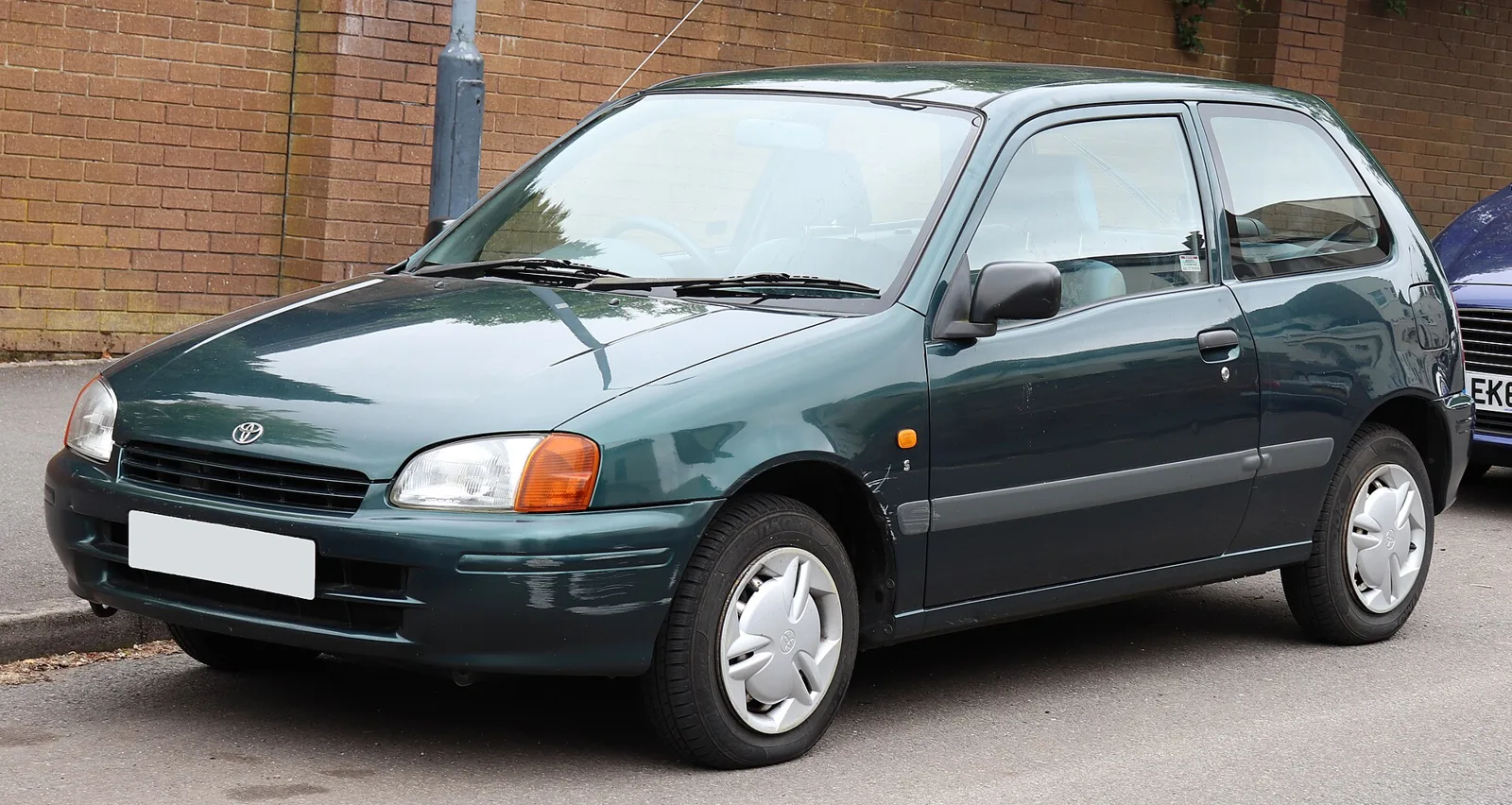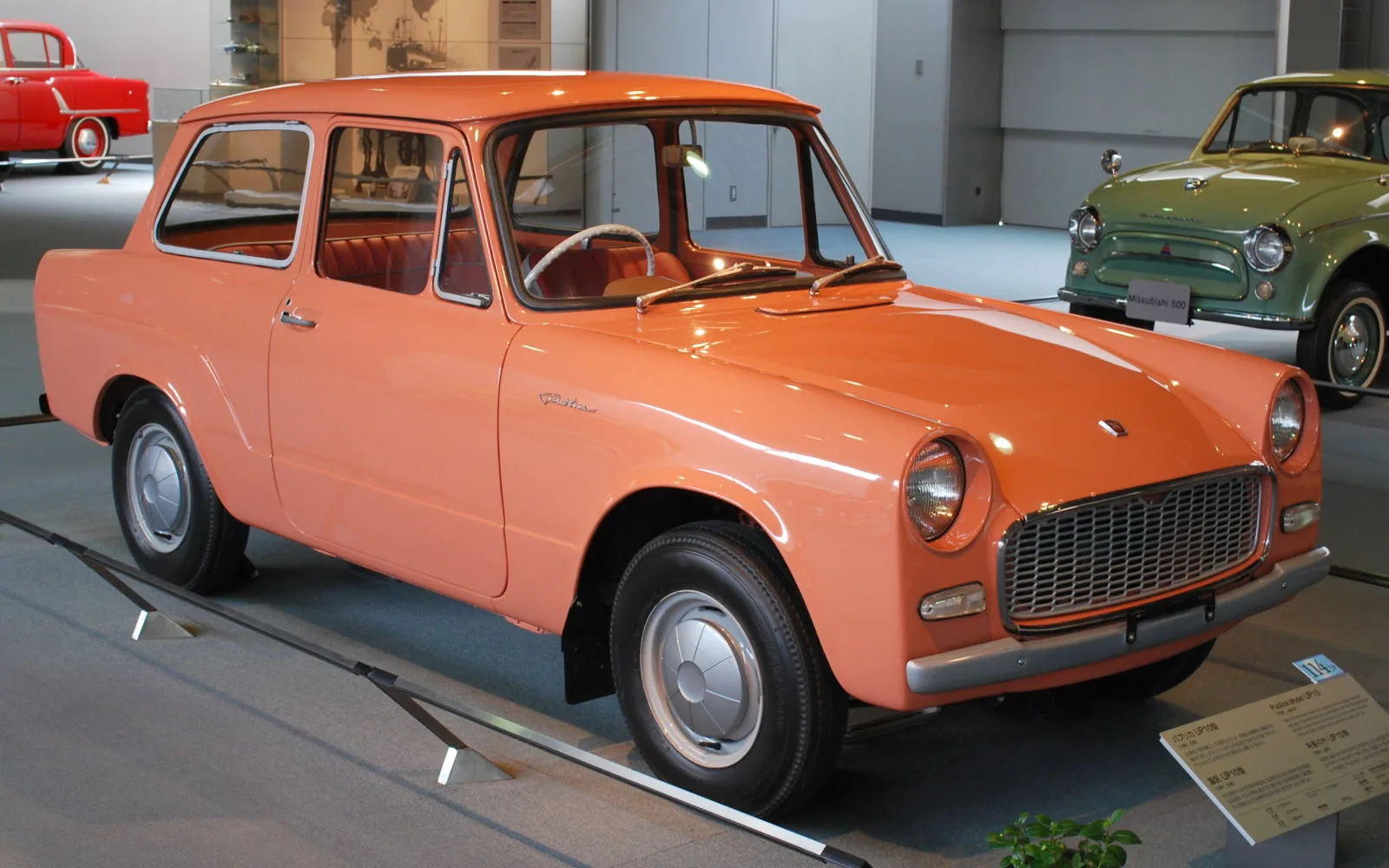
A 1961 family car born from a government wish list, with an air-cooled boxer engine, a coupe pickup that lasted a decade longer than its siblings and a rally-tuned edition.
Built by Toyota from 1961 to 1978, the Publica grew out of Japan's national car concept for an affordable family car. Its first engine was a boxer, and the Starlet, which began as a Publica coupe, later took over its small-Toyota role.
The Publica was Toyota's two-door family car from 1961 to 1978. It came out of a Japanese government plan for an affordable national car, and it used an air-cooled boxer engine at first before moving to a water-cooled four-cylinder in its later years.
Where did the Publica come from?
The Publica grew out of the national car concept that Japan's Ministry of International Trade and Industry announced in 1955. The ministry wanted a car that could top 100 km/h, weigh under 400 kg and run for at least 100,000 km without breaking down or needing major repairs.
The ministry also set a fuel target of 30 km/L at an average of 60 km/h on a level road. Toyota took those requirements as its brief, and the Publica was the company's answer, aimed at families who needed a practical small car rather than a luxury one.
Because the Publica was the smallest Toyota of its period, it carried the family-car role for the brand until the Starlet arrived. The Starlet started life as a version of the Publica, and it eventually took over the smallest-Toyota slot entirely.
A government wish list for a cheap, reliable family car, turned into a two-door Toyota that lasted from 1961 to 1978.
Why did Toyota abandon front-wheel drive for the Publica?
Toyota's engineers first wanted a front-engined, front-wheel drive layout, which was an innovative idea at the time. The FF design proved too complicated to finish in the time available, so the team switched to a more conventional front-engined, rear-wheel drive arrangement.
Eiji Toyoda had been keen on the FF approach, and the change was a practical compromise rather than a rejection of the idea. Toyota kept the rear-drive architecture conventional, which suited a schedule that was already tight.
The engineers did borrow from Europe. The Citroen 2CV, with its two-cylinder, air-cooled, horizontally opposed engine, was a clear inspiration for the Publica's basic concept, even though the 2CV drove its front wheels.
What engine did the first Publica use?
The first engine was an air-cooled 697 cc two-cylinder boxer producing 28 PS (21 kW). Toyota called it the U engine internally. It powered the first cars from the 1961 launch, and its size kept the car in the lowest annual road tax bracket.
The company had originally planned a smaller unit, because the government had announced tax breaks for engines under 500 cc. Engineers judged that a 500 cc engine would not give enough power on the highways, so they raised the planned displacement to 700 cc.
The tax breaks never materialised, but the 697 cc size still qualified for the lowest annual road tax bracket, which helped sales. The lower tax band was still a real help to sales, even though the incentive itself never arrived.
How did the Publica sell at launch?
The Publica went on sale in June 1961 with a basic price of 389,000 yen, and the first cars were spartan, with no radio or heater. Demand only picked up once the Deluxe trim and the convertible arrived in 1963, when monthly sales reached the target of 3,000 to 4,000 units.
Toyota sold the car through a new dealer network that stood apart from its existing Toyota and Toyopet dealerships. The outlets were called Toyota Publica Stores, and they were later renamed Toyota Corolla Stores once the Corolla outsold the Publica.
Buyers had come to see a car like this as an aspirational purchase, and many expected more comfort than the first model offered. The 1963 Deluxe, with reclining seats, a heater, a radio and chrome trim, answered that expectation, and sales began to climb.
What did the Publica look like?
The Publica was a two-door car with room for four people and a useful boot, and its body came in several forms. Options ranged from the basic sedan to a station wagon, a convertible, a coupe utility pickup and a light van.
The suspension combined a double wishbone arrangement at the front with semi-elliptical leaf springs at the rear. That combination was practical for a car built to carry families and luggage.
The coupe utility arrived in February 1964, and it outlived the other Publica models by about a decade. A derivative sports car, the Toyota Sports 800, was first marketed as the Publica Sport and debuted at the 1962 Tokyo Motor Show.
How did the P20 and P30 generations change the Publica?
The 1966 P20 range, designated UP20, increased the engine to 790 cc, and the air-cooled unit was renamed the 2U. Power rose only slightly, from 35 PS to 36 PS, while the convertible gained a 45 PS twin-carburettor engine borrowed from the Sports 800.
The P30 arrived in April 1969 and was in effect a smaller Corolla, built on a shortened version of that car's wheelbase. Its cornerstone was a new water-cooled four-cylinder K-series unit of 993 cc, known as the 2K, which made 58 PS (43 kW).
The 2K was closely related to the 1,077 cc unit found in the Corolla of the time. The old air-cooled 790 cc 2U survived only in the cheapest domestic versions, which shows where the range was heading.
How quick was the Publica 800 and 1100 SL?
The Publica 800, coded UP30, produced 40 PS (29 kW) and reached a top speed of 120 km/h (75 mph). The 1100 SL was the faster choice, with a top speed of 155 km/h (96 mph). Both figures come from the P30 range that replaced the earlier cars in 1969.
Both the 800 and the 1000 came in Standard or Deluxe equipment, as sedan or van. The van was geared lower for work use, with claimed top speeds of 115 km/h (71 mph) and 135 km/h (84 mph) for the two versions.
The Publica SL picked up a 1.2-litre engine in October 1969, when the Corolla was refreshed. Output rose from 73 PS to 77 PS (54 to 57 kW), and the same 1.2 later reached a well-equipped Hi-Deluxe variant.
Was there a sporty Publica?
Yes. The SR, which stood for Sports Rally, arrived in March 1971 with radial tyres, front disc brakes, firmer suspension and a tachometer. It was the sportiest road Publica offered. The equipment list leaned toward handling, and enthusiasts could also look to the Toyota Sports 800, a separate sporting derivative of the range.
The SR was criticised in period testing. Its radial tyres were described as unpredictable near the limit, offering high grip with little feedback, and the car could threaten to roll over under hard driving.
The Toyota Sports 800 was the separate sporting derivative, and it lent its twin-carburettor engine to the Publica convertible. No competition results for the Publica itself are given here, so its sporting reputation rests on the SR and the Sports 800 family.
How did the Publica engines and transmissions develop after 1972?
The January 1972 facelift gave the KP30 new front and rear fascias and a semi-fastback profile. The U-engine model was dropped at the same time, because the boxer unit could no longer meet emissions standards. The change was a notable one, since the boxer had been the car's original engine.
The KP50 sedan used the de-smogged 3K-U engine, rated at 64 PS (47 kW). In June 1976 the P50 became the first Publica to offer a five-speed manual transmission, and the pickup gained a five-speed gearbox in August 1985.
Later pickups used a de-smogged 1,166 cc 3K-HJ engine from November 1975, and then a 1,290 cc 4K-J engine from June 1979. Export versions, however, kept the 1-litre 2K engine, so the same model could vary a great deal depending on the market it was sold in.
Did the Publica offer an automatic gearbox?
Yes, but only in a limited way. Toyota offered the Toyoglide, a two-speed semi-automatic coded A20, which was a first for the class in Japan. Such units are now very rare, because few mechanics of that era knew how to repair automatic transmissions.
The Toyoglide was unusual for a car of this size, and very few examples remain today.
What are the Toyota Publica specifications?
| Specification | Detail |
|---|---|
| Production span | 1961 to 1978 as a sedan; van to June 1979; pickup to August 1988 |
| Internal designations | UP10 (1961), UP20 (1966), P30 (1969), KP30, KP50 sedan, KP60 Starlet (1978) |
| First engine | 697 cc air-cooled 2-cylinder boxer, 28 PS (21 kW), known internally as the U engine |
| 1966 engine | 790 cc 2U, 36 PS |
| 1969 engine | 993 cc 2K water-cooled four-cylinder, 58 PS (43 kW) |
| Publica 800 (UP30) | 40 PS (29 kW); top speed 120 km/h (75 mph) |
| Publica 1100 SL | Top speed 155 km/h (96 mph) |
| Publica SL after October 1969 | 1.2-litre engine; 77 PS (57 kW) |
| KP50 sedan | 1,166 cc 3K-U, 64 PS (47 kW); five-speed from June 1976 |
| Toyota 1000 export | 993 cc 2K, 45 PS (33 kW) in export trim |
| Front suspension | Double wishbones |
| Rear suspension | Semi-elliptical leaf springs |
| Launch price | 389,000 yen (June 1961); 359,000 yen for 1967 |
| Automatic option | Toyoglide two-speed semi-automatic, code A20 |
Where was the Publica sold outside Japan?
Outside Japan the Publica was sold in several markets, and in many of them it became the Toyota 1000. Canada took the car in November 1964, where it joined the Crown as one of Toyota's first two models offered in the country.
Badged as the Toyota 1000, the P30 with the 993 cc 2K engine was the car's name in most overseas markets. It went on sale in West Germany in the fourth quarter of 1974, when the country was Europe's largest national car market, and it arrived with a surprisingly generous standard specification.
The German car came with radial tyres, head restraints up front, tinted glass, a heated back window and a radio as standard. In Switzerland and the Netherlands it was marketed as the Copain, while Belgian buyers knew it as the Toyota Osaka for a while.
Some Toyota 1000 pickups were sold in South Africa with a 1,166 cc 3K engine, showing how the same family of cars adapted to different regional demands. The P60 Starlet took over from the Toyota 1000 sedans and wagons in 1978.
What was the Timangi pickup?
The Timangi was the name given to the pickup version of the Toyota 1000 in Finland, where it went on sale in March 1976. It proved popular with younger buyers, and sales grew quickly enough to prompt a change in the rules.
Finnish authorities rewrote the rules for pickups, raising the minimum cargo area from 155 cm (61 in) to 185 cm (73 in). That change removed the tax breaks the Timangi had relied on, so sales stopped almost at once, once about 2,000 cars had been sold over 18 months.
How did Publica production end?
The Publica sedan continued until February 1978, when the KP60 took over and was marketed as the Toyota Starlet. The Starlet had begun in 1973 as a coupe version of the facelifted Publica, so the badge carried on the same family lineage.
The van remained on sale until June 1979, and the pickup stayed in production until August 1988, outliving the rest of the range by about a decade. Those dates bracket the whole Publica story.
Who built the commercial versions of the Publica?
Hino Motors built many of the commercial versions at its Hamura plant from 1970, and by then Toyota had taken over the company. Van production had moved to Hino as early as March 1968, and the cab-over MiniAce van, launched in 1966, was based on the UB20 Publica.
Daihatsu began building Publicas in September 1969. Toyota had begun acquiring the kei car maker in 1966, and in 1969 Daihatsu launched the Consorte, a mildly restyled P30 that relied on the company's own 1.0-litre FE unit in its entry versions.
How did buyers and critics react to the Publica?
At first the Publica struggled because its early specification was so basic. Toyota later marketed the 1967 car as a 1000 dollar car, since the dollar was then worth about 360 yen, and the price cut made that claim possible.
The Corolla eventually won the affordable small-car contest, and by 1969 the Publica showrooms had been rebranded as Corolla outlets. Pickup demand also grew strongly, partly because the post-war baby boomers were reaching driving age, and Toyota began to position the Publica as an entry-level car for first-time young buyers.