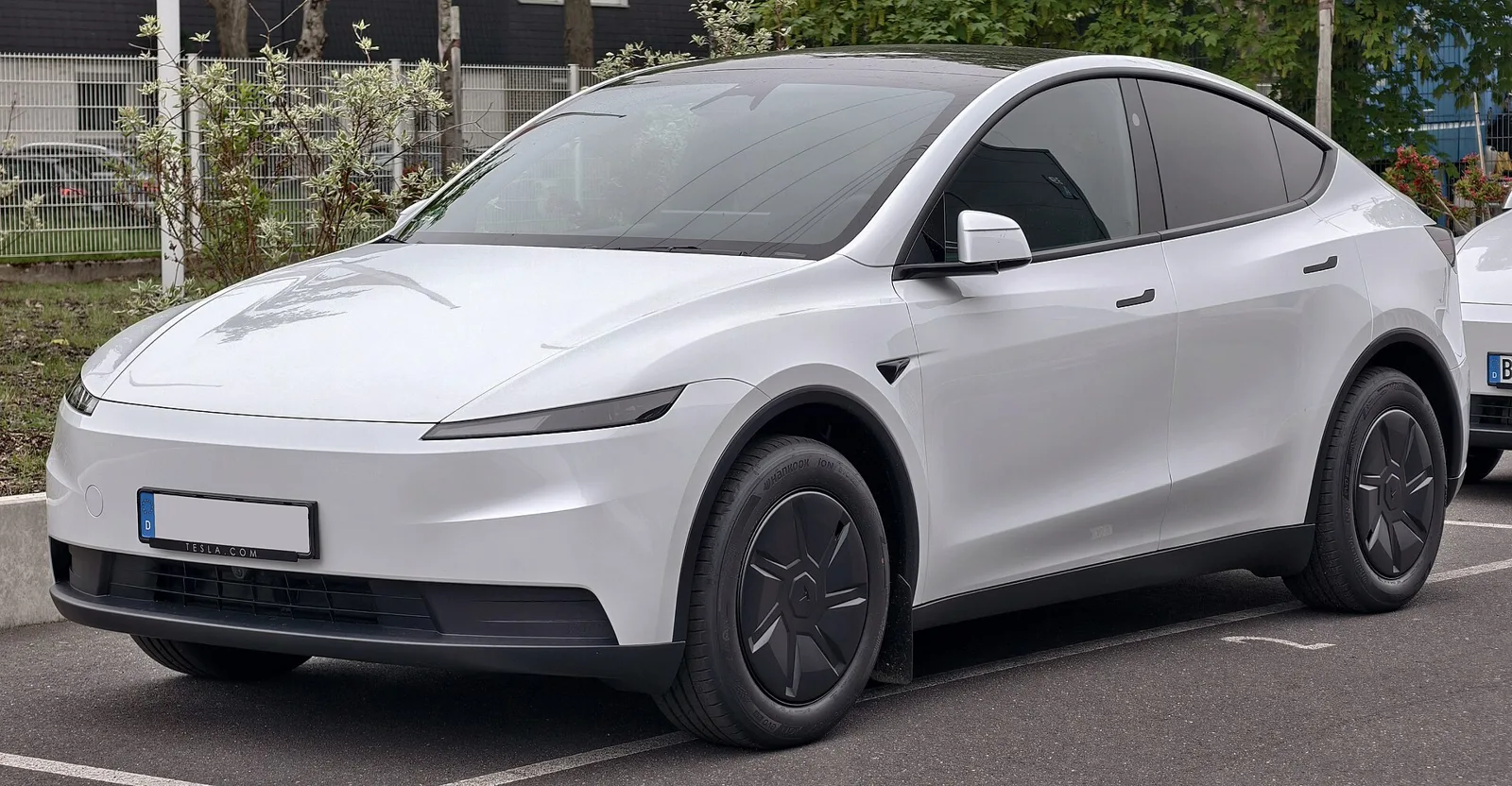
A head-to-head between the world's best-selling EV and Hyundai's global compact crossover stalwart, compared on history, engineering and character.
The Tesla Model Y is a battery-electric compact crossover launched in 2020, while the Hyundai Tucson is a petrol, diesel and hybrid compact SUV that has been on sale since 2004. Both compete in the same mainstream compact crossover class, but they take very different routes to get there.
Tesla's Model Y, an electric compact crossover, has been built since 2020. Hyundai's Tucson, a compact SUV offered with petrol and hybrid drivetrains, dates back to 2004. Both sit in the global compact crossover segment, yet each embodies a distinct period and approach to vehicle design.
How did the Tesla Model Y come about?
March 2019 saw the unveiling of Tesla's fifth production car, which sits on a stretched variant of the Model 3 saloon's underpinnings. A trademark for the badge had already been filed in 2013, while initial concepts floated falcon-wing doors, an idea later set aside in favour of conventional doors.
The gestation was far from smooth. A 2017 silhouette tease confirmed that a new factory would be needed because Fremont was already at capacity, and the project slipped from an original 2018 target as Model 3 production problems consumed the company. By October 2018 Elon Musk had approved the final design, with production set for 2020. A further silhouette emerged in June 2018, and on 3 March 2019 Musk used Twitter to confirm the unveiling and specifications. What arrived was a streamlined crossover that shared roughly 75 per cent of its components with the Model 3, a deliberate move to keep costs and complexity down.
Both are compact crossovers, but only one of them has been doing this since the mid-2000s.
How did the Hyundai Tucson establish itself?
In November 2003 Hyundai revealed the Tucson name, then brought the vehicle to market in 2004, taking its name from the Arizona city. Buyers were offered it as a more compact option than the Santa Fe, and right from the first generation it was engineered together with the Kia Sportage.
The first-generation Tucson used the same platform as the Hyundai Elantra. From launch, standard kit was generous: air conditioning, dual front and side airbags plus curtain airbags, ESC, a single-disc stereo, alloy rims, keyless entry and upgraded cloth upholstery. American customers could choose between GLS, SE and Limited trim levels, while 2007 brought a renaming of GL and GLS to GLS and SE respectively. Utility was boosted by a front passenger seatback that could fold down flat, opening up a longer load bay - a sensible feature that showed how family needs shaped the design. Across two decades and more, the Tucson has grown into Hyundai's top-selling nameplate, surpassing seven million global sales since 2004, 1.4 million of which were registered in Europe.
What is the Tesla Model Y like to look at?
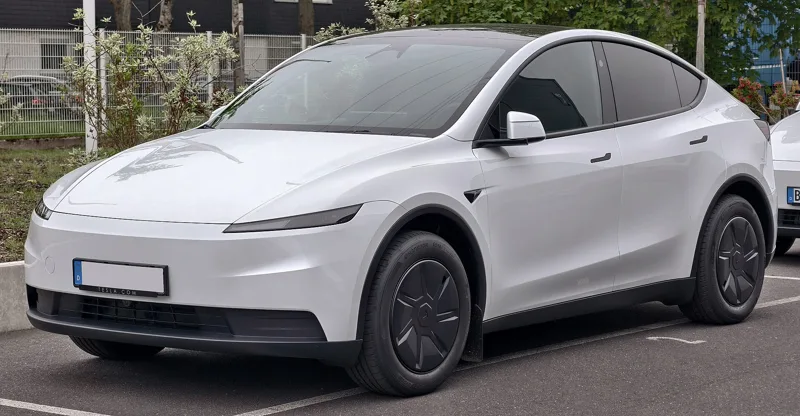
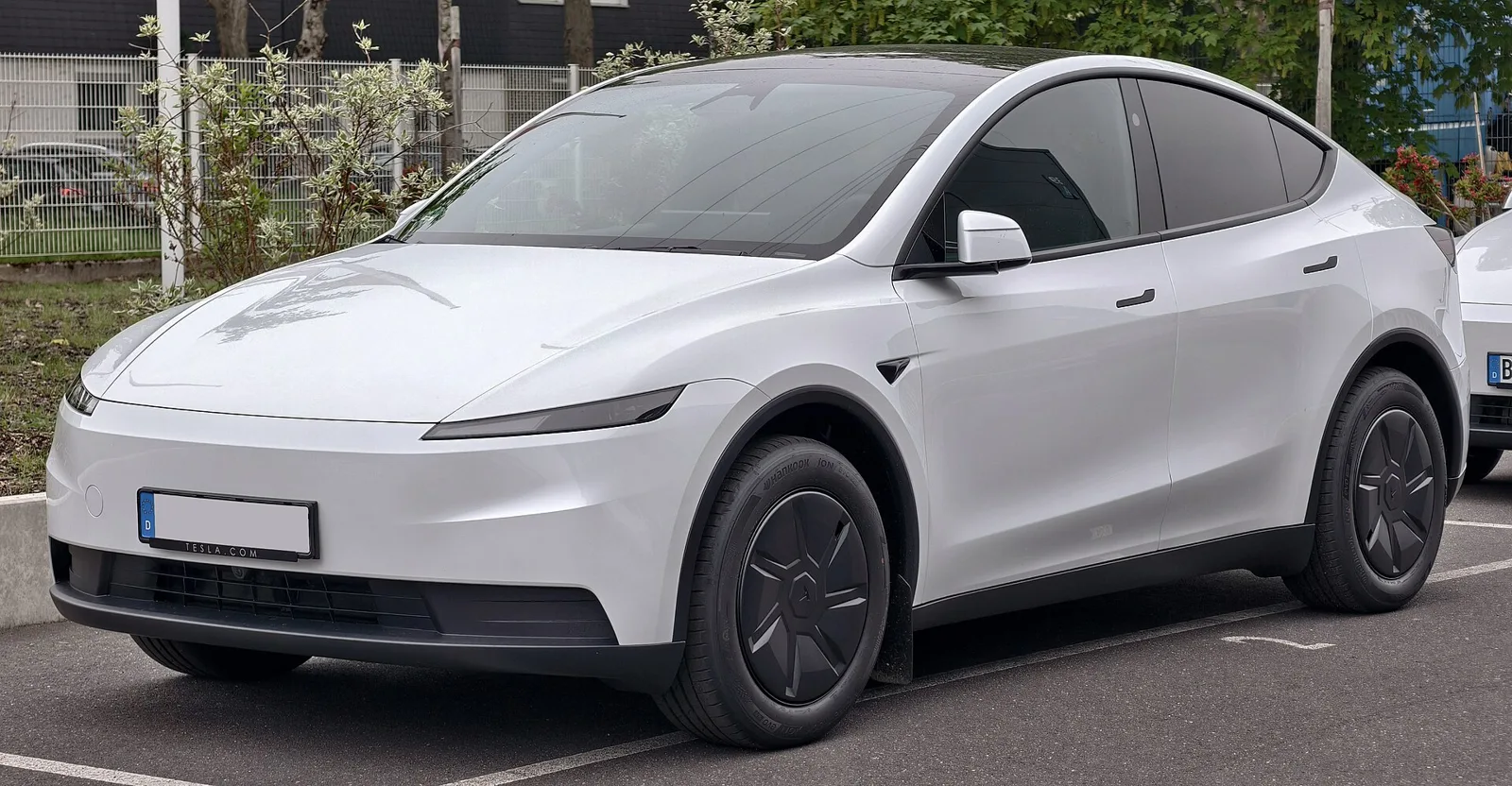
Sharing its underpinnings with the Model 3, the Model Y is a streamlined crossover that records a drag coefficient of 0.23. It features a front end without a grille, narrow LED headlights and a sculpted bumper, while a fastback roofline, a short rear overhang and an SUV profile reminiscent of a coupe give it its sporty feel.
At the back, the tailgate spans the full width of the car and incorporates LED taillights, topped by a lip spoiler. A black plastic lower diffuser helps reduce the visual height of the rear end. The 2025 refresh, codenamed Juniper, brought a full-width light bar for the daytime running lights and tail lights, a sleeker nose with a thin light bar across the hood, and no T badge on the hood in most markets. Redesigned wheels and a revised rear diffuser were added for drag and lift improvements. The long-wheelbase Model Y L goes further with a redesigned roofline and rear spoiler that drops the drag coefficient to 0.216, plus a new Cosmic Silver exterior colour.
How does the Tucson's design differ?
Across the Tucson's generations, Hyundai's design approach has changed considerably. Thomas Burkle oversaw the 2007 styling of the second generation, which Cha Il-Hoei penned at the firm's Russelsheim facility in Germany. Drawing on the Hyundai ix-onic concept, this model brought in 'fluidic sculpture', its flowing coupe-like lines meant to convey a more premium character than its predecessor.
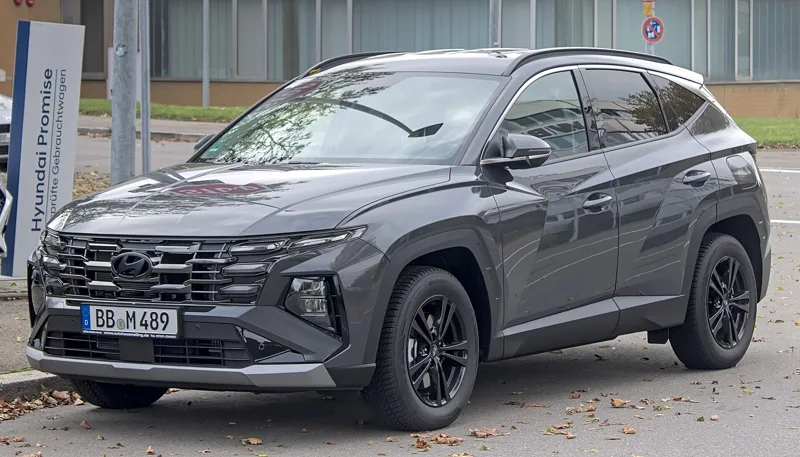
Unveiled in production form after the Vision T Concept appeared at the 2019 Los Angeles Auto Show, the fourth generation was overseen by SangYup Lee, who holds the role of senior vice president and heads Hyundai's Global Design Center. Styling cues included a grille likened to a jewel, daytime running lights with geometric shapes, bulging wheel arches, slanted wheel housings, a flat roof and short overhangs. The cabin offered the option of a hoodless fully digital instrument cluster, a four-spoke steering wheel and two 10.25 in (260 mm) screens arranged vertically, with full-touch control supplemented by some capacitive buttons. Through its 2018 facelift, the third generation had already received a new cascade grille, a revised hood and tailgate, a rectangular fuel door, fresh wheel designs and updated LED headlights.
Tesla Model Y vs Hyundai Tucson: how do the specifications compare?
| Specification | Tesla Model Y | Hyundai Tucson |
|---|---|---|
| Production start | 2020 | 2004 |
| Body style | 5-door crossover SUV | 5-door SUV |
| Class | Compact crossover SUV | Compact crossover SUV |
| Market | Global | Global |
| Drag coefficient | 0.23 (Model Y L 0.216) | Not applicable |
| Battery capacity | Approx 60 to 81 kWh usable | Not applicable |
| DC fast charging | Up to 250 kW (225 kW Standard) | Not applicable |
| Global sales milestone | 1.2 million delivered in 2023 | More than 7 million since 2004 |
What engineering sits under the Model Y?
At the bottom of the range, the Model Y drives only its rear wheels via a single internal permanent-magnet synchronous reluctance unit positioned at the back. Fit a front induction motor as well and you get the all-wheel-drive variants; that extra front unit cuts out whenever it is not required. Which battery you get follows the trim: LFP in the standard range, NMC in Long Range and Performance. Among the cell formats are 2170, prismatic LFP for the standard model sold in China, and 4680 structural packs built in Texas. On alternating current, charging tops out at 11.5 kW, whereas direct-current fast charging can hit 250 kW, dropping to 225 kW for the Standard.
The Model Y was the first Tesla to use a heat pump for cabin heating, and it is up to 300 per cent more efficient than resistance heating. The system features a Super Manifold and an Octovalve with eight ports, combining water-glycol coolant and R1234YF refrigerant circuits. Single-piece castings from the Giga Press, supplied by Idra, unified 70 metal parts into two at the rear, although Tesla abandoned plans for a one-piece gigacasting in May 2024. The company also removed radar from adaptive cruise control in April 2021, passenger seat lumbar support in May 2021, and ultrasonic sensors in October 2022, moving to a camera-only driver assistance system. Software version 2022.20.9 switched radar-equipped cars to Tesla Vision.
How does the Tucson's engineering story unfold?
The first-generation Tucson shared its Elantra-derived platform with the second-generation Kia Sportage. Hyundai also built a fuel cell test vehicle, unveiled at the 2005 Los Angeles Auto Show, using an 80 kW electric motor from Enova Systems, UTC Fuel Cells from South Windsor, Connecticut, a 152V battery co-developed with LG Chem, and 152 L hydrogen storage tanks from Dynetek Industries. It completed a 4,300-mile Hydrogen Road Tour in 2008 and offered a range of 300 km (186.4 mi).
The second generation was created over a 36-month period under the project name LM, at a cost of 280 billion won, and featured a newly designed six-speed automatic transmission. Euro-5 emissions standards were satisfied by its 2.0-litre diesel, while the 2.4-litre engine gave 20 per cent greater fuel economy than the previous four-cylinder. Compared with its predecessor, the third generation was 65 mm longer and 30 mm wider, had a 30 mm longer wheelbase, and offered rear storage of 465 to 513 litres with the seats up. It additionally introduced lane departure warning, blind spot detection, auto braking for pedestrians and cars, a twin-clutch automatic transmission and torque vectoring via Hyundai Active Cornering Control.
Where are the Model Y and Tucson built and sold?
The Model Y's first production site was Fremont, where manufacturing got under way in January 2020; US customers received their cars from March that year, choosing between Long Range AWD and Performance versions. December 2020 saw Giga Shanghai begin operating, Gigafactory Texas followed with output starting in late 2021, and Giga Berlin handed over its first cars in March 2022. Output in China kicked off in mid-December 2020, with 250,000 units projected for 2021, backed by an LG Chem battery cell deal signed in November 2020. Tesla handed over 1.2 million Model Ys during 2023, enough to top global vehicle sales and become the first EV to hold that position, ahead of the Toyota Corolla. In 2024 the model dropped to second place, with the Toyota RAV4 ahead of it. From March, the 2025 update went on sale in the US, Canada and Mexico at roughly $60,000, and Chinese buyers could take delivery from February 2025. October 2025 brought a new name in North America, the Model Y Premium, while Model Y L handovers in China commenced on 2 September 2025. The long-wheelbase variant reached Australia and New Zealand on 13 March 2026, badged Premium Long Range AWD, with the Philippines following in March 2026.
The Tucson has never been manufactured in just a single nation. From October 2009 until late 2018, the first-generation car rolled out of a Brazilian factory, while a facelifted version made exclusively for the Chinese market originated from Beijing Hyundai. Under its second generation, most markets received the vehicle as the ix35, with South Korea and North America being the exceptions; it was first shown publicly at the 2009 Frankfurt Motor Show, and in Korea it carried the Tucson ix badge. With the third generation, the ix35 label was retired and Tucson returned as the global name. Its reveal occurred in February 2015, it appeared at the Geneva Motor Show on 3 March 2015, and it arrived in dealerships during late 2015 as a 2016 model year vehicle. North American buyers first saw it in April 2015, also as a 2016 model year offering, with sales starting in July 2015. A facelift for 2018 went on display at the New York International Auto Show, the N-Line was primarily sold in Europe from early 2019, and Hyundai Nishat started assembling the car locally in Pakistan in August 2020.
What variants and trims does each offer?
Buyers can pick from three Model Y versions. At the entry point sits the Standard Range, which uses LFP cells and can take DC charging at up to 225 kW. Above it comes the Long Range AWD, fitted with NMC cells, capable of 0-100 km/h in 4.8 s and a maximum of 125 mph. The Performance tops the range and was launched first in August 2025 across Europe, the Middle East and Africa, then in North America in October 2025. This 2025 update carried the internal codename Juniper. A run-limited Launch Series added unique badges, a vegan suede cabin, a puddle lamp logo, doorsill plates and charging console wordmarks, along with a 320-mile battery and Full Self-Driving fitted as standard. June 2025 saw the arrival of the Model Y L, a six-seat long-wheelbase model with 19-inch aero wheels and captain chairs that heat, ventilate and recline. Its dimensions are 4,976 mm long, 1,982 mm wide and 1,668 mm tall, on a 3,040 mm wheelbase - 179 mm longer and 44 mm taller than the regular Model Y. Curb weight stands at 2,088 kg, 96 kg above the standard AWD, while cargo capacity grows to 2,539 litres from 2,130 litres. Equipment includes a 16-inch central touchscreen, simultaneous 50 W and 30 W wireless charging, 19 speakers plus a subwoofer and two overhead speakers, and 2-2-2 seating with a 50:50 split third row. Chinese cars use an 82 kWh pack; Australia and New Zealand receive an 88.2 kWh gross (84 kWh usable) battery. The 0-100 km/h figure is 4.5 s in China and 5.0 s in ANZ. Ahead of the 2025 refresh, optional third-row seats were available to US buyers.
Tucson trim lines differed between markets. In America, the range opened with GLS, SE and Limited; a 2007 revision swapped the names so that GL became GLS and GLS became SE, and the SE gained a roof rack for sport, all-wheel drive and a V6. For 2006 the Limited replaced the LX, adding body-coloured cladding, dual-zone automatic air conditioning and an upgraded audio system, whereas the GLS retained grey cladding and no longer carried HYUNDAI lettering on its front doors. Brazilian buyers from October 2009 picked between GL and GLS: the GL paired a 2.0-litre four with either a five-speed manual or a four-speed automatic, while the GLS came solely with a four-speed automatic, matched to a 2.7-litre V6 or a 2.0-litre four. Second-generation Australian cars were offered as Active, Elite and Highlander, with a 2.0 Theta II petrol engine and front-wheel drive on Active and Elite, and a 2.4 Theta II petrol or 2.0 R-series diesel on Elite and Highlander. UK trim names began as Style and Premium, then switched in September 2013 to S, SE and Premium. American second-generation Tucsons came in GL, GLS and Limited, and all-wheel drive could be specified on GLS and Limited. Third-generation Australian Tucsons used a 2.0 GDi manufactured in South Korea, whereas the 2.0 MPi, 1.6 T-GDi and 2.0 R-Series were manufactured in the Czech Republic.
How have both been received?
No other electric car has sold in such numbers: the Model Y holds the record for the highest total of any EV, and when it took the 2023 worldwide sales title it marked a turning point for the segment. Among the two most important alterations to the Model Y, Elon Musk highlighted the heat pump, which needs considerably fewer components, alongside its castings. The same executive called the version built in Berlin a complete rethink of how the car is manufactured. There were problems too: the NHTSA opened a phantom braking investigation in February 2022, and by May 2024 that case remained open.
The Tucson earned its reputation through protection and trustworthiness. It was named Best New Crossover in the Canadian Car of the Year awards for 2005, and a 2009 Consumer Reports study ranked it among the most dependable vehicles. In Euro NCAP's 2006 test of the first generation, adult occupants received four stars, toddlers three and pedestrians one, while NHTSA in 2009 awarded five stars for frontal driver and passenger plus side driver and passenger. The second generation collected a 2010 IIHS Top Safety Pick and arrived with extra power, lower fuel consumption, more comfort and enhanced safety. Over twenty years later, the Tucson remains Hyundai's top-selling model, and this history explains why.
Which one should you choose?
These two compact SUVs were built with different buyers in mind. The Model Y from Tesla is battery-electric only, accepts fast charging, includes a heat pump, gains features through over-the-air software updates and has a minimalist interior centred on one screen; its 2023 sales show how much it changed expectations in this segment. The Tucson from Hyundai instead offers petrol and hybrid drivetrains, has a much longer production history, comes in a broader range of trims and engines, and has a reliability record stretching back to 2004. If home charging and lower running costs matter most, the Tesla will appeal; if what you want is a familiar, long-established family SUV with many powertrain choices, the Hyundai is the easier one to live with. Both compete in the compact crossover segment, but only the Hyundai has done so since the mid-2000s.
_%E2%80%93_f_05052026.jpg)