A Philadelphia garage startup, a Missouri family firm, a Memphis grocer's side project and three stores sold off in 1932: how four names shaped the US auto-parts trade.
AutoZone, O'Reilly, Advance Auto Parts and Pep Boys grew through new stores, big acquisitions and regional distribution networks. AutoZone opened in 1979, O'Reilly in 1957, Advance traces to a 1932 purchase from Pep Boys, and Pep Boys, founded in 1921, now concentrates on service work.
Pep Boys sold the three stores that became Advance Auto Parts in 1932, sold 100 of its Express shops to AutoZone in 1998, and in 2021 handed over the premises of 109 California stores to Advance. America's best-known parts chains kept trading with one another for decades.
Who started AutoZone, and how did Auto Shack become a chain?
J.R. Hyde III, known as Pitt, launched it as the parts arm of his family's Memphis wholesale grocery firm, Malone & Hyde. The first store, called Auto Shack, opened in Forrest City, Arkansas, on 4 July 1979.
Hyde had joined the board of Wal-Mart the year before and was looking for ways to widen the family business. He admitted no deep knowledge of cars. What he had was a retail idea: good service, everyday low prices and a clean, brightly lit shop. Doc Crain managed the store, and day one produced $300.00 in sales.
Growth came quickly. By 1980 there were eight stores in five states and a year later there were 20. A first Express Parts Service depot opened in Memphis in 1981, a way to supply the awkward parts that most shops could not hold. The 100th store arrived in Weslaco, Texas, in 1983.
The corporate picture shifted in 1984, when a management buyout involving Hyde, the investment firm Kohlberg Kravis Roberts and other executives took Malone & Hyde private. The company counted 194 locations in 13 states that year. Peter Formanek became president in 1985, and in 1986 the parts business was spun off with Hyde and Formanek still in charge. Malone & Hyde itself was sold to Fleming Companies in 1988.
By 1986 the chain had 339 stores in 15 states. That year also brought two ideas that still define the business: the Duralast own-brand line, starting with alternators and starters, and Loan-A-Tool, which let customers borrow specialist tools instead of buying them for a single job.
Pep Boys sold Advance its first three stores in 1932, sold AutoZone 100 shops in 1998, then saw Advance take over its California sites in 2021.
Why did Auto Shack change its name to AutoZone?
Radio Shack sued over trademark infringement in 1986. A court first ruled for Auto Shack, but Radio Shack won on appeal, and in 1987 the company announced it would trade as AutoZone.
The first AutoZone store opened in Enid, Oklahoma. The company also introduced an electronic catalogue for finding parts, checking warranties and viewing stock, and by then it had 459 stores in 16 states.
How did AutoZone grow to thousands of stores?
Hyde and KKR floated the company on the New York Stock Exchange in 1991 under the ticker AZO, and the 1990s turned into a decade of rapid expansion. KKR, the largest shareholder at first, began selling down from 1993.
A satellite link connected stores to head office in 1994, the year sales hit $1.5 billion. The 1,000th store opened in Louisville, Kentucky, in 1995, when the company counted 1,143 stores in 26 states and launched Duralast batteries. A website followed in 1996, along with a $56 million purchase of ALLDATA, a software company supplying diagnostic and repair information.
Hyde retired as chairman and chief executive in 1997 and John Adams took over. Then came 1998, the year of the shopping spree: 112 Auto Palace stores across six states, a $55 million purchase, 43 TruckPro locations, 560 Chief Auto Parts stores and 100 Express shops from Pep Boys. In December of that year the first Mexican store opened in Nuevo Laredo, giving the company an international footprint. The decade closed with AutoZone's first appearance on the Fortune 500 list in 1999.
The pace held after the turn of the century. Steve Odland became chief executive in January 2001, and the 3,000th store opened in Cicero, Illinois, that May. TruckPro was sold to Paratus Capital Management in December. By 2003 the chain had 3,219 stores in 48 states plus 49 in Mexico, and the 4,000th store opened in Houston in 2007. The 5,000th store, in Wasilla, opened on 17 August 2012 and made Alaska the 49th state to have one. A Brazilian store in Sao Paulo followed in the same year, and the 6,000th store opened in Memphis on 25 August 2017, when the company counted 5,465 locations in the United States, 524 in Mexico and 46 in Brazil.
What is a hub store and why does AutoZone build them?
In 2002 AutoZone organised hub, feeder and satellite stores into one network. The aim, as the company framed it, was to place more product close to customers in each market while spending less on inventory.
The idea grew with the business. By November 2015 hubs had been stretched into mega hubs, sited in New Jersey, Memphis, Los Angeles, Chicago and Atlanta. In June 2019 the company counted 174 hub stores and 28 mega hubs, and in September 2021 it had 58 mega hubs with 20 more planned for the following year. By May 2024 it had opened more than 100.
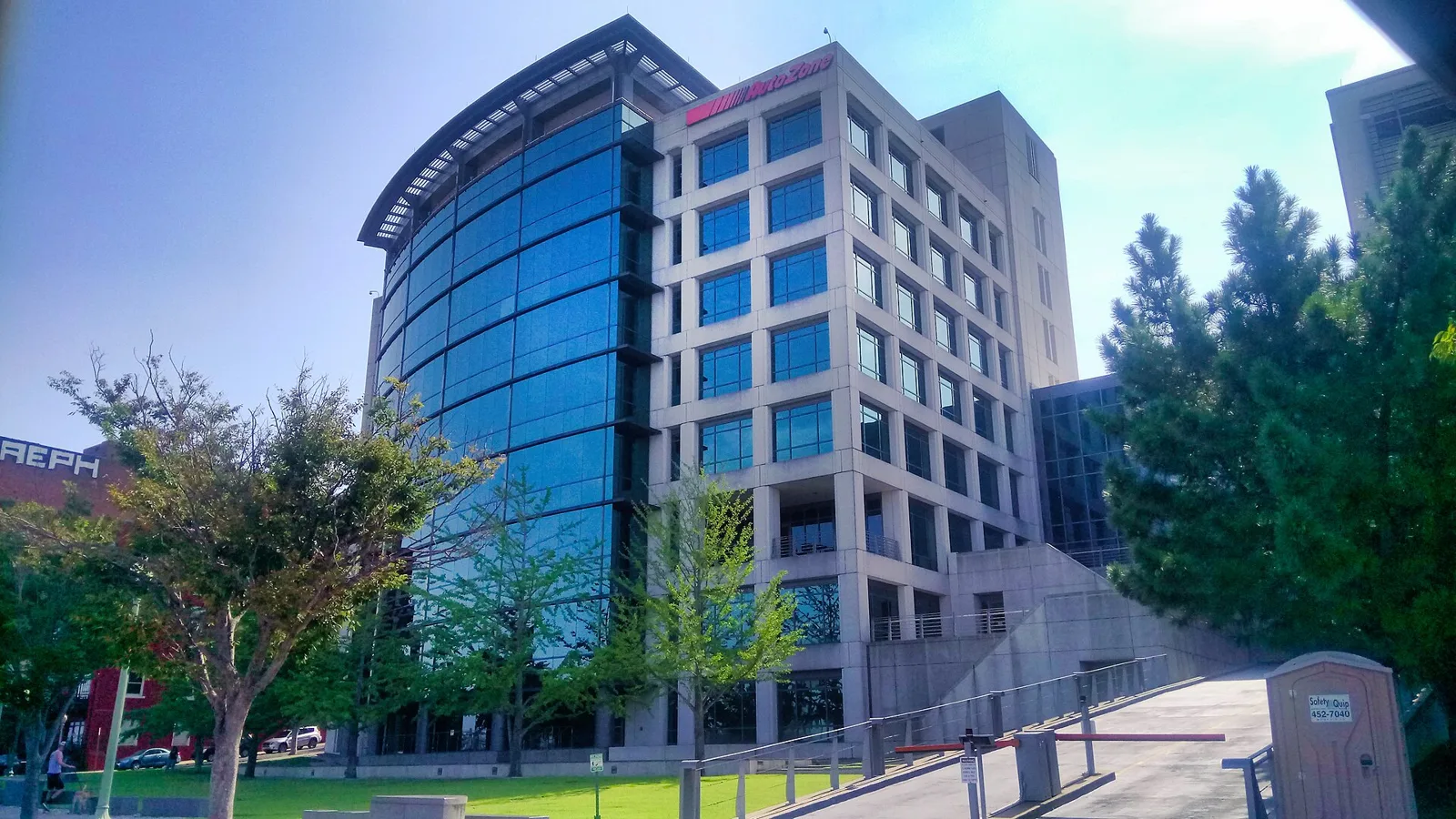
The company's Memphis headquarters tells its own story of scale. The J.R. Hyde III Store Support Center, in use since October 1995, is an eight-storey building of 270,000 square feet (25,000 m2) with a base isolation system, costing $950,000, built to withstand a magnitude 9.0 earthquake.
How did O'Reilly grow from one store in Springfield?
Charles F. O'Reilly and his son Charles H., known as Chub, opened O'Reilly Automotive in Springfield, Missouri, on 2 December 1957. It began with one store and 13 employees, and sales in 1958 came to $700,000.
The family had a long link with the trade. Michael Byrne O'Reilly emigrated from Ireland in 1849. His son Charles Francis began in 1914 selling on the road for a St. Louis firm, Fred Campbell Auto Supply and by 1932 was managing Link Motor Supply in Springfield, where Chub joined him. When Link planned a reorganisation in 1957 that would retire the 72-year-old father and move Chub to Kansas City, the pair chose to start their own firm instead.
Combined sales with the Ozark Automotive Distributors division, which served independent jobbers, reached $1.3 million in 1961. By March 1975 volume had risen to $7 million, a 52,000-square-foot warehouse had been built, and O'Reilly had nine stores, all in southwestern Missouri. The company listed on NASDAQ on 23 April 1993 under the symbol ORLY and offers employees a stock purchase plan.
What did O'Reilly buy on the way up?
Acquisitions did most of the work. The Hi/LO Auto Supply merger of 30 January 1998 added 182 stores in Texas and Louisiana and put the company among the top 10 chains. KarPro followed in 2000 with 14 stores and a distribution centre in Little Rock.
Mid-State Automotive Distributors, bought in 2001, brought 82 stores in seven states and two distribution centres, which lifted O'Reilly into the top five. Midwest Automotive Distributors added 72 locations in 2005. The largest deal came on 11 July 2008, when O'Reilly bought CSK Auto and gained 1,273 stores in 12 states. Combined with earlier purchases, that made it the third largest chain behind Advance and AutoZone.
Later purchases pushed outwards. VIP Parts, Tires and Service, with 56 stores in Maine, New Hampshire and Massachusetts, took the company into New England in December 2012. The Pittsburgh market came with Frank's Auto Supermarket in 2016, followed by the 51-store Bond Auto Parts chain, and in November 2018 O'Reilly announced the 33-store Bennett Auto Supply in Florida.
Its first move abroad came in August 2019, when it agreed to buy Mayasa Auto Parts of Mexico, which had five distribution centres, 20 company-run stores and over 2000 independent jobber outlets. Puerto Rico followed in May 2023. In December 2023 the Mexican stores were rebranded O'Reilly Autopartes, and O'Reilly announced it would buy Vast-Auto of Montreal, which ran 23 company-owned stores, opening the Canadian market.
How did Advance Auto Parts begin, and what did it absorb?
Arthur Taubman bought the Advance Stores from Pep Boys in April 1932: two in Roanoke, Virginia, and one in Lynchburg. The company is now based in Raleigh, North Carolina, and serves professional installers and do-it-yourself customers.
Its first major expansion came in 1998 with the remaining Western Auto operations, most of which Sears had taken over in 1987. In 2001 it bought Carport Auto Parts, a regional chain of 29 stores in Alabama and Mississippi, and then Discount Auto Parts, with 671 stores across five southern states. That second deal made Advance a public company listed on the New York Stock Exchange as AAP, finishing the year at 2,484 stores in 38 states. In July 2002 a bankruptcy court approved a purchase of 57 Trak Auto stores.
The Carquest brand arrived through two steps. BWP Distributors, a Carquest franchise for New England, came in December 2012 with 124 company-owned stores and two distribution centres. In October 2013 Advance agreed to buy General Parts International, the supplier behind the Carquest and WorldPac brands, and the deal closed on 3 January 2014. The company described the result as the largest aftermarket parts provider in North America.
Advance also bought brand power. In December 2019 it paid $200 million in cash to buy the DieHard battery name from Sears and promoted it with a film starring Bruce Willis. Its other owned battery brand is Argos. The company moved its headquarters from Roanoke to Raleigh, and since 2020 it has occupied a tower in the North Hills area.
How did Pep Boys begin, and why does it no longer sell parts?
Four friends each put in $200 in August 1921 to open one auto-parts store in Philadelphia, calling it Pep Auto Supply Company. By December 2023 the company had finished moving away from retail to concentrate only on automotive services.
The Pep name came from a shipment of Pep Valve grinding compound that the founders noticed on the shelves. The Pep Boys nickname is credited to a local police officer who, on stopping drivers without lights at night, would send them to Pep for a new oil wick, the kind of lamp used before electric headlights. After a trip to California, Moe Strauss admired a dress shop named Minnie, Maude and Mabel's, and the firm became The Pep Boys - Manny, Moe & Jack. The founders commissioned the caricatures that remain the logo. Jack Jackson left in 1927 and Isadore (Izzy) Strauss took his place in the artwork, although the name kept its reference to Jack.
The Great Depression barely dented the firm. Manny and Moe carried no business debt beyond reasonable mortgages on store properties, and they laid off nobody and cut no salaries. In 1933 Murray Rosenfeld opened the first West Coast store, and within three years the California company had 11. Pep Boys went public in 1945. By 1969 each store had added service bays and service managers, and the 1980s brought the supercenter format, a listing on the New York Stock Exchange and more than $2 billion in annual sales.
The 2010s were messier. A 2012 agreement to be sold to The Gores Group at $15 per share, about $1 billion, collapsed four months later. In October 2015 Bridgestone Retail Operations agreed to buy the company for $835,000,000, but Pep Boys cancelled that in December and signed with Icahn Automotive Group instead. Icahn completed the cash purchase in February 2016 at $18.50 per share, about $1.03 billion. By 2016 the company ran over 9,000 service bays in 35 states plus Puerto Rico, and in 2017 it bought the 134-store Just Brakes chain.
From early 2021 parts and service were split into two companies, with the parts side run as Auto Plus Auto Parts. Auto Plus filed for Chapter 11 bankruptcy on 31 January 2023, and Pep Boys emerged as a separate service business. Its headquarters are in Bala Cynwyd, a suburb of Philadelphia.
How the four chains compare
| Chain | Start | Base | Footprint in the latest figures | Today |
|---|---|---|---|---|
| AutoZone | Opened 1979 as Auto Shack | Memphis, Tennessee | 7,657 outlets at 30 August 2025, in the United States, Mexico and Brazil | Parts retailer, all stores company-owned |
| O'Reilly Auto Parts | Opened 1957 | Springfield, Missouri | Over 6,400 stores across 48 states, Puerto Rico, Mexico and Canada (March 2025) | Serves professionals and do-it-yourself customers |
| Advance Auto Parts | 1932 purchase of three Pep Boys stores | Raleigh, North Carolina | 523 corporate stores and 204 independent locations marked for closure in November 2024 | Serves professional installers and do-it-yourself customers |
| Pep Boys | Opened August 1921 | Bala Cynwyd, Pennsylvania | Nearly 800 locations at the time of the 2026 sale agreement | Automotive service only since December 2023 |
What do these chains offer someone who fixes their own car?
The record points to a few services built around the home mechanic. AutoZone's Loan-A-Tool scheme dates to 1986, and its electronic catalogue lets staff look up parts, warranties and local stock. The company added a Buy Online Pick-Up In-Store service in 2010, free curbside collection for those orders in March 2020, and next-day home delivery of 100,000 products in 83 US markets in September 2018, widened to 95 markets by the end of that year.
Own-brand goods are the other thread. AutoZone sells under Valucraft and Duralast, with its batteries made mainly by Johnson Controls. Advance carries DieHard and Argos batteries. ALLDATA, an AutoZone unit that supplies diagnostic and repair information, widened its direct Canadian presence in December 2011.
Pep Boys has moved the other way. Where it once sold parts across the counter, it now offers tyres, maintenance and repair, fleet work and a Mobile Crew service trailer that carries out maintenance at the customer's location. In 2019 it added smaller fleet vans to that crew.
What has gone wrong for the chains along the way?
Growth brought legal bills. AutoZone paid $1.5 million to settle a 2005 case brought by California prosecutors over used oil handling and overcharging, and in June 2019 it agreed an $11 million settlement with California over hazardous waste and materials and the handling of customers' confidential data. Pep Boys agreed in September 2019 to pay $3.7 million over claims of illegal hazardous-waste disposal in California. Advance reported in July 2024 a data breach in which personal details of nearly 3 million people were stolen, part of a wider campaign against customers of a data-platform provider.
Where this goes next
Advance is in the middle of the biggest reshaping. Its November 2024 plan closes four distribution centres, 523 corporate stores and 204 independent locations, and it expected the overhaul to cost between $350 million and $750 million. All California stores were shut as of March 2025. WorldPac had earlier gone to Carlyle, an investment firm, for $1.5 billion, with the sale closing on 4 November 2024.
Pep Boys faces a change of owner. Icahn Enterprises agreed in July 2026 to sell it to Mavis Tire, for roughly US$700 million in cash. Nearly 800 Pep Boys locations would join Mavis, lifting its network beyond 4,400 service centres in the US and Canada. Both sides expected completion within several months, once ordinary closing conditions were met.
AutoZone is still building hubs, with more than 100 mega hubs open by May 2024, and Phillip Daniele has been chief executive since January 2024. O'Reilly, meanwhile, has moved into Puerto Rico, Mexico and Canada, and became title sponsor of the NASCAR O'Reilly Auto Parts Series in 2026.