A Marine pilot, a cost-cutter, a salesman and a newspaper editor each reached the top floor of a car company, and each left a mark on what ended up in showrooms and on grids.
Bob Lutz held senior posts at Ford, Chrysler and General Motors. Jacques Nasser was Ford's president and chief executive from 1999 to 2001. Roy Abernethy ran American Motors as president from 1962 to 1967. Walter Hayes was Ford's public relations chief and backed the Cosworth DFV engine.
Exactly one of these four men held a senior post at all three of America's Big Three carmakers, and he got there after flying for the Marines and selling vacuum cleaners to fund an MBA. That man is Bob Lutz. The others were a student intern who became Ford's chief executive, a mechanic's apprentice who ran American Motors, and a newspaper editor who built Ford's racing programme.
Who were Bob Lutz, Jacques Nasser, Roy Abernethy and Walter Hayes?
| Executive | Main employer | Senior role | Years in that role |
|---|---|---|---|
| Bob Lutz | Chrysler, GM and Ford | Chrysler president and chief operating officer; GM vice chairman | Chrysler 1986 to 1998; GM 2001 to 2010 |
| Jacques Nasser | Ford | President and chief executive | 1 January 1999 to October 2001 |
| Roy Abernethy | American Motors Corporation | President | 12 February 1962 to 9 January 1967 |
| Walter Hayes | Ford | Head of Ford UK public relations; vice-chairman of Ford of Europe | January 1962 to December 1989 |
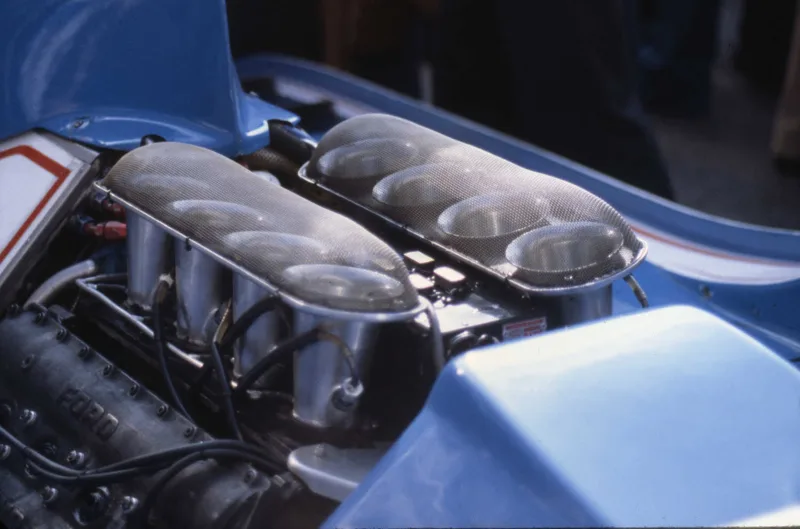
A newspaper editor turned press officer backed a 100,000-pound engine that had 155 race wins by 1983.
Who is Bob Lutz and which Big Three jobs did he hold?
Robert Anthony Lutz was born in Zurich on 12 February 1932, the son of a Credit Suisse vice chairman, and moved to the United States aged seven. He took an MBA at Berkeley in 1962, was a naval aviator with the Marines from 1954 to 1959, and kept flying in the reserve while selling vacuum cleaners in Walnut Creek to support two of his four young daughters.
His car career began at General Motors in September 1963, and he stayed in Europe until December 1971, eight years with GM Opel. BMW followed: as executive vice president of sales and marketing in Munich from 1971 to 1974 he sat on the management board. He takes some credit for the BMW 3 Series and for the Motorsport division.
Lutz at Ford and Chrysler
From 1974 to 1986 he worked for Ford. His last job there was running truck operations as an executive vice president, and he also chaired Ford of Europe and led Ford International Operations. In Europe he drove the third-generation Escort and the Sierra, and once back in the United States in 1985 he started development of the original Explorer.
Chrysler hired him in 1986 as executive vice president and promoted him onto its board soon afterwards. He ran its car business from sales and marketing through to manufacturing and the supplier base, and became president and chief operating officer for cars and trucks worldwide. His global product development remit produced the Dodge Viper and the LH cars.
Lee Iacocca later said he should have picked Lutz rather than Bob Eaton as his successor when he retired at the end of 1992, though at the time the two were not getting along. Eaton went on to oversee Chrysler's sale to Daimler-Benz in 1998, which Daimler reversed in 2007 by selling to Cerberus Capital Management. Lutz moved on in 1998 to chair Exide Technologies and serve as its chief executive.
Lutz at General Motors
GM took him back on 1 September 2001 as its product development vice chairman, and he was made chairman of GM North America that November. From April 2005 he also took charge of global product development, and for a few months of 2004 he stood in as president of GM Europe. Cars credited to his initiatives include the Pontiac GTO, which was the Holden Monaro imported to America, the Pontiac Solstice and Saturn Sky, the Chevrolet Camaro and the Cadillac CTS. He also backed the 2010 Chevrolet Volt, and in 2008 he called the electrification of the car inevitable.
In February 2009 GM announced that he would step back from product development on 1 April 2009 and take an advisory role. He pointed to the regulatory climate in Washington, which he said would push GM to build what officials wanted rather than what drivers wanted. By July 2009 he was vice chairman for marketing and communications, reporting to Fritz Henderson. He retired from GM on 1 May 2010, and GM retained him again in September 2011.
How did Jacques Nasser go from Ford intern to chief executive?
Jacques Nasser was born in Amioun, Lebanon, on 27 December 1947, and grew up in Melbourne after his family moved when he was four.
With a business degree from RMIT in 1968, he joined Ford at 20 as a financial analyst in Australia. Postings in the United States, Asia-Pacific and Latin America followed, and in Argentina he was kidnapped by political extremists and handed back at the Ford plant two days afterwards. In 1987 he became first director and vice president of Autolatina, the Ford and Volkswagen venture in Brazil and Argentina. Ford Australia gave him the top job from 1989 to 1993, where cost-cutting earned him the nickname Jac the Knife. He chaired Ford Europe from 1 January 1993, took group responsibility for product development in 1994 and began heading Ford Automotive Operations on 1 November 1996.
Nasser as Ford's chief executive
Fortune had called him heir apparent to chief executive Alex Trotman in June 1998. He took over as president and chief executive on 1 January 1999 while Bill Ford became chairman. Ford was then described as the world's most profitable automaker, earning $7.2 billion on sales of $163 billion, and Nasser had licence to experiment. According to The Economist, he wanted Ford to become a consumer-products and services company.
Loss-making plants were closed, and he set a policy allowing the weakest 10 percent of managers to be dismissed. In 1999 Ford created the Premier Automotive Group for its upmarket marques, and Nasser hired the designer J Mays. He also bought into the Kwik Fit chain in Europe, American scrapyards and Mazda's consumer-finance arm, because, as The Economist put it, carmakers were lucky to scrape an operating margin above 5 percent from building cars, while finance and repair could earn 10 to 15 percent. The Ford Focus went on sale in North America in October 1999 as a 2000 model.
The Firestone recall
Tyres ended the run of good news. An investigation in early 2000 linked tread separation on Firestone tyres to deaths in some Ford Explorers, and Nasser went on prime-time television to announce a recall. Firestone argued that the Explorer, not its rubber, caused the crashes, and Nasser called the Explorer one of the safer SUVs on sale. On 6 September 2000 he and Bridgestone's Masatoshi Ono faced a Congressional sub-committee.
On 22 May 2001 Bridgestone's chief executive cancelled the 100-year supply relationship. Ford spent AUS$4.4 billion of its own money replacing Firestone tyres, and the affair helped drive a sharp dip in its 2001 quarterly share prices. His manager evaluation system also drew allegations of reverse discrimination, and Ford settled several lawsuits without admitting liability. In October 2001 Nasser retired, and William Clay Ford Jr, Henry Ford's great-grandson, took over both of his positions.
What did Roy Abernethy do at American Motors?
Roy Abernethy was born on 29 September 1906 in Monterey, Pennsylvania. His first job was looking after mules at a coal mine. He joined Packard in 1926 as an apprentice mechanic on 18 cents an hour, later sold US$1 million of its cars in one year from a dealership in Hartford, Connecticut, and became vice president of sales at Willys before American Motors hired him in 1954.
American Motors was created on 1 May 1954, after Nash Motors and Hudson agreed to merge. As vice president of sales Abernethy first signed up every existing Hudson and Nash dealer as an AMC outlet, because he saw advertising as useless without a strong dealer body. He flew 50,000 miles (80,000 km) a year to build AMC's name as the compact car company, and by 1962 Rambler ranked third in US sales among all brands.
On 12 February 1962 the board picked Abernethy, then 56, to succeed George Romney, who resigned to become governor of Michigan. For the first time the president's job was separate from the chairman's. Abernethy ran day-to-day operations, while Richard E. Cross became chairman and was called chief executive officer. The company was strong: working capital had grown from $46 million in 1957 to $103 million, and sales had passed $1 billion (422,273 units) in 1960.
Abernethy and the Rambler image
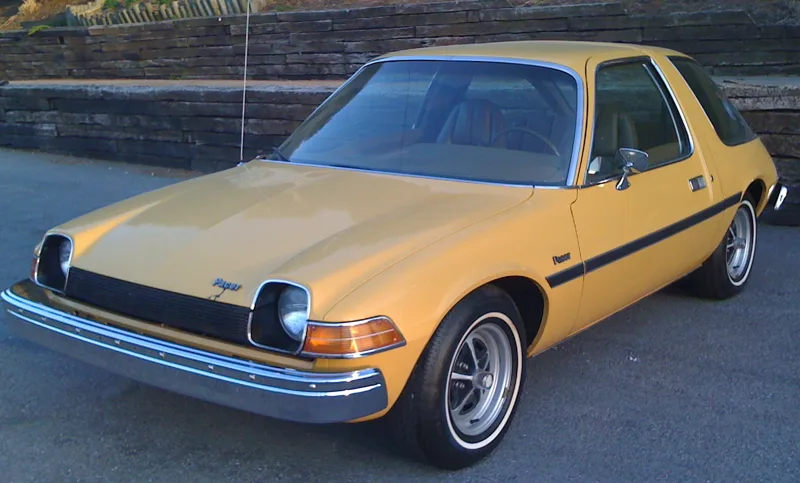
AMC kept to the industry's racing ban, and its advertising said the only race Rambler cared about was the human race. Even so, a 287 cu in (4.7 L) V8 became an option on the Rambler Classic in mid-1963, and the fastback Rambler Marlin arrived midway through the 1965 model year.
Abernethy, a 237 lb (108 kg) man who smoked ten cigars a day, wanted more. He believed AMC could meet Ford, Chevrolet and Plymouth head to head if it dropped its economy-car label. He called the main problem image lag, moved the Ambassador upmarket and scrapped Romney's plan for parts sharing across the range. The 1965 cars were sold as the Sensible Spectaculars.
For a while the numbers backed him: Ambassador sales climbed from 18,647 in 1964 to over 64,000 in 1965 and more than 71,000 in 1966. But earnings per share of 27 cents were the lowest since 1958, and the 1966 annual report went out in a plain brown wrapper. Sales fell by a fifth in the first half of 1966, and Robert B. Evans put in more than US$2 million, became the largest shareholder and was named chairman. A fresh design for 1967 added $60 million in tooling costs, along with a guarantee of five years or 50,000 miles (80,000 km) on engine and drivetrain, described as the strongest backing from any carmaker up to that time.
Abernethy took early retirement on 9 January 1967, and Evans left with him. William V. Luneburg became president, and the new management promptly took AMC racing, hiring Carl Chamakian as Performance Activities Director to attract younger buyers.
What did Walter Hayes do at Ford?
Walter Hayes came into the world in Harrow on 12 April 1924, the eldest child of a lithographer, and trained as a cadet pilot in the RAF. His father's trade smoothed his way into Fleet Street, where he reached the post of Daily Mail associate editor, then, in 1956 at 32, the final editor of the Sunday Dispatch. A motoring column brought him together with Lotus owner Colin Chapman.
In January 1962 Ford asked him to head its UK public relations. Ford's range was dour but reliable, built around cars like the Cortina and Zodiac, and Hayes decided that competition was the way to change its image. In his first weeks he backed Tony Brookes's attempt on six International class G records at Montlhery with a 105E Anglia, and two years later the same team collected 13 International class F records at Monza in a Corsair GT.
Taking on Ferrari and signing Jackie Stewart
When Ferrari turned down a proposed Ford takeover, Hayes joined the team behind Henry Ford II's plan to take on Ferrari in racing instead. A Lotus agreement produced an Indianapolis 500 programme, and Lola built the prototype Ford GT40s. At the 1964 British International Motor Show he also approached the unknown Scottish driver Jackie Stewart, and later offered him 500 pounds to promote Ford products in 1965, plus the white Zodiac from the stand.
The Cosworth DFV
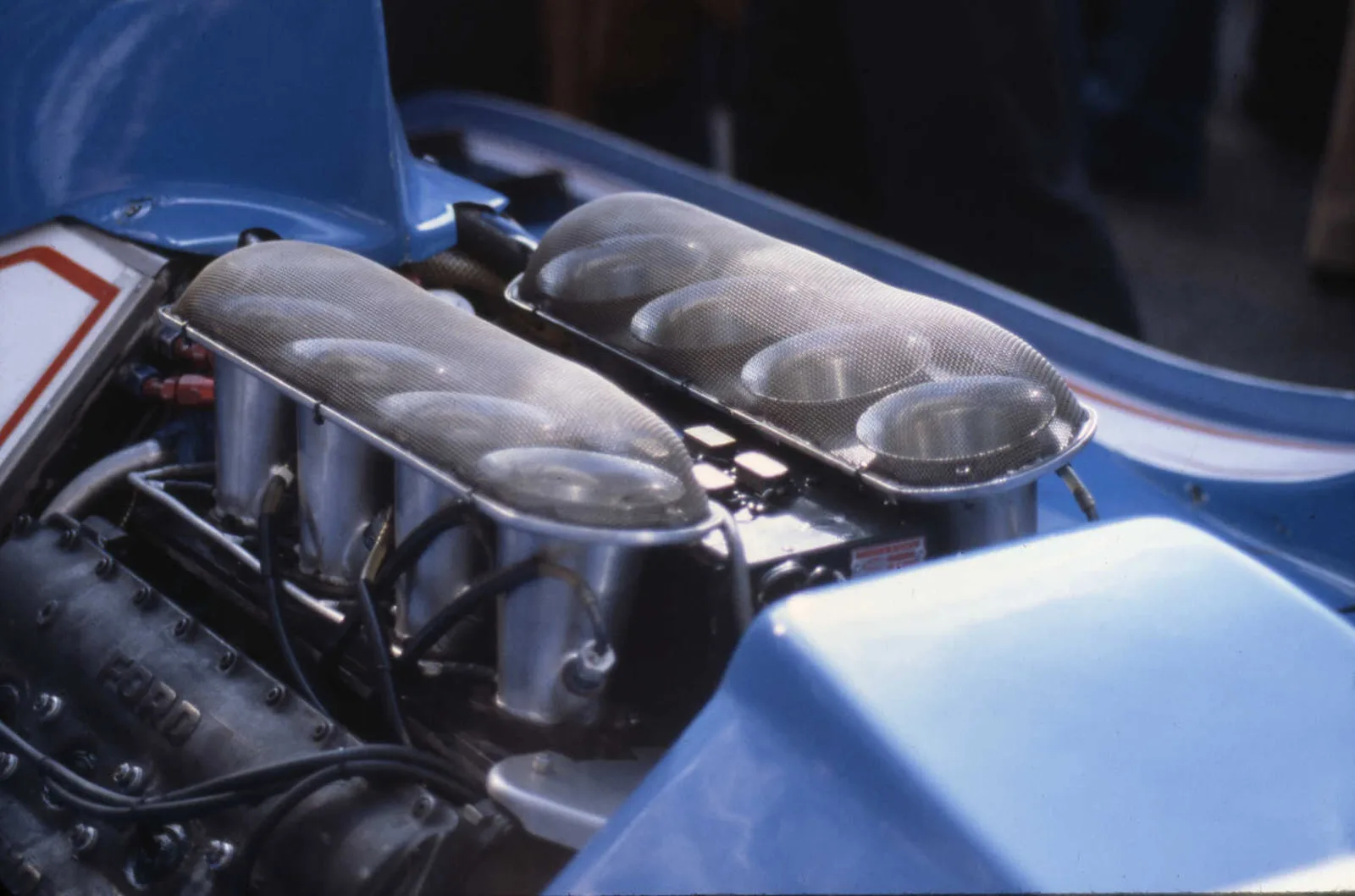
Formula One moved to three-litre engines for 1966, and Coventry Climax, which supplied Chapman, chose not to build one. Cosworth's Keith Duckworth said he could build a competitive engine for a development budget of 100,000 pounds. Chapman tried Ford first, without success.
Hayes arranged a dinner for Chapman with Harley Copp, the American engineer who had backed Ford's NASCAR entry in the 1950s. The two produced a plan that Ford UK chairman Stanley Gillen supported and Detroit approved in two stages: a four-cylinder twin-cam Formula Two unit, then by May 1967 a Formula One V8. In return Chapman would engineer special models for Ford, beginning with the Lotus Cortina.
The DFV won first time out, in the Dutch Grand Prix on 4 June 1967, in Jim Clark's Lotus 49. The original deal tied Ford, Cosworth and Lotus together, with no plan to supply other teams. Hayes looked at the opposition, from a weak Ferrari and a heavy BRM to the unreliable Maserati, and concluded that Ford's name could suffer unless the engine spread. Chapman agreed to release it, and the first customer was Matra, run by Ken Tyrrell with Stewart driving.
Tyrrell won the 1983 Detroit Grand Prix with a DFV, the engine's 155th race victory. Hayes had told Henry Ford II at the outset that it stood a fair chance of winning a World Championship. It went on to power champions including Stewart, Emerson Fittipaldi and James Hunt, and it won constructors' titles for Lotus, Matra, Tyrrell, McLaren and Williams.
Ford of Europe, Detroit and Aston Martin
Henry Ford II rewarded the success by putting Hayes on the board of Ford of Europe when it was founded in 1967. Hayes became its vice-chairman in 1976, and in 1980 he moved to Detroit as a vice-president of the American parent to lead public affairs, launching new motorsport programmes including the IMSA GTP projects.
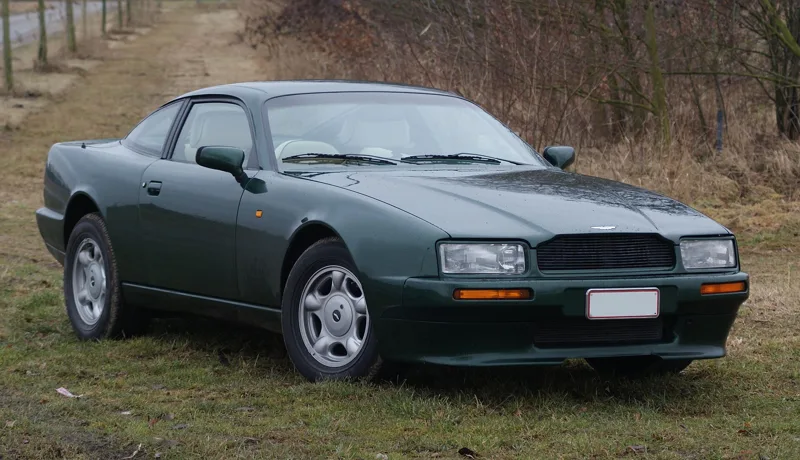
Back in Britain, he met Aston Martin's backers at a Mille Miglia revival in May 1987, and Ford took a shareholding that September. He had steered Ford into buying AC Cars, then a stake in Aston Martin, and then Jaguar. Hayes left Ford of Europe that December.
At Aston he saw a need for a cheaper, higher-volume car, and the DB7 was planned under his guidance. It followed in 1993, based on the Jaguar XJS and engineered by Tom Walkinshaw's TWR Group, and it lifted output by 500 percent. Ford opened a new factory at Bloxham in 1994, and Hayes retired again. He died on 26 December 2000. Stewart called him probably the greatest public relations officer the industry ever had.
Which cars did these car company executives put on the road?
- Lutz: the Dodge Viper, the original Explorer, the Escort and Sierra in Europe, the Pontiac GTO, the Camaro and the Volt.
- Nasser: the Premier Automotive Group, Volvo and Land Rover, and the Ford Focus in North America.
- Abernethy: the Rambler Marlin, the revised Ambassador and Rebel, and the five-year engine and drivetrain guarantee.
- Hayes: the GT40 programme, the Cosworth DFV, the Lotus Cortina and the Aston Martin DB7.
Where did Bob Lutz and Jacques Nasser go next?
Lutz founded Lutz Communications in 2010 and was still running it in 2021. He chaired VIA Motors from 2011, started VLF Automotive with Gilbert Villarreal in 2013, and received an Edison Achievement Award in 2015. In late 2017 he wrote in Automotive News that large fleets, the end of dealerships and eventually a ban on people driving were coming.
In 2002 Nasser joined One Equity Partners as a senior partner and sat on the Sky board until November 2012. He joined BHP Billiton's board in June 2006 and became chairman on 13 March 2010, succeeding Don Argus after an 18-month search. Ken MacKenzie took over from 1 September 2017. Nasser has been on the Koc Holding board since 2015, and from March 2019 on Fox Corporation's board as lead independent director.