A roofless prototype built with Williams, a production-based GT car and a hybrid V8, each BMW's answer to endurance racing in its own era.
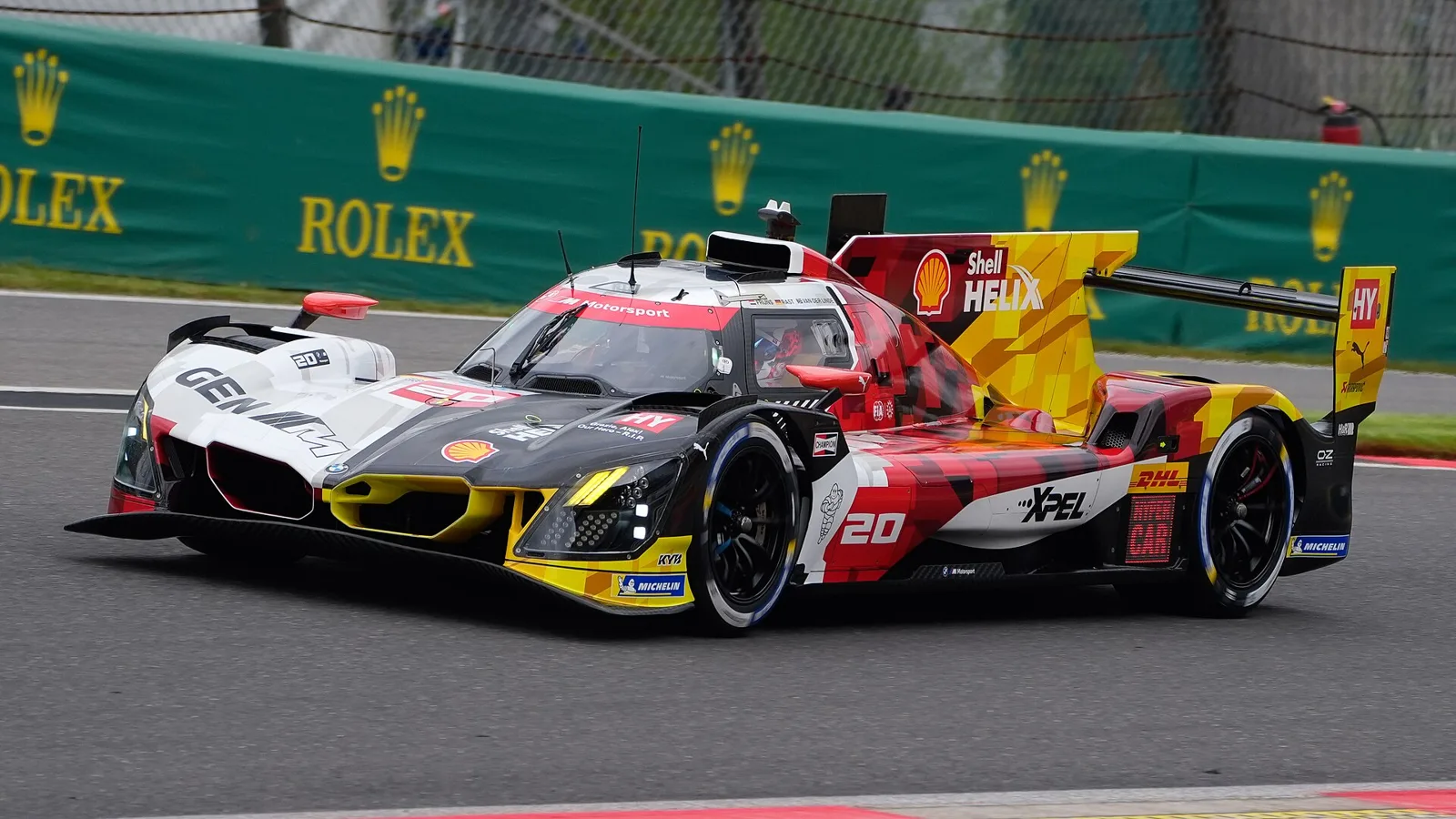
The BMW V12 LMR won the 1999 24 Hours of Le Mans, BMW's only overall victory there to date. The M8 GTE was a GT car that raced from 2018, and the M Hybrid V8 is a Dallara-built LMDh prototype that raced in IMSA from 2023 and the World Endurance Championship from 2024.
BMW has won the 24 Hours of Le Mans outright exactly once, in 1999, with a roofless prototype that was retired a year later. The BMW V12 LMR is still the only car to have given the marque overall victory at Le Mans, and its record frames everything BMW has done in endurance racing since. Two later cars, the M8 GTE and the M Hybrid V8, belong to very different categories, and each tells its own story about how BMW has returned to the sport.
Why did BMW build the V12 LMR?
The V12 LMR was a Le Mans Prototype built for 1999 and 2000 as a joint project of BMW Motorsport and Williams Racing. It was the successor to the BMW V12 LM, which had been a failure. At the 1998 24 Hours of Le Mans both V12 LMs failed to finish, hit by mechanical problems and held back by poor aerodynamics. BMW Motorsport decided at once to revamp the programme radically and replace the car for 1999.
The new car kept only the basic structures of the old one, with all bodywork redone from scratch. Cooling ducts, a big problem on the V12 LM because they drew in hot air from beneath the car, moved to the top. Among the more radical ideas was a small roll hoop behind the driver's seat only, rather than a wide hoop covering the whole cockpit, which exploited a loophole in the ACO's prototype rules and cut drag and obstruction for air flowing to the rear wing. Williams Racing built four new chassis in Britain. The engine stayed the BMW S70/3 V12 of 5990 cc used in the V12 LM, and Schnitzer Motorsport ran the team at Le Mans and in the new American Le Mans Series.
BMW has won the 24 Hours of Le Mans outright exactly once, in 1999, with a roofless prototype that was retired a year later.
How the V12 LMR won Le Mans in 1999
The car debuted at the 12 Hours of Sebring with a two-car team and took pole. Both cars ran near the front for the first six hours, then chassis #001 had a big accident that ended its career, and the other V12 LMR won overall.
BMW took what it learned to Europe. At the first Le Mans test in early May three V12 LMRs appeared, one wearing a paint job by the artist Jenny Holzer in the tradition of the BMW Art Cars. Unlike at Sebring, the LMRs faced closed-cockpit prototypes, which were theoretically quicker over a single lap but less economical with fuel. Even so, a V12 LMR set the fourth-fastest lap in practice, trailing only a Panoz and a pair of Toyota GT-Ones.
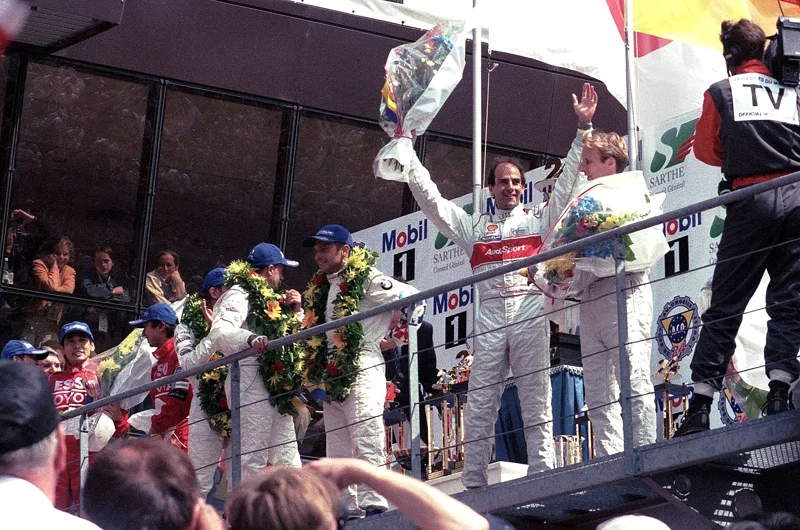
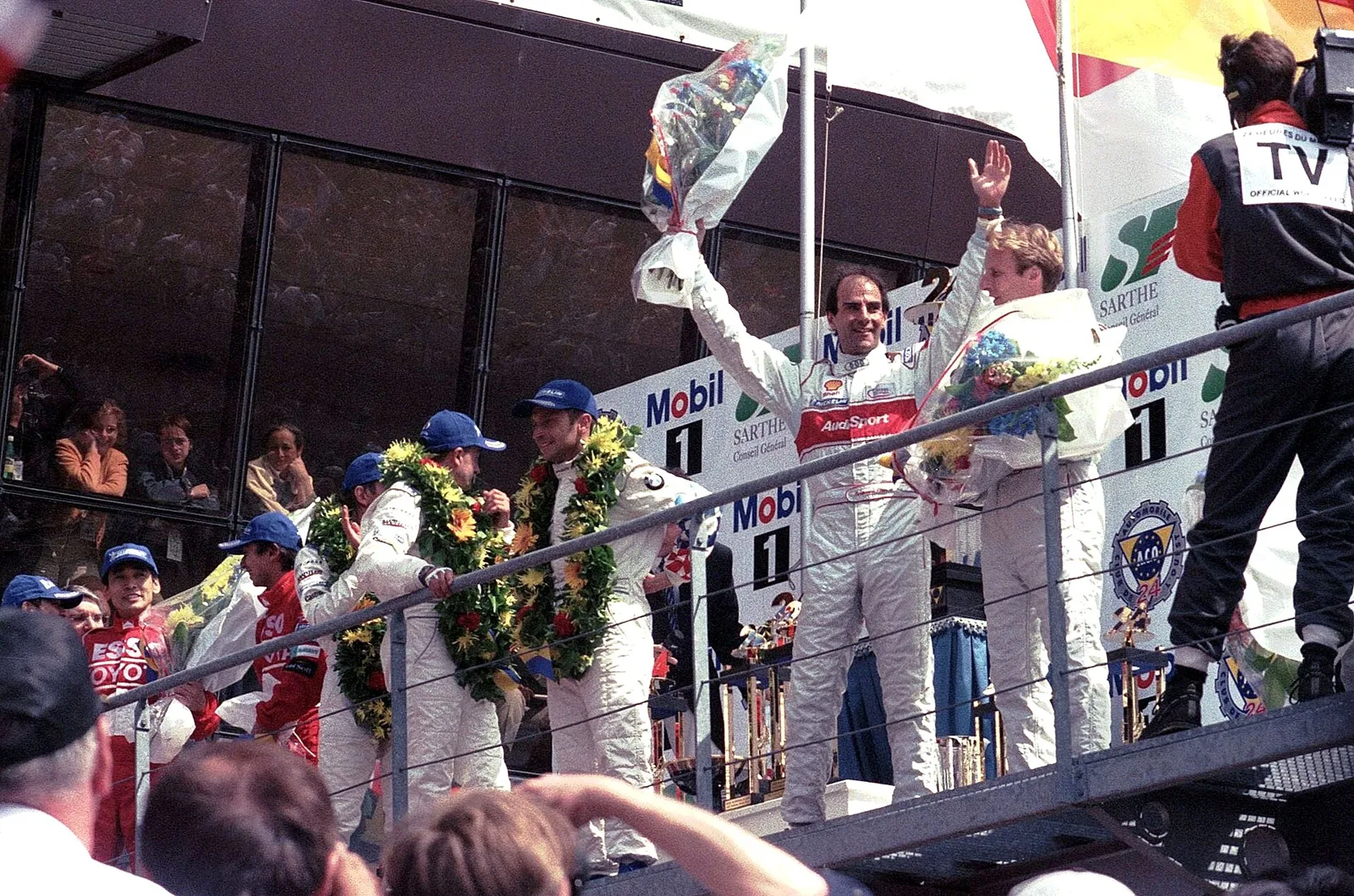
Only two cars started the race, as the Art Car was dropped. They qualified third and sixth, beaten only by the Toyotas, and ran strongly while many closed-cockpit rivals, among them entries from Mercedes-Benz, Nissan, Toyota and Audi, ran into trouble. In the second half the main opposition was two Audi R8Rs, also open-topped, and the last Toyota GT-One still running. As the race entered its final hours the #17 BMW, driven by JJ Lehto, crashed heavily at the Porsche Curves after its throttle stuck, leaving the #15 in front by less than a lap. The Toyota was closing in until it suffered a tyre blowout at high speed, and Joachim Winkelhock, Pierluigi Martini and Yannick Dalmas brought the BMW home a lap clear.
The V12 LMR is estimated to have made about 580 hp, enough to reach 342 km/h (214 mph) on the Mulsanne Straight in 1999. After Le Mans the team went back to North America and won at Sears Point, then took two more wins in the final four races but lost twice to the American Panoz prototypes. BMW had skipped two ALMS races to go to Europe after Sebring, and it lost the teams' title to Panoz by two points.
The V12 LMR in 2000: Formula One takes over
Through its Williams link BMW entered Formula One in 2000 as an engine supplier. The company decided to put its efforts into Formula One's worldwide exposure and not to defend at Le Mans, but it ran a full American Le Mans Series season so the cars would not go to waste.
The season began badly at Sebring, where Audi debuted its second-generation R8. The BMWs qualified fifth and sixth and finished third and fourth behind both Audis. For two rounds Audi raced its older R8R, which let BMW win at Charlotte and at Silverstone. At BMW's home race at the Nurburgring a Panoz beat the V12 LMR, although it did beat an Audi R8. After Audi won Le Mans, the BMW could do no better than second in the following four rounds, because the R8 won every one.
At Petit Le Mans BMW brought out the Holzer Art Car, chassis #004, which had only run in the 1999 Le Mans test. Several cars suffered, including one that flipped over backwards and hit the side barriers, as a Porsche 911 GT1 had in the same spot two years earlier. The Art Car was the sole V12 LMR that saw the flag, in fifth. BMW did not win either of the last two North American rounds and skipped the Australian finale, finishing second in the teams' championship behind Audi. No customer ever bought a V12 LMR, in contrast to the V12 LM.
| Car | Category | Engine | Built by | First raced |
|---|---|---|---|---|
| BMW V12 LMR | Le Mans Prototype | 5990 cc V12, about 580 hp | BMW Motorsport and Williams Racing | 1999, Sebring |
| BMW M8 GTE | LM GTE grand tourer | BMW P63/1 turbocharged V8 | BMW Motorsport | 2018, IMSA and WEC |
| BMW M Hybrid V8 | LMDh prototype | Twin-turbocharged V8 with hybrid parts | Designed by BMW M, built by Dallara | 2023, Daytona |
BMW M8 GTE: a ground-up GT car
The M8 GTE is an endurance grand tourer developed from late 2016 and based on the road-going BMW M8. It replaced the M6 GTLM at the end of 2017 and made its public bow at the Frankfurt Motor Show on 12 September 2017. Design work started in mid-2016, the first chassis came together in June 2017 and the first complete car followed in July. The car made its competitive debut in the 2018 IMSA season and the World Endurance Championship, which marked BMW Motorsport's return to the 24 Hours of Le Mans following six years away.
It was the first car BMW Motorsport built from the ground up as a homologated LM GTE vehicle instead of adapting an existing design. Additive manufacturing was used for rapid prototyping of components, and a transaxle combined the transmission, driveshaft and axle assembly into one unit to balance weight from front to rear. Power came from the front-mid mounted BMW P63/1, a turbocharged V8 and the motorsport version of the S63 engine in the F90 M5 and the 8 Series.
BMW M Hybrid V8: back in the top class
BMW M designed the M Hybrid V8, a sports prototype that Dallara builds to the LMDh rules. It debuted in the 2023 IMSA season at the 24 Hours of Daytona and has contested the World Endurance Championship since 2024. It put BMW back at the top level of prototype racing for the first time since 1999 and the V12 LMR.
BMW announced in June 2021 that it would enter IMSA's GTP class in 2023. Three months later it named Dallara as chassis supplier, the first LMDh manufacturer to pick Dallara as its partner. In November 2021 it confirmed Rahal Letterman Lanigan Racing to run the cars in IMSA, a relationship that dated to the BMW M3 GT2 of 2009. The engine is a twin-turbocharged V8 developed from the unit in the BMW M4 DTM car of 2017 and 2018, and the standardised hybrid hardware comes from Williams Advanced Engineering, Bosch and Xtrac. BMW said in August 2022 that it would also enter the World Endurance Championship, with Team WRT operating the cars. Late July 2022 saw the first shakedown, at Varano de Melegari, and testing then moved on to Barcelona, Watkins Glen, Road Atlanta and Sebring.
BMW M Hybrid V8 in 2023: first podiums and a first win
Daytona was a hard start. Both Rahal Letterman Lanigan cars hit problems with the hybrid system, brakes and electrics, although the #24 still finished in the top six. At Sebring, the #25 crew of Nick Yelloly, Sheldon van der Linde and Connor De Phillippi recovered after a brake change and benefited from a crash between an Acura and two Porsches to take second. De Phillippi added another second place at Long Beach, passing a Porsche and gaining a place when Ricky Taylor crashed on the penultimate lap.
Victory first arrived at Watkins Glen. A better strategy let De Phillippi lead with 40 minutes remaining, but Mathieu Jaminet passed him in the final minutes in the #6 Porsche, shortly before the race ended behind the safety car. A post-race penalty for illegal skid block wear put the Porsche out of the result, and the #25 BMW inherited a maiden victory. BMW had not won in a prototype since the American Le Mans Series round at Silverstone in 2000. Two further podiums followed, at the Chevrolet Grand Prix on an alternative strategy and at the Battle on the Bricks, where the #25 jumped a Cadillac in the final round of pit stops. BMW also tested with Team WRT at MotorLand Aragon and Spa-Francorchamps to prepare for the 2024 World Endurance Championship.
2024 and 2025: Le Mans return, Art Car and new drivers
BMW officially joined the World Endurance Championship in 2024. Raffaele Marciello, Dries Vanthoor and Marco Wittmann drove the #15, and Robin Frijns, Rene Rast and Sheldon van der Linde the #20. WRT scored in the car's first outing, the Qatar 1812 km, where the #20 finished tenth.
The return to the 24 Hours of Le Mans in 2024 was the first time the German marque had contested the top class in 25 years. Before the race, the #20 became the 20th car in the BMW Art Car project, carrying the Everywhen painting by the Ethiopian-American artist Julie Mehretu. The car qualified well, but neither BMW reached the finish. Its first WEC podium arrived in Japan, with the #15 second at Fuji.
In IMSA, Jesse Krohn replaced Augusto Farfus in the #24 car, with Farfus moving to BMW's LMGT3 programme in the WEC. The cars started in the midfield and gradually got faster, culminating in a 1-2 finish at the Battle on the Bricks in Indianapolis, the car's second win across IMSA and the WEC.
For 2025 Kevin Magnussen returned to sports car racing with BMW, replacing Wittmann in the WEC and also driving the IMSA Michelin Endurance Cup rounds, and Vanthoor moved to a full-time IMSA seat in place of Krohn. With Vanthoor at the wheel the car took four consecutive poles from Daytona to Monterey, and the #24 finished on the podium at Long Beach and Laguna Seca. In the WEC the #20 equalled the car's best finish with second at Imola.
The Rahal partnership ends and the first WEC win comes in 2026
BMW said in July 2025 that its partnership with Rahal Letterman Lanigan Racing would end after the season. It later showed an updated M Hybrid V8 for 2026, with new front styling, a smaller kidney grille and improved aerodynamics. In 2026 the car scored its first World Endurance Championship victory, a one-two at Spa-Francorchamps in the 6 Hours race, after BMW switched to an alternative strategy following a weak qualifying performance.