From the grey film that does the stopping to the squeal that warns of wear, disc and drum brakes work and wear out in their own ways.
Brake pads are clamped onto a spinning disc and turn a car's motion into heat; drum brakes press shoes outwards inside a drum. Pads are generally inspected every 5,000 miles and replaced around 50,000 miles, discs around 70,000 miles. Squeals and grinding can signal worn brakes.
When a brake pad heats up against a disc, it leaves a dull grey film of its own material on the metal, and the two then grip each other as coated surfaces.
How do disc brakes and brake pads work?
A disc brake slows a car by squeezing two brake pads onto a spinning disc, or rotor. When the driver presses the pedal, hydraulic pressure drives a caliper to clamp the pads against the disc. The friction converts the car's motion into heat, which the disc and pads then release into the air.
The sums explain why this job is so punishing. Kinetic energy rises with the square of speed, so an object moving at 10 m/s carries 100 times the energy it has at 1 m/s. At the traction limit, the theoretical braking distance grows in the same proportion. Everything that energy becomes has to be absorbed as heat by the brakes.
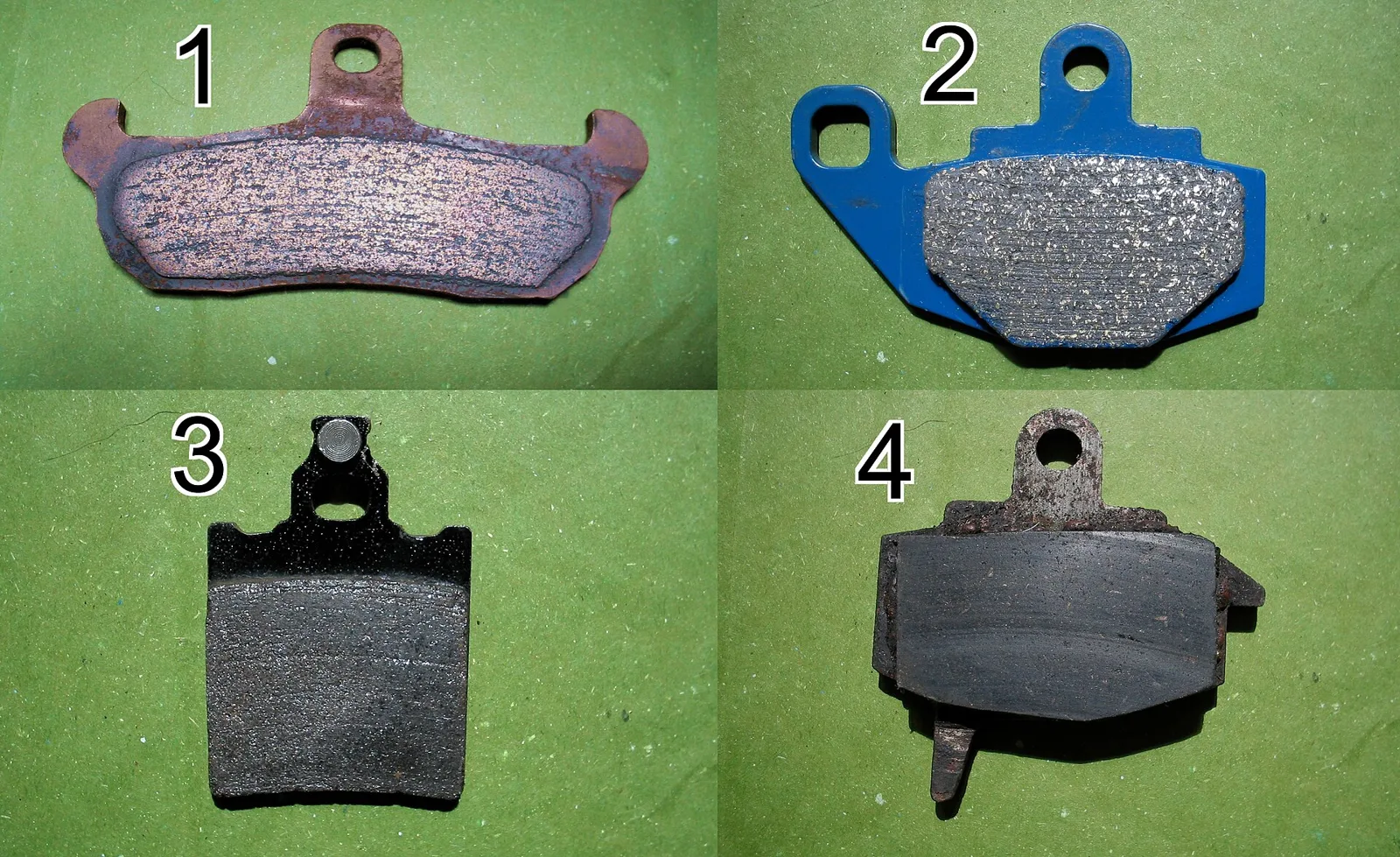
Each pad is a steel backing plate with friction material bonded to the face that meets the rotor. Cars usually have two pads per disc, held and driven by a caliper mounted on the hub or on the suspension upright. Racing calipers can run as many as six pads, with differing friction properties in a staggered pattern to get the best from the disc.
The disc itself is usually cast iron or ceramic, and it is bolted to the wheel or axle. It is the disc that spreads heat, and the pad that is sacrificed to the process.
What are brake pads made of?
Pad makers balance a long list of demands. The material has to resist fade as it heats, cope with moisture, recover quickly, wear slowly without eating the rotor, touch the disc smoothly and stay quiet. Friction coefficients usually fall between 0.3 and 0.5: low enough to stop the wheels locking, high enough to stop the car. A softer, more aggressive compound grips harder but gives up more of itself, while a harder compound lasts longer and bites less.
Asbestos became a common ingredient after the First World War, when speeds rose, because it soaked up heat that can reach 500 degrees F and still gripped. Its health hazards ended that, and non-asbestos organic materials have largely replaced it in the richer countries. Modern pads fall into four groups.
- Non-metallic. Synthetic composites (cellulose, aramid, PAN, sintered glass) that treat rotors gently but shed a fair amount of dust, so their service life is short.
- Semi-metallic. Synthetics mixed with flaked metal. They are harder, more resistant to fade and longer-lasting, at the price of faster rotor wear and a need for more pedal force.
- Fully metallic. Sintered steel with no synthetic additives, used only in racing. They last a very long time, but need more force, wear rotors quicker and are very loud.
- Ceramic. Clay and porcelain bound with copper flakes and filaments, a compromise between metal durability and synthetic grip. They shed heat poorly, which over time can warp pads or other parts, yet they seem exceptionally quiet because the noise they make lies beyond human hearing.
Binders and fillers complete the recipe. Phenol formaldehyde resin is a frequent binder, graphite serves as both friction material and binder, and zirconium silicate is another common friction ingredient. An Italian producer is researching cement as a cheap, less energy-hungry binder.
Heat is the real enemy.
How do drum brakes work?
A drum brake presses a set of shoes outwards against the inside of a rotating bowl-shaped drum. When the driver brakes, fluid from the master cylinder pushes two pistons in the wheel cylinder, which force the shoes into contact with the drum. Return springs pull them back when the pedal is released.
The drum is generally made from a special heat-conductive, wear-resistant cast iron, and it rotates with the wheel. The backing plate holds everything together, protects the parts from dust and road debris and absorbs the torque of braking, which is why it is also called the torque plate. Each shoe is two pieces of steel welded together, with friction lining riveted or glued on. The lining mixes friction modifiers such as graphite and cashew nut shells, powdered metals, binders, curing agents and rubber chips to cut noise.
Drums have a trick that discs lack. As the drum turns, it drags one or both shoes into the friction surface, so the brake bites harder and increases the force holding it against the drum. This self-applying, or self-energizing, effect boosts stopping power without extra driver effort. The cost is a brake that is harder to modulate and more sensitive to fade, because less friction also means less assistance.
Disc brakes have no such effect, since the hydraulic pressure on their pads acts at right angles to the direction of rotation. Braking force at a disc is always proportional to the pressure on the pedal, though many systems still add a servo, or brake booster, to lighten the effort.
The self-adjusting drum
As linings wear, the shoes have to travel further to reach the drum. In systems with automatic adjusters, a lever rocks enough to advance a toothed gear by one tooth, unscrewing a threaded adjuster slightly to fill the gap. The adjusters typically operate only when the car is reversing with the brakes applied. Self-adjusting drums arrived in the 1950s; before them, brakes needed regular manual adjustment.
The parking brake on a drum is purely mechanical. Steel cables run from a hand lever or foot pedal to a lever in the brake, bypassing the hydraulics, so the car can be stopped even after a total brake failure.
Disc and drum brakes compared
| Feature | Disc brake | Drum brake |
|---|---|---|
| How it works | Caliper squeezes two pads onto a rotor | Shoes press outwards on the inside of a drum |
| Fade | Better resistance to overheating | Prone to fade with repeated use |
| Self-applying effect | None; force follows pedal pressure | Yes; shoes drag into the drum |
| Inspection and replacement | Easier | Harder |
| Cost to make | Higher | Lower |
| Typical use | Front wheels of practically all cars; many use all four | Rear wheels, parking brakes, heavy trucks and buses |
| Particulate emissions | Higher | Lower, since wear particles are mostly sealed in |
Why do some cars still have drum brakes at the rear?
Cost and workload explain it. Drum brakes are cheaper to make than discs, and the front wheels do most of the stopping, so the rear brakes see far less heat. A drum also accepts a parking brake with little fuss, which suits a rear axle.
The rear drum has gained a second life on electrified cars. Regenerative braking greatly reduces wear on the friction brakes, so some hybrids and electric cars, such as the Toyota Prius before its third generation and the Volkswagen ID.3 and ID.4, use drums at the back. Some cars with rear discs still fit a small drum inside the disc as a parking brake, an arrangement known as drum-in-hat or banksia.
How discs overtook drums
The disc brake idea was patented by F. W. Lanchester in 1902, but high cost and poor efficiency kept it off ordinary cars until after the Second World War. The turning point came in 1953, when Jaguar entered three disc-braked cars at Le Mans and won. The drivers could carry more speed into corners and brake later than rivals on drums.
Uptake was uneven. As late as 1963, most disc-braked cars were European, and American makers followed in the late 1960s once fixed calipers made fitting cheaper and more compact. From the 1960s to the 1980s, discs gradually took over the front wheels. The Jeep CJ-5, built by AM General for the United States Postal Service, was the last American automobile with front drums when it left production in 1986.
When should you replace brake pads?
Pad wear is unique to each vehicle, but the general recommendation is to inspect pads for heavy or uneven wear no less often than every 5,000 miles and to replace them every 50,000 miles. Discs, also called rotors, typically last longer, with replacement generally recommended every 70,000 miles.
Pad material, vehicle weight and driving speeds all move those figures. Semi-metallic and fully metallic pads wear rotors faster, and pad designers try to avoid compounds that wear the rotor out faster than the pad itself.
Most pads carry a built-in wear alert. One common design is a small central groove that disappears as the pad wears, which marks the end of its life. Another is a thin soft-metal strip set in a groove, which squeals audibly when wear exposes it. A third is a soft metal tab that closes an electric circuit when the pad gets thin and lights a warning on the dashboard.
What do squeaky brakes and grinding noises mean?
Brakes usually make some minor noise when applied, but loud squeals or grinding sounds can be signs of brakes wearing out. Noise levels vary with tyre construction, road surface and how hard the car decelerates. A squeal can also be deliberate: it is the sound of the soft metal wear strip touching the disc.
Pad material matters too. Fully metallic pads are very loud by nature, and non-metallic pads shed dust. Ceramic pads sound quiet because their noise is pitched beyond the range of human hearing. Pad makers also use rubber chips in shoe linings to reduce noise.
Choosing non-standard pads needs care. Most manufacturers recommend a specific pad, and compounds can be changed to suit taste and driving style, but operating temperature ranges differ. Performance pads may not brake efficiently when cold, and standard pads can fade under hard driving. Cars that suffer excessive fade can improve by moving to better quality, more aggressive pads.
What happens when brake discs wear or overheat?
Discs wear more slowly than pads, but they are not immune. Material that crumbles into chunks instead of wearing evenly can pit and dent the surface it touches, and the harder pad compounds accelerate rotor wear. A disc can also develop scoring from drag when pistons fail to retract fully after braking.
Heat is the real enemy. A brake that overheats becomes less effective, which is brake fade, and in extreme cases discs can glow red hot and set on fire. At the Tuscan Grand Prix, the front carbon discs on the Mercedes W11 almost burst into flames because of low ventilation and heavy use. Some Mercedes Sprinter vans have suffered brake fires when the load adjusting sensor seized and the rear brakes had to compensate for the fronts.
Brakes also waste energy by design, even when regenerative braking recovers part of it. Minimising brake use ranks among the fuel economy habits, and drag from pads that fail to clear the disc can add to losses.
What is brake dust doing to the air?
Brake pads are a major source of non-exhaust traffic emissions, producing airborne particles as they wear. These particles contain metallic flakes, carbon-based material and friction additives, and they can make up as much as 55 percent of non-exhaust PM2.5 and PM10 emissions in cities. Studies list iron, copper, antimony and barium among them, and laboratory work has shown that brake dust can trigger inflammatory responses comparable to diesel exhaust particles.
Regulators have responded. Washington State's SSB 6557 bill of 2010 limits the copper allowed in friction materials, because high copper levels harm aquatic life. Washington and California went on to enact the Better Brakes rules that cap copper, lead, mercury, cadmium and hexavalent chromium used in friction materials.
Where this goes next
The Better Brakes rules set a timetable for copper: below 5 percent by weight by 2021 and 0.5 percent by 2025. Different material combinations have been developed in its place, although no direct replacement is available yet, and compounds containing antimony are being studied. The EU LIFE+ Rebrake project is working on friction materials with reduced environmental toxicity that keep performance up.